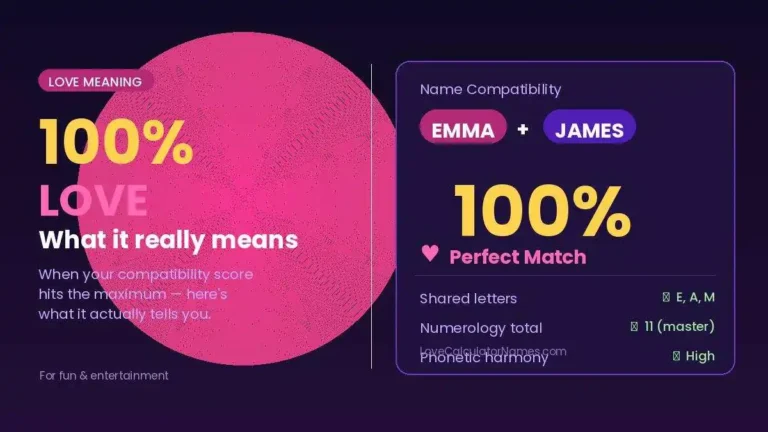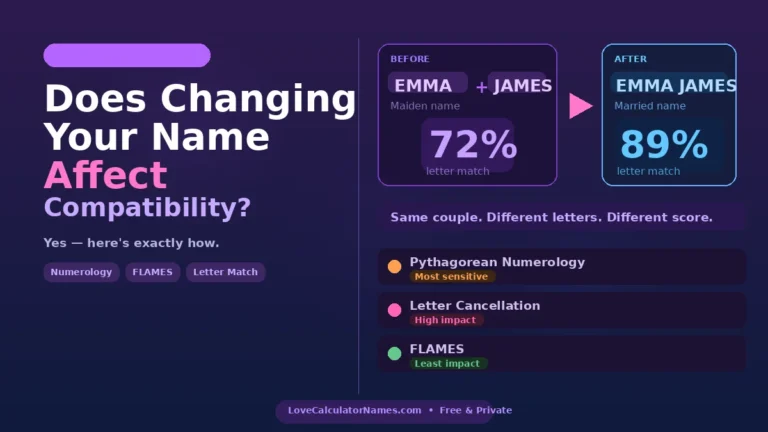
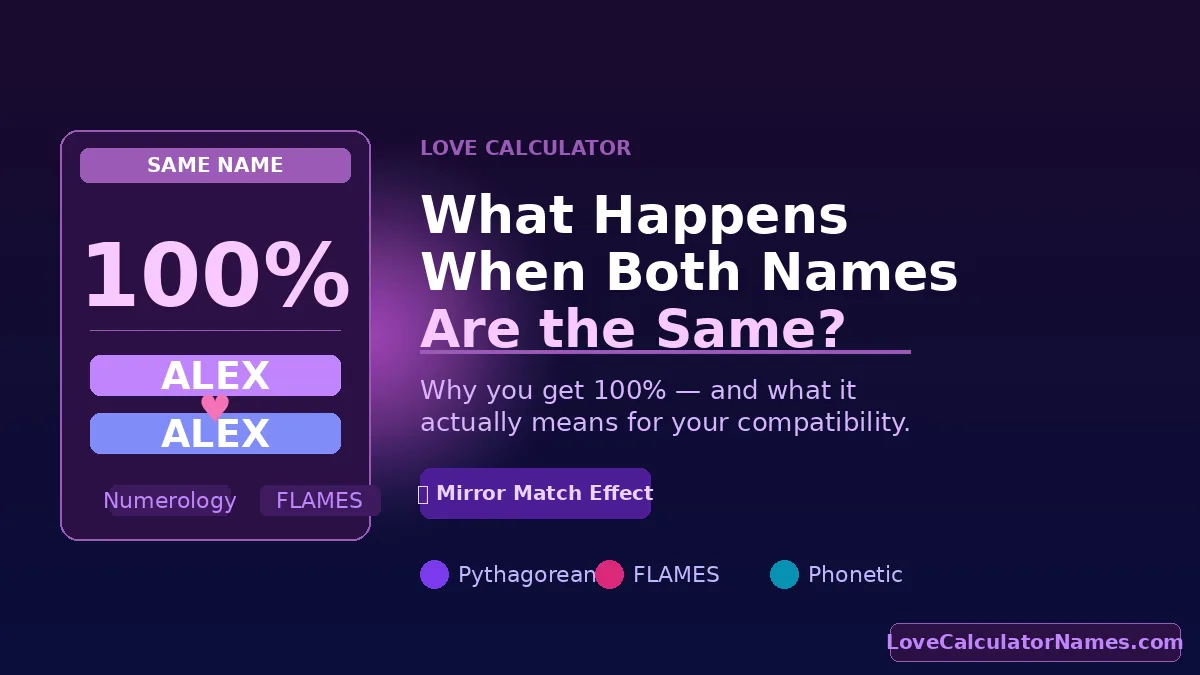
You typed the same name into both fields — maybe on a whim, maybe to test the calculator — and got a surprising result. Here’s the short answer: most love calculators return a score of 100% when both names are identical. That’s not a glitch. It’s the predictable output of the math running under the hood. Every letter-cancellation formula, Pythagorean numerology engine, and FLAMES counter is working correctly — identical inputs just happen to produce a perfect score. This article explains exactly why that happens, what each method does with matching names, and what (if anything) it tells you about real-world compatibility.
Just so we’re on the same page from the start: love calculators are a fun, lighthearted activity — not a scientific relationship tool. This article is for entertainment and curiosity only.
Why Does a Love Calculator Give 100% for the Same Name?
When both names match exactly, every letter-based calculation method converges on the highest possible score because there is zero difference between the two inputs. The formula finds no “distance” between the names, so the compatibility reading tops out. Think of it like asking how far two identical GPS coordinates are from each other — the answer is zero, which maps to perfect overlap.
Here’s what happens method by method:
Letter-frequency cancellation is the most common algorithm on basic love calculator sites. The tool lists both names, crosses out every letter that appears in both, and counts what’s left. If the names are identical, every letter in the first name cancels against its twin in the second name. Nothing remains. That zero remainder typically maps to 100% compatibility.
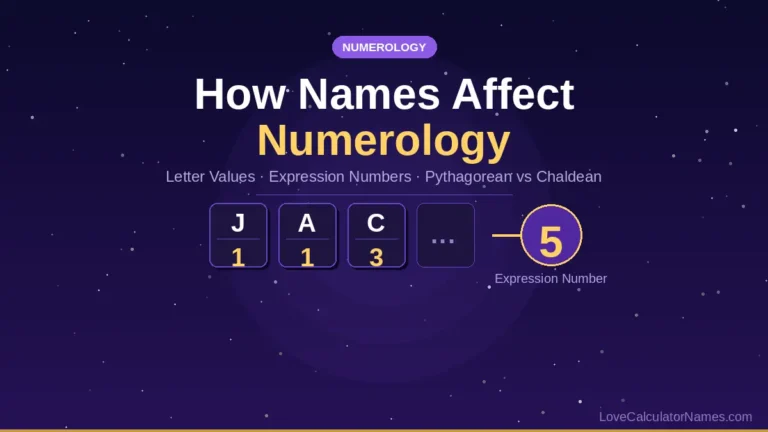
Pythagorean numerology assigns each letter a number (A=1, B=2 … Z=26, or the reduced Pythagorean table). The scores for each name are totaled, reduced to a single digit, and compared against a compatibility chart. When both names are the same, both totals are identical — and most compatibility charts treat a perfect numerical match as a 100% or “master” reading.
FLAMES works differently. You write both names, cross out shared letters, and count the remaining letters to spin through the FLAMES wheel (Friends, Lovers, Affection, Marriage, Enemies, Siblings). Identical names leave zero remaining letters — and most online FLAMES tools interpret a zero-count as “M” for Marriage, the highest-stakes outcome.
The takeaway: the result isn’t a mistake, and it isn’t secretly meaningful about your relationship. It’s just math doing what math does with identical inputs.
How Each Calculation Method Handles Matching Names — Step by Step
Each method produces a “perfect” result through a different route. Here’s a walkthrough using the name ALEX paired with ALEX.
Method 1: Letter-Frequency Cancellation
- Write both names side by side: A-L-E-X and A-L-E-X
- Cross out every letter that appears in both: A cancels A, L cancels L, E cancels E, X cancels X
- Count remaining letters: 0 remaining
- A zero remainder in this system = 100% compatibility score
Method 2: Pythagorean Numerology
- Assign values: A=1, L=3, E=5, X=6 (reduced Pythagorean table)
- Sum for ALEX: 1+3+5+6 = 15 → reduced to 1+5 = 6
- Sum for second ALEX: identical process → 6
- Compare 6 and 6 on a compatibility grid: same life-path number = maximum harmony reading
- Most tools output 100%
Method 3: FLAMES Count-Out
- Write ALEX + ALEX
- Cross out all shared letters: all four cancel
- Remaining letters: 0
- Most FLAMES engines treat a zero-count as spinning to M (Marriage)
- Some tools display “100% — Marriage” as a combined output
Method 4: Phonetic Harmony Analysis
A smaller number of advanced calculators analyze how names sound, not just their spelling. Identical names share identical phonemes — every vowel sound, consonant cluster, and stress pattern lines up. Phonetic harmony tools will also return a perfect score for the same reason the others do: there is no acoustic “distance” between two sounds that are literally the same sound.
Comparison: What the Score Looks Like Across Five Popular Methods
| Method | Based On | Same-Name Output | What It Actually Measures |
|---|---|---|---|
| Letter Cancellation | Shared letters | 0 remaining → 100% | Letter overlap between two names |
| Pythagorean Numerology | Letter-to-number values | Identical life paths → 100% | Numerological resonance |
| FLAMES | Letter count-out | 0 remaining → M (Marriage) | Outcome wheel count-out |
| Phonetic Harmony | Sound patterns | Perfect acoustic match → 100% | How alike two names sound |
| Destiny Number | Full name numerology | Matching destiny numbers → 100% | Combined name vibration |
All five arrive at the same destination through different roads. That consistency is actually interesting — it tells you the algorithms are working, not broken.
Real Examples: Famous People Who Share a Name
If you’re curious what happens with real-world same-name pairs, here are a few worth trying:
Alex + Alex. Total letter overlap. Every method returns 100% or Marriage. Good choice for testing how a calculator handles identical inputs.
Taylor + Taylor. Same result — all letters cancel, numerology totals match. FLAMES counts to M. The name is common enough that plenty of real couples both named Taylor exist, which is a fun angle.
Jordan + Jordan. A gender-neutral name that works the same way. Zero remainder, perfect score.
Sam + Sam. Shorter name, same logic. Four letters, four cancellations, zero remainder, 100%.
The pattern holds regardless of name length or origin. What varies is how the site communicates the result — some show a percentage, others show a FLAMES outcome, and a few show both.
What Does a 100% Score for the Same Name Actually Mean?
A perfect score for identical names tells you the algorithm is working normally — it does not predict relationship success. This is the part competitors often skip, and it matters.
Here’s why the 100% is mathematically inevitable rather than romantically significant:
Love calculators measure name overlap, not emotional compatibility. When the names are the same, overlap is total. The calculator has no information about the people behind the names — their personalities, values, communication styles, or shared history. It only sees letters, and identical letters cancel perfectly.
Psychology has a term for this kind of result: confirmation bias bait. A 100% score feels meaningful because perfect scores carry cultural weight. But the number is a direct output of a formula applied to text — it carries the same meaning whether you type your name twice or type any two identical strings.
That said, there’s something genuinely interesting in the result. Psychologists who study name-based attraction — a field called onomastics — have noted that people are sometimes drawn to partners whose names share sounds or letters with their own. A 2004 study by Pelham, Mirenberg, and Jones found evidence of implicit egotism: a mild, largely unconscious tendency to prefer things associated with the self, including names. A same-name couple isn’t as rare as you might think, and the attraction dynamic is more complicated than a calculator can capture.
5 Myths About Same-Name Love Calculator Results
Same-name results generate a lot of speculation online. Here are the ones that don’t hold up.
Myth 1: A 100% score means you’re soulmates. The score reflects letter-formula output, not emotional compatibility. Any two identical inputs produce 100%. The calculator has no information about your relationship.
Myth 2: The calculator is broken when both names score 100%. It’s working correctly. The math is designed to measure overlap — identical names have total overlap by definition. A 100% result is the expected and accurate output.
Myth 3: Same-name couples never actually work out. Real couples sharing the same first name exist in every culture. The name is one small piece of identity. Relationship success depends on factors no name-based tool can measure.
Myth 4: You should try alternate spellings to get a different result. Changing the spelling does change the score for some methods (letter cancellation responds to spelling; phonetic harmony responds to sound). But the only reason to do this is curiosity — it won’t tell you more about real compatibility.
Myth 5: FLAMES giving “Marriage” for same names means you’re destined to marry yourself. FLAMES is a paper-and-pencil game that’s been played at slumber parties for decades. The Marriage outcome for zero remaining letters is a quirk of the count-out mechanic, not a prediction.
Frequently Asked Questions
What score do you get when both names are the same in a love calculator? Most love calculators return 100% when both names are identical. Some also show FLAMES outcome “M” (Marriage). This is the mathematically correct output — all letter-overlap methods return a perfect score when there are no differing letters between the two inputs.
Does getting 100% on a love calculator mean you’re meant to be together? No. A 100% score reflects how the algorithm handles identical inputs, not real emotional or psychological compatibility. Love calculators are entertainment tools — they don’t have access to information about your personalities, communication, or values.
Is it cheating to enter the same name twice to get 100%? There’s nothing to “cheat” on — love calculators are a lighthearted game with no stakes. Entering the same name twice is a completely valid way to test how a tool behaves, and it gives you useful insight into how the algorithm works.
Why does FLAMES say “Marriage” when both names are the same? FLAMES works by crossing out shared letters and counting the remaining ones. When both names match, all letters cancel and the remainder is zero. Most FLAMES engines treat a zero count as landing on M for Marriage — this is a built-in rule of the mechanic, not a cosmic sign.
Does spelling matter if I use the same name twice? For letter-cancellation and Pythagorean numerology methods, spelling is everything. “Alex” and “ALEX” may produce slightly different results depending on how the site handles case. Phonetic harmony methods focus on sound, so spelling variants of the same pronunciation (like “Sara” and “Sarah”) can produce identical scores.
What if two people have the same name but different middle or last names? Most basic love calculators only use the input you provide. If you enter just first names and they match, you get 100%. If you include full names and they differ in the middle or last name, the score will drop below 100% because those extra letters introduce differences the algorithm can detect.
Do all love calculators give the same result for identical names? Nearly all return 100% or a top-category FLAMES outcome, but the exact display varies by site. Some show “100% — Perfect Match,” others show a FLAMES wheel landing on Marriage, and a few display a compatibility category label like “Mirror Match” or “Twin Souls.” The underlying math reaches the same place.
Is there psychological research on same-name attraction? Research in onomastics and social psychology has explored implicit egotism — the tendency for people to show mild preferences for things that share letters with their own name, including potential partners’ names. It’s a subtle and debated effect, not a reliable predictor. Real relationship compatibility involves far more than name similarity.
The Bottom Line on Same-Name Results
If both names are the same in a love calculator, you’ll get 100% — or a Marriage result in FLAMES — every single time. That’s not a bug, and it’s not magic. Every letter-based method is designed to measure how much two names overlap, and identical names overlap completely by definition.
The more interesting question is what draws people to try it in the first place. Testing the same name is often a way of probing how the calculator works, which is genuinely curious and smart. And the psychology of same-name attraction — people drawn to partners who share their name — is real enough to have academic literature behind it, even if no calculator can capture it.
Three things to carry away: same-name scores are mathematically expected, not predictive; spelling and capitalization can create small variations across sites; and FLAMES’ Marriage result for identical names is a mechanic quirk, not a prophecy.
Ready to see what a different name pairing produces? Try the free name compatibility test at LoveCalculatorNames.com — no sign-up, 100% private, results in seconds.
Try our name love test and see the score your two names produce together.