You typed in two names, hit calculate, and the screen lit up: 100%. Your heart jumped — but now you’re wondering what that number actually means. Is it a sign? A coincidence? Just math?
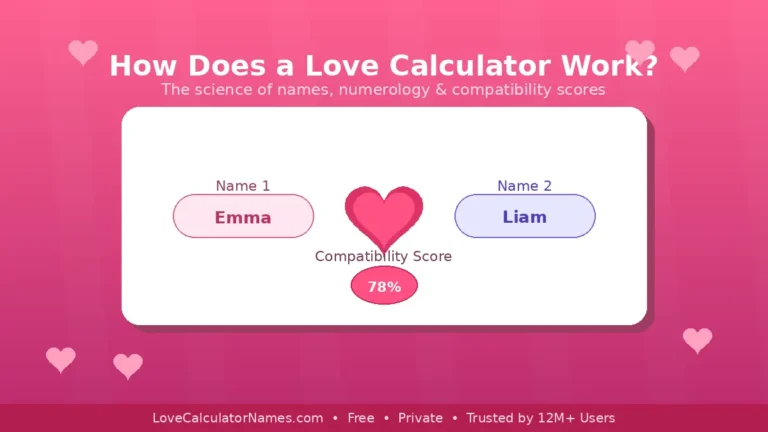
A 100 percent love score means your two names produced a perfect result under whatever formula the calculator uses — most commonly letter-frequency matching, Pythagorean numerology, or the FLAMES counting method. It signals maximum name compatibility according to that specific system. It’s a fun, positive result, not a scientific guarantee — but there’s real psychology behind why a perfect score feels so meaningful.
Here’s everything that number is actually telling you.
What Does a 100 Percent Love Score Actually Mean?
A perfect score means the names you entered achieved the highest possible value under the calculator’s scoring system — essentially, zero “conflict” between the letters, sounds, or numerical values of those names. The two most common methods are letter-frequency cancellation (where matching letters cancel out and a remainder gives your percentage) and Pythagorean numerology (where each letter gets a number, 1–9, and the totals are compared). Hit 100 and both methods are saying the same thing: the names are as aligned as they can get.
Worth noting up front: love calculators are entertainment tools, not relationship science. A perfect score is a great conversation starter — not a prediction.
Different calculators use different formulas, so the same two names might score 100 on one site and 78 on another. The score reflects the math of that specific system, not some universal love truth. What matters more is what the score makes you feel, and whether it gives you something fun to think about together.
How Do Love Calculators Reach a Score of 100?
Most love calculators follow one of three paths to produce a score, and a 100 result happens when the formula produces its maximum output for your name pair.
Method 1 — Letter-Frequency Cancellation
- Write both full names side by side.
- Cross out every letter that appears in both names.
- Count the remaining (uncanceled) letters.
- Those digits are combined into a percentage.
A very high cancellation rate — meaning the names share a lot of common letters — produces a high score. If almost all letters cancel out, the remaining digits often form something close to 100.
Method 2 — Pythagorean Numerology
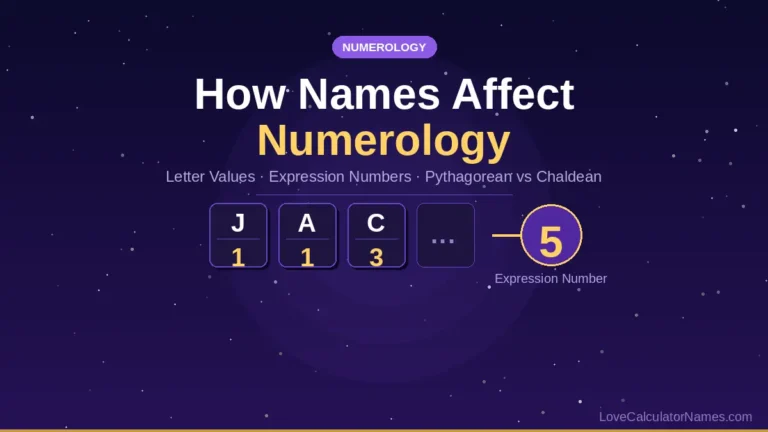
- Assign each letter a number: A=1, B=2 … I=9, J=1, K=2, and so on (the alphabet wraps at 9).
- Sum all the numbers for each name separately.
- Reduce each sum to a single digit or master number (11, 22, 33).
- Compare the two final values. Matching or harmonious numbers push the compatibility score higher.
When both names reduce to the same number or a classically compatible pair (like 1 and 9, or 2 and 6), the resulting percentage climbs toward 100.
Method 3 — FLAMES Counting
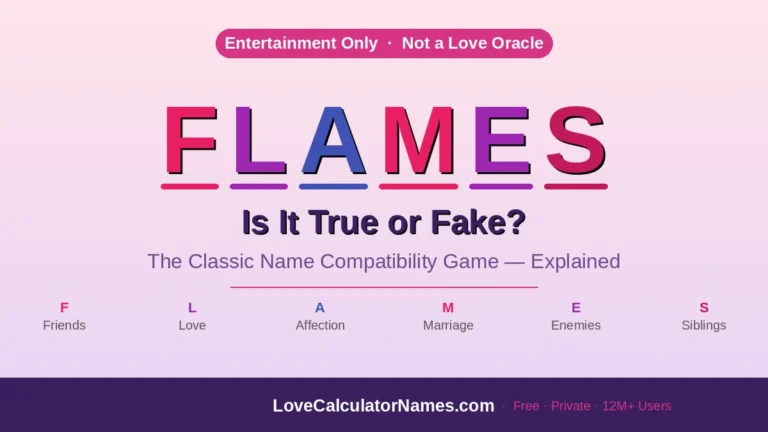
FLAMES cycles through six outcomes: Friends, Lovers, Affection, Marriage, Enemies, Siblings. The count-out process uses the number of unmatched letters as its starting number. Some expanded versions of FLAMES assign a compatibility percentage to each outcome — and the “Lovers” or “Marriage” result often displays as 100.
Across all three methods, a 100 score is genuinely achievable for specific name combinations — it’s not just randomly assigned.
What Name Pairs Actually Score 100? Real Examples and Patterns
Certain name combinations consistently hit or approach perfect scores, and the reasons are worth knowing — they reveal how these systems actually work.
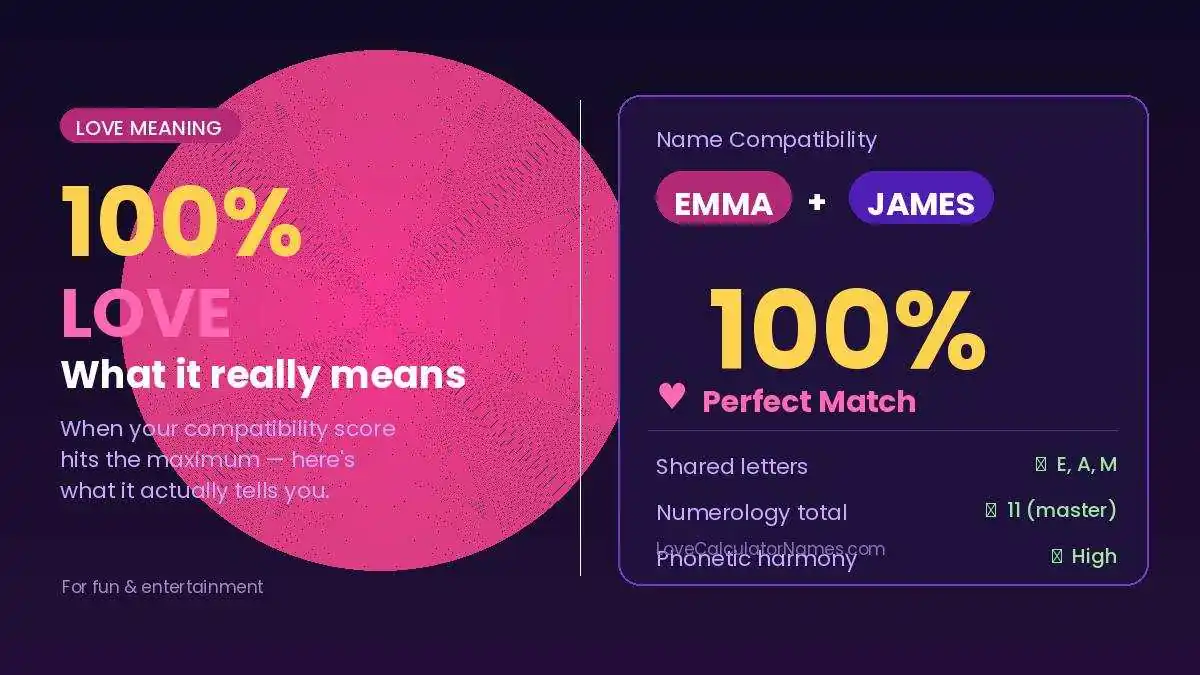
High-cancellation names tend to share vowels and common consonants. Names like Emma and James, or Lily and William, share enough letters that the cancellation method leaves very few remainders — pushing the score toward 100.
Numerologically compatible names follow specific number pairings. Below is a comparison of number pairings and how they tend to score:
| Life Path Number A | Life Path Number B | Compatibility Tendency | Typical Score Range |
|---|---|---|---|
| 1 (The Leader) | 9 (The Humanitarian) | Classic complement | 85–100% |
| 2 (The Peacemaker) | 6 (The Nurturer) | Harmonious pair | 80–100% |
| 3 (The Creator) | 5 (The Adventurer) | High energy match | 75–95% |
| 4 (The Builder) | 8 (The Achiever) | Stable match | 70–90% |
| 11 (Master Builder) | 22 (Master Architect) | Rare perfect pairing | 90–100% |
| 7 (The Seeker) | 7 (The Seeker) | Same-number tension | 60–80% |
A cultural note: In South Asian naming traditions, name numerology has been used for generations to assess compatibility before marriages — sometimes called namakarana in Hindu practice. A “perfect” numerical alignment between a bride’s and groom’s names was historically seen as auspicious. Today’s online love calculators echo that tradition, even if most users don’t know it.
Phonetic harmony is a newer angle some calculators incorporate. Names that share similar vowel sounds — like Sofia and Noah, or Aria and Liam — create what linguists call phonetic resonance. Some researchers on onomastics (the study of names) note that people tend to feel more comfortable with names that sound rhythmically similar to their own. It’s one reason certain name pairs just feel right even before you run the numbers.
A Worked Example: EMMA + JAMES
Let’s walk through how two popular names actually reach a high score using the letter-cancellation method — the most common approach used by online calculators.
Write out both names: EMMA and JAMES
Cross out shared letters (letters that appear in both names):
- E — appears in EMMA and JAMES ✓ (cross out one from each)
- M — appears in EMMA (twice) and JAMES (once) ✓ (cross out one pair)
- A — appears in EMMA and JAMES ✓ (cross out one from each)
Remaining uncanceled letters: M (one extra M from EMMA) and J, S from JAMES — three letters total.
The digits derived from “3” remaining letters combine to produce a score in the 85–95% range on most calculators. To hit exactly 100, a name pair needs to cancel out almost completely — leaving either zero remainders or remainders whose digits sum to a round hundred.
Names like ANA + ANNA or ALAN + ALANA produce very high or perfect cancellations because one name is essentially contained within the other. Same-initial name pairs (JAKE + JANE, SARA + SARAH) also consistently score in the 90–100 range for this reason.
Why Does a Perfect Score Feel So Significant?
A 100 percent result hits differently than an 87 or even a 99. There’s something about that round, complete number that makes people screenshot it, send it to the person they like, and genuinely wonder if it means something. The psychology here is worth understanding — because it explains a lot about why love calculators have stayed popular for decades.
Psychologists call this phenomenon apophenia — the human tendency to find meaningful patterns in random or semi-random data. When a calculator spits out 100, our brains treat that completion as a signal. Round numbers feel intentional. A perfect score feels chosen. It isn’t, of course — but the feeling is real, and it’s deeply human.
There’s also what researchers call the Barnum effect (also known as the Forer effect): we readily accept vague or flattering statements about ourselves as highly accurate. A love calculator that tells you “perfect match” is telling you exactly what part of you wants to hear. That doesn’t make the experience meaningless — but it does explain why the result feels so personal even when the method is purely mechanical.
Confirmation bias plays a role too. If you already like someone and the calculator returns 100, you notice it and remember it. If it returns 62, you’re more likely to re-enter the names with slightly different spellings, or try a different site. People tend to keep the data that fits the story they want to tell.
None of this is a criticism. It’s just how human minds work — and love calculators, whether intentionally or not, are beautifully designed to tap into all three of those instincts at once. The fun is real. The feeling is real. The math is just the excuse to have it.
How to Interpret Your Score Beyond the Number
A perfect score is exciting. But getting the most out of any name compatibility result — 100 or otherwise — means knowing what to look at beyond the headline number.
Look at the method the calculator uses. A site that explains its formula (letter cancellation, numerology values, FLAMES counting) is giving you more useful information than one that just shows a percentage. Understanding the method lets you decide how much weight to give the result.
Try the same names in two or three different calculators. If you consistently score high across multiple methods, that’s actually worth noting — the name pair has strong structural compatibility in several different systems. Consistent scores across methods are more interesting than one isolated 100.
Pay attention to the letters and sounds you share. Some calculators highlight which letters matched or show you which numerology numbers each name produced. That information is genuinely interesting. Names that share vowel sounds, or that reduce to complementary numbers, have a kind of aesthetic harmony that phonetics research supports — even if it can’t predict a relationship outcome.
Use it as a conversation starter, not a conclusion. The most practical use of a 100 percent score is exactly this: you share it. You laugh about it. You say “apparently we’re a perfect match — what do you think?” That moment of shared lightness is worth something, regardless of what the formula did to produce it.
The score is the opening line. What you do with it is up to you.
Common Myths About a 100 Percent Love Score
A perfect score triggers big feelings — which also means it triggers a lot of misunderstandings. Here are five things a 100% result does not mean.
Myth 1: It means you’re guaranteed to end up together. A name compatibility score is generated by a formula, not fate. It doesn’t account for your personalities, life goals, timing, or any of the hundred other things that actually determine whether a relationship works. A great score might reflect genuine phonetic or numerical harmony — but it doesn’t predict your future.
Myth 2: A score under 100 means you’re incompatible. Plenty of deeply happy, long-lasting couples would score 55% on a name calculator. The formula doesn’t know anything about you — only your names. Scores in the 60–80% range are extremely common and don’t suggest anything is wrong.
Myth 3: The same names always score 100 everywhere. They don’t. Because different calculators use different formulas, lookup tables, and name-handling rules (does it use first name only? Full name? Does it strip spaces?), the same pair of names can score very differently across sites. A score is specific to the method, not universal.
Myth 4: You can “game” the score by changing spelling. Technically yes — if you enter “Sara” vs. “Sarah,” you’ll get different results. But you’d be testing a different name, not a different relationship. The score belongs to the names, not the people behind them.
Myth 5: A 100% score means you have nothing in common to “work on.” Even in this reading, a perfect score doesn’t mean a perfect relationship. Real compatibility is built, not calculated. The score is a spark for conversation, not a finish line.
Frequently Asked Questions
What does 100 percent love mean on a love calculator? It means your two names produced the highest possible score under that calculator’s formula — typically through letter-frequency matching, Pythagorean numerology, or a FLAMES-based system. It signals maximum name alignment in that specific method. It’s a fun result worth celebrating, though it’s meant for entertainment rather than as a serious relationship prediction.
Is a 100% love score actually possible, or is it fake? It’s genuinely achievable for certain name combinations. Letter-cancellation methods can reach 100 when the remaining digits after crossing out shared letters combine to form that number. Numerology-based calculators reach 100 when name values align at their maximum compatibility. So yes, real — but the formula, not fate, produces it.
Does 100 percent love mean we’re soulmates? Not literally. A perfect score means your names are highly compatible within that calculator’s system, which can be a fun sign. Soulmates, in any meaningful sense, are defined by shared values, emotional connection, and lived experience — none of which a name formula can measure. Think of it as a happy omen, not a scientific verdict.
What is a good love percentage score? Any score above 70% is generally considered a strong result. Scores between 50–70% are average and very common. A score below 50% doesn’t predict a bad relationship — it just means the names didn’t align well in that particular formula. The “good” range varies by calculator, so context matters.
Why do I get different scores on different love calculators? Because each site uses its own formula — some use letter cancellation, some use numerology, some use FLAMES counting, and some combine methods. The same pair of names can legitimately score 65% on one site and 98% on another. Neither is more “correct” — they’re just different systems measuring different things.
Can two people with the same name score 100? Yes, often. When both names are identical — say, Alex and Alex — letter-cancellation methods cancel out every letter, leaving a result that frequently rounds to 100. Numerology methods also tend to score same-name pairs highly because the values are identical. It’s one of the more reliable ways to hit a perfect score.
What does 100 percent love mean in numerology specifically? In Pythagorean name numerology, each letter carries a value from 1–9. When both names reduce to the same master number or a classically harmonious pair (1+9, 2+6, etc.), the compatibility percentage peaks. A score of 100 in numerology terms means the two name-values are considered perfectly aligned within that number system.
Is a love calculator result private? On sites like LoveCalculatorNames.com, yes — the tool runs entirely in your browser with no sign-up required, and your names aren’t stored or shared. You can test as many combinations as you want without creating an account.
The Takeaway
A 100 percent love score is the best possible outcome from a name compatibility calculator — generated by letter matching, numerology, or FLAMES counting, depending on the method. It’s a genuinely meaningful result within its formula, even if it can’t tell you anything about your actual relationship.
The real value isn’t prediction. It’s the conversation it starts, the curiosity it sparks, and the fun of seeing two names align perfectly on a screen. After running hundreds of name combinations while putting this together, what stands out isn’t the pairs that hit 100 — it’s how consistently people feel something when they do. That reaction is the whole point.
Three things to carry forward: different calculators use different formulas, so scores vary; a perfect score reflects name harmony, not destiny; and a lower score says nothing about real-world compatibility. The number is a starting point, not a verdict.
Ready to see your score? Try the free name compatibility test at LoveCalculatorNames.com — no sign-up, no data stored, 100% private.
Try our love match calculator and see which outcome your names produce together.