Your name isn’t just a label — in numerology, it’s a coded message. Every letter you were given at birth carries a specific numerical value, and those values combine to reveal something said to describe your personality, purpose, and compatibility.
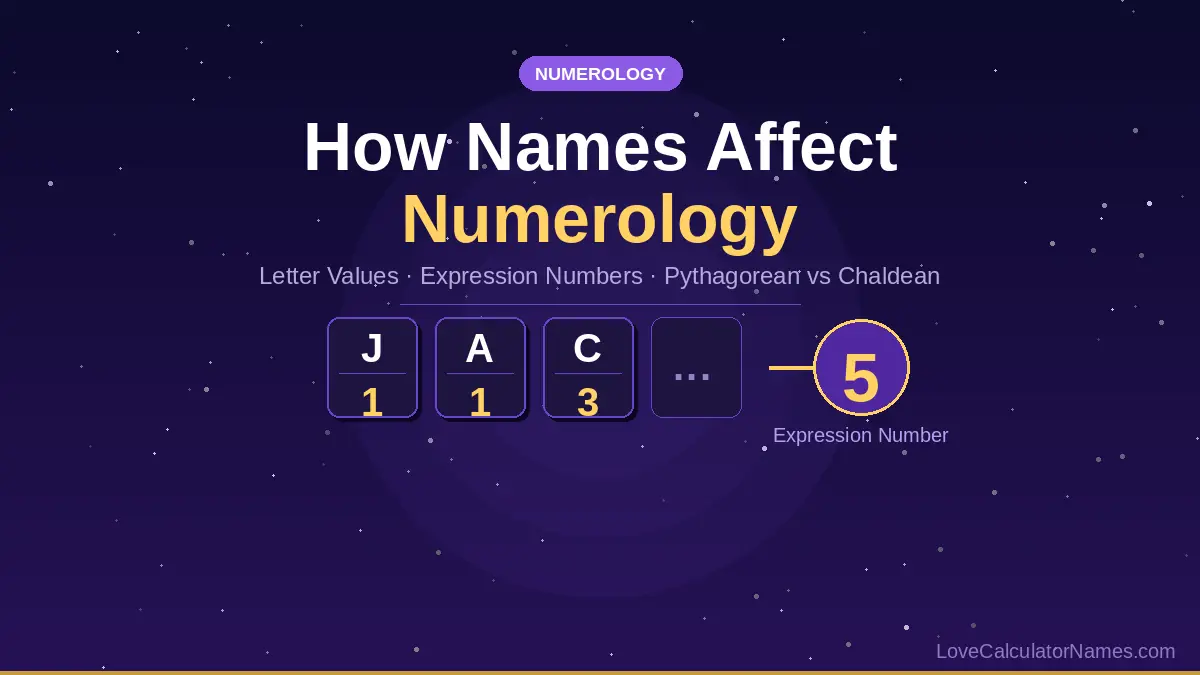
Names affect numerology by converting each letter into a number using a structured chart — typically 1 through 9. Add those numbers together, reduce them to a single digit (or a Master Number: 11, 22, or 33), and you get your Expression Number. This figure is believed to describe your natural talents, life direction, and the energy you bring to relationships. Your full birth name — not a nickname — is the foundation of this calculation.
This guide explains how the two main systems work, walks through the math step by step, and covers what each number is said to mean.
Numerology is a form of entertainment and personal reflection — not a scientific method for predicting personality or relationships.
What Is the Connection Between Your Name and Numerology Numbers?
Names affect numerology because letters are treated as symbols that carry fixed numerical energy. In the most widely used system (Pythagorean), every letter from A to Z is assigned a number from 1 to 9. Your full birth name, when converted and added up, produces a number that numerologists interpret as a core part of your personal profile.
This idea has roots going back thousands of years. Ancient Greek philosopher Pythagoras believed that numbers were the foundation of all reality — including human character. His followers extended this to language, arguing that the sounds and letters in a name resonated at specific numerical frequencies.
Modern numerology inherited that framework. Today, practitioners still use the name-to-number chart as the backbone of personal readings. The belief isn’t that parents consciously chose a “numerologically correct” name — it’s that they were intuitively drawn to one that matched the vibration their child was meant to carry.
Different resulting numbers are associated with different traits. A name that reduces to 1 is linked to leadership and independence. One that reduces to 7 suggests introspection and analytical depth. A result of 9 points toward idealism and humanitarian instincts. These aren’t psychological tests — they’re interpretive traditions used across many cultures for centuries as tools for self-understanding.
How Do You Calculate Your Name’s Numerology Number?
To calculate your name’s numerology number, assign each letter its value using the Pythagorean chart (A=1, B=2, C=3, continuing through I=9, then repeating). Add every digit together, then reduce any two-digit result by adding those digits — unless you reach 11, 22, or 33, which are Master Numbers and stay as-is.
Here’s a complete step-by-step walkthrough using the name James Oliver King:
Step 1: Write out your full birth name Use the exact name on your birth certificate — first, middle, and last. Nicknames and married names are calculated separately.
Step 2: Assign each letter a number using the Pythagorean chart
| A=1 | B=2 | C=3 | D=4 | E=5 | F=6 | G=7 | H=8 | I=9 |
|---|---|---|---|---|---|---|---|---|
| J=1 | K=2 | L=3 | M=4 | N=5 | O=6 | P=7 | Q=8 | R=9 |
| S=1 | T=2 | U=3 | V=4 | W=5 | X=6 | Y=7 | Z=8 | — |
Step 3: Map each word in the name
- J(1) A(1) M(4) E(5) S(1) = 12 → 1+2 = 3
- O(6) L(3) I(9) V(4) E(5) R(9) = 36 → 3+6 = 9
- K(2) I(9) N(5) G(7) = 23 → 2+3 = 5
Step 4: Add the three sub-totals 3 + 9 + 5 = 17 → 1+7 = 8
Step 5: Check for Master Numbers before reducing If your total before final reduction is 11, 22, or 33 — stop there. These are kept intact and carry special significance in numerology tradition.
Step 6: Identify your result James Oliver King has an Expression Number of 8 — associated in numerology with ambition, authority, and business instincts.
Step 7: Combine with your Life Path Number for a fuller picture Most numerology readings pair the Expression Number (from your name) with the Life Path Number (from your birthdate). Neither alone tells the complete story; together they create a layered profile.
One critical note: always begin with your birth name as written on your birth certificate. We’ll cover why name changes don’t overwrite this in a later section.
How Do Different Numerology Systems Assign Name Values?
Not all numerology systems use the same letter-to-number chart. The two most widely used are Pythagorean (Western) and Chaldean (ancient Babylonian). Each assigns different values to the same letters, which means the same name can produce different numbers depending on which tradition you follow.
This is one of the most overlooked aspects of name numerology — and a genuine source of confusion for anyone who has gotten conflicting readings from different practitioners.
Pythagorean vs. Chaldean: A Direct Comparison
| Feature | Pythagorean | Chaldean |
|---|---|---|
| Origin | Ancient Greece (Pythagoras, ~500 BCE) | Ancient Babylon/Mesopotamia |
| Letter assignment basis | Sequential alphabetical order | Sound vibration of each letter |
| Numbers used for letters | 1–9 (cycled through alphabet) | 1–8 only (9 is considered sacred) |
| Name used | Full birth name | Name commonly used day-to-day |
| Master Numbers | 11, 22, 33 | Some traditions recognize 11 and 22 |
| Most common in | USA, UK, Australia, Western Europe | India, Middle East, South Asia |
| General reputation | More accessible and structured | Older, considered more mystical |
The Pythagorean method dominates in the Western world because it’s straightforward — the A=1 through Z cycle makes it easy to learn and verify independently.
The Chaldean system is considered older and more spiritually layered. It assigns values based on the vibrational energy of each letter’s sound rather than alphabetical position — which is why 9 is absent from the letter chart. In Chaldean tradition, 9 was sacred and reserved for God, not ordinary letter assignments.
A Real-World Example: The Name “Diana”
Pythagorean calculation: D(4) I(9) A(1) N(5) A(1) = 20 → 2+0 = 2
Chaldean calculation (where D=4, I=1, A=1, N=5, A=1): D(4) I(1) A(1) N(5) A(1) = 12 → 1+2 = 3
Same name. Two different Expression Numbers. This is exactly why experienced numerologists always specify which system they’re working from before sharing results.
How Global Cultures Weave Name Numerology into Naming Traditions
In parts of India, parents often consult a Jyotishi (Vedic astrologer) before finalizing a child’s name. The process combines birth chart analysis with numerological calculations — sometimes Chaldean, sometimes a regional variant — to select a name believed to support the child’s cosmic path.
In Jewish Kabbalistic tradition, Gematria assigns numerical values to Hebrew letters. Scholars have used it for centuries to find meaning in sacred texts and names. The Hebrew name David (דוד) — Dalet(4) + Vav(6) + Dalet(4) — equals 14, a number with deep symbolic significance in Jewish thought.
In Chinese naming practice, the number of brushstrokes in each character carries numerological weight through traditions related to Zi Wei Dou Shu and related systems. Families may count the total strokes across a child’s name to reach what’s considered an auspicious total.
These traditions share one underlying idea: names carry numerical identity, and that identity shapes destiny.
Does Changing Your Name Change Your Numerology Reading?
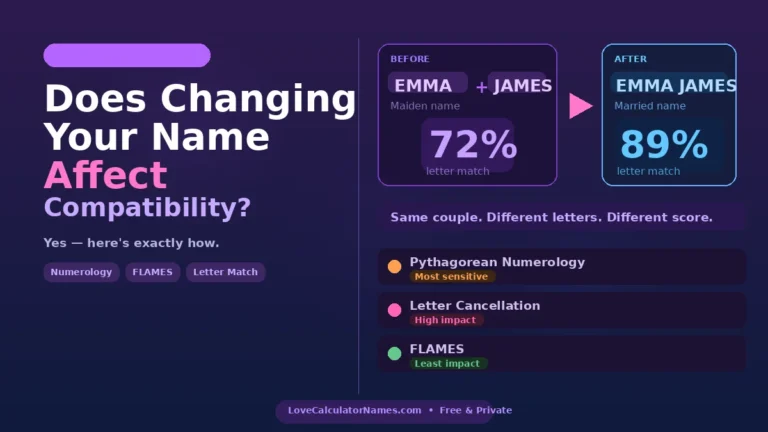
Yes — but with an important distinction. In Pythagorean numerology, your full birth name is your permanent “blueprint” and never changes. A nickname, married name, or legally changed name creates a secondary number called the Active Name or Personality Number, which reflects the energy you project in everyday life — but it doesn’t replace the original.
This is one of the most misunderstood aspects of name numerology. Here are the five most common myths — and the clearer picture behind each.
5 Common Myths About Names and Numerology
Myth 1: Your married name replaces your birth name in numerology. Most traditions don’t replace — they layer. Taking a new surname after marriage adds a different “public frequency” to your profile, but your Expression Number calculated from your birth name stays intact. Many practitioners calculate both and read them in combination.
Myth 2: Changing your name guarantees better outcomes. Some people legally change their names specifically to reach a “better” number. Numerologists are divided on whether this works as intended. The general view is that a chosen name can shift the everyday energy others perceive in you, but it doesn’t overwrite the birth name’s influence — which is considered the deeper, permanent layer.
Myth 3: Nicknames don’t count. If you’ve gone by a consistent name for decades — professionally or personally — that name does carry weight in some traditions. It generates what practitioners call an Active Name Number, calculated and interpreted alongside the birth name reading, not instead of it.
Myth 4: Only the first name matters. Your full birth name — first, middle, and last — is the standard input. Each section is totaled separately, then combined into the final Expression Number. Skipping the middle or last name produces an incomplete reading.
Myth 5: Numerology and astrology treat names the same way. They don’t. Astrology works entirely from birth date, time, and location — names play no role in a traditional natal chart. Numerology relies on both your birth name and birthdate. They’re parallel systems, not interchangeable ones.
What Does Each Expression Number Actually Mean?
Once you have your Expression Number, the next step is knowing what it represents. Numerology assigns distinct qualities to each number from 1 through 9, plus three Master Numbers — 11, 22, and 33. These aren’t fixed personality labels; they’re interpretive frameworks that many people find surprisingly resonant when used for self-reflection.
Here’s what each number is traditionally associated with:
1 — The Leader: Independence, ambition, pioneering drive. Names reducing to 1 are linked to originality and a strong sense of self-direction.
2 — The Diplomat: Sensitivity, cooperation, partnership. Associated with empathy, tact, and a gift for mediation.
3 — The Communicator: Creativity, self-expression, social energy. Linked to artistic gifts, humor, and verbal fluency.
4 — The Builder: Practicality, structure, discipline. Associated with methodical thinking and a strong work ethic.
5 — The Explorer: Freedom, adaptability, curiosity. Linked to variety-seeking, travel, and a dislike of routine.
6 — The Nurturer: Responsibility, harmony, care. Associated with a strong protective instinct and family orientation.
7 — The Thinker: Analysis, introspection, spiritual depth. Linked to solitary study, research, and philosophical inquiry.
8 — The Achiever: Ambition, authority, material drive. Associated with leadership in business, finance, and organizational settings.
9 — The Idealist: Compassion, vision, universal purpose. Linked to generosity, humanitarian instincts, and big-picture thinking.
11 (Master Number) — The Visionary: Elevated intuition, inspiration, spiritual sensitivity. Considered rare and highly charged.
22 (Master Number) — The Architect: Practical mastery at scale. Called the “Master Builder” — combines visionary scope with disciplined execution.
33 (Master Number) — The Teacher: Universal love, healing, selfless service. Considered the rarest Master Number, associated with a life of guiding others.
These profiles work best as starting points for reflection — not endpoints. Most people find it useful to read their number as a general tendency rather than a fixed identity.
How Does Name Numerology Affect Compatibility Readings?
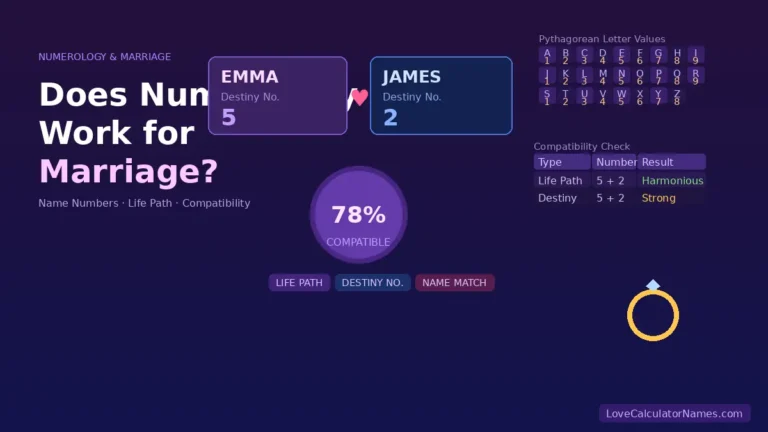
One of the most popular uses of name numerology is compatibility — comparing two people’s Expression Numbers to see how their energies might blend. Some number pairings are considered naturally harmonious, while others create productive friction. This isn’t a relationship verdict; it’s a lens for understanding potential dynamics between two people.
A few pairings that come up often in numerology compatibility discussions:
- 1 and 8 share ambition and a results-focused mindset — mutual respect for drive.
- 2 and 6 are both relationship-centered and harmony-seeking — often described as naturally supportive.
- 3 and 5 bring creative energy and a love of novelty — a lively, stimulating match.
- 4 and 7 both value structure and depth — different expressions of the same need for substance.
- 9 and any even number introduces idealism that may require grounding from a practical partner.
The most interesting compatibility readings combine the Expression Number (from the name) with the Life Path Number (from the birthdate). Practitioners look at both before drawing any conclusions — and they treat the result as a prompt for conversation, not a compatibility score to live by.
If you want to explore how names interact as a compatibility tool, the free name compatibility test at LoveCalculatorNames.com gives you results instantly — no account, no personal data required. It’s a low-stakes way to explore the concept and start a conversation.
Frequently Asked Questions
How do names affect numerology? Each letter in your name is assigned a number from 1 to 9 using a standardized chart (most commonly Pythagorean). Those numbers are added together and reduced to a single digit — your Expression Number. This figure is believed in numerology tradition to reflect your natural talents, personality tendencies, and overall life direction.
Which numerology system is most commonly used for names? Pythagorean numerology dominates in Western countries due to its simple, sequential structure (A=1 through Z=8, cycling through 1–9). The Chaldean system — older and more common in South Asia and the Middle East — assigns letters based on sound vibration rather than alphabetical order and deliberately excludes the number 9.
Does my full birth name or nickname matter more in numerology? Your full birth name (exactly as it appears on your birth certificate) is the foundation of your Expression Number — it doesn’t change. A nickname or everyday name generates a separate Active Name Number that reflects how you present yourself publicly. Most practitioners use both, treating the birth name as the deeper, permanent reading.
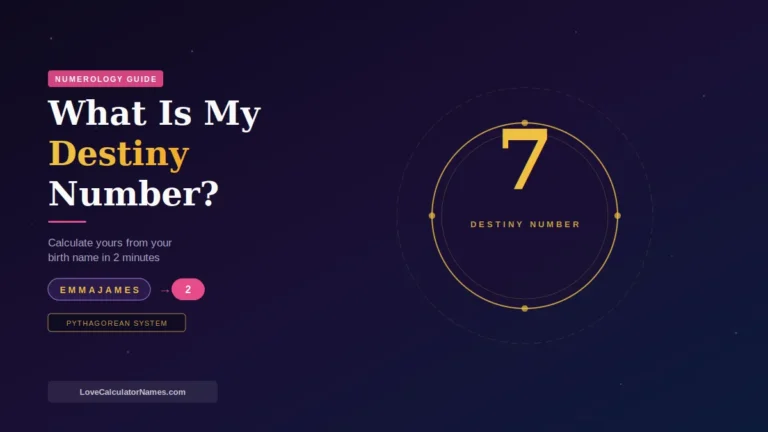
What is the Expression Number in numerology? The Expression Number — also called the Destiny Number — is calculated by converting every letter in your full birth name to a numerical value and reducing the total to a single digit or Master Number (11, 22, 33). It’s one of the five core numbers in a numerology chart and is said to represent your innate strengths and life purpose.
Can a name change affect your numerology? A legal name change or marriage name creates a new Active Number that runs alongside your birth name reading. Most traditions treat the birth name as permanent. However, a name used consistently for decades — especially a professional name — is believed by some practitioners to gradually shift the everyday energy others experience from you over time.
Do first, middle, and last names affect numerology differently? Yes. The first name often reflects personal traits and self-presentation. The last name can carry ancestral or family energy patterns. The middle name sometimes surfaces in private life or under pressure. Together, all three feed the full Expression Number. Some practitioners also calculate each part individually for additional insight into different life areas.
Is numerology based on names scientifically proven? No. Numerology is not a recognized science, and no peer-reviewed research supports the idea that names influence personality or life outcomes through numerical values. It’s best used as a reflective tool or a form of entertainment. Many people find it valuable for self-exploration and conversation — but it shouldn’t guide serious decisions.
How do I find my Expression Number if my birth name has hyphens or apostrophes? Simply ignore hyphens and apostrophes — calculate only the letters. Hyphenated last names (like Smith-Jones) are treated as one continuous word: S+M+I+T+H+J+O+N+E+S. The punctuation has no numerical value in either the Pythagorean or Chaldean system.
What This All Means for You
Three key takeaways from this guide:
First, names affect numerology through a letter-to-number conversion — Pythagorean is the most widely used system in Western countries, while Chaldean is older and more common in South Asia. Both are legitimate traditions; knowing which one your reading comes from helps you contextualize the result.
Second, your birth name is the anchor. Nicknames and legal name changes add layers to your numerological profile — they don’t erase the original. The birth name Expression Number is considered the primary, permanent signature.
Third, treat the numbers as mirrors, not verdicts. Numerology’s real value is in prompting reflection — about patterns in your personality, the way you relate to others, and what you want your life to mean. Whether your number resonates immediately or takes some sitting with, it’s a starting point for a more interesting conversation with yourself.
Ready to see your score? Try the free name compatibility test on LoveCalculatorNames.com — no sign-up, 100% private.
Check your name compatibility and see which category your names land in.