What do two names really say about a relationship? It’s one of those questions that sounds simple but pulls people down a surprisingly deep rabbit hole — numerology systems, letter-counting games, ancient phonetic theories, and modern psychology all have something to say about it.
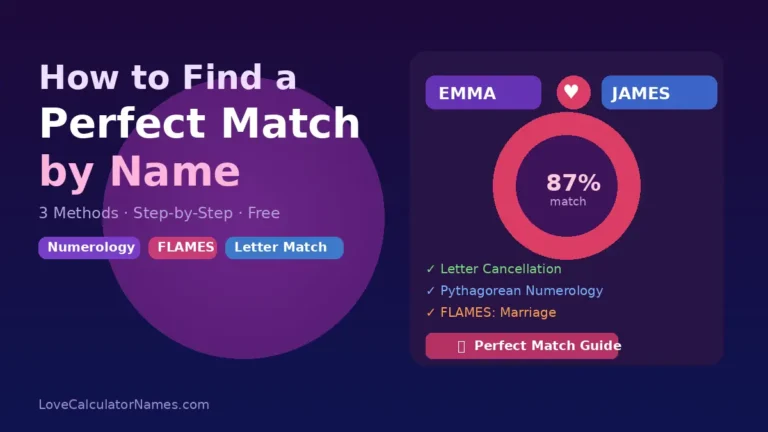
Here’s the short answer: You check name compatibility by converting names into numbers (numerology), running letter-overlap games like FLAMES, or analyzing phonetic patterns. Each method scores or compares the names differently. None of them predict real relationship outcomes — they’re entertainment tools rooted in cultural tradition — but they’re genuinely fun and often spark meaningful conversations about what you want in a connection.
This guide covers every major method, shows you real examples, and explains what each result actually means.
What Does Name Compatibility Actually Mean?
Name compatibility is a way of comparing two names — usually a first name, sometimes the full name — to produce a score, result, or reading that reflects how well the pair “fits.” It draws on numerology, letter analysis, phonetics, and cultural tradition. Think of it as a personality sketch written in the alphabet rather than a scientific measurement.
The concept isn’t new. Cultures from ancient Greece to medieval Europe to classical India have long believed that a name carries energy, vibration, or destiny. Modern name compatibility tools distill those traditions into quick, accessible formats anyone can try.
Three things drive the calculations:
1. Letter-to-number conversion. Systems like Pythagorean numerology assign each letter a digit from 1–9. You add up the values in each name, reduce them to a single number, then compare or combine them.
2. Letter overlap counting. Methods like FLAMES count shared or unique letters between two names to produce a categorical result (Friends, Lovers, Admirers, Marriage, Enemies, Siblings — more on that below).
3. Phonetic and vowel harmony. Some systems analyze which vowel sounds dominate a name and whether they “blend” with the partner’s dominant sounds. Names heavy in open vowels (A, O) are thought to pair well with names anchored by resonant consonants.
None of this is science. It’s cultural play — and it’s been a meaningful form of that for centuries.
How to Check Name Compatibility Using Numerology (Step-by-Step)
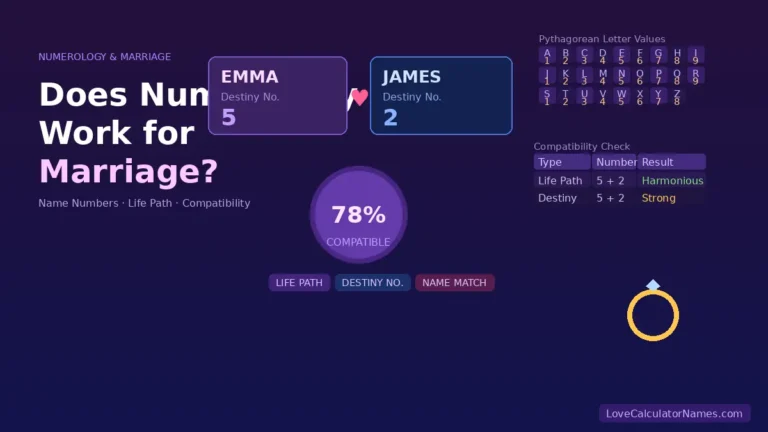
Numerology is the most widely used system for name compatibility. It converts letters to numbers, sums them, and compares the results between two names. The most popular version is Pythagorean numerology, where A=1, B=2 … I=9, then the cycle repeats (J=1, K=2, and so on).
Here’s how to do it by hand:
Step 1: Write out both names. Use first names only, or full names — just be consistent between the two people.
Step 2: Assign each letter a number using the Pythagorean chart.
| A=1 | B=2 | C=3 | D=4 | E=5 | F=6 | G=7 | H=8 | I=9 |
|---|---|---|---|---|---|---|---|---|
| J=1 | K=2 | L=3 | M=4 | N=5 | O=6 | P=7 | Q=8 | R=9 |
| S=1 | T=2 | U=3 | V=4 | W=5 | X=6 | Y=7 | Z=8 | — |
Step 3: Add up all the digits in each name. Keep adding until you reach a single digit (1–9), unless you land on 11, 22, or 33 — those are “master numbers” in numerology and stay as-is.
Step 4: Compare the two resulting numbers. Some tools add the two final numbers together and reduce again. Others look up what each number “means” and how compatible those meanings are.
Step 5: Interpret the result. Below is a quick reference:
| Your Number | Traits | Best Compatible With |
|---|---|---|
| 1 | Independent, driven | 3, 5 |
| 2 | Sensitive, cooperative | 6, 9 |
| 3 | Creative, expressive | 1, 5 |
| 4 | Practical, loyal | 7, 8 |
| 5 | Adventurous, free | 1, 3 |
| 6 | Nurturing, responsible | 2, 9 |
| 7 | Analytical, introspective | 4, 5 |
| 8 | Ambitious, organized | 4, 6 |
| 9 | Compassionate, idealistic | 2, 6 |
| 11 | Intuitive, visionary | 2, 6 |
| 22 | Master builder | 4, 8 |
Example: The name EMMA reduces to 5+4+4+1 = 14 → 1+4 = 5. The name JAMES reduces to 1+1+4+5+1 = 12 → 1+2 = 3. According to Pythagorean compatibility, 5 and 3 are a strong pairing.
There’s also a lesser-known variation called Expression Number compatibility, which uses the full birth name (first, middle, last) rather than just the first name. This is supposed to capture the complete “energy” of a person’s identity — not just their everyday social self. Many numerologists recommend calculating both (first name only + full name) and looking for agreement between the two results.
A third approach skips the reduction entirely and simply adds both names’ total raw values together, then looks up that combined number in a compatibility chart. Some online tools use this method because it produces a wider range of scores (less clustering around the same 1–9 results).
How Does the FLAMES Method Work for Name Compatibility?
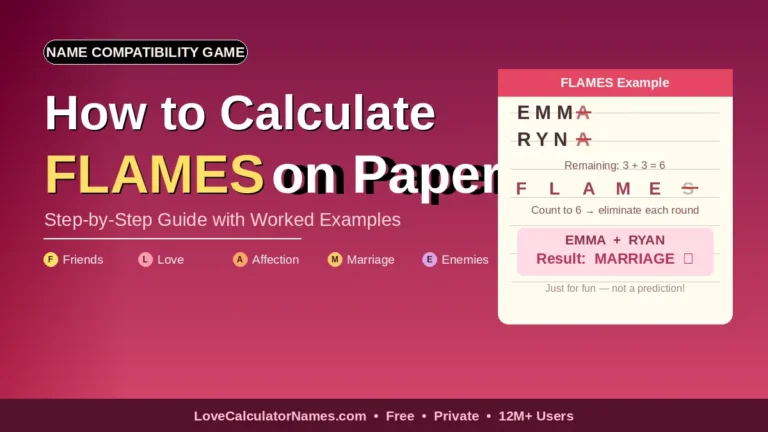
FLAMES is a letter-counting game — not numerology — that’s been popular in schools and playgrounds for decades. It works by counting the letters that don’t overlap between two names, then cycling through the FLAMES categories until one remains. Each letter in FLAMES stands for: Friends, Lovers, Admirers, Marriage, Enemies, Siblings.
Here’s the step-by-step:
Step 1: Write both names in full. Example: SOPHIE and DANIEL
Step 2: Cross out all letters that appear in both names. S-O-P-H-I-E and D-A-N-I-E-L share I and E. Cross them out in both names.
Step 3: Count the remaining letters. Remaining in SOPHIE: S, O, P, H = 4 Remaining in DANIEL: D, A, N, L = 4 Total remaining = 8
Step 4: Cycle through FLAMES using the count. Starting at F, count 8 letters repeatedly through F-L-A-M-E-S, crossing out each letter you land on. The last one standing is the result.
F(1) L(2) A(3) M(4) E(5) S(6) F(7) L(8) → cross out L Continue: F(1) A(2) M(3) E(4) S(5) F(6) A(7) M(8) → cross out M Continue: F(1) E(2) S(3) F(4) E(5) S(6) F(7) E(8) → cross out E Continue: F(1) S(2) F(3) S(4) F(5) S(6) F(7) S(8) → cross out S Continue: F(1) F(2) F(3) F(4) F(5) F(6) F(7) F(8) → cross out F Remaining: A — Admirers
The FLAMES result for Sophie and Daniel is Admirers. Whether that means anything real is up to them — the fun is in the conversation it starts.
Does Name Compatibility Differ Across Cultures?
Yes, and the differences are fascinating. What counts as a “compatible” name pairing isn’t universal — it’s shaped by language, numerology tradition, and cultural values around naming.
Here’s a comparison of major cultural approaches:
| Culture / Tradition | Method Used | What It Analyzes |
|---|---|---|
| Western (Pythagorean) | Number reduction | Letters converted to 1–9, life-path matching |
| Indian (Chaldean / Vedic) | Nakshatra (birth star) compatibility | First letter of name tied to moon sign |
| Chinese | Stroke count | Number of brushstrokes in written name characters |
| Japanese | Gojuuon / sound harmony | Vowel and consonant patterns, name “tone” |
| Hebrew (Gematria) | Letter-number values | Ancient letter-value system, symbolic pairing |
| Arabic (Abjad) | Letter numerical values | Traditional letter coding for spiritual resonance |
Indian tradition is especially interesting here. Vedic astrology doesn’t just compare names — it ties the first letter of each name to a birth star (Nakshatra) and compares those stars for emotional, physical, and mental compatibility across eight categories. The total is called the “Guna Milan” score, rated out of 36. A score above 18 is generally considered compatible.
Chinese tradition takes a completely different approach: it counts the number of brushstrokes needed to write each name character. Even numbers and odd numbers interact in specific ways; some totals are considered auspicious and others less so.
After testing dozens of name pairs across these systems, I’ve found that the same couple often gets wildly different “scores” depending on which tradition you use. That’s not a bug — it’s a reminder that these are cultural frameworks for reflection, not objective measurements.
What all these traditions share is the underlying belief that a name is more than just a label. It’s a sound pattern repeated thousands of times over a lifetime — in introductions, in affection, in frustration, in celebration. Research on phonaesthetics (the study of sound symbolism) suggests that certain sound patterns do carry emotional weight and can influence how people feel when they hear a name. Whether or not that translates to relationship compatibility is a much bigger leap, but the intuition that names carry meaning isn’t as irrational as it might first seem.
For mixed-cultural couples, these different systems can actually be a fun bridge. Going through each tradition together — comparing your Pythagorean numbers, your Vedic Nakshatra match, your FLAMES result — becomes a way to share cultural context and start conversations that go well beyond the scores themselves.
Common Myths About Name Compatibility (And What’s Actually True)
Name compatibility is fun, but a few persistent myths give people the wrong expectations. Here are the five most common ones — and the reality behind each.
Myth 1: “A high compatibility score means a good relationship.” Not even close. Two people with a 99% name score can be completely wrong for each other; two people with a 40% score can have a decades-long happy partnership. The score reflects a mathematical or symbolic calculation — nothing about communication, values, or actual attraction.
Myth 2: “The full name matters more than the first name.” It depends on the system. Pythagorean numerology traditionally uses the full birth name for “life path” readings but uses the first name (or the “use name”) for day-to-day compatibility. Most online tools default to first names. Neither approach is universally “correct.”
Myth 3: “Matching first letters guarantee compatibility.” This one comes from a real observation — people do tend to feel warmth toward names that start with the same letter as their own (research on name-letter effect in social psychology supports this). But it’s a subtle psychological bias, not a compatibility guarantee. Plenty of strong pairs share no letters at all.
Myth 4: “Low scores mean you’re incompatible.” Many tools present this as a warning. It isn’t one. A “low” score in one system might be a high score in another. These numbers are starting points for fun conversation, not relationship verdicts.
Myth 5: “Name compatibility tools use real psychology or science.” They don’t — and the good ones say so. Name compatibility is rooted in numerology, cultural tradition, and playful letter analysis. It can prompt genuinely interesting self-reflection, but it’s entertainment, not a clinical assessment. Any tool that claims otherwise should be treated with healthy skepticism.
Frequently Asked Questions
How do I check name compatibility for free? You can check name compatibility for free on LoveCalculatorNames.com — no account required, no personal data collected. Enter both first names, and the tool returns a score plus an interpretation. You can also do it by hand using numerology (letter-to-number conversion) or FLAMES — both methods are explained step-by-step in this article.
Is name compatibility accurate or scientific? Name compatibility is not scientifically proven to predict relationship success. It’s an entertainment tool grounded in numerology and cultural tradition. Think of it the way you’d think of a horoscope: a fun way to reflect on a connection, not a verdict. Real compatibility comes down to values, communication, and shared goals — not letter patterns.
What is the FLAMES method for name compatibility? FLAMES is a letter-counting game that compares two names by crossing out shared letters and cycling through six categories: Friends, Lovers, Admirers, Marriage, Enemies, Siblings. The final remaining category is your result. It’s a playground classic with surprisingly deep cultural roots, and it works for romantic pairs, friendships, or just about any two people.
Can I check name compatibility for friendship, not just romance? Yes. Name compatibility tools aren’t limited to couples. Many people use them to check friendship dynamics, sibling bonds, coworker energy, or even parent-child name harmony. Most tools let you label the relationship type, and the underlying calculation works the same way regardless of relationship category.
What does a high name compatibility score mean? A high score — say, 80–100% on most tools — means the names align well according to the system being used (usually numerology or letter analysis). It’s a positive signal in the context of the tool, but it doesn’t predict real-world relationship quality. Think of it as a fun green light, not a guarantee.
What is Pythagorean numerology, and how does it apply to names? Pythagorean numerology assigns each letter a number from 1–9 (A=1, B=2 … I=9, then J=1 again, and so on). You add up the values in a name until you reach a single digit, then compare the two resulting numbers for compatibility. It’s the most widely used numerology system in Western name analysis.
Do cultural backgrounds affect name compatibility results? Yes. Different traditions use completely different systems — Vedic astrology uses birth-star matching, Chinese tradition counts brushstrokes, and Hebrew Gematria uses ancient letter values. The same two names can score high in one tradition and low in another, which is why it’s best to treat results as cultural exploration rather than definitive answers.
Is it okay to use a name compatibility tool just for fun? Absolutely — that’s exactly what these tools are designed for. They’re a lighthearted way to explore a connection, spark a conversation, or just satisfy curiosity. The best results come when you treat them as a starting point for reflection, not a final word on a relationship.
Ready to Try It Yourself?
Name compatibility sits at the crossroads of cultural tradition, playful mathematics, and genuine human curiosity. Whether you use numerology (Pythagorean or Chaldean), the classic FLAMES letter game, phonetic harmony analysis, or a simple letter-value tool, you’re tapping into a tradition that spans centuries and dozens of cultures.
Three things to remember: the method you choose shapes the result, all results are entertainment rather than prediction, and the most useful part of any compatibility check is usually the conversation it starts.
If you want a fast, private result without the hand-calculations, try the free name compatibility test at LoveCalculatorNames.com — no sign-up, no data stored, just your names and a score. Fun for couples, friends, families, or anyone who’s ever wondered what two names say when placed side by side.
Our simple love test is a fun way to explore the meaning behind two names.