You typed two names into a love calculator and watched a percentage appear. Now you’re wondering if any of that means anything.
Name matching is not scientifically proven as a relationship predictor. But it isn’t random noise either. Most name-based compatibility tools use the Pythagorean letter-value system, the FLAMES letter-cancellation method, or a numerological Expression Number comparison: all rule-based systems with roots in traditions thousands of years old. The same two names always produce the same result. Whether that result tells you anything real about those two people is a different question. The honest answer is: not really. It’s a playful tradition, not a diagnostic.
This guide explains exactly how name matching works, what psychology and history actually say about names, where the myths come from, and why 12 million people still find the experience genuinely fun.
Note: Name matching tools are for entertainment only. No algorithm can predict real-life relationship success.
What Is Name Matching, and Why Has It Existed for Thousands of Years?
Name matching compares two people’s names using letter values, numerological systems, or sound patterns to generate a compatibility score. It’s a modern interface for a very old practice. Cultures across the ancient world believed names carried intrinsic meaning, and that comparing names could reveal something about how two people might connect.
The roots go back further than most people expect. Around 500 BC, Pythagoras — yes, the triangle guy — developed a number system in which every digit from 1 to 9 carries specific personality traits. He assigned values to the letters of the Greek alphabet. That framework was later adapted to the Roman alphabet and became the Pythagorean numerology system most Western love calculators use today. The number 1 represents independence and drive. The number 2 is cooperative and sensitive. The number 7 is analytical and private. When you run two names through a calculator, it’s often reducing those names down to single-digit “expression numbers” and checking whether the pair appears harmonious or discordant.
Ancient Hebrews developed gematria independently: a system assigning unique numerical values to Hebrew letters, used to find hidden relationships between words, names, and sacred text. It’s still studied in Kabbalistic tradition and remains a living practice in some communities.
In South Asia, Vedic astrology uses name-sound matching as part of marriage compatibility analysis, called Kundli matching. When detailed birth chart data isn’t available, name phonetics serve as a shortcut. Parents in some communities consult astrologers specifically to choose a name whose sound energy aligns with the child’s planetary chart.
Chinese naming traditions analyze both the meaning and the stroke count of name characters. The goal is to balance the five elements (wood, fire, water, metal, earth) across the family’s names. A poorly balanced name is believed to bring friction; a balanced one, harmony.
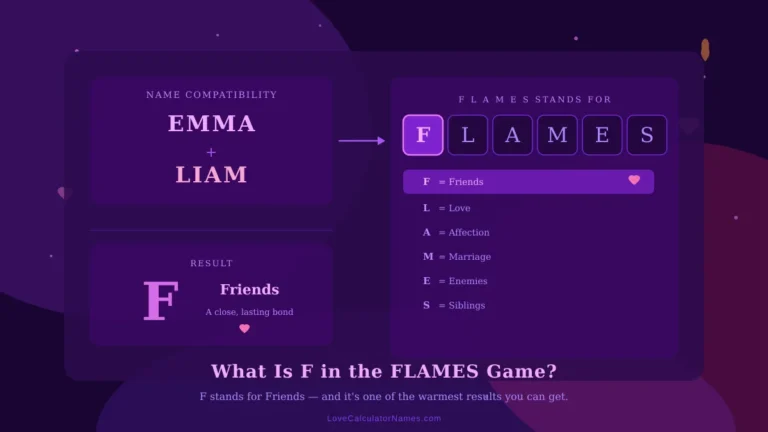
The FLAMES game, which stands for Friends, Love, Affection, Marriage, Enemy, Siblings, traveled through schoolyards across India, the UK, and the United States for decades before anyone built a website around it. It predates the internet by a generation.
Names have always carried social weight beyond these formal systems. In many African cultures, naming ceremonies rank among the most significant events in a person’s life. A child’s name is chosen to reflect the circumstances of birth, a family’s hopes, or an ancestor’s qualities. The name isn’t just an identifier; it’s a statement about who the child is meant to become.
In Western naming traditions, the practice of naming children after saints was standard for centuries, partly for religious reasons, and partly because a saint’s name was believed to offer protection. The idea that a name carries something beyond its syllables is genuinely universal.
All of these traditions share one belief: names aren’t arbitrary. They carry identity, and identity shapes connection. The online calculator is just the newest way to explore that idea.
How Do Name Matching Calculators Actually Work?
Name compatibility tools use one of three main calculation methods: Pythagorean letter-value scoring, the FLAMES algorithm, or numerological Expression Number comparison. Each produces a consistent, repeatable result for any given pair of names, meaning the same two names will always score the same way in the same calculator.
Here’s how each method works in practice:
Method 1: Pythagorean Letter-Value Scoring
- Write out both full names.
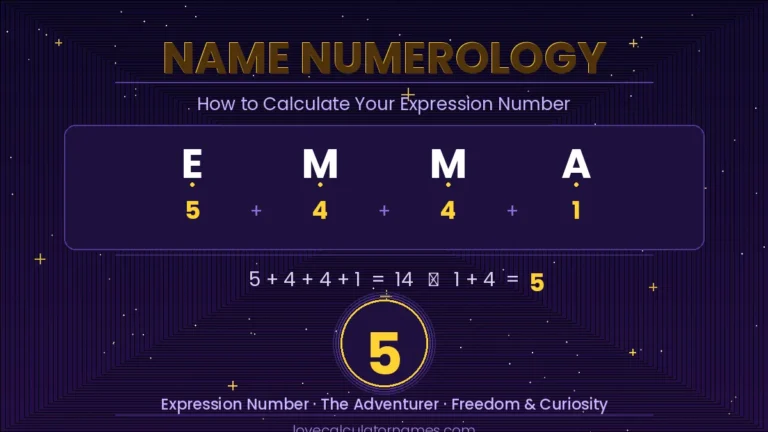
- Assign each letter a value using the Pythagorean chart: A=1, B=2, C=3, D=4, E=5, F=6, G=7, H=8, I=9. Then the cycle repeats: J=1, K=2, L=3, and so on through Z.
- Add up the letter values for each name separately.
- Reduce each total to a single digit by adding its component digits. So 34 becomes 3+4=7, and 19 becomes 1+9=10, then 1+0=1.
- Cross-reference the two resulting numbers against a compatibility table. Certain number pairs are considered harmonious; others, challenging.
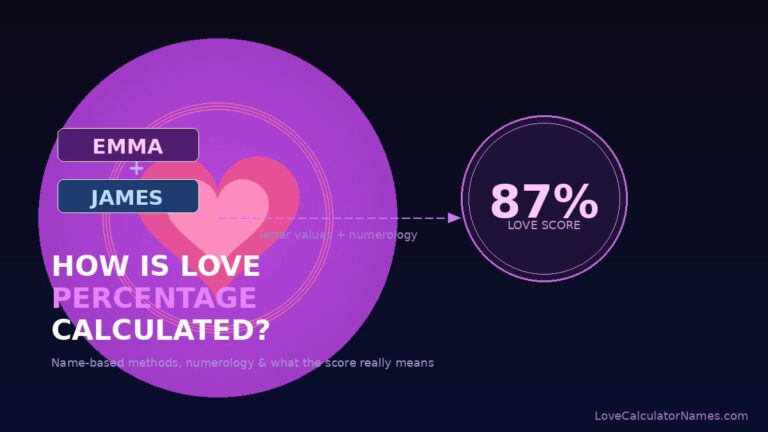
- The calculator converts that relationship into a percentage score and sometimes adds a brief description.
Method 2: FLAMES
- Write both full names side by side.
- Cross out any letter that appears in both names (regardless of position).
- Count the total number of uncrossed letters remaining.
- Use that count to cycle through the letters F-L-A-M-E-S, eliminating one letter per cycle.
- The last letter standing gives the relationship category: Friends, Love, Affection, Marriage, Enemy, or Siblings.
Method 3: Expression Number Comparison
- Assign each letter in both names a Pythagorean value (same chart as above).
- Sum all values for each name and reduce to a single digit. This is each person’s Expression Number.
- Compare both Expression Numbers using a compatibility grid. Some grids are simple; others factor in secondary numbers.
- More advanced calculators also pull in birthdate numerology to calculate Life Path Numbers and weight them alongside the name score.
Different calculators use different versions of these methods. Some use only first names; others include full legal names or middle names. Some treat double-digit “master numbers” (11, 22) as special categories rather than reducing them further. This is why running the same pair of names on three different sites sometimes produces three different results; each is applying its own interpretation of the underlying framework.
What these systems share is internal consistency. They follow defined rules. They’re not guessing.
What Do Psychology and Cultural History Actually Say About Names?
Research on names and human behavior is more interesting than most people expect, even if it doesn’t validate love calculators directly. The scientific field of nominal determinism examines the subtle ways people’s names influence their choices, perceptions, and even who they’re attracted to.
One well-documented finding: people tend to be slightly more attracted to partners whose first or last names begin with the same letter as their own. A study published in the Journal of Personality and Social Psychology found this pattern across a large sample of married couples. The researchers attributed it to implicit egotism: a tendency to feel warmth toward things that resemble the self. It’s a small effect. But it’s real.
Phonetics is another legitimate angle. Linguists have studied how individual sounds carry emotional associations. Names heavy in soft, voiced sounds (“l,” “m,” “n,” “a,” “o”) tend to register as warmer and more approachable. Names loaded with hard stops (“k,” “t,” “p,” “d”) feel sharper or more assertive. Whether that phonetic impression affects attraction over time is debated. But the initial perception appears to be consistent across languages and cultures.
Here’s how the major name-matching traditions compare:
| Tradition | Origin | Core Method | Primary Use |
|---|---|---|---|
| Pythagorean Numerology | Ancient Greece | Letter-to-number (1–9 cycle) | Personality and compatibility |
| Gematria | Ancient Hebrew | Unique letter-to-number values | Spiritual alignment |
| Vedic/Kundli Matching | India | Birth chart and name phonetics | Marriage compatibility |
| Chinese Name Analysis | China | Character meaning and stroke count | Life harmony and balance |
| FLAMES | Global folk tradition | Letter cancellation game | Relationship category |
| Western Love Calculators | Modern internet | Letter-value algorithms | Percentage compatibility score |
What’s striking across all of these systems is how consistent the underlying logic is. Cultures with no contact with each other developed remarkably similar ideas: that names carry meaning, and meaning interacts with other names in ways worth understanding.
Do celebrity name pairs produce accurate results? Fans love testing them: Taylor and Travis, Harry and Meghan, Beyoncé and Jay-Z. Results vary depending on the calculator used, which tells you something useful about the nature of these systems. The fun is in the test, not the verdict.
There’s also a psychological reason why name matching feels meaningful even when people know it’s not scientific. Psychologists call it confirmation bias: we notice and remember results that fit what we already feel, and quietly set aside results that don’t. If you’re hoping a relationship will work and you get an 88% score, that number sticks. If you get 44%, you probably run it again with a slightly different name spelling. This isn’t foolishness. It’s ordinary human cognition. Understanding it helps you enjoy the tool for what it is rather than over-reading the output.
One more thing worth knowing: the percentage scores aren’t calibrated against any real-world data. A calculator that outputs “78% compatible” isn’t saying that 78% of couples with those names stay together. The percentage is a relative score within the calculator’s own internal scale. Keep that in mind when a result surprises you in either direction.
What Are the Biggest Myths About Name Matching?
The most common mistake is treating a high compatibility score as confirmation and a low score as a warning. Neither interpretation is supported by what these tools actually do. Here’s where the understanding usually goes wrong.
Myth 1: Name matching is random output.
It isn’t. The calculations follow rules drawn from numerological systems that have been consistent for centuries. The Pythagorean letter-value method produces the same result every single time for the same pair of names. Random output means different results each time you run it; that’s not what happens. The system is deterministic. Whether the system captures anything meaningful about two human beings is a different question.
Myth 2: A high score means a relationship will work.
This is the most harmful misreading of name-matching results. No letter-value algorithm accounts for how two people communicate, whether they share values, how they handle conflict, or whether the timing in their lives is right. A 92% score between two people with fundamentally different needs doesn’t change those needs. Treat high scores as fun, not as a forecast.
Myth 3: A low score is a warning sign.
The inverse is equally untrue. Some of the most stable relationships on record would score “poorly” under any numerological method. The score reflects patterns in letters, nothing more. A couple that works hard at their relationship will outperform their name-match score every time.
Myth 4: All name calculators give the same result.
They don’t, and this surprises a lot of people. Different sites use different algorithm versions. Some include middle names; others don’t. Some apply master number rules; others reduce everything to a single digit. Running identical names on multiple calculators often produces meaningfully different scores. That’s not a bug. It’s just the natural variation between interpretive systems.
Myth 5: Name matching is an internet-age invention.
The opposite is true. Numerological name comparison was documented in ancient Greece, Rome, and the Near East. Vedic name-sound matching has been part of Indian marriage traditions for centuries. Chinese name analysis predates the internet by over a thousand years. FLAMES was being played in school notebooks long before anyone built a website. The online tool is the newest version of something genuinely old.
Frequently Asked Questions
Is name matching scientifically proven?
No. Name matching draws from numerological and folk traditions, not peer-reviewed science. The calculations follow consistent rules and produce repeatable results, but no study has validated these methods as reliable predictors of relationship success. They’re designed for entertainment, not as a substitute for actually getting to know someone.
What does a 100% name compatibility score actually mean?
It means the two names hit the maximum value under that specific calculator’s algorithm. It does not mean the people are destined for each other or guaranteed any particular outcome. The score reflects mathematical patterns in letter values, nothing more. A perfect score is fun to get, not a relationship endorsement.
Can two people’s names really affect how their relationship goes?
Not in the way name calculators suggest. Research on nominal determinism shows that name similarities can subtly influence initial attraction, but these are small, population-level tendencies rather than rules for individuals. Your name doesn’t control your choices, your emotions, or how you treat people close to you.
Is the FLAMES game an actual prediction method?
FLAMES is a folk game with no scientific basis, passed through schoolyards across the world for decades as a lighthearted way to process feelings about a crush. It produces a consistent result for any name pair, but that result isn’t a prediction. It’s a conversation starter, and it works best when treated that way.
Does name matching work for friendships too, or just romance?
Yes. The same calculation methods apply regardless of relationship type. Many people use name-matching tools to compare best friends, siblings, or even colleagues. The entertainment value is identical, and so is the caveat. Whether you’re testing a friendship or a romance, the numbers measure letter patterns, not the relationship itself.
Are name matching sites safe and private to use?
Reputable tools don’t require an account or store your name data. Names are typically processed immediately and discarded after generating a result. That said, check the privacy policy of any site before using it. Well-run tools are explicit about how they handle personal data.
Why do different calculators give different scores for the same names?
Each calculator applies its own version of the algorithm, using different name components (first name only vs. full name), different rules for master numbers, and different compatibility grids. There’s no single authoritative method because these systems are interpretive, not empirical. The variation is a feature of the tradition, not a technical error.
Why do so many people find name matching meaningful if it isn’t proven?
Humans are wired to seek patterns and find meaning. It’s a core feature of cognition, not a flaw. Name matching taps into that instinct in a low-stakes, enjoyable context. Getting a result that fits feels satisfying; getting a surprising one sparks conversation. The value is in the experience, not the prediction.
The Bottom Line
Name matching isn’t a scientific measurement, but calling it “just nonsense” misses how interesting it actually is. The systems behind it draw from real numerological frameworks used across multiple civilizations. They reflect a genuine human impulse: the belief that names carry identity, and identity shapes connection.
People have been comparing names for compatibility since before the Roman Empire. That doesn’t make the practice accurate. But it does make it deeply human. The skeptical question, is name matching real, is worth asking. The tradition is real, the math is consistent, and the prediction is not. Most people who use these tools already sense that distinction. They’re not looking for certainty. They’re looking for a moment of curiosity, a conversation topic, a small thrill before a first date.
The calculations follow consistent rules, not guesswork. The results are meant for entertainment, not life decisions. And the tradition behind them is genuinely rich, built up over centuries before any website existed.
Whether you’re curious about a new crush, a longtime partner, or just having fun with a friend’s name, the experience is the point. Ready to see your score? Try the free name compatibility test at LoveCalculatorNames.com — no sign-up required, 100% private.
Find your way back to what truly matters by exploring our tender wisdom inside our quiet healing corner.