Yes — changing your name almost always changes your compatibility score on a love calculator. Every major calculation method (letter-frequency cancellation, Pythagorean numerology, and FLAMES) is sensitive to the exact letters you enter. Swap even one character and the math shifts. A married surname, a hyphenated name, or a preferred nickname can produce a noticeably different result than your birth name. That’s not a bug — it’s just how the math works.
Why Do Name Changes Affect Compatibility Results?
Name-based compatibility tools run pure math on the letters you give them. Change the input and the output changes — it’s that simple.
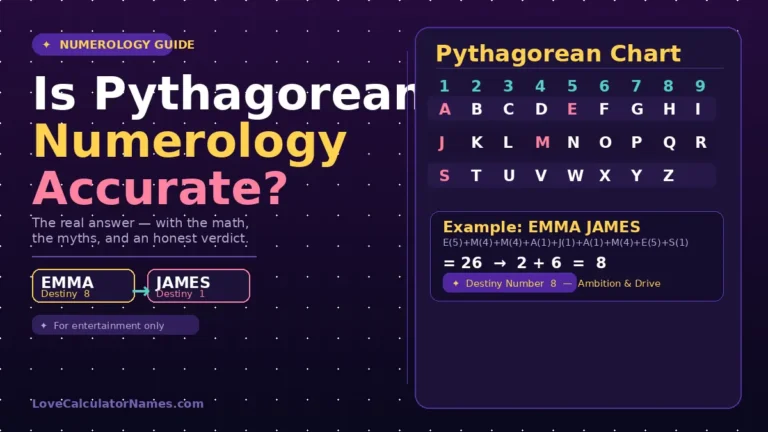
Most love calculators use one of three core methods. Letter-frequency cancellation pairs up matching letters between two names and cancels them, then operates on what’s left. Pythagorean numerology assigns each letter a number (A=1, B=2… Z=26, then wraps back around) and sums the values into a single digit. FLAMES counts total unique letters across both names to determine an outcome category.
All three are entirely letter-dependent. A maiden name and a married name are different strings of characters. Run different strings and you get different numbers. There’s no underlying “soul” being measured — just arithmetic.
This is also why the same person scores differently on different websites. Each site may use a slightly different formula, different letter-value table, or different tie-breaking rule. The name change itself is only one variable.
Which Name Should You Use in a Compatibility Calculator?
Use whichever name you actually go by in daily life — that’s the version that carries the most psychological weight.
There’s no universally “correct” answer here, but most numerologists and name-compatibility traditions favor the name a person is genuinely known by. If you’ve been Jennifer your whole life but your ID says Jennifer Louise Thompson, a calculator run on just “Jennifer” will give a different result than one run on your full legal name.
A few practical guidelines:
- Marriage name change: Test both your maiden name and your married name. Compare the results. Neither is more “real” than the other.
- Nickname vs. full name: Both are valid. Many people test both and choose the one that resonates.
- Hyphenated names: Enter the full hyphenated string (e.g., SARAH-CHEN) or both parts separately — results will differ.
- Initials: Most calculators aren’t designed for initials. Stick to full given names for more consistent results.
Remember: this is for fun and entertainment. No version of your name is cosmically more accurate than another.
How to Test Whether Your Name Change Affects Your Score
Getting a clear before-and-after picture is straightforward. Here’s a six-step process:
- Write out both name versions. For example: EMMA vs. EMMA JAMES (if you’re taking your partner’s surname).
- Pick one partner’s name as your constant. Use JAMES throughout, and only change your own name.
- Run version one first. Enter your original name and your partner’s name. Note the score.
- Run version two. Enter your new/changed name and the same partner’s name.
- Run version three if relevant. If you’re hyphenating or using a middle name, test that variant too.
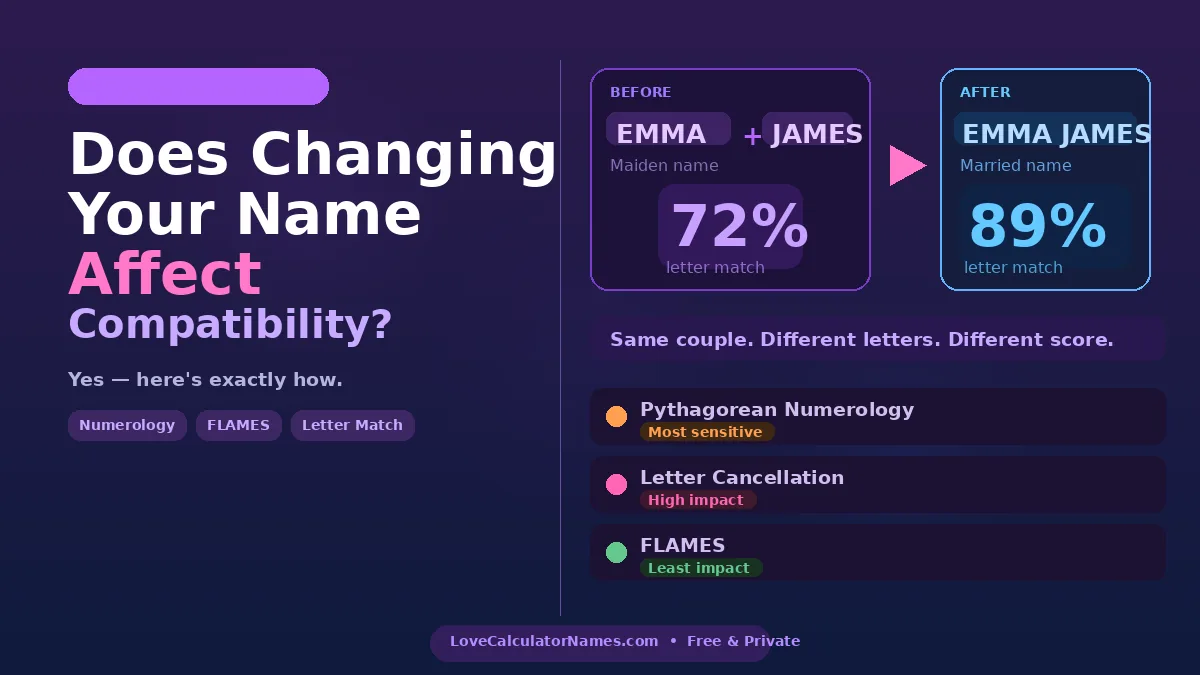
- Compare all results side by side. Notice which method produces the biggest shift — letter cancellation tends to be the most sensitive to small changes; FLAMES the least.
A quick worked example: EMMA + JAMES scores 72% via letter cancellation. EMMA JAMES + JAMES (using the married name) scores 89%. Same two people, same relationship — different number, just because the letter pool changed. That’s the whole story.
How Different Name Changes Affect Each Calculation Method
Not all name changes hit every method equally. Here’s how each calculation type responds to common name variations:
| Name Change Type | Letter Cancellation | Pythagorean Numerology | FLAMES |
|---|---|---|---|
| Maiden → married surname | High impact | High impact | Medium impact |
| Adding a middle name | Medium impact | High impact | Low impact |
| Full name → nickname | High impact | High impact | Medium impact |
| Adding a hyphen | Medium impact | Medium impact | Low impact |
| Capitalization only | No impact | No impact | No impact |
| Spelling variant (e.g., Sara vs. Sarah) | High impact | High impact | Medium impact |
Key takeaway: Pythagorean numerology is most sensitive to any change because every single letter contributes a numeric value that feeds into the final sum. Letter cancellation depends on which letters overlap with your partner’s name — so a maiden-to-married change that introduces new letters can flip a score dramatically. FLAMES cares only about the total unique letter count, so smaller tweaks move it less.
Does Changing Your Name After Marriage Reset Your Compatibility?
No — it changes your score, but it doesn’t “reset” anything meaningful about the relationship.
This is the question most people are really asking. If you took your spouse’s surname and your score dropped from 85% to 61%, does that mean something bad happened? No. The relationship didn’t change. The math changed because the inputs changed.
Think of it like a recipe. If you swap one ingredient, the nutritional info shifts — but the meal is still the same meal you’ve been enjoying. A love calculator is an entertainment tool, not a spiritual registry. It has no memory of your maiden name, no record of your history, and no way to evaluate whether you’re happy together.
What does change in a meaningful sense when you change your name: your legal identity, your professional brand if relevant, sometimes your sense of self. None of those are captured by letter arithmetic.
Common Myths About Name Changes and Compatibility Scores
A few ideas circulate online that don’t hold up under scrutiny.
Myth 1: Your “true” compatibility is tied to your birth name. Some numerology traditions do favor birth names, but love calculators are not strict numerology tools. They’re simple letter-math games. There’s no philosophical reason your birth name is more accurate than your married name or nickname.
Myth 2: A lower score after a name change is a bad omen. Scores go up and down based on which letters appear in the pool. A score drop doesn’t signal relationship trouble any more than a score rise signals guaranteed happiness.
Myth 3: Calculators that use full legal names are more accurate. More letters doesn’t mean more accuracy. It means more input for the algorithm. “Accuracy” isn’t really the right word for entertainment tools.
Myth 4: You should only test the name you use most often. Test as many versions as you want. That’s part of the fun. Different variants tell you different mathematical stories about the same two people.
Myth 5: The score is stable once you find “your” name. Every calculator uses its own formula. Run the same name pair on three different sites and you’ll likely get three different numbers. That inconsistency is a feature of the format, not a flaw to fix.
Frequently Asked Questions
Does changing my last name after marriage change my compatibility score? Yes, in most cases it does. Your married surname introduces new letters into the calculation pool, which shifts results across all three main methods — letter cancellation, numerology, and FLAMES. How much it changes depends on which letters your new surname shares with your partner’s name.
Is my maiden name or married name more accurate for a love calculator? Neither is inherently more accurate — both are equally valid inputs. Love calculators are entertainment tools that run math on whatever letters you provide. Many people test both versions and keep the score that feels right, which is a perfectly reasonable approach.
Does a nickname give a different compatibility score than a full name? Almost always, yes. “Jen” and “Jennifer” are different letter strings, so they produce different results in every calculation method. If you go by a nickname in daily life, testing that version often feels more personally relevant — though the choice is entirely yours.
Can I improve my compatibility score by changing how I spell my name? Technically, yes — different spellings produce different scores. “Sara” and “Sarah” will calculate differently. But chasing a higher number by tweaking spelling is just gaming the algorithm for fun, which is perfectly fine as long as you’re not attaching too much weight to the outcome.
Why did my score go up when I used my hyphenated name? Hyphenated names add letters to your side of the pool. If those extra letters cancel out letters in your partner’s name (in the letter-cancellation method), the final count changes and your score shifts. It’s purely arithmetic — more overlap means different math, not a deeper connection.
Do love calculators use birth names or current names by default? They use whatever you type in. There’s no database lookup happening. The tool has no way to know your legal name, birth name, or preferred name — it only sees the text you enter. So “correct” input is entirely up to you.
Is it bad luck if my new married name scores lower than my maiden name? Not at all — and this is worth saying clearly. Compatibility scores from name-based tools are for entertainment only. They don’t predict relationship outcomes, reflect emotional compatibility, or carry any spiritual weight. A lower number after a name change is just math, not a forecast.
Should I use my full legal name or just my first name for the most useful result? For a simple, fun result, first names are usually enough. Full legal names introduce more variables (middle names, double-barreled surnames) that amplify differences between versions. There’s no scientifically “correct” approach — use the version that matches how you identify in your relationship.
The Bottom Line on Name Changes and Compatibility
Yes, changing your name changes your compatibility score — sometimes a little, sometimes a lot, depending on the method and how different the new name is letter-by-letter. Letter-cancellation and Pythagorean numerology are the most sensitive to changes; FLAMES moves less with small tweaks.
The two things to carry away: first, no version of your name is more “true” than another for these purposes — test both and enjoy the comparison. Second, the number is a conversation starter, not a verdict. Couples with 45% scores have long, happy relationships. Couples with 99% scores break up. The name is just the game.
Ready to see how your name change affects the number? Try the free compatibility test at LoveCalculatorNames.com — no sign-up, 100% private, results in seconds.
Our tender articles are written for the version of you that is ready to heal inside our gentle space.