You remember writing it in your notebook during class — maybe in pencil so you could erase it later. FLAMES. A simple letter-counting game that turned two names into a relationship verdict: Friends, Lovers, Affectionate, Marriage, Enemies, or Siblings. Fast, fun, slightly nerve-wracking.
But can FLAMES actually predict marriage? Here is the short answer: No, FLAMES cannot predict marriage in any scientific sense. It is a folk game with no empirical basis — but that does not make it useless. As an ice-breaker, a conversation starter, or a playful way to explore name compatibility, it has charmed people across generations and cultures. This article explains exactly how it works, where it came from, and what (if anything) it might genuinely tell you about two names.
What Is the FLAMES Game and How Did It Start?
FLAMES is a letter-elimination game played with two people’s names. You cancel out shared letters, count the remaining ones, and use the total to cycle through the word FLAMES until one letter survives. That letter determines the “relationship category.” It originated as a schoolyard pastime, likely in South Asia and Southeast Asia during the mid-20th century, and spread globally through word of mouth.
The game’s origins are fuzzy by design — no one person invented it. Most accounts trace FLAMES to Indian school culture in the 1960s and 70s, where it was played in notebooks by students curious about their crushes. It spread to the Philippines, Malaysia, and other parts of Asia before appearing in Western countries through immigrant communities and, later, the internet.
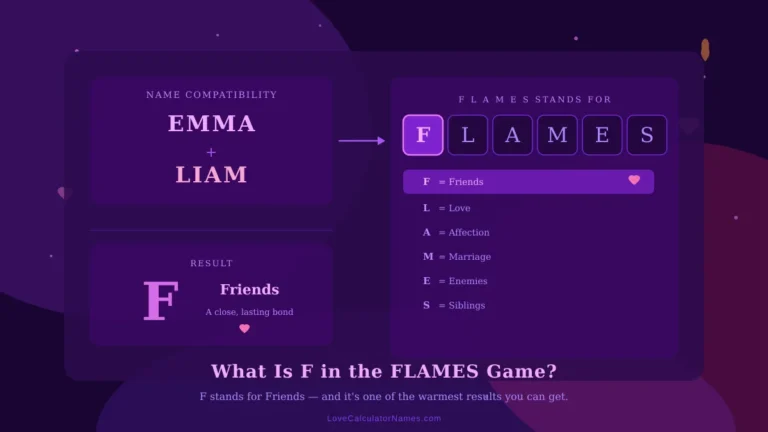
Each letter in FLAMES stands for a relationship type: Friends, Lovers, Affectionate, Marriage, Enemies, Siblings. The combination varies slightly by region — some versions swap “Affectionate” for “Attraction” or replace “Enemies” with “Engaged” — but the core six categories appear almost universally.
What gave it sticking power is the same thing that drives astrology, tarot, and numerology: the appeal of a structured system that takes something personal (your name) and produces a meaningful-sounding result. Names feel intimate. When a game uses your actual name as an input, the output feels less random.
How Do You Play FLAMES? Step-by-Step Instructions
To play FLAMES, write both names, cancel all shared letters, count the remaining letters, and eliminate categories by counting around the word FLAMES repeatedly. Whichever letter survives is your result. The full process takes under two minutes and works the same way whether you use first names, full names, or nicknames.
Here is exactly how to do it:
- Write both names in full. Use first names only, or full names — just be consistent. Example: OLIVIA and JAMES.
- Cross out every letter that appears in both names. For each shared letter, cancel one instance from each name. OLIVIA and JAMES share the letters A. Cross out one A from each name.
- Count the remaining uncrossed letters. In our example: O-L-I-V-I (5) from OLIVIA and J-M-S (3) from JAMES = 8 remaining letters total.
- Start counting through F-L-A-M-E-S. Count to your number (8), then eliminate the letter you land on. Restart counting from 1 on the next letter, skipping eliminated ones.
- Keep going until one letter remains. That letter is the result: F (Friends), L (Lovers), A (Affectionate), M (Marriage), E (Enemies), or S (Siblings).
One common point of confusion: when you cancel shared letters, you cancel them in pairs — one from each name per shared letter. If both names share the letter “E” twice, you cancel two E’s from each. If one name only has one E and the other has three, you cancel one E from each and leave the extras.
Different teachers and regions use slightly different rules about whether to use first names only or full names. The result often changes significantly based on which version you use — which is actually part of the charm.
Does FLAMES Give Different Results for Famous Couples?
When you run FLAMES on real couples, the results are all over the map — some land on “Marriage,” many don’t. This is expected from a random elimination process. The game doesn’t know who ended up together; it just counts letters. But comparing famous name pairs is a fun way to see the mechanics in action.
Here is a comparison of well-known couples and their FLAMES outcomes:
| Couple | FLAMES Result | Actual Outcome |
|---|---|---|
| William + Catherine | Lovers | Married |
| Harry + Meghan | Siblings | Married |
| Barack + Michelle | Affectionate | Married |
| Taylor + Travis | Friends | Dating |
| Romeo + Juliet (fictional) | Marriage | Tragic love story |
| Elizabeth + Darcy (fictional) | Enemies | Married |
The results are genuinely random relative to real outcomes. Harry and Meghan get “Siblings.” Elizabeth Bennet and Mr. Darcy — whose whole relationship arc starts as mutual dislike — land on “Enemies,” which is accidentally quite accurate for the beginning of their story, but not the ending.
What this table shows is not that FLAMES is broken. It shows that the game produces outcomes determined entirely by letter count, not by any quality of the relationship. Two names that happen to share many letters will produce a lower count and may land on a different result than two names with fewer shared letters.
Why Do Some Results Feel Surprisingly Accurate?
This is called confirmation bias — we remember the hits and forget the misses. If FLAMES says “Marriage” and you later end up with that person, the game feels prophetic. If it says “Enemies” and you dated for three years, you probably don’t bring it up.
There is also the Barnum effect (sometimes called the Forer effect), named after psychologist Bertram Forer. People tend to accept vague or general statements as personally accurate. FLAMES only has six categories, and every human relationship can be described by at least one of them in some context. “Affectionate” fits most good relationships. “Siblings” fits close friendships. The categories are broad enough that they rarely feel completely wrong.
Common Myths About FLAMES and Name Compatibility
Most misconceptions about FLAMES overstate what the game can do. It is not numerology, not psychology, and not rooted in any cultural divination tradition. It is letter counting. Understanding what it actually is makes it more fun, not less.
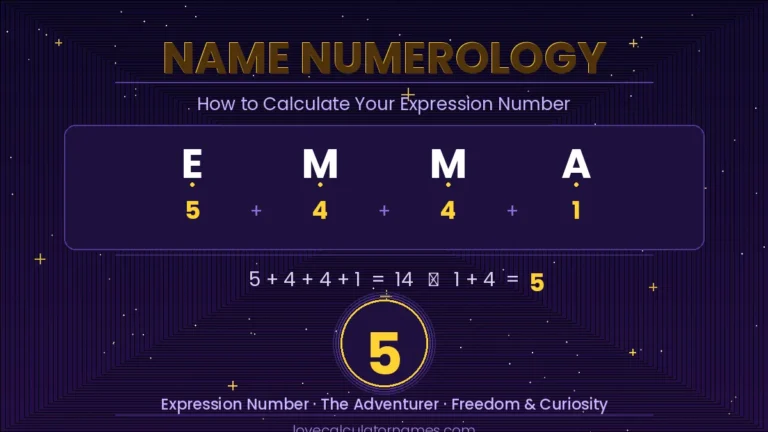
Myth 1: FLAMES is the same as numerology. Not quite. Numerology assigns numeric values to each letter (A=1, B=2, etc.) and reduces names to single-digit “life path numbers” or “expression numbers” — a system with roots in Pythagorean mathematics and centuries of philosophical tradition. FLAMES simply counts uncrossed letters and cycles through six categories. They both use names, but the methods and claims are completely different.
Myth 2: Using your full name gives a more accurate result. There is no “accurate” result because FLAMES has no predictive validity. Using full names versus first names just produces a different letter count, which produces a different category. Neither is more meaningful than the other.
Myth 3: Getting “Enemies” means you should avoid that person. This one is worth saying clearly: the game is entertainment. No one should make relationship decisions based on a letter-counting game from a school notebook. The “Enemies” result has no bearing on real compatibility.
Myth 4: FLAMES originated in a specific ancient tradition. Some articles claim FLAMES has roots in astrology or ancient Chinese name-matching. There is no credible evidence for this. The game appears to be a 20th-century schoolyard invention — fun and widely loved, but not ancient wisdom.
Myth 5: The game always works the same way. Regional variations are surprisingly significant. Some versions use all six FLAMES letters; others drop “Enemies” and use “Engaged” instead. Some count forward only; others allow restarting from the first remaining letter. The “correct” version is whichever one you grew up with.
Frequently Asked Questions
Can FLAMES predict marriage accurately?
No. FLAMES is a letter-counting game with no scientific basis for predicting marriage or any relationship outcome. The result depends entirely on how many uncrossed letters two names produce, which varies by spelling. It is best understood as entertainment — a fun way to see your name interact with someone else’s, not a forecast.
What does it mean if FLAMES says “Marriage” for two names?
It means the letter count happened to eliminate F, L, A, E, and S before reaching M. That’s it. The “Marriage” result carries no predictive weight. If you enjoy the result, great — but don’t make any life decisions based on it. Use it as a fun excuse to think about someone whose name you like.
What is the most common FLAMES result?
This varies based on the names involved, but statistically, all six outcomes are roughly equally likely over a large sample of random name pairs. Some letters in FLAMES are slightly easier to survive (due to position), but the variation depends heavily on name length and shared letters, not any inherent tendency.
Can I play FLAMES with full names instead of first names?
Yes, and many people prefer it. Using full names tends to produce larger counts and can change the result dramatically compared to first names only. There is no official rule — the game is informal. Try both and see which result you like better.
Does FLAMES work in other languages?
The game works with any alphabet-based writing system. It is commonly played in Hindi, Tagalog, Malay, and other languages. The six FLAMES categories may be translated or adapted — for example, some South Asian versions use different relationship terms while keeping the same counting method.
Is there a faster way to calculate FLAMES online?
Yes. Several websites offer automated FLAMES calculators where you enter two names and get an instant result. LoveCalculatorNames.com offers a free name compatibility tool that gives you a result in seconds, with no account needed.
Why do I get different results when I switch the order of the names?
The order can affect which letters cancel out first. In strict versions of the game, both names are written on separate lines and shared letters are crossed out simultaneously, so order should not matter. In practice, many people write one name above the other and cancel sequentially — which can produce slightly different counts. There is no “correct” order.
Is FLAMES appropriate for kids to play?
Absolutely. FLAMES is one of the most kid-friendly games around — it involves spelling, counting, and harmless curiosity about friendships and crushes. The most important thing is reminding younger players that it is just a game, not a real prediction.
The Bottom Line on FLAMES and Marriage Prediction
FLAMES cannot predict marriage. It never claimed to — that is actually part of what makes it charming. It is a game that turns two names into a moment of anticipation, a shared laugh, or a slightly awkward revelation. For generations of students scribbling in notebooks, that was exactly enough.
What FLAMES does well is create connection. You play it because someone matters to you enough that you want to see their name next to yours. That impulse — curiosity, affection, the hope that two people might fit together — is the part worth paying attention to.
If you want to go beyond the classic game and explore name compatibility in more depth, tools that draw on phonetic harmony, letter frequency, and name-meaning traditions can add an interesting layer. Ready to see your result? Try the free name compatibility test at LoveCalculatorNames.com — no sign-up required, completely private, and results in seconds.
Discover what your names mean together by using our free compatibility checker.