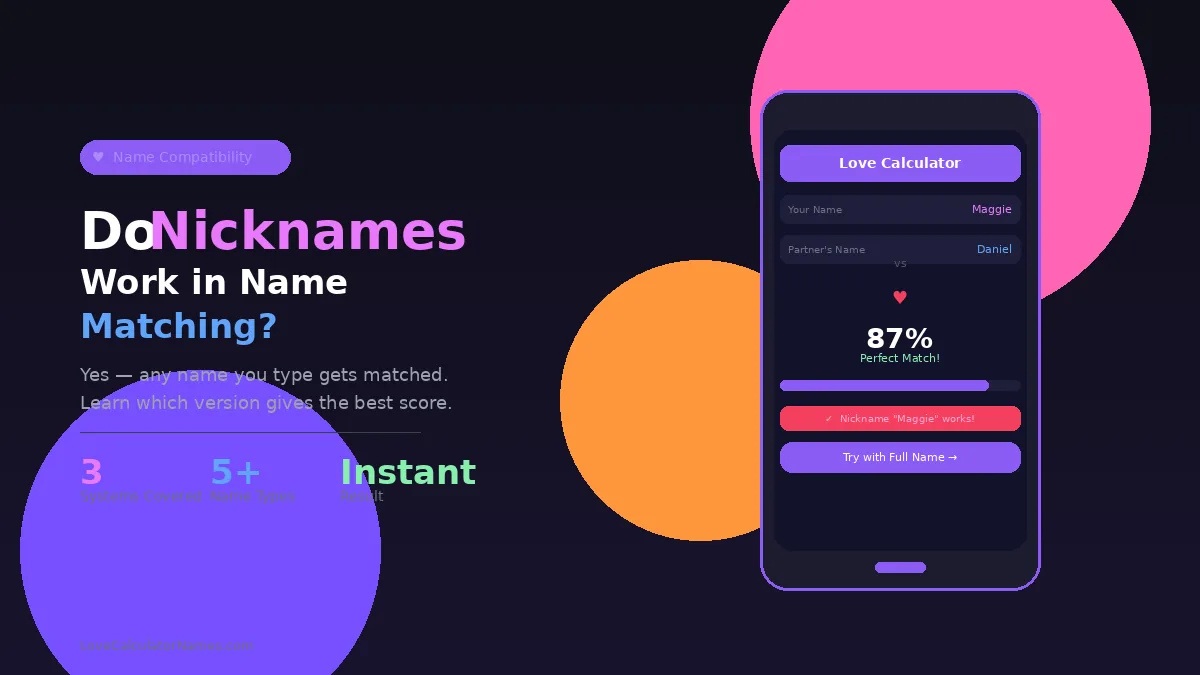
Have you ever paused before typing your name into a love calculator and wondered — “Maggie” or “Margaret”? You’re not overthinking it. This question comes up constantly, and the answer actually changes your score.
Yes, nicknames work in name matching. Every compatibility tool — whether it runs FLAMES, a letter-percentage calculation, or Pythagorean numerology — processes whatever name you type. There’s no background check, no legal verification. If you enter “Maggie,” the system calculates for “Maggie.” In numerology specifically, the name you use day-to-day (called your Expression Name) often carries as much weight as your birth name. Different name versions will produce different results, so it’s worth knowing which version to enter before you run the test. These tools are designed for fun and entertainment — not scientific relationship prediction.
This article covers how each major name matching system handles nicknames, what changes when you switch versions, and which choice typically feels most meaningful.
Does a Nickname Count the Same as a Legal Name in Compatibility Tests?
A nickname counts exactly the same as any other name in a compatibility test. Name matching tools work with letters, not legal documents. Whatever you type gets processed. The question isn’t whether a nickname is “valid” — it’s whether the nickname you choose gives you a result that feels personally meaningful.
Name compatibility calculators are entirely input-based. You type a name, they run a formula on those letters. The tool has no way to know — and no interest in knowing — whether “Bex” is a legal first name, a nickname for Rebecca, or a stage name. To the algorithm, “Bex” is three letters: B, E, X.
This is freeing, once you think about it. If everyone you know calls you “Bex,” you’ve been walking through life as Bex. Your relationships formed under that name. Using it in a compatibility test connects the result to your actual social identity, not to a document your parents filed.
The important thing to understand: “Rebecca” and “Bex” will not produce the same score against the same partner name. They share most letters, but the differences matter. “Rebecca” is seven letters; “Bex” is three. That gap changes every calculation — FLAMES letter crossings, numerology digit sums, percentage overlaps. Same person, meaningfully different results.
That’s not a flaw in the system. It’s a reason to test both versions. You might find one result resonates far more than the other.
There’s also a psychological layer worth acknowledging. Research on name identity suggests that the name people call you shapes how you see yourself in a relationship context. The name your partner uses when they look at you across a room — that version of your name carries real meaning. It’s often the better input for a personal compatibility test.
How Do Name Matching Systems Actually Process a Nickname?
All major name matching methods treat a nickname the same way they treat any name: they analyze its letters. FLAMES counts shared letters between two names and eliminates them. Numerology converts each letter to a number and reduces the total. Phonetic matching compares sound structures. In every system, a nickname enters the formula exactly like a formal name would.
Here’s how each method handles a nickname, step by step.
FLAMES Method
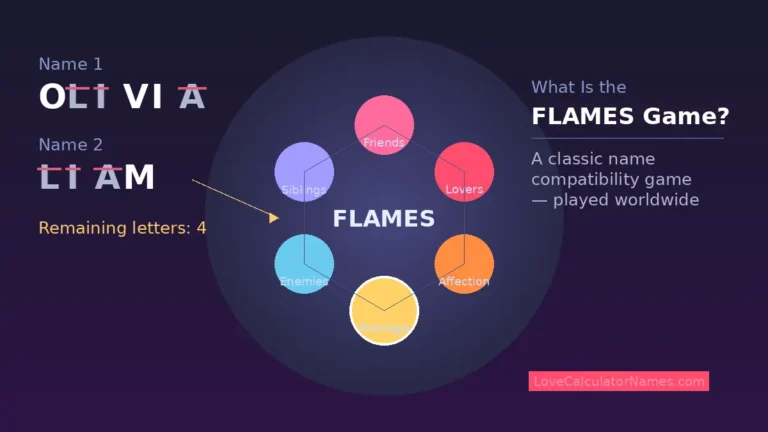
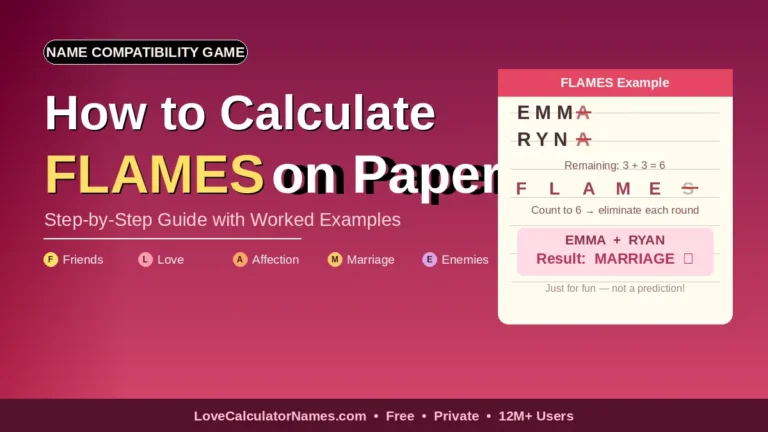
- Write both names next to each other — for example, “Jake” and “Sofia.”
- Cross out every letter that appears in both names. Each crossing-out removes one instance from each name (not all instances).
- Count the total letters that remain uncrossed.
- Starting from F, cycle through F-L-A-M-E-S repeatedly, counting down from the remaining letter total, eliminating each letter you land on until one remains.
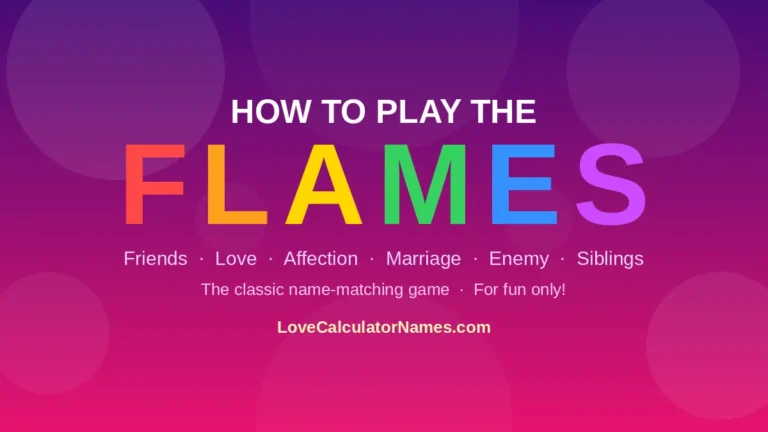
- The surviving letter tells you the relationship type: Friends, Love, Affection, Marriage, Enemies, or Siblings.
When you swap “Jake” for “J” or swap “Sofia” for “Sophie,” the pool of shared letters changes. That changes the count that remains. That changes what survives the cycle. A nickname produces a legitimately different FLAMES result — not a less valid one.
Pythagorean Numerology
- Write out the name you want to test — nickname, full name, whatever feels right.
- Assign a number to each letter using the Pythagorean chart: A=1, B=2, C=3, D=4, E=5, F=6, G=7, H=8, I=9, then cycle back (J=1, K=2, and so on).
- Add all the numbers together.
- If the total is two or more digits, add those digits together. Keep reducing until you reach a single digit.
- Compare both partners’ final numbers for compatibility.
“Nick” reduces to N(5)+I(9)+C(3)+K(2) = 19, then 1+9 = 10, then 1+0 = 1. “Nicholas” reduces to N(5)+I(9)+C(3)+H(8)+O(6)+L(3)+A(1)+S(1) = 36, then 3+6 = 9.
Same person. Completely different numerology numbers. Both are legitimate in their own right — numerologists recognize the name you use daily as your Expression Number, sometimes weighted more heavily than the birth name number because it reflects your living identity.
Letter-Percentage Method
- Write both names.
- Count the letters the two names share (each unique letter counts once, not per occurrence).
- Divide the shared count by the total number of unique letters across both names combined.
- Multiply by 100 to get your compatibility percentage.
“Kat” brings three unique letters to the table. “Katherine” brings six. A shorter nickname creates a smaller shared-letter pool, which can either raise or lower the percentage depending on which specific letters overlap with your partner’s name. There’s no rule that shorter names score lower — it entirely depends on the letter combinations at play.
Nickname vs. Full Name — Which Version Gives the Best Compatibility Result?
There’s no universal answer to which version scores higher — it depends on the specific letters in each name. Shorter names tend to create cleaner, more extreme results (very high or very low), while longer names often produce moderate scores. The version that feels most personally meaningful is almost always the better choice.
Here’s a comparison of how different versions of the same name perform in a typical letter-percentage test against “Emma”:
| Name Version | Letters Used | Letter Count | Shared with “Emma” | Compatibility |
|---|---|---|---|---|
| Katherine | K, A, T, H, E, R, I, N | 8 | A, E (2 letters) | Moderate |
| Katie | K, A, T, I, E | 5 | A, E (2 letters) | Higher % (smaller pool) |
| Kate | K, A, T, E | 4 | A, E (2 letters) | Higher % still |
| Kat | K, A, T | 3 | A (1 letter) | Lower % |
| Kit | K, I, T | 3 | None | Very low |
The same person, five name versions, five different scores. None of these is the “real” answer — they’re just different cuts of the same data.
Famous name pairs illustrate this nicely. Test “Harry” against “Meghan” and you’ll get a different result than “Prince Harry” against “Meghan Markle.” Neither is more meaningful than the other; they’re just different inputs. What matters is which version you actually use.
Across cultures, people often have several valid name options. In South Asian naming traditions, many individuals have a “daak naam” — a home name used within the family — that’s completely different from their formal name. In Arabic culture, the “kunya” is an informal name that may be what someone is known by socially. In Korean culture, a person might use an English name in some contexts and a Korean name in others. All of these are fair game for a name compatibility test. The name tied to your relationship is the one that makes the most personal sense.
Numerologists have a specific framework for this. Your birth name generates what’s called the Destiny Number — the number associated with who you were born to become. Your commonly used name generates the Expression Number, tied to who you actually are in your daily life. Both matter. Neither cancels out the other. Practitioners often run readings on both and look at them together.
For a love calculator or compatibility test, the simplest rule: use the name your partner uses for you. That version of your name lives inside the relationship.
Common Myths About Using Nicknames in Name Matching
The biggest myth is that you need your legal name to get a “real” result. You don’t. Name matching tools don’t access databases, birth certificates, or any official records. Another widespread misunderstanding is that one version of your name is “correct” while others are wrong — in reality, each version simply runs a different calculation.
Myth 1: Only your birth name gives accurate numerology results.
This confuses two different numerological concepts. Your birth name generates your Destiny Number, which numerologists study separately from your Expression Number (based on your everyday name). Nicknames aren’t excluded from numerology — they sit in their own recognized category. Many numerologists consider the Expression Number more relevant to a current relationship because it reflects who you are right now.
Myth 2: A shorter nickname will always give a lower compatibility score.
Not true. A shorter name has fewer letters, which means a smaller shared pool — but that can go either way. If your nickname shares a high proportion of letters with your partner’s name, your percentage can actually be higher than what your full name would score. “Eli” and “Ella” share two out of their combined unique letters; the result depends on the full letter set, not just length.
Myth 3: Using a nickname in a compatibility test is somehow “cheating.”
There’s nothing to cheat on. Name compatibility tools are for entertainment. They don’t measure real psychological fit, communication skills, shared values, or long-term compatibility. They run a fun mathematical formula on whatever letters you give them. Using your nickname isn’t gaming the system — it’s choosing the version of your name that feels most personally relevant.
Myth 4: You should always use your middle name for more precision.
Some people add middle names hoping for a more “complete” result. Whether that makes sense depends entirely on how much your middle name is part of your identity. If you go by “Mary Jo” and that’s genuinely what people call you, include it. If your middle name exists only on your birth certificate and you’ve heard it maybe twice in your life, it adds length but not meaning.
Myth 5: Name matching tools actually predict relationship success.
They don’t, and no serious tool claims they do. Name compatibility calculators — including love calculators that ask whether do nicknames work in name matching or any other variable — are built for lighthearted exploration. Think of them like a horoscope: fun to read, interesting to discuss with someone you like, not a substitute for actually getting to know each other.
Frequently Asked Questions
Do nicknames work in name matching tools and love calculators?
Yes, nicknames work perfectly well. Name matching tools process whatever name you type — there’s no identity verification or legal name check. Enter your nickname, your full name, or any version of your name and the calculator will generate a score. Trying both versions and comparing the results can actually be more fun than settling on just one.
Should I use my full name or my nickname for the most meaningful result?
Use the name your partner actually calls you. If everyone in the relationship knows you as “Jo,” use “Jo” — not “Josephine.” The version of your name tied to your real relationship is the one most worth testing. You can always run both and see which result feels more like you. There’s no single correct answer here.
Will my score be different with my nickname versus my legal name?
Almost always, yes. Different letters produce different results in every name matching system. “Dave” and “David” share most letters but not all, so they’ll score differently against the same partner name. In Pythagorean numerology, each version reduces to its own number — “Dave” gives a completely different single digit than “David” does. Testing both is recommended.
Does numerology treat nicknames differently from birth names?
Yes, but both are recognized and valued. Your birth name generates your Destiny Number in Pythagorean numerology. The name you use daily generates your Expression Number. Nicknames aren’t a lesser category — they’re analyzed under a different framework. Many numerologists argue the Expression Number is actually more relevant to a current romantic compatibility reading because it reflects your active identity.
What if my nickname is completely different from my legal name?
That’s fine. Nicknames like “Ned” for Edward or “Billie” for Wilhelmina share almost no letters with the original name. If you’ve used your nickname your entire life and your partner has never even heard your legal name, the nickname is clearly the more personally meaningful input. Use what you’re actually called. The result will feel more connected to your real experience.
Can I use a username or online alias in a name compatibility test?
You can type any name into the field and get a result. Whether a username feels personally meaningful is up to you. If you met someone online and they only know you by a handle, testing that version is a fun option. For something that connects to your real identity in the relationship, stick with the name you’d introduce yourself with in person.
Do middle names change the result in name matching?
They do, if you include them. Adding a middle name changes the letter pool in FLAMES, shifts the numerology reduction, and alters the percentage calculation. If your middle name is genuinely part of your everyday identity — like going by “Anna Marie” socially — including it makes sense. If it lives only on official documents, your first name alone gives a cleaner result.
Is name matching actually accurate in predicting compatibility?
Name matching is designed for fun and entertainment, not prediction. The formulas are consistent and reproducible — but they don’t measure real compatibility factors like shared values, communication style, or emotional intelligence. Think of a name compatibility score the way you’d think of a personality quiz: worth reflecting on, interesting to talk about, and genuinely enjoyable — just not a life decision.
Try Both and See What Resonates
Here are the key things to take away. Nicknames work in name matching — there’s no rule requiring a legal name, and no system checks. Every compatibility tool processes whatever letters you give it. Different name versions produce different scores, which is worth knowing before you run your test. And in numerology, the name you use daily has its own recognized category and may be more relevant to a current relationship than your birth name.
The most useful approach: try both versions and see which result resonates. Sometimes “Maggie” and “Margaret” score surprisingly differently against the same partner name. Sometimes they’re close. Either way, comparing them takes thirty seconds and gives you twice the conversation starter.
Name compatibility tests are lighthearted — treat them that way and you’ll get the most out of them.
Ready to see your own score? Try the free name compatibility test at LoveCalculatorNames.com — no sign-up, 100% private, and results in seconds. Use whatever name feels most like you.
Our popular love compatibility tool has helped millions of curious people worldwide.