Informational. Users want clear, step-by-step instructions to calculate their life path number, then understand what it means. Secondary intent: relationship compatibility exploration. This article delivers an immediate direct answer inside the first 100 words, then expands with numbered steps, a comparison table, real worked examples, and 8 FAQs — satisfying both the “how to calculate” and “what does it mean” intent in one comprehensive resource.
How to Find Your Life Path Number – Free Guide
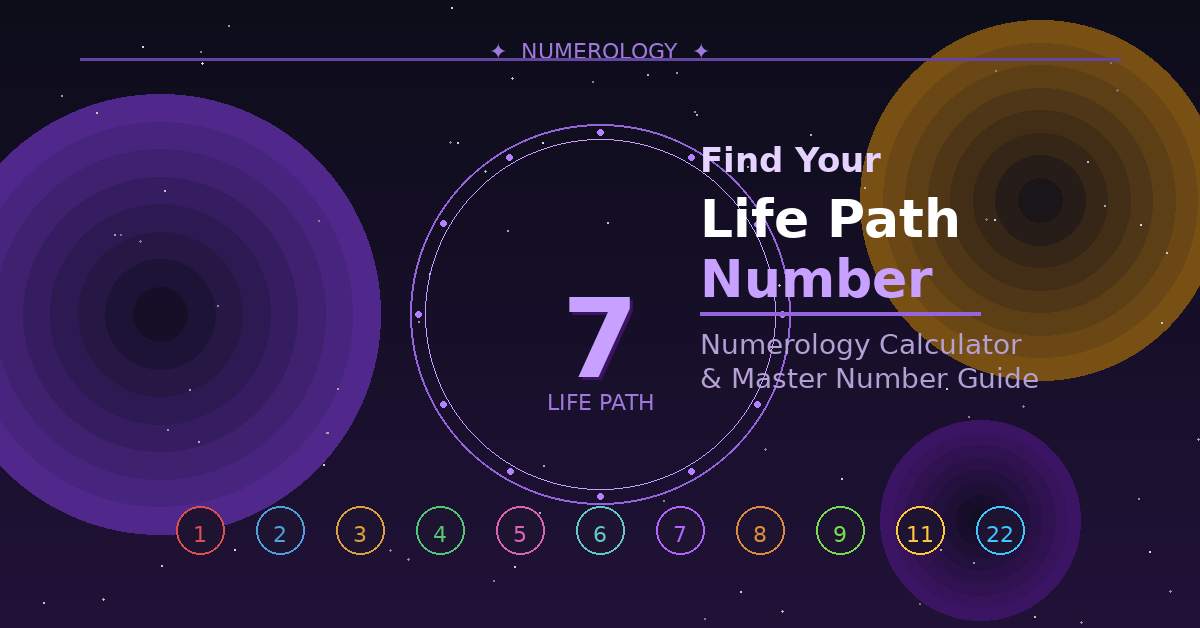
Your birth date carries more information than most people realize. For centuries, numerologists have used a simple addition method to derive a single number from the date you were born — your life path number. It reflects core personality traits, natural strengths, and how you tend to connect with others.
Direct answer: To find your life path number, reduce your birth month, day, and year each to a single digit, then add those three results and reduce to a final digit between 1 and 9. If any step produces 11, 22, or 33, stop — these are master numbers that stay as-is. The whole process takes under two minutes.
This guide covers the exact steps, explains what each number from 1 to 33 means, walks through compatibility pairings, and corrects the five most common calculation mistakes. Numerology is presented here as a reflective, entertaining tradition — not as science or relationship advice.
What Is a Life Path Number, and Why Do People Use It?
A life path number is a single digit (1–9) or one of three master numbers (11, 22, 33) derived from your full date of birth. Numerologists treat it as a snapshot of your core temperament, natural tendencies, and life direction — the most stable number in any numerological reading because your birth date never changes.
The concept comes from Pythagorean numerology, the dominant Western tradition. Ancient Greek philosopher Pythagoras taught that numbers underlie the structure of reality — a belief that shaped centuries of philosophical and mystical thought. Medieval scholars and Renaissance thinkers expanded that foundation. By the early 20th century, writers like Florence Campbell and L. Dow Balliett had systematized it into the numerology most widely practiced today.
Part of the life path number’s lasting appeal is its simplicity. You need only your birth date — no birth time, no location, no special knowledge. The math uses basic addition anyone can follow.
Interest in numerology has grown alongside a broader resurgence in self-discovery tools, personality typing, and astrology. Life path numbers are particularly popular for exploring relationship dynamics — comparing your number with a partner’s or a close friend’s opens surprisingly real conversations about shared traits, differences, and strengths. Many people find that even a brief discussion of their numbers leads to genuine reflection.
Part of numerology’s staying power is that it doesn’t require a specific belief system. People who don’t consider themselves spiritual still find the numbers useful as a personality shorthand — a lightweight way to start a conversation about how someone tends to think, lead, or connect.
The life path number differs from systems like MBTI or the Enneagram in one meaningful way: it’s rooted in a fixed mathematical method tied to your birth date, not a self-reported questionnaire. The result can’t change if you “retake” it. That stability makes comparison across people straightforward — and a natural entry point for compatibility conversations.
It’s also just one layer of a fuller numerological picture. Others include the expression number (from your full birth name), the soul urge number (from vowels in your name), and the personal year number (which shifts each calendar year). But the life path number remains the most searched and most accessible starting point for anyone new to numerology.
How to Find Your Life Path Number: Step-by-Step
To calculate your life path number, write out your full birth date in numbers, reduce the month, day, and year each to a single digit — never reducing 11, 22, or 33 — add those three values together, and reduce one final time. The entire process takes about two minutes with no tools required.
Step 1: Write your birth date in numeric form. Use the calendar month number, not the name.
Example: April 7, 1993 → 4 / 7 / 1993
Step 2: Reduce the birth month. Single-digit months (January–September, 1–9) need no reduction.
- October (10) → 1 + 0 = 1
- November (11) → keep as 11 (master number)
- December (12) → 1 + 2 = 3
Step 3: Reduce the birth day. Add both digits together. Stop at 11, 22, or 33.
- Days 1–9: no reduction needed
- 10 → 1, 11 → 11 (master), 12 → 3, 13 → 4, 14 → 5, 15 → 6, 16 → 7, 17 → 8, 18 → 9
- 19 → 1, 20 → 2, 21 → 3, 22 → 22 (master), 23 → 5, 24 → 6, 25 → 7, 26 → 8, 27 → 9
- 28 → 1, 29 → 11 (master), 30 → 3, 31 → 4
Special cases — born on the 11th, 22nd, or 29th? If your birthday is the 11th, your day is already a master number — keep it as 11. Born on the 22nd, same rule — keep it as 22. Born on the 29th, add 2+9=11 and stop. These three birth days are the most commonly mishandled in life path calculations because people often don’t realize that 29 reduces to a master number.
Step 4: Reduce the birth year. Add all four digits, then reduce. Stop at master numbers.
- 1990 → 1+9+9+0 = 19 → 1+9 = 10 → 1+0 = 1
- 1993 → 1+9+9+3 = 22 → keep as 22 (master)
- 1985 → 1+9+8+5 = 23 → 2+3 = 5
- 2001 → 2+0+0+1 = 3
Step 5: Add the three reduced values and reduce once more.
Example A — March 15, 1990:
- Month: 3 | Day: 15 → 6 | Year: 1990 → 1
- Total: 3+6+1 = 10 → 1+0 = 1
- ✦ Life path number: 1
Example B — November 29, 1987:
- Month: 11 (master) | Day: 29 → 11 (master) | Year: 1987 → 1+9+8+7 = 25 → 7
- Total: 11+11+7 = 29 → 2+9 = 11
- ✦ Life path number: 11 (master number)
Step 6: Final check. If your final total is 11, 22, or 33, stop. That is your life path number — do not reduce further.
Quick cross-check: Once you have your number, you can verify it by adding every single digit in your full birth date in one chain. If you had no master numbers at intermediate steps, both methods produce the same result. If they differ, you likely reduced a master number — go back and check each step carefully.
What Does Each Life Path Number Mean — and Who’s Compatible?
Each life path number carries a distinct set of personality traits and compatibility tendencies developed through centuries of numerological tradition. No number is better or worse — they reflect different energies, each with its own strengths and challenges. Use this table as a starting point for reflection, not a fixed identity.
| Life Path | Core Traits | Pairs Well With |
|---|---|---|
| 1 | Independent, driven, pioneering | 3, 5, 9 |
| 2 | Diplomatic, empathetic, partnership-focused | 4, 6, 8 |
| 3 | Creative, expressive, optimistic | 1, 5, 9 |
| 4 | Grounded, disciplined, loyal | 2, 6, 8 |
| 5 | Adventurous, curious, freedom-loving | 1, 3, 7 |
| 6 | Nurturing, responsible, family-centered | 2, 4, 9 |
| 7 | Analytical, introspective, spiritual | 5, 7 |
| 8 | Ambitious, strategic, results-driven | 2, 4, 6 |
| 9 | Compassionate, idealistic, humanitarian | 1, 3, 6 |
| 11 | Visionary, intuitive, spiritually sensitive | 2, 6, 11 |
| 22 | Master builder, practical idealist | 4, 8, 22 |
| 33 | Master teacher, deeply empathetic | 6, 9, 33 |
Pairings numerologists highlight most often:
Life path 1 and 9 — The pioneer and the humanitarian. The 1 brings direction and drive; the 9 brings compassion and depth. These contrasting strengths are said to complement each other naturally.
Life path 2 and 8 — The empathetic 2 and the goal-driven 8 create a stable dynamic. One provides emotional warmth; the other provides focus and strategic direction.
Life path 5 and 7 — The freedom-loving 5 and the introspective 7 often find each other genuinely compelling. The 5’s adaptability opens the 7’s world; the 7’s depth gives the 5 something real to explore. Numerologists frequently cite this as a pairing that stays intellectually alive over time.
Life path 7 and 7 — Two introspective personalities who deeply understand each other’s need for solitude, depth, and intellectual space. Often cited as a pairing that “gets” each other without lengthy explanation.
Life path 4 and 8 — Two practical, results-driven personalities. Strong on loyalty and shared ambition — though numerologists note it benefits from conscious effort toward emotional depth and spontaneity.
Master numbers together — Life paths 11, 22, and 33 carry heightened intensity. Two master numbers in a relationship can create deep resonance — or amplify each other’s challenges. Both outcomes are possible.
Cultural note: Western Pythagorean numerology focuses on personality. Chinese numerology assigns luck values — 8 is auspicious (sounds like “prosperity” in Mandarin); 4 is avoided (sounds like “death”). These systems don’t map onto each other. The life path number described here is strictly Pythagorean.
All compatibility associations are traditional numerology frameworks — for fun and self-reflection, not scientific relationship guidance.
5 Common Mistakes in Life Path Calculations — and How to Avoid Them
The most frequent calculation errors involve master numbers — specifically, reducing them when they should be preserved at every step. Other mistakes come from wrong date formats or mixing up two different numerology methods. Correct these five and your result will be accurate every time.
Mistake 1: Reducing master numbers mid-calculation. This is the #1 error. If your birth day reduces to 11 (born on the 29th → 2+9=11), keep it as 11 — don’t continue to 1+1=2. Same for 22 or 33 at any step. Reducing a master number prematurely changes your entire final result.
Mistake 2: Treating November and October identically. November is month 11 — a master number, kept as 11. October is month 10 — not a master number — it reduces to 1. December (12) reduces to 3. A common error is either reducing all two-digit months or keeping all of them. Only 11, 22, and 33 are ever preserved.
Mistake 3: Adding all birth date digits in one chain. The standard Pythagorean method reduces month, day, and year separately before adding. An alternative “whole addition” method adds every digit together at once. Both exist — but produce different results for many birth dates. This article uses the Pythagorean method, which is the most widely practiced.
Mistake 4: Using a short-form year or nickname birth date. Always use your full four-digit birth year. Born in 1988? Use 1+9+8+8=26 → 2+6=8, not 8+8=16 → 7. Those are completely different life path numbers. Use your full legal birth date, not a shortened or preferred version.
Mistake 5: Treating the life path number as your complete numerological profile. The life path number is the entry point — not the whole system. The expression number (from your full birth name) and the personal year number each add nuance. Many people who try numerology once and dismiss it as inaccurate have only seen a fraction of the picture. The good news: once you know these five pitfalls, you’ll catch them instantly.
Frequently Asked Questions
How do I find my life path number step by step?
Reduce your birth month, day, and year each to a single digit — keeping 11, 22, and 33 as master numbers. Add those three results. Reduce the total to one digit or master number. Example: born June 12, 1990 → 6 + 3 + 1 = 10 → 1+0 = 7. Life path: 7. The whole process takes under two minutes with no special tools needed.
What are master numbers in numerology?
Master numbers are 11, 22, and 33. They appear when a reduction step naturally produces one of these values — and unlike other two-digit results, they stay intact throughout the calculation. Numerologists associate them with heightened potential and greater life challenges. Life path 11 links to intuition; 22, to large-scale vision and building; 33, to compassion and teaching.
Is my life path number the same as my destiny number?
No. Your life path number is calculated from your birth date. Your destiny (or expression) number comes from the summed numerical values of all letters in your full birth name. Both appear in most numerology readings but measure different things — birth energy vs. name vibration. They rarely produce the same result unless the numbers happen to align.
What is the rarest or most powerful life path number?
No life path number is objectively more powerful. Master numbers (11, 22, 33) occur less frequently, since they require specific date combinations. Among single-digit numbers, all appear with roughly similar frequency in large populations. Some numerologists note that 1 represents pure beginning and 9 represents completion — poetic associations, not rankings of worth. Power comes from how fully someone embodies their number’s traits and challenges.
Can my life path number predict my future?
No. Numerology has no scientific support as a predictive system. It’s a tradition with rich cultural roots, valued by many as a self-reflection and conversation tool. Your life path number can prompt useful thinking about personality tendencies — but should not drive major life decisions. This article treats numerology strictly as fun and informational, not factual prediction.
How do life path numbers work for relationship compatibility?
Numerologists assign compatibility tendencies based on how different numbers’ core traits interact. Life path 2 (empathetic, diplomatic) pairs well with 8 (ambitious, grounded) because they balance each other’s strengths. Two life path 7s often share a deep mutual understanding of solitude and depth. These are traditional frameworks — not psychological science — but a genuinely fun lens for exploring relationship dynamics.
What if I calculated two different life path numbers for myself?
This almost always means a master number was reduced at a step where it shouldn’t have been. Recalculate carefully: check whether you reduced 11, 22, or 29 (which equals 11) before adding everything together. Keep every 11, 22, and 33 intact at each step. You may also be mixing the Pythagorean and whole-addition methods — these produce different results for many dates.
Can I use my life path number alongside name compatibility tools?
Yes — many numerologists use both together for a fuller picture. Your life path number captures core personality from your birth date; your name’s numerological value (expression number) reflects how you present to the world. The free name compatibility calculator at LoveCalculatorNames.com explores name-based compatibility in minutes — no sign-up, 100% private.
Your Life Path Number Is Two Minutes Away
Finding your life path number requires nothing more than your birth date and basic addition. Reduce the month, day, and year each to a single digit — preserving master numbers 11, 22, and 33 at every step — add the three values, and reduce once more.
Three things to carry forward: master numbers are never reduced mid-calculation, the Pythagorean method (reduce each part separately first) gives the most consistent results, and your number reflects tendencies — not a fixed fate or a permanent verdict. Numerology at its best is a spark — a starting point for conversations that feel surprisingly real, even when you know they’re rooted in something playful.
The real value lies in what it opens up. Comparing life path numbers with a partner, sibling, or close friend tends to spark genuine conversations about how people see themselves, where they differ, and what each person naturally brings to a connection.
Ready to take it further? The free name compatibility test at LoveCalculatorNames.com pairs the same numerological tradition with name-based compatibility — no sign-up, 100% private, and a surprisingly revealing way to see what the numbers say about a connection.
Find your result now by trying our free name-based calculator for yourself today.