Have you ever typed two names into a love calculator and wondered where that number actually comes from? Most people just accept the percentage — but the math behind it is surprisingly straightforward.
Name match percentage is calculated using one of three core methods: letter overlap scoring, Pythagorean numerology, or the FLAMES letter-cancellation system. Each method assigns values to the letters in two names and produces a score between 0% and 100%. The specific method a tool uses — and how it weights each factor — determines the final result.
This article walks you through all three approaches with clear examples, compares how different calculators handle the same name pair, and clears up the most common misconceptions about what these scores actually mean.
Keep in mind: name compatibility tools are designed purely for fun and entertainment — they’re not a scientific predictor of real-world relationship success.
What Is a Name Match Percentage?
A name match percentage is a score between 0 and 100 that reflects how “compatible” two names appear to be based on shared letters, sound patterns, or numerological values. It doesn’t measure real-world compatibility — it quantifies a mathematical relationship between two sets of characters using a defined algorithm. The same two names can legitimately score 28% on one site and 74% on another.
The difference in results comes down to which formula a tool uses. One site might count overlapping letters; another converts each letter to a number; another runs the FLAMES letter-cancellation sequence. All three are valid within their own systems — they’re just measuring different things.
The tradition of finding meaning in names is ancient. Numerology — the practice of linking symbolic significance to numbers derived from names and dates — appears across Greek, Hebrew, Chinese, and Indian traditions spanning thousands of years. The modern love calculator is a playful, secular descendant of these practices, stripped of spiritual weight and redesigned for entertainment.
Name games like FLAMES were a schoolyard staple long before the internet. Kids played them with pencils in notebook margins throughout the 1980s and 90s. Digital tools automated the same logic and made it instant. What hasn’t changed is the curiosity that drives people to try them — whether you’re exploring a new name combination, testing a celebrity couple, or just passing time with a friend.
How Do You Calculate Name Match Percentage? (3 Core Methods)
There are three widely used methods to calculate name match percentage: letter overlap scoring, Pythagorean numerology, and the FLAMES letter-cancellation method. Most online calculators use one of these — or a hybrid — to generate their output. Each produces different results for the same pair of names.
Method 1: Letter Overlap Scoring (The Classic Love Calculator)
This is the most common algorithm behind basic love percentage tools. It compares how many letters two names share relative to their total combined length.
Step-by-step:
- Write both names in full — use the same format for each (either both first names only, or both full names)
- Go through both names and identify every letter that appears in both
- Count total shared letter instances — count repeats, not just unique shared letters
- Add up the total number of letters across both names combined
- Divide shared letter count by total letters, then multiply by 100
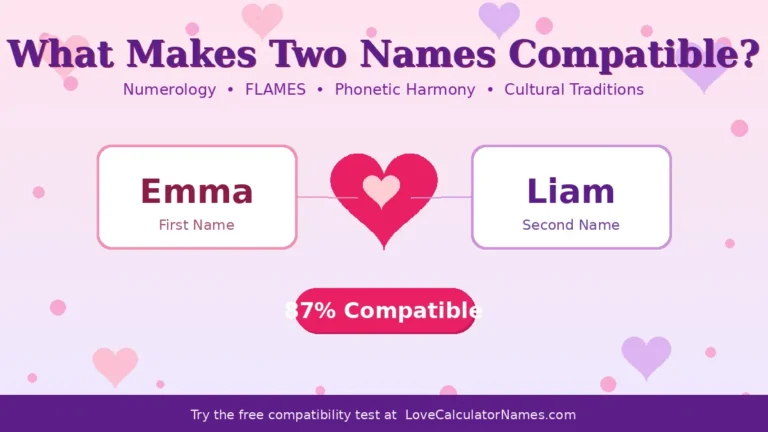
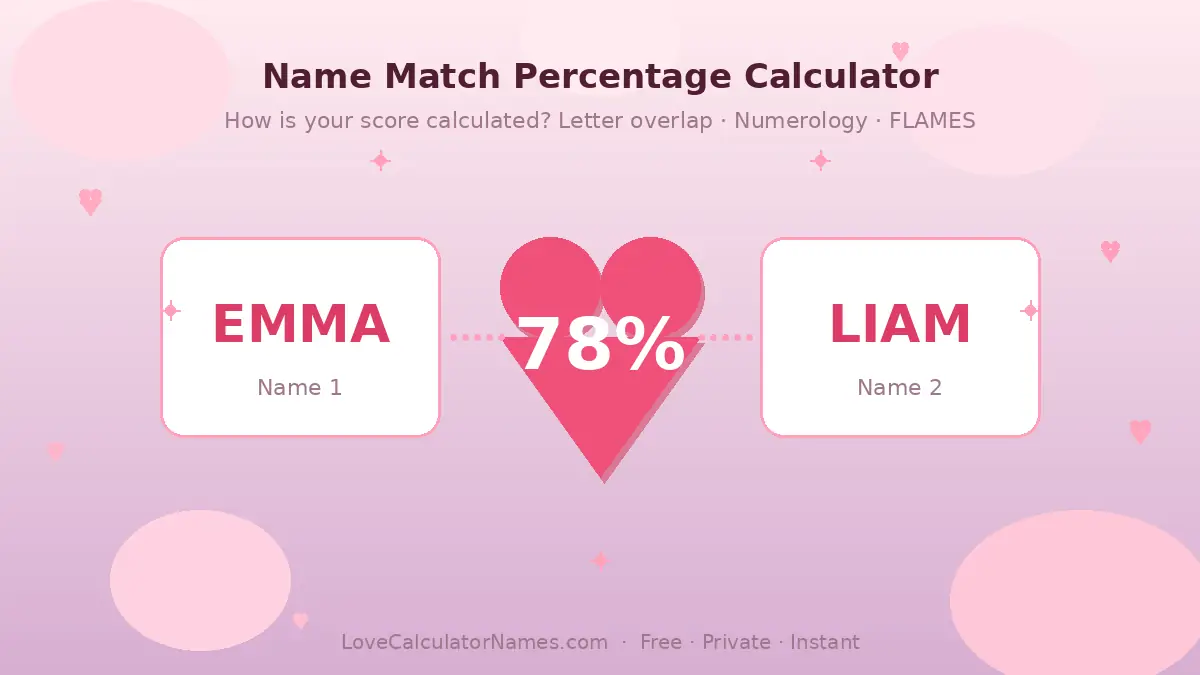
Example A: EMMA + LIAM
- EMMA: E, M, M, A → 4 letters
- LIAM: L, I, A, M → 4 letters
- Shared: M (1 match) + A (1 match) = 2 shared letters
- Total: 4 + 4 = 8
- Score: (2 ÷ 8) × 100 = 25%
Example B: ANNA + LANA
- ANNA: A, N, N, A → 4 letters
- LANA: L, A, N, A → 4 letters
- Shared: A (2 matches) + N (1 match) = 3 shared
- Total: 8
- Score: (3 ÷ 8) × 100 = 37.5%
Example C: SARAH + ASHLEY
- SARAH: S, A, R, A, H → 5 letters
- ASHLEY: A, S, H, L, E, Y → 6 letters
- Shared: S (1), A (1), H (1) = 3 shared
- Total: 5 + 6 = 11
- Score: (3 ÷ 11) × 100 = ~27%
Some tools use a more elaborate cancellation version: they cross out matching letters in sequence, count the remaining uncanceled characters as digits, and combine those digits into a percentage. Results vary by tool, but the underlying principle — shared letters relative to total letters — stays consistent.
Method 2: Pythagorean Numerology
Pythagorean numerology converts each letter in a name to a number, sums all values, reduces to a single digit, then compares the two resulting numbers using a compatibility system.
The number chart (repeating cycle of 1–9):
| Letters | Value |
|---|---|
| A, J, S | 1 |
| B, K, T | 2 |
| C, L, U | 3 |
| D, M, V | 4 |
| E, N, W | 5 |
| F, O, X | 6 |
| G, P, Y | 7 |
| H, Q, Z | 8 |
| I, R | 9 |
Step-by-step:
- Convert every letter in Name 1 to its Pythagorean number using the chart above
- Add all the values together
- If the result is two or more digits, add those digits together until you reach a single number — this is the life path number
- Repeat for Name 2
- Compare both life path numbers using a compatibility matrix
Example: JAMES + OLIVIA
- J(1) + A(1) + M(4) + E(5) + S(1) = 12 → 1+2 = 3
- O(6) + L(3) + I(9) + V(4) + I(9) + A(1) = 32 → 3+2 = 5
- Life path 3 + 5: creative meets adventurous — typically rated high compatibility in Western numerology systems
Compatibility ratings vary by tradition. Most systems treat certain combinations as naturally harmonious (1+5, 2+6, 4+8) and others as more challenging (1+4, 3+7). When a tool displays a percentage, it usually pulls from a pre-built compatibility matrix tied to these number pairings.
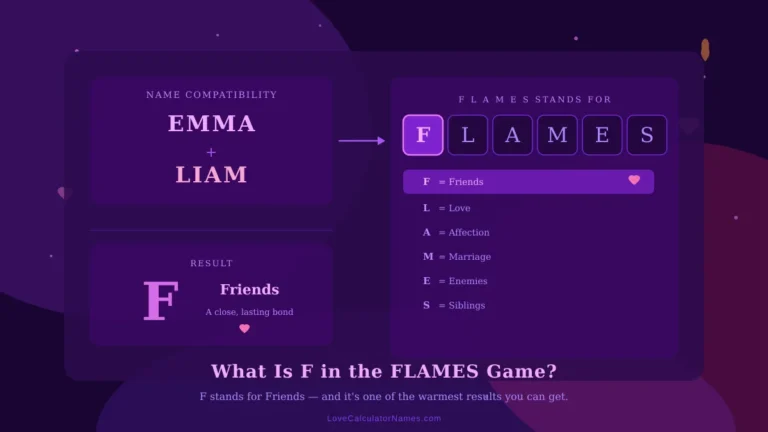
Method 3: The FLAMES Letter-Cancellation Method
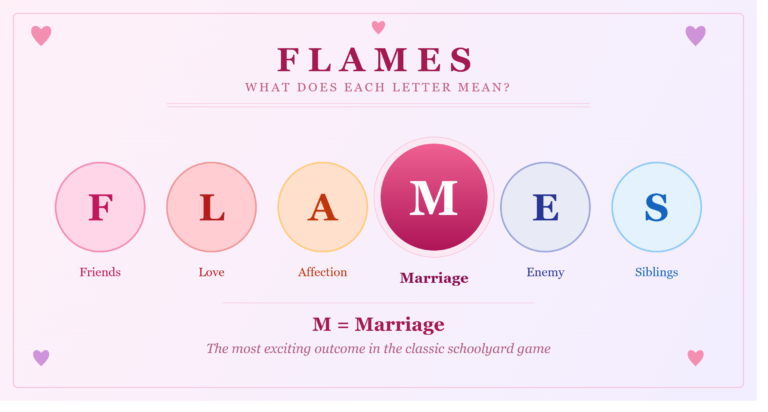
FLAMES is a classic name game that produces one of six relationship categories rather than a percentage. It predates digital calculators by decades and was played with paper and pencil in schools worldwide.
The acronym: F = Friends, L = Love, A = Affection, M = Marriage, E = Enemies, S = Siblings
Step-by-step:
- Write both full names out
- Cross out every letter that appears in both names — cancel one letter per matching pair (if both names have two A’s, cancel one A from each)
- Count all remaining uncanceled letters across both names
- Starting at F, count forward through F-L-A-M-E-S repeatedly (wrap around when you reach S)
- When your count ends on a letter, eliminate it from the sequence
- Continue counting from where you left off through the remaining letters
- Repeat until one letter remains — that is your FLAMES result
Example: NOAH + AVA
- NOAH: N, O, A, H — AVA: A, V, A
- Shared letter: A (cancel one A from each name)
- Remaining: N, O, H (3) + V, A (2) = 5 uncanceled letters
- Count to 5 through F-L-A-M-E-S → lands on E → eliminate E
- Remaining: F, L, A, M, S → count to 5 → lands on S → eliminate S
- Continue until one letter remains
Many modern tools convert the FLAMES category directly to a score: Marriage = 95%, Love = 85%, Affection = 72%, Friends = 60%, Siblings = 50%, Enemies = 20%. The exact percentage values differ by tool.
Which Name Matching Method Is Most Accurate?
No single method is objectively more accurate — each one tests something completely different. Letter overlap measures character similarity. Numerology measures symbolic number harmony. FLAMES measures letter-cancellation outcomes. Since name compatibility has no real-world benchmark, “accuracy” isn’t the right question. The better question is which method feels most meaningful to you.
Here’s a direct side-by-side comparison:
| Method | What It Tests | Output | Speed | Best For |
|---|---|---|---|---|
| Letter Overlap | Shared characters between names | 0–100% score | Instant | Quick, intuitive comparisons |
| Pythagorean Numerology | Number symbolism of each name | Life path + rating | Moderate | Numerology enthusiasts, deeper reflection |
| FLAMES | Letter-cancellation category | One of 6 outcomes | Instant | Groups, nostalgia, casual fun |
| Phonetic Harmony | Sound rhythm and syllable patterns | Quality rating | Varies | Name aesthetics, creative naming |
How Other Cultures Calculate Name Compatibility
Western letter-based calculators are one approach in a much broader global tradition of finding meaning in names.
Indian Vedic (Kundli) matching uses the birth star — called a Nakshatra — linked to the phonetic sounds in a person’s name. Compatibility is scored through a 36-point system called Guna Milan. A score of 18 or higher is traditionally considered favorable. This system is rooted in Sanskrit phonetics, not Latin letters.
Chinese naming traditions analyze the stroke count of the characters that compose a person’s name. Specific totals are considered lucky or harmonious, and pairs are assessed by comparing their combined stroke values.
Japanese Seimei Handan (name fortune-telling) assigns luck ratings across five categories — Heaven Luck, Human Luck, Earth Luck, Outer Luck, and General Luck — based on the kanji stroke count in a name.
All three traditions share the same underlying idea as Western name calculators: that names carry a pattern worth exploring.
What Myths Exist About Name Match Percentages?
The most common myth about name match percentage is that a higher score predicts a better real-life relationship. It doesn’t. These scores are generated from letter math or number symbolism — neither of which measures personality, communication, emotional connection, or shared values.
Here are five misconceptions worth clearing up:
Myth 1: A higher percentage means greater real-world compatibility. Name compatibility algorithms don’t account for any psychological variable. A 94% score means the names share specific mathematical properties — nothing more. Research on what makes relationships work consistently points to shared values, effective communication, and emotional attunement — none of which appear in a name.
Myth 2: Using first names vs. full names gives the same result. Not at all. “Sarah” and “Sarah Mitchell” produce completely different scores against the same partner name because the total letter count changes. Always use the same format for both names — either first names only, or complete full names — to keep comparisons consistent.
Myth 3: All name calculators use the same algorithm. They don’t. One tool may use letter overlap, another numerology, another FLAMES. The same two names can legitimately score 22% on one site and 81% on another. Both results are internally correct — they’re just answering different questions about the same names.
Myth 4: Nicknames are interchangeable with formal names. They produce entirely different results. “Elizabeth” and “Liz” will generate different scores with any partner name. If you want to explore the difference, try both — it’s actually one of the more interesting parts of the exercise.
Myth 5: A score below 50% is a red flag. There’s no passing or failing mark in name compatibility. These tools produce numbers algorithmically and assign no meaningful threshold to where those numbers land. Treat any result — high or low — as a conversation starter, not a verdict.
Frequently Asked Questions
How does a love calculator calculate name match percentage?
Most love calculators count the letters shared between two names, divide by the total combined letter count, and multiply by 100 to produce a percentage. Some tools use Pythagorean numerology — converting each letter to a number and comparing name sums — while others run the FLAMES letter-cancellation sequence. Each tool builds its own formula, so results vary across sites.
Is name match percentage scientifically accurate?
No — name match percentage is an entertainment calculation, not a validated psychological tool. The result reflects a mathematical relationship between two sets of letters, not personality traits, values, or relationship potential. Treat it the way you’d treat a horoscope: fun to explore, but not a basis for important decisions.
What is a good name match percentage?
There’s no universal standard. Most tools display 60%+ as favorable and 80%+ as excellent, but since the calculation is letter-based rather than psychological, any score is simply a conversation starter. A 40% score is not a relationship verdict — it’s just a number produced by a specific algorithm.
Can you manually calculate name match percentage at home?
Yes. For a basic letter overlap score: count how many letters appear in both names, divide by the total combined letter count, and multiply by 100. For numerology: assign each letter its Pythagorean value (A=1, B=2… cycling 1–9), sum the letters in each name separately, reduce each to a single digit, and compare the results.
Does the order you enter names affect the result?
Sometimes. Letter overlap methods typically produce identical results regardless of which name is entered first. Some numerology-based tools treat the first and second name differently in their formula, which can cause slight variation when names are swapped. If you want to be thorough, try both orders.
What’s the difference between FLAMES and a percentage score?
FLAMES produces a relationship category — Friends, Love, Affection, Marriage, Enemies, or Siblings — through letter cancellation, rather than a number. Many modern calculators convert the FLAMES outcome into an approximate percentage afterward: Marriage typically maps to around 95%, Love around 85%, and so on. The exact values vary by tool.
Does capitalization or spacing change name calculation results?
In most digital tools, no. Calculators typically normalize names to lowercase and strip spaces before running the algorithm. However, some tools do count spaces as characters — so “John Smith” and “JohnSmith” might produce different scores. If you get an unexpected result, try removing spaces from both names.
Why do different calculators give completely different results for the same names?
Every calculator uses its own algorithm and weighting system. One tool weights letter overlap, another uses a numerology matrix, another uses FLAMES with its own counting variant. There is no industry standard — which is why the same name pair can score 25% on one site and 79% on another. Both results are valid within their own system.
What It All Comes Down To
Name match percentage is the output of three main systems: letter overlap scoring, Pythagorean numerology, or the FLAMES letter-cancellation method. Each measures something different, uses different math, and produces different results — even for identical name pairs.
Two things to keep in mind: always use the same name format for both people, and understand which method your calculator is using before comparing scores across different sites. These tools are built to spark curiosity and fun — not to make relationship decisions for you.
Ready to see your score? Try the free name compatibility test on LoveCalculatorNames.com — no sign-up required, results in seconds, and completely private.
Let our warm library be the soft landing your tired mind deserves—come to our healing corner today.