Ever scribbled two names on a notebook page, crossed out letters, and counted down to see if you’d be “friends” or something more? That’s the FLAMES game — one of the most recognized name-based compatibility rituals in the world. Millions of people played it in school, and it’s just as popular online today.
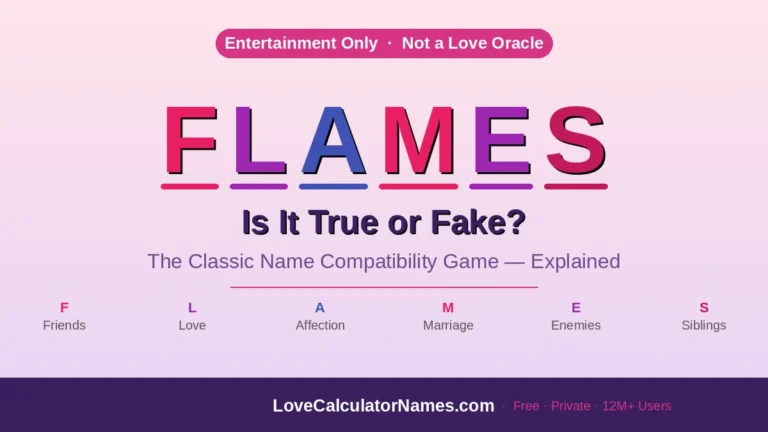
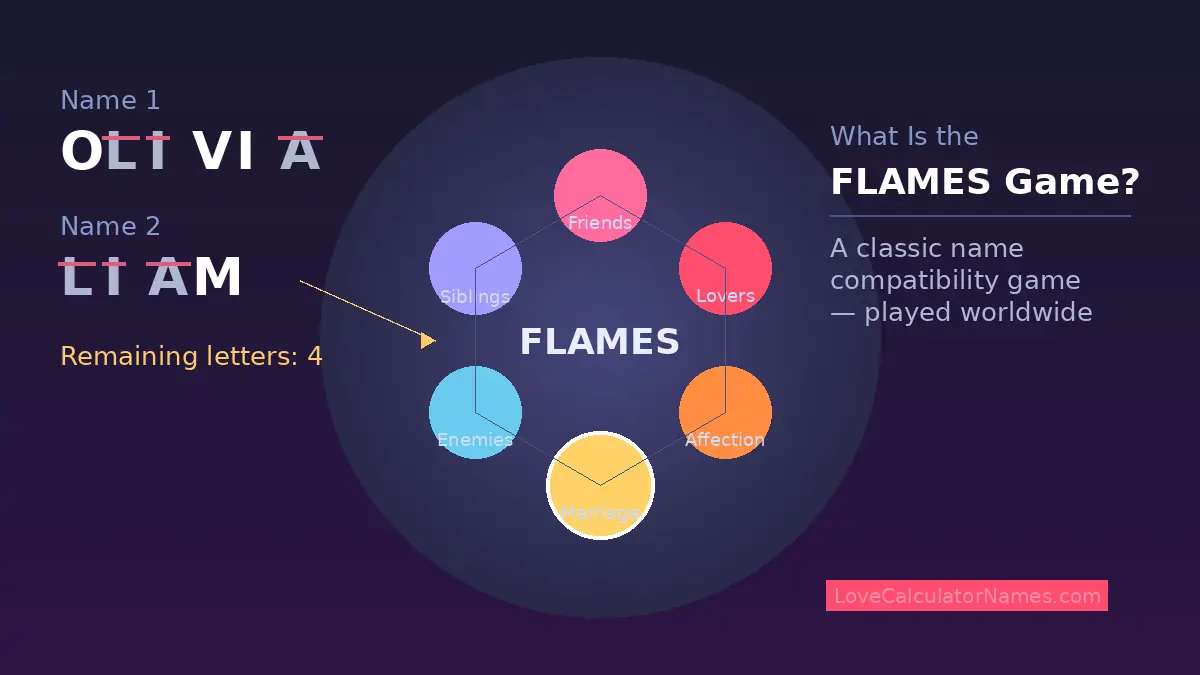
What is the FLAMES game? FLAMES is a name-based compatibility game where you eliminate shared letters between two names, then count through the remaining letters to land on one of six outcomes: Friends, Lovers, Affection, Marriage, Enemies, or Siblings. Each letter stands for a relationship type. The result is meant to be fun, not predictive — it’s a lighthearted way to explore name pairing.
Entertainment disclaimer: FLAMES is a game of chance, not a scientific relationship predictor. Results are for fun only.
What Does FLAMES Stand For and What Does Each Letter Mean?
FLAMES is an acronym, and each letter represents a different relationship outcome. Friends is the neutral starting point — a solid, comfortable connection. Lovers suggests a romantic bond. Affection points to warmth and fondness without full romance. Marriage is the most serious outcome, implying long-term partnership. Enemies signals conflict or incompatibility. Siblings means a close but platonic, family-like bond.
The full breakdown:
| Letter | Meaning | Vibe |
|---|---|---|
| F | Friends | Comfortable, trusted, platonic |
| L | Lovers | Romantic connection |
| A | Affection | Warmth, fondness, soft crush |
| M | Marriage | Long-term partnership |
| E | Enemies | Friction, incompatibility |
| S | Siblings | Close but brother/sister energy |
The result you land on depends entirely on the math of the name elimination process — not on anything “real” about the two people involved. That’s what makes it a game.
Different regions sometimes shuffle the letter meanings slightly. In some South Asian versions, “A” becomes “Attraction” or “Admiration.” In parts of Southeast Asia, a seventh letter is added for “Crush.” The core FLAMES acronym, though, has stayed consistent across generations and continents.
How Do You Play the FLAMES Game? Step-by-Step
To play the FLAMES game, write both names, cross out any letters the two names share, count the remaining letters, and use that number to eliminate options from FLAMES one at a time until only one remains. The surviving letter is your result.
Here’s the exact process:
- Write both full names side by side. Use first names only, or first and last — just be consistent for both people.
- Cross out matching letters. Go through each name and cancel out any letter that appears in both. Each letter can only cancel one corresponding letter (so if both names have two E’s, cross out one E from each).
- Count the remaining uncrossed letters across both names combined.
- Write out F-L-A-M-E-S and begin counting through the letters repeatedly, using your total count as the stopping point.
- Cross out the letter you land on and restart the count from the next letter, using the same number.
- Repeat until one letter remains. That letter is your FLAMES result.
Example: Say the count is 7. You count F(1) L(2) A(3) M(4) E(5) S(6) F(7) — so F is eliminated first. Then count from L: L(1) A(2) M(3) E(4) S(5) L(6) A(7) — A is crossed out. Keep going until only one letter survives.
It takes about two minutes by hand. Online versions run the calculation instantly.
Where Did the FLAMES Game Come From?
The FLAMES game has roots in childhood paper-and-pencil fortune-telling traditions, but no single inventor ever claimed it. It spread through school playgrounds across South Asia, Southeast Asia, and parts of the Middle East during the 1980s and 1990s, then traveled to Western classrooms through cultural exchange and eventually the internet. By the 2000s, it had gone fully global.
The tradition of using names and numbers for compatibility predictions is much older. Pythagorean numerology — which assigns numerical values to letters of the alphabet — dates back to ancient Greece. Medieval European scholars developed similar letter-value systems. FLAMES took this ancient impulse and turned it into a fast, social, paper-based game any kid could play at lunch.
What made it stick? The acronym is memorable, the rules are simple enough to learn in thirty seconds, and the six outcomes cover the full social spectrum — from “just friends” to “sworn enemies.” It hits differently depending on who you’re playing it with, which kept it alive through generations.
How FLAMES compares to similar name compatibility methods:
| Method | How It Works | Origin Region | Speed |
|---|---|---|---|
| FLAMES | Letter elimination + counting | South/Southeast Asia | 2–3 min |
| Love Calculator (%) | Numerological letter values, percentage score | Western/global | Instant |
| Name Numerology | Full name reduced to life path number | Ancient / global | 5–10 min |
| Soulmate Number | Birthday + name number pairing | Western numerology | 10+ min |
| Compatibility Astrology | Birth chart comparison | Global, ancient | Variable |
FLAMES wins on speed and simplicity. That’s why it became a playground staple rather than a mystical practice — anyone could play it on a napkin.
Common Myths About the FLAMES Game (And What’s Actually True)
The FLAMES game is simple enough that people assume they understand it completely, but a few stubborn misconceptions keep circulating. Here are the ones that come up most often.
Myth 1: The result is always the same no matter how you spell the names. Not true. Spelling matters. “Jon” and “John” produce different letter counts. Different name formats (first name only vs. full name) change the outcome. Even adding or dropping a middle name shifts the result. This is worth knowing before you interpret a result too seriously.
Myth 2: Getting “Enemies” means the two people genuinely clash. FLAMES is not a personality test. The word “Enemies” appears in the acronym because it rhymes and completes the sequence — not because it reflects real-world incompatibility. Getting “Enemies” with your best friend’s name is common and means nothing about your actual relationship.
Myth 3: You can manipulate the result by choosing a specific name format. Technically yes — using “Will” instead of “William” changes the count. But this is why most people agree on a format before playing. Using your legal first name and letting the math run is the most neutral approach. “Hacking” the result defeats the point of the game.
Myth 4: Marriage is always the best result. Marriage sounds like the jackpot, but plenty of people playing with a celebrity crush or a fictional character get “Marriage” and it means nothing beyond the arithmetic. Meanwhile, “Affection” or “Friends” with someone you genuinely care about can feel more meaningful. The meaning you bring to the result matters far more than the letter itself.
Myth 5: The game is scientifically based on numerology. FLAMES draws inspiration from the tradition of letter-value systems, but it isn’t a rigorous numerological method. It’s a folk game — and folk games are valuable precisely because they’re playful, not precise.
Frequently Asked Questions About the FLAMES Game
What is the FLAMES game used for? FLAMES is used as a fun, social compatibility game to see what kind of relationship two people’s names suggest. It’s popular among friends, couples, and anyone curious about name-based matching. The results are entertainment only — no scientific or psychological validity is claimed. Think of it as a conversation starter, not a relationship forecast.
Can you play FLAMES with your own name? Yes. Some people play FLAMES using their own name twice, or pairing their name with a crush, a celebrity, or even a fictional character. The game works the same way regardless of who the names belong to. Just agree on a name format — first name, full name, or nickname — before you start counting.
Does FLAMES work in languages other than English? FLAMES works best with names written in the Latin alphabet since the acronym itself is English. However, many cultures have adapted the concept using translated versions of the six outcomes. In Hindi, for example, similar games use regional acronyms with equivalent meanings. The core elimination mechanic transfers across languages even when the letters change.
What if I get the same result every time I play? If you use the same name formats consistently, you will get the same result every time — the process is deterministic, not random. To get a different result, try a different name format (first name only vs. full name vs. nickname). The math changes, and so does the outcome.
Is FLAMES related to numerology? FLAMES shares the spirit of letter-counting systems like Pythagorean numerology, but it’s a simplified folk game rather than a formal numerological method. Traditional numerology assigns specific values (1–9) to each letter and reduces names to single-digit numbers. FLAMES just counts and eliminates. The connection is cultural ancestry, not methodology.
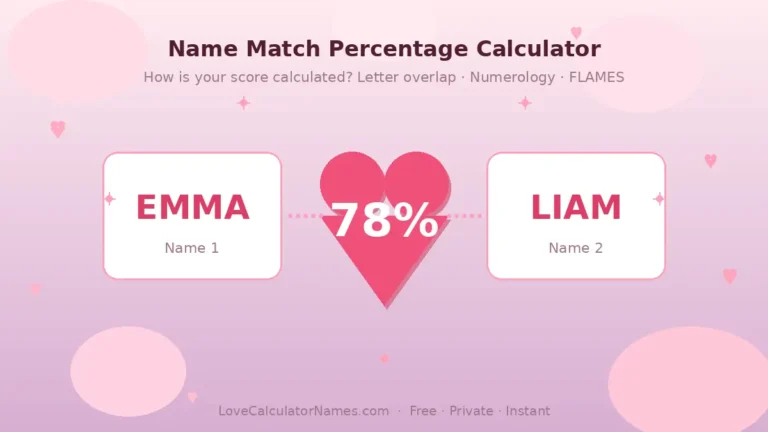
How is FLAMES different from a love percentage calculator? A love percentage calculator typically assigns numerical values to each letter, adds the totals for both names, and produces a percentage score. FLAMES uses an elimination process to land on one of six specific outcome words. Both are name-based compatibility games; neither has scientific backing. A percentage feels more specific, while FLAMES gives you a relationship category.
What does it mean if FLAMES gives you “Siblings”? Siblings in FLAMES suggests a close, loyal, protective bond — think of it as the platonic friendship result with extra warmth. It doesn’t mean anything uncomfortable; it simply means your names’ letter counts ended on “S.” Many people who play FLAMES with their best friend land on Siblings, which tracks emotionally even if the math is coincidental.
Can two people get different results playing the same names? Yes, if they use different name formats. “Emma Watson” and “Emma” produce different letter counts when paired with the same second name. Agreeing on a consistent format — first name only, for example — is the only way to get a repeatable result. Online calculators remove this ambiguity by standardizing the input.
Ready to Find Your FLAMES Result?
The FLAMES game has been bringing people together — and occasionally “making enemies” — for decades. Whether you remember it from school notebooks or you’re trying it for the first time, the fun is in the process: writing the names, crossing out the letters, and seeing what the count reveals.
A few things worth taking away: the result changes with the name format you use, “Enemies” is just a word in an acronym, and Marriage isn’t automatically the goal. The real appeal of FLAMES is that it turns two names into a shared moment — playful, low-stakes, and surprisingly memorable.
Want to skip the hand-counting? Try the free FLAMES name compatibility test at LoveCalculatorNames.com — no sign-up required, completely private, and it runs in seconds.
Our popular love name test is a lighthearted way to explore name compatibility.