Everyone has been there: two names on a piece of paper, a pencil hovering over a notebook, and a quiet hope the game lands somewhere good. FLAMES is one of the most enduring schoolyard games ever created — fast, simple, and surprisingly suspenseful.
But what does it actually mean when FLAMES lands on M?
In FLAMES, M stands for Marriage. It signals a deep, committed, long-term romantic relationship between the two names you entered. M is widely considered one of the most exciting outcomes — a step beyond casual love or affection, pointing straight toward a lifelong partnership. Like all FLAMES results, it’s determined by a simple letter-counting method with no scientific validity. This game is designed entirely for entertainment and fun.
This guide covers exactly what M means, how the calculation works, how every letter compares, and why name-based games still capture our attention decades after they first appeared on school desks.
What Does FLAMES Stand For — and Where Does M Fit?
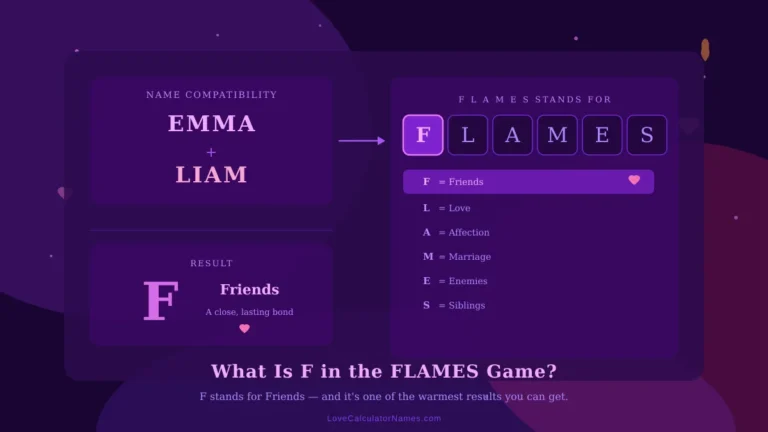
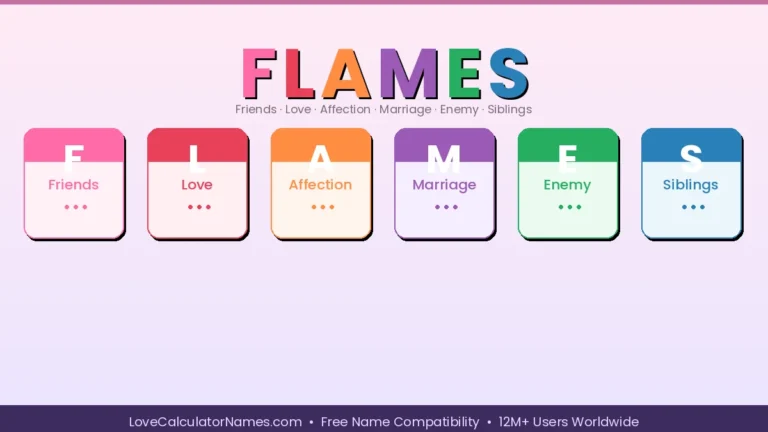
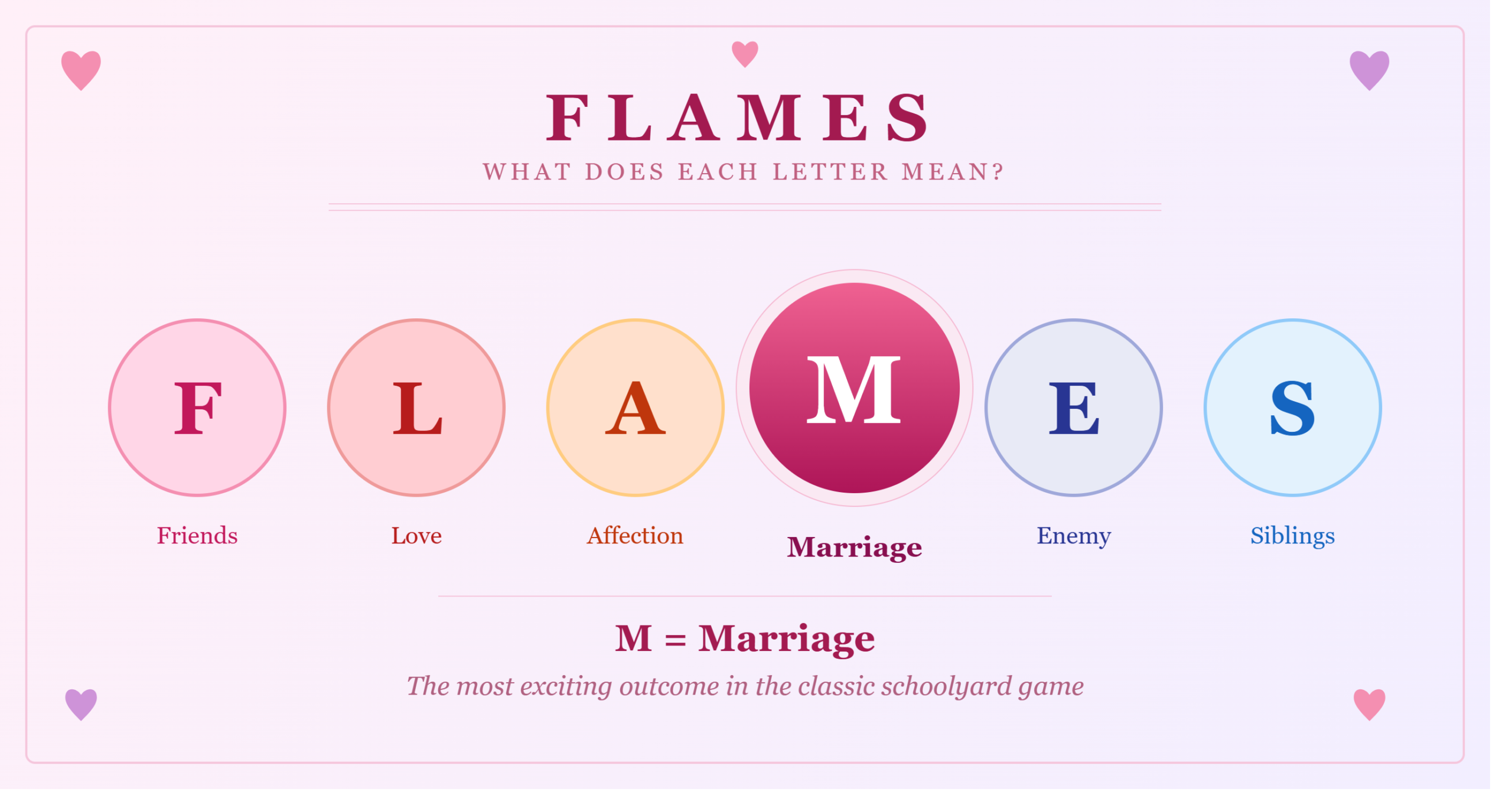
FLAMES is an acronym: Friends, Love, Affection, Marriage, Enemy, Siblings. Each letter represents a type of relationship between two people. M — the fourth letter in the sequence — stands for Marriage, making it the game’s most serious romantic outcome: a signal for lifelong commitment and deep partnership between two names.
The game has been popular across generations, with no confirmed single creator. It emerged through school culture in the 1980s and spread without any official rulebook — from classrooms in the US and UK to schoolyards across South Asia and beyond. Today it’s played by students in California and Chennai alike, and dozens of online calculators have built digital versions around the original pen-and-paper format.
Here’s what every letter in FLAMES represents:
- F = Friends
- L = Love
- A = Affection
- M = Marriage
- E = Enemy
- S = Siblings
M’s placement in the center of the acronym is no coincidence. The game flows from casual warmth (Friends) through growing romance (Love, Affection) to lifelong commitment (Marriage), then turns toward tension (Enemy) and settles into family-like closeness (Siblings). Getting M puts you squarely in the “serious romance” category — past a crush, past simple affection, and into life-partner territory.
Why “Marriage” Resonates as a Game Outcome
There’s something instantly satisfying about the word “marriage” appearing in a schoolyard game. It implies permanence, depth, and mutual commitment — qualities that players understand as meaningful even at a young age.
Compared to L (Love), M carries a slightly more official weight. That’s exactly why landing on M sparks a stronger reaction than most other outcomes: laughing, gasping, the instant urge to tell someone.
Even if you’re twelve and playing during lunch, M creates a moment. That moment — shared, immediate, slightly embarrassing — is precisely what keeps FLAMES being played generation after generation.
How Do You Calculate Your FLAMES Result? (Step-by-Step)
To find your FLAMES result, write both names, cross out letters that appear in both, count what’s left, then use that number to eliminate letters from FLAMES one by one in a loop. The last letter standing is your result. If M survives the entire elimination, the outcome is Marriage.
Here are the full steps:
Step 1 — Write both names. Use first names only, or both first and last names — but stay consistent. Mixing formats (first name for one person, full name for the other) will skew the count.
Step 2 — Cancel shared letters. Go through both names and cross out letters that appear in both. Each letter can only be canceled once per occurrence. If Name 1 has two A’s and Name 2 has one A, cancel just one A from each name.
Step 3 — Count what remains. Count every uncanceled letter across both names combined. This total is your FLAMES number.
Step 4 — Write out F-L-A-M-E-S. Write all six letters in a row or arrange them in a circle.
Step 5 — Begin eliminating. Starting from F, count forward through the remaining letters. When you reach your number, cross that letter out.
Step 6 — Restart from the next letter. After eliminating one letter, restart your count from the very next remaining letter. Keep going in a continuous loop.
Step 7 — Read the survivor. The last letter left standing is your FLAMES result. If that letter is M, the game says Marriage.
Worked Example: Emma and James
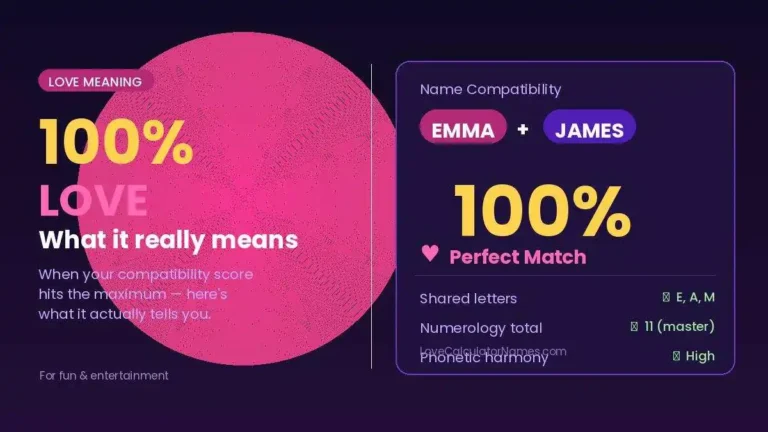
Names: E-M-M-A and J-A-M-E-S
- Shared letters: A (one each), M (one each), E (one each) — cancel one of each from both names
- Remaining uncanceled: M (from Emma), J, S (from James) = 3 letters
- FLAMES number: 3
- Count 3 through FLAMES: F(1), L(2), A(3) → eliminate A
- Remaining: FLMES → count from M: M(1), E(2), S(3) → eliminate S
- Remaining: FLME → count from F: F(1), L(2), M(3) → eliminate M
- Remaining: FLE → count from E: E(1), F(2) — wait, re-count from E: E(1), F(2), L(3) → eliminate L
- Remaining: FE → count from E: E(1), F(2), E(3) → eliminate E
- Result: F — Friends
Change one letter in either name and the entire chain shifts — which is exactly why using a nickname instead of a full name can flip your result from M all the way to E.
What Does Each FLAMES Result Really Mean — and How Does M Compare?
Getting M in FLAMES means the game has landed on Marriage — its symbol for a lasting, life-partner-level bond between two names. M sits alongside L and A as one of the three “positive” outcomes. It represents the deepest form of romantic commitment the game recognizes, and most players treat it as the ultimate good result.
Here’s how all six FLAMES outcomes compare:
| Letter | Stands For | What It Suggests | Typical Player Reaction |
|---|---|---|---|
| F | Friends | Warm platonic bond, close but not romantic | Comfortable, sometimes a little disappointing |
| L | Love | Romantic attraction, dating energy | Excited, hopeful |
| A | Affection | Deep emotional warmth, strong caring | Sweet, positive — but milder than L |
| M | Marriage | Long-term commitment, life partnership | Most dramatic — gasps, laughter, screenshotting |
| E | Enemy | Conflict, tension, or rivalry | Usually the loudest reaction — teasing, disbelief |
| S | Siblings | Brotherly/sisterly bond, non-romantic closeness | Laughter, mild disappointment |
Is M the best result in FLAMES? Many players think so — but L (Love) runs close, especially for younger players who find “Marriage” almost too grown-up to be exciting. The real answer depends on where you are in life. For a couple already serious about each other, M landing on the screen feels strangely satisfying. For two friends just messing around, L might feel more appropriate and fun.
What’s worth noting is that no FLAMES result is truly “bad.” Even E (Enemy) tends to generate the most energy and the most laughs in any group.
How Different Cultures Interpret M
The FLAMES game is genuinely global, and M (Marriage) lands differently depending on where you’re playing:
- United States and United Kingdom: Treated as lighthearted and funny. Getting M usually means sending a screenshot to friends or posting it as a joke.
- India, Pakistan, Bangladesh: FLAMES is taken with noticeably more enthusiasm in South Asian school culture. M is discussed with real energy — even between classmates who barely know each other — though everyone knows it’s just a game.
- Regional variations: Some versions replace S with “Sweetheart” or E with “Engagement.” A handful of regional versions add a seventh letter or modify the acronym. But across every known version of FLAMES worldwide, M = Marriage is the one constant. No other letter has the same universal consistency.
Why Name Compatibility Games Feel So Personal
Name-based games like FLAMES tap into something real: the human brain’s tendency to find patterns and meaning in random things. Even when we know a game has no scientific basis, entering two names and waiting for a result creates genuine suspense — and that feeling is worth understanding.
Psychologists call this tendency apophenia — the brain’s habit of finding meaningful connections in unrelated data. When a game produces a result that matches how we feel, we remember it. When it contradicts our feelings, we shrug it off. FLAMES wins either way.
Names also carry cultural weight that makes this kind of game feel more meaningful than it logically should. In many traditions, names are thought to hold energy, meaning, or vibration. Pythagorean numerology, for example, assigns number values to each letter (A=1, B=2, C=3, and so on) and uses those to calculate life path numbers, compatibility scores, and personality profiles. FLAMES doesn’t use this system — it relies purely on a letter-cancellation count — but it borrows from the same deep cultural fascination with names as meaningful data.
The reason FLAMES survives in the age of TikTok and dating apps comes down to three things: it’s instant, it’s social, and it requires no setup. You can play it during class, on a road trip, or in a group chat — no WiFi required, no personal information needed.
For name-based compatibility tools that go a bit deeper — using letter-value systems, phonetic harmony, and name pattern analysis — LoveCalculatorNames.com turns the underlying concept into a more thoughtful (and still entirely fun) experience, completely free and private.
Common FLAMES Myths You Should Stop Believing
FLAMES is often treated as more complex — or more meaningful — than it actually is. The game is a simple letter-counting exercise with six preset outcomes. It has no real connection to numerology, astrology, or relationship psychology, despite what some online sources suggest.
Here are five misconceptions worth clearing up:
Myth 1: FLAMES uses numerology. Not quite. True numerology (like the Pythagorean system) assigns specific values to letters and reduces them to significant numbers. FLAMES simply counts uncanceled letters and runs an elimination loop. No letter has a numerical value in FLAMES — only the raw count matters.
Myth 2: Getting M means you’ll actually get married. The result changes entirely depending on whether you use a nickname or a full name, how you spell someone’s name, or whether you include a middle name. The outcome is a mathematical artifact of letter overlap, not a prediction of anything real. Treat it as the fun icebreaker it’s designed to be.
Myth 3: FLAMES originated in one specific country. No confirmed origin exists. The game appears to have emerged independently and simultaneously across the US, UK, and South Asia during the 1970s–1980s — a case of parallel schoolyard invention. Every known version across all these cultures uses M = Marriage, which suggests it was a natural, universal choice for “most serious romantic outcome.”
Myth 4: Your first name is always the right name to use. Some players use first names only; others use full names including surnames. Different online calculators handle this differently. Because the result is entirely based on letter counts, using “Kat” vs. “Katherine” can flip your outcome from M to E. There’s no official standard — just pick one format and stick with it across both names.
Myth 5: E (Enemy) is always a bad result. In practice, E generates the loudest, most entertaining reactions. It sparks immediate debate, playful teasing, and the kind of group energy that makes FLAMES fun in the first place. Plenty of close friends and committed couples have gotten E when playing. It’s not a verdict — it’s a conversation starter.
Frequently Asked Questions
What does M mean in FLAMES?
M in FLAMES stands for Marriage. It means the game has “predicted” a long-term, committed romantic bond between the two names you entered. Marriage is considered one of the most positive outcomes in FLAMES, alongside Love and Affection. FLAMES is purely for entertainment — it has no scientific basis and results should never be taken as a real relationship forecast.
What do all the letters in FLAMES stand for?
F = Friends, L = Love, A = Affection, M = Marriage, E = Enemy, S = Siblings. Some regional versions swap S for “Sweetheart” or E for “Engagement,” but these six meanings form the standard version played worldwide. The M = Marriage interpretation is the most universally consistent letter in every known variant of the game.
Is M the best result in FLAMES?
Many players consider M the most exciting outcome because it implies the deepest level of romantic commitment. However, L (Love) runs a close second, especially for younger players who find Marriage a little too serious. The “best” result is entirely subjective — it depends on the players’ ages, relationship status, and how much fun they want the game to generate.
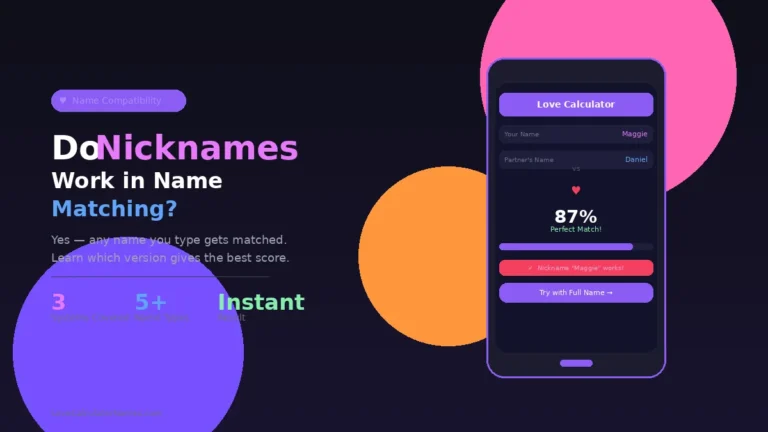
Does using a nickname instead of a full name change the FLAMES result?
Yes — often dramatically. Because FLAMES is based purely on letter counts, using “Sam” instead of “Samuel” changes how many letters cancel out, which shifts the FLAMES number, which changes the entire elimination chain. Results can flip from M to E or anything in between just by changing name format. Consistency between both names is the only real rule.
How accurate is the FLAMES game?
FLAMES has zero scientific validity as a relationship predictor. The result is mathematically determined by letter overlap between two names — a process entirely unrelated to compatibility psychology, personality research, or any meaningful metric. It’s a counting game with six preset outputs. Play it for the fun of the reveal, not as guidance for real-life decisions.
What happens if you get E (Enemy) in FLAMES?
E stands for Enemy — the game’s “conflict” outcome. Despite sounding alarming, most players treat E as the funniest and most socially energetic result. Close friends, longtime couples, and siblings routinely get E when playing FLAMES. It sparks laughter and teasing more than anything else. It’s not a verdict on your real relationship.
Can I play FLAMES online without signing up?
Yes — many websites offer instant, free FLAMES calculators. You enter two names and the tool runs the elimination automatically. LoveCalculatorNames.com offers a free, private name compatibility test with no account required and no personal data collected, giving you an instant result for any name pair you choose.
Why does FLAMES include Marriage if it started as a kids’ game?
FLAMES was designed to cover the full spectrum of relationships — from light friendship all the way to lifelong commitment. Marriage was included because it represents the most “official” and dramatic romantic outcome, adding a sense of high stakes that makes the game more exciting. Its inclusion has always been considered wholesome; it simply gives the game a wider emotional range and a result that consistently produces the strongest reactions.
The Verdict on M in FLAMES
FLAMES has outlasted fads, platforms, and entire generations of students — and M remains its most celebrated result. Whether you’re scribbling names on notebook paper or using an online calculator, landing on Marriage sparks a reaction that few other outcomes can match.
Here are three things worth keeping in mind:
- M = Marriage — the game’s signal for deep, long-term romantic compatibility between two names.
- Your result depends entirely on letter overlap. Changing name formats will often change the outcome, sometimes completely.
- FLAMES is entertainment only. Enjoy the result, share it, laugh about it — but let your real relationships be shaped by real conversations and real connection.
Ready to see what FLAMES says about your names? Try the free name compatibility test on LoveCalculatorNames.com — no sign-up, 100% private, and your result appears instantly.
Check your name love score and share the fun result with someone you know.