You’re in class. Two names are scribbled in a notebook margin, and you’re counting through F-L-A-M-E-S with the tip of a pencil. The result lands on “Marriage” — and your stomach does a small, happy flip. Then the real question hits: is the FLAMES game actually accurate?
Millions of people across the US, India, the UK, Australia, and dozens of other countries have played this pencil-and-paper classic. It’s been passed between generations on school notebooks and lunch tables. Yet very few players stop to ask what the game is genuinely measuring — and why the result sometimes lands with surprising force.
The short answer: No, the FLAMES game is not scientifically accurate as a compatibility predictor. It’s a letter-counting algorithm that produces one of six random outcomes — Friends, Lovers, Affectionate, Marriage, Enemies, or Siblings — based purely on arithmetic, with no connection to personality, emotional chemistry, or relationship science. That said, it taps into well-documented psychological patterns that explain why results feel meaningful. FLAMES is best enjoyed as fun, nostalgic entertainment — not a love forecast.
This article covers how FLAMES works, the psychology behind why it feels accurate, cultural context, and five myths worth clearing up.
What Does the FLAMES Game Actually Measure?
The FLAMES game measures nothing about real compatibility. It’s a counting algorithm that eliminates letters based on arithmetic, producing one of six results at random: Friends, Lovers, Affectionate, Marriage, Enemies, or Siblings. The outcome depends entirely on how many non-shared letters two names contain — not personality, chemistry, shared values, or emotional connection.
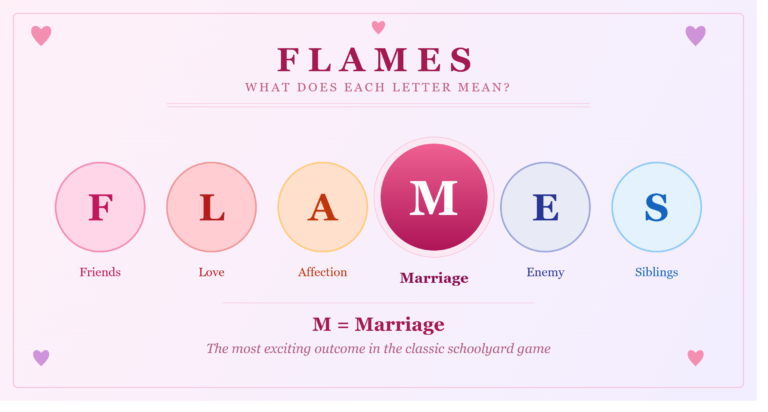
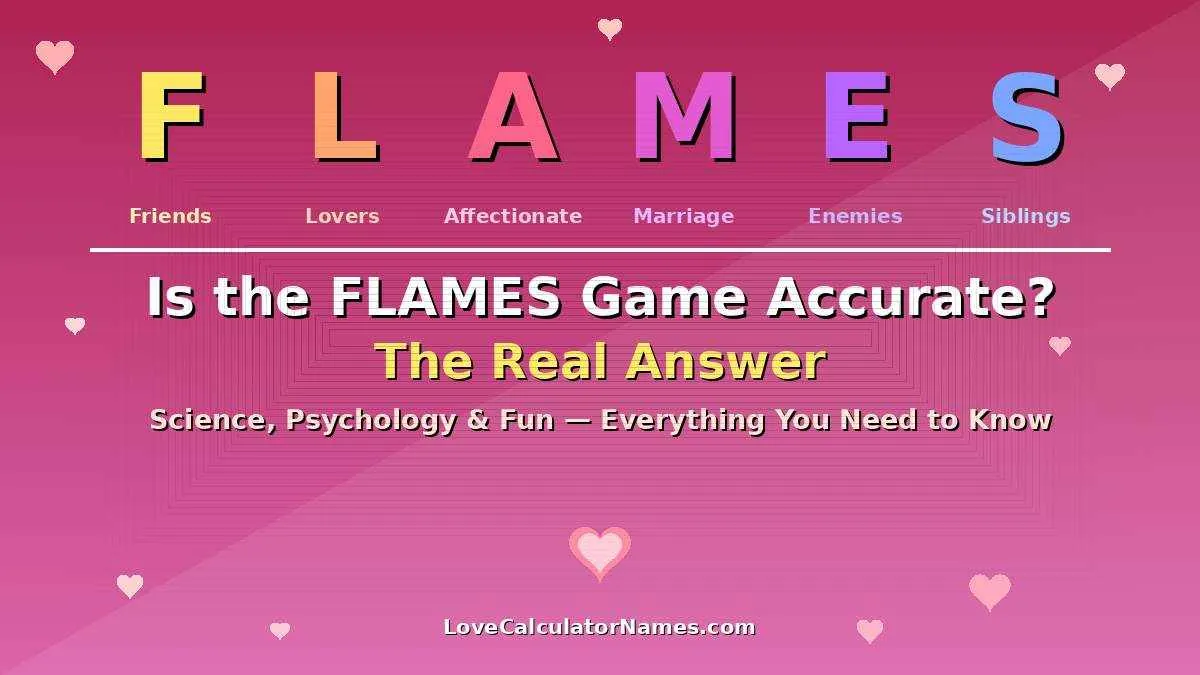
FLAMES stands for Friends, Lovers, Affectionate, Marriage, Enemies, Siblings. Each letter represents a possible relationship category between two people.
What determines the result? Simple math. You write two names, cross out the letters they share, count what remains, then cycle through F-L-A-M-E-S — eliminating one option each round until one letter survives. There is no personality input, no behavioral data, no emotional weighting.
The game treats “Taylor” and “Tyler” identically to any other pairing. It doesn’t know if those two people share a sense of humor, have been inseparable for years, or have never spoken. It just counts letters.
That’s not a design flaw — FLAMES was never built as a compatibility tool. It originated as a playful schoolyard pastime, most likely in South Asian classrooms sometime in the mid-20th century, and spread globally through sleepovers and lunch breaks. Its value has always been social and nostalgic, not predictive.
How Does the FLAMES Name Game Work? (Step-by-Step)
FLAMES works by writing two names, crossing out every letter that appears in both, counting the remaining letters, then eliminating options from the FLAMES sequence one by one until a single category survives. The full process takes under a minute — and requires nothing but pen and paper, or a free online name compatibility calculator.
Here’s the classic method:
- Write both full names — first names only, or full names. Pick one format and use it consistently.
- Cross out shared letters — find each letter that appears in both names and cancel it out, matching one occurrence at a time.
- Count the remaining letters — total all uncrossed letters across both names.
- Start the FLAMES countdown — write F-L-A-M-E-S in a row. Beginning at F, count through the sequence repeatedly. When your count hits the number from step 3, cross out that letter.
- Restart from the next letter — skip any previously eliminated letters as you continue counting.
- Repeat until one letter remains — that final survivor is your FLAMES result.
Worked example:
- Name 1: SARAH → S-A-R-A-H
- Name 2: JAMES → J-A-M-E-S
- Shared letters: A (one pair) and S (one pair) — cross these out
- Remaining letters: S, R, H (from SARAH) + J, M, E (from JAMES) = 6 letters
- Count to 6 through F-L-A-M-E-S → lands on S (Siblings) → eliminate S
- Resume counting from F with the remaining letters
- Continue until one letter remains
One important nuance: different FLAMES calculators apply slightly different rules when the count restarts after an elimination. That’s why the same couple can get different results on different tools or from different players — the underlying arithmetic isn’t always standardized.
Why Does the FLAMES Game Feel Accurate Sometimes?
FLAMES results feel accurate largely due to the Barnum effect — the well-documented human tendency to accept vague or general statements as personally meaningful. With only six possible outcomes covering the full range of human relationships, any result maps plausibly onto real feelings. That’s psychology at work, not prediction.
Three mechanisms explain why asking “is the FLAMES game accurate” often gets a surprisingly complicated answer from players:
The Barnum Effect (also called the Forer Effect): Named after showman P.T. Barnum, this is the documented psychological pattern where people interpret general outcomes as uniquely accurate for their own situation. If FLAMES produces “Friends” between you and your crush, you might think, Well, we do genuinely get along. If it produces “Enemies,” that one awkward moment from last week suddenly feels relevant. The result shapes your interpretation — not the other way around.
Confirmation Bias: People remember the times FLAMES matched their feelings and forget the far more frequent misses. Over years of playing, the memorable moments cluster around the “hits.” The misses fade quietly.
Self-Fulfilling Social Dynamics: Among younger players especially, landing “Lovers” between two friends can shift how they interact — creating a playful tension that later feels like the game predicted something. In reality, the game influenced the relationship, not the other way around.
FLAMES vs. Other Compatibility Methods
| Method | Based On | Scientific Validity | Best Use |
|---|---|---|---|
| FLAMES Game | Letter counting / arithmetic | None | Fun, social bonding, nostalgia |
| Numerology | Name/birth date number systems | Speculative | Cultural or spiritual exploration |
| Astrology | Birth date / star sign systems | Debated | Entertainment, self-reflection |
| Myers-Briggs (MBTI) | Self-reported personality traits | Moderate (debated) | Personal and professional insight |
| Attachment Theory | Behavioral and developmental psychology | Strong | Real relationship counseling |
| Name compatibility tools | Phonetic patterns + numerological scoring | Speculative | Fun, cultural exploration |
FLAMES sits firmly at the entertainment end — alongside astrology and numerology-based tools. None of these are clinical relationship predictors, and responsible platforms present them clearly as fun rather than fact.
Cultural reach matters here too. FLAMES became a classroom staple across South Asia, Southeast Asia, the Middle East, and English-speaking Western countries. In India and Pakistan especially, it’s embedded in school culture — generations filled exercise books with name-counting games. In the Philippines, it’s a common playground activity. In the UK and US, it spread through the 1980s and 90s before gaining a second life online. That global reach speaks to the game’s true function: it creates shared moments, fuels conversation, and gives players a low-stakes way to think about feelings they might not say out loud.
Common Myths About the FLAMES Game — Debunked
Several persistent myths surround the question of whether the FLAMES game is accurate, from claims that it’s rooted in numerology to the belief that using full names produces better results. Here are five of the most common misconceptions — and what’s actually true.
Myth 1: “FLAMES is based on numerology.” Not exactly. Numerology assigns specific numerical values to individual letters and uses those weighted scores to calculate personality or compatibility profiles. FLAMES simply counts uncrossed letters — the specific letters involved don’t matter, only the final count. The two systems share a playful feel but not a method.
Myth 2: “Full names give more accurate results than nicknames.” Since FLAMES has no real predictive accuracy to begin with, the name format doesn’t make results more or less meaningful. Different inputs produce different letter counts and therefore different outcomes — but none are closer to the truth than others. Consistency is more useful than any particular format.
Myth 3: “Getting ‘Marriage’ means you’ll actually end up together.” This is pure entertainment. FLAMES doesn’t have access to anyone’s life trajectory, emotional history, or future decisions. Getting “Marriage” means two names produced a specific arithmetic outcome — nothing more. Enjoy the result, but make real relationship decisions based on genuine connection.
Myth 4: “FLAMES gets celebrity couples right, so it must know something.” With six possible outcomes, the probability of a “hit” on any given game is roughly 1-in-6. People play FLAMES with famous couples, notice when it lands on “Lovers” or “Marriage,” and remember that. The many misses don’t get shared on social media. Classic confirmation bias.
Myth 5: “Online FLAMES calculators are more accurate than the handwritten version.” Online tools are faster and eliminate human counting errors — that’s their real advantage. But since the game isn’t a relationship predictor in the first place, “consistent” doesn’t mean “more accurate.” You’ll get the same result every time for the same input, which is useful for comparison, not prediction.
Entertainment disclaimer: The FLAMES game and all name-based compatibility tools — including online calculators — are designed for entertainment purposes only. They do not reflect real relationship outcomes and are not a substitute for genuine communication, mutual respect, or professional relationship guidance.
Frequently Asked Questions About Whether the FLAMES Game Is Accurate
Is the FLAMES game scientifically proven to work?
No. FLAMES is a letter-counting game with no scientific foundation in psychology, relationship science, or compatibility research. It produces one of six outcomes based purely on arithmetic — not on personality, emotional intelligence, or behavioral compatibility. It’s a fun social activity designed for entertainment, not a predictor of real relationship outcomes.
Why does FLAMES sometimes feel so accurate?
The Barnum effect explains most of it. With only six outcomes — Friends, Lovers, Affectionate, Marriage, Enemies, Siblings — one will almost always feel relevant to existing feelings. Humans are natural pattern-finders, so we interpret results through our own emotions and memories. The result feels accurate because we make it fit, not because it predicted anything.
Can I use FLAMES for same-sex couples or platonic friendships?
Absolutely. FLAMES works identically regardless of relationship type — it’s arithmetic, not a social judgment. Many people use it for friendship dynamics, sibling relationships, and classmate pairings. The game has no gender or orientation assumptions built in, making it equally playable for everyone.
Does it matter whether I use first names or full names?
It changes the result, but not the accuracy — since no real accuracy is involved. Different name inputs produce different letter counts and therefore different FLAMES outcomes. For consistent comparisons across multiple plays, pick one format (first names only, or full names) and stick with it throughout.
Where did the FLAMES game originally come from?
The exact origin is uncertain, but FLAMES is widely believed to have emerged in South Asian school culture — particularly India — sometime in the mid-20th century, before spreading to Southeast Asia, the Middle East, the UK, and the United States. It became a classroom staple through the 1980s and 90s and found a second audience online in the 2000s and beyond.
Is there a reliable online version of the FLAMES game?
Yes — several free FLAMES calculators exist online, including tools on name compatibility platforms. These automate the counting process for instant results and eliminate the calculation errors that can happen with pen and paper. They’re great for playing with friends or testing different name combinations quickly.
What’s the difference between FLAMES and a name compatibility calculator?
FLAMES uses a specific letter-elimination method to assign one of six relationship categories. Name compatibility calculators — like the one at LoveCalculatorNames.com — typically use numerological scoring, phonetic harmony analysis, or letter-value systems to generate a compatibility percentage with more detailed breakdowns. Both are entertainment tools — calculators just offer more nuance.
Should I take my FLAMES result seriously?
Treat it the way you’d treat a fortune cookie — interesting to read, worth a laugh, but not the basis for real decisions. FLAMES is a conversation starter, a nostalgic throwback, and a low-pressure way to play around with the idea of compatibility. For genuine insight into a relationship, pay attention to how you actually feel, communicate, and connect with the other person.
The Bottom Line on FLAMES Game Accuracy
The FLAMES game is not accurate in any scientific sense — and it was never intended to be. It’s an arithmetic letter game that generates one of six relationship categories based purely on name-letter math. No psychology. No compatibility science. No prediction.
But that misses the point of why people love it.
FLAMES works because it gives players a playful, low-stakes reason to think about someone they care about, laugh with friends, and revisit a bit of shared nostalgia. The thrill of the countdown, the moment of the reveal, the collective “no way!” — that shared social ritual is the real product. The result is just the excuse.
The times FLAMES felt right weren’t magic. They were the Barnum effect, confirmation bias, and human pattern-seeking doing exactly what they always do. And that’s genuinely fine. Games don’t need to be predictive to be meaningful — they need to be fun and connecting.
Ready to see your score? Try the free name compatibility test at LoveCalculatorNames.com — no sign-up required, 100% private, and built for exactly this kind of playful exploration.
Our simple name matcher shows your love score in just a couple of seconds.