The FLAMES game is not scientifically accurate. It’s a letter-counting game — the result depends entirely on how many letters remain after crossing out shared ones from two names, not on psychology, numerology, or compatibility research. Results change depending on whether you use first names or full names, proving the outcome is arithmetic, not destiny. FLAMES is beloved entertainment worldwide — but it predicts nothing about your actual relationship.
Have you ever scribbled two names on a notebook, crossed out matching letters, and counted your way to “Love” — or groaned at “Enemies”? You’re not alone. Millions of people across India, the US, the UK, Southeast Asia, and dozens of other countries have played FLAMES in school hallways, on folded notebook pages, and in WhatsApp group chats. Now you’re asking the real question: is the FLAMES game true or fake?
This article explains how FLAMES works, where it came from, what each result means, and why it has stayed popular for decades despite predicting absolutely nothing.
Note: Like all name-based compatibility games, FLAMES is designed for entertainment only — not for making real decisions about relationships.
What Is the FLAMES Game, and Does It Have Any Real Basis?
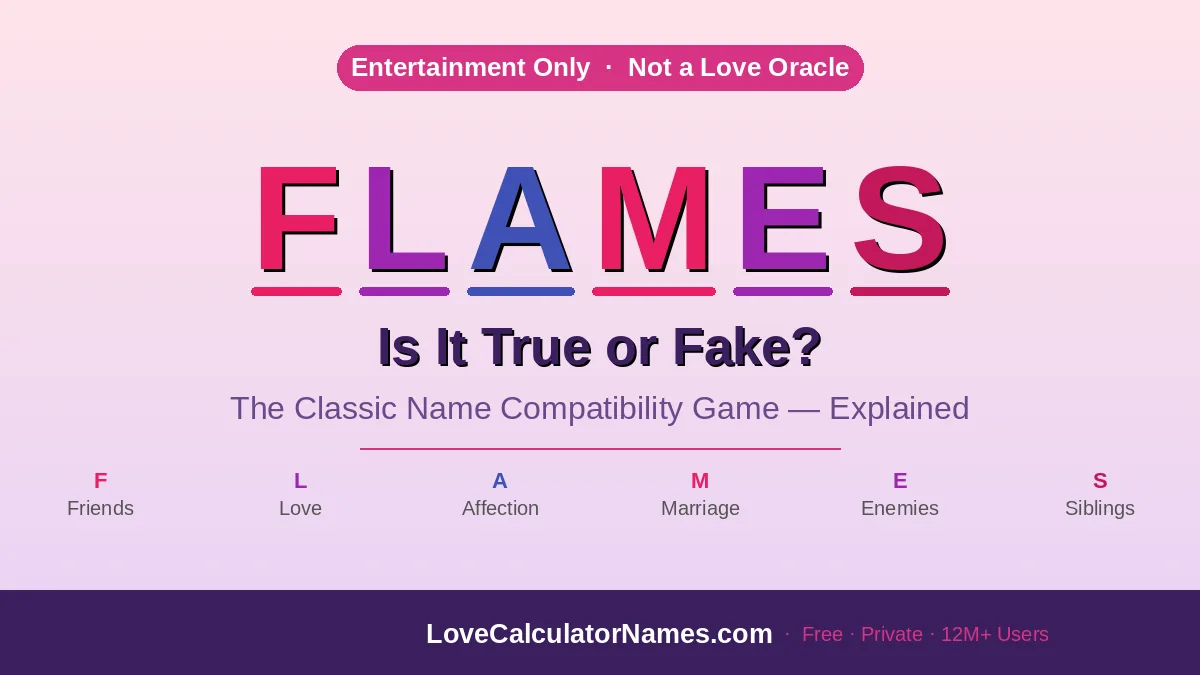
FLAMES stands for Friends, Love, Affection, Marriage, Enemies, and Siblings. It’s a letter-elimination counting game where the result is governed entirely by arithmetic — how many letters remain after canceling shared ones from two names — not by relationship science, personality data, or psychological research. It is not true in a predictive sense, but it is genuinely, enduringly fun.
The game has no scientific framework whatsoever. It doesn’t measure emotional intelligence, communication style, shared values, or personality compatibility — the factors that real relationship research consistently identifies as predictors of lasting connection. The outcome is purely a product of letter math.
And yet, FLAMES has traveled from student to student, older sibling to younger sibling, and classroom to classroom for at least four decades. It’s popular across South Asia — India, Pakistan, Bangladesh, Sri Lanka — as well as Southeast Asia, North America, the UK, Canada, Australia, and diaspora communities worldwide. The game spread without a publisher, a rulebook, or any marketing. It traveled because it creates a shared social moment that’s low-risk and genuinely enjoyable.
The “truth” in FLAMES is social, not scientific. It gives people a playful excuse to talk about attraction without requiring direct vulnerability. Instead of admitting “I like you,” you let the game say it for you — and either celebrate or dispute the result. That psychological function is very real, even if the letter count predicts nothing about what actually happens next.
Name-based compatibility games that use letters and names to suggest relationship categories have existed across cultures for centuries. The concept of reading meaning into names — called onomancy — appears in Greek, Hebrew, Arabic, and medieval European traditions. FLAMES is the modern, secular, playground-friendly version of that ancient human fascination. It strips away all the mysticism and keeps only the laughter.
The most telling proof that FLAMES isn’t measuring anything real: the same two people often get completely different results depending on which naming convention is used — first name only, full name, nickname, or an alternate spelling. If there were real information being processed, the result would be stable. It isn’t.
How Does the FLAMES Game Actually Work? (Step-by-Step)
FLAMES works by crossing out letters shared between two names, counting what remains, and using that number to eliminate the letters of the word FLAMES one at a time until only one survives. The full process takes under two minutes and needs only a pen, paper, and the ability to count.
Here’s the complete, correct method — step by step:
- Write both names clearly. Decide upfront whether you’re using first names only or full names — and apply that rule consistently to both names.
- Cross out shared letters. For each letter that appears in both names, cancel one matching instance from each name. If a letter appears twice in one name and once in the other, only one instance is canceled per side.
- Count all remaining uncanceled letters across both names combined. This total becomes your counting number.
- Write the word FLAMES clearly — F, L, A, M, E, S — in a straight line or a circle.
- Start counting from F, one letter per count. When your count lands on a letter, cross it out.
- Reset your count to 1 and continue from the very next uncrossed letter, skipping any already-eliminated ones.
- Repeat until only one letter remains. That surviving letter is your FLAMES result.
Worked example:
- Name 1: MAYA → M, A, Y, A
- Name 2: RYAN → R, Y, A, N
Shared letters: Y (one each) and A (one each). Cross out one Y and one A from each name.
Remaining: M, A (from Maya) + R, N (from Ryan) = 4 letters remaining
Count to 4 through FLAMES, crossing out the letter you land on each round. Continue until one letter survives — that’s your result.
Why do the rules vary so much between players?
FLAMES was never formally codified in any rulebook. It spread entirely by word of mouth, and regional variations developed naturally. Some players restart counting from the letter right after the eliminated one; others restart from F every time. Some count the remaining letters from both names; others count only one. These differences produce different results for the same pair — which is one more reason to enjoy the game as playful tradition rather than a precise system.
Online versions are also popular. Free name compatibility tools can run the FLAMES calculation instantly, so you skip the hand-counting and get your result in under a second — useful when you want to test multiple name combinations quickly.
FLAMES Results Compared: What Each Letter Really Means
Each FLAMES result represents a relationship category. None is objectively better or worse than the others — they’re designed to trigger emotional reactions and spark conversation, not to reveal truth about your actual relationship. The categories cover the full spectrum from closeness to conflict, which is exactly why every result feels significant.
After testing dozens of name combinations across different naming conventions, one pattern becomes clear: change the name version — first name, full name, nickname, alternate spelling — and you frequently land on a completely different FLAMES letter for the exact same pair. That variability is the most honest evidence that the game captures letter patterns, not love patterns.
Here’s a breakdown of all six FLAMES categories and what they typically spark in real life:
| FLAMES Letter | Relationship Category | Typical Emotional Reaction | Most Common Follow-Up |
|---|---|---|---|
| F | Friends | Relief or mild disappointment | “That’s fine… I guess.” |
| L | Love | Excitement, blushing, screenshots | “I KNEW IT. Look at this.” |
| A | Affection | Warm but ambiguous | Usually replayed to try for L |
| M | Marriage | The “ultimate” result | Maximum teasing from the group |
| E | Enemies | Dramatic shock or disbelief | “No. That’s wrong. I’m doing it again.” |
| S | Siblings | Groans and eye-rolls | Immediate replay, especially with a crush |
Notice the design: every single result generates an emotional response and a social reaction. No outcome lands quietly. That’s part of what makes FLAMES so durable — it manufactures engagement automatically, no matter what letter appears.
Cultural variation shapes the result more than players realize.
In South Asia, where FLAMES is enormously popular, players typically use first names only — sometimes in regional-language transliteration alongside English spelling. “Priya” gives a different letter count than “Priya Sharma,” which gives a different count again from “Priyanka.” In the US and UK, players more commonly use full names, adding more letters and shifting the count entirely.
Two people sitting in the same room, playing FLAMES for the same couple, can reach opposite results simply because one used first names and the other used full names. That’s the clearest proof available that the game is measuring naming conventions, not romantic compatibility.
A real-world illustration:
Take any celebrity couple you know. Run FLAMES using their stage names, their full legal names, their first names only, and their commonly used nicknames. You’ll likely get a different result each time. The same two people, four different answers — which tells you everything you need to know about what FLAMES is actually measuring.
Historical roots of name-based games:
Divination games using names, initials, and letter patterns were recorded in medieval Europe and across multiple ancient cultures. People have always found meaning in names — it’s one of the most deeply human instincts. FLAMES taps into that instinct in a completely modern, secular, low-stakes way. The fascination with names is ancient; the counting method is a 20th-century schoolyard invention.
Common Myths About FLAMES That Most People Still Believe
Most myths about FLAMES come from treating a structured-looking game as though structure implies accuracy. The counting method feels consistent and systematic — so people assume the results carry real meaning. They don’t. Here are the five most persistent misconceptions, cleared up directly.
Myth 1: FLAMES is a form of numerology.
Numerology assigns specific numerical values to letters — in the Pythagorean system, A=1, B=2, C=3, and so on — and uses those values to calculate personality traits, life paths, and relationship energies. FLAMES assigns absolutely no value to any letter. It only counts how many letters remain uncanceled after the name-matching step. There’s no letter-to-number conversion, no root-number reduction, no cross-referencing of birth dates, and no spiritual or philosophical framework connecting letter counts to cosmic meaning. FLAMES and numerology share the input of names — nothing else at all.
Myth 2: Getting “Enemies” means you and that person won’t work out.
This is the most emotionally loaded myth and the least accurate. Relationship success is built on communication, emotional availability, mutual respect, and shared goals — none of which are captured by a counting game. Plenty of real couples who played FLAMES together got “Enemies” and are thriving. Plenty of strangers got “Marriage” and have never spoken again. The result carries no information whatsoever about your actual dynamic or future trajectory.
Myth 3: Using full names gives a more accurate result than using first names.
Accuracy assumes the game is measuring something real — which it isn’t. Using full names changes the letter pool, changes the remaining count, changes the elimination sequence, and changes the result. But it doesn’t make the result more meaningful. FLAMES isn’t processing semantic meaning from your name length; it’s processing letter patterns. More letters produce a different count, not a truer answer. Both versions are equally fictional.
Myth 4: The first result you get is the real one; replaying is cheating.
Since the result has no bearing on real compatibility, the first result and the tenth result carry the same weight — which is zero. The impulse to replay until you get “Love” or “Marriage” is actually proof of something important: instinctively, players know it’s a game. Deep down, nobody really believes the first result is binding. The replaying is just the game being played again, which is perfectly fine.
Myth 5: FLAMES and online love calculators are the same thing.
They operate differently. A name-based love calculator typically assigns numerical values to letters — using Pythagorean, Chaldean, or other systems — calculates a combined compatibility score, and returns a percentage. FLAMES eliminates letters through counting and returns a relationship category. Love calculators feel more “data-like” because they produce a specific number; FLAMES produces a category label. Both are entertainment tools built around names, but their mechanics are distinct. The experience of each feels different, even though neither is scientifically predictive.
Frequently Asked Questions About the FLAMES Game
Is the FLAMES game true or fake?
FLAMES is a game — not a truth or a falsehood in any scientific sense. Its results are produced by letter-counting arithmetic and have no connection to relationship research, psychology, or compatibility science. It cannot accurately predict who you’ll fall in love with, who your enemies are, or how any relationship will unfold. It’s designed for entertainment only and should be treated exactly that way.
Can FLAMES actually predict who you’ll end up with?
No. Predicting relationship outcomes requires understanding personality fit, communication patterns, emotional maturity, and shared values — none of which are captured by counting leftover letters between two names. FLAMES cannot tell you who you’ll marry or fall in love with. What it can do is start a conversation, lift the mood, and give you something to laugh about with friends.
Why do I get a different FLAMES result with my full name vs. my first name?
Because the result depends entirely on how many letters remain after canceling shared ones. A different name version changes the letter pool, which changes the remaining count, which changes the elimination sequence, which changes the final result. No naming convention is “more correct” than another — and that inconsistency is exactly what confirms FLAMES measures naming patterns, not relationship reality.
Is FLAMES played the same way in every country?
The core mechanic is globally consistent: cross out shared letters, count what’s left, eliminate FLAMES letters by that count until one remains. But practical variations exist — which names to use, how to reset the count, whether to count from both names or just one. South Asia favors first names; the West more often uses full names. The spirit is universal; the exact rules vary by region and whoever taught you to play.
What does it mean if I always get “Enemies” in FLAMES?
It means the math of your most-used name combinations consistently lands on “E.” It says nothing about your real relationships. If you keep getting “Enemies” with people you’re close to, try a different name version — first name, full name, nickname — and you’ll likely get a different result. The pattern you’re seeing is a letter-math pattern, not a relationship pattern.
Is FLAMES connected to astrology, tarot, or numerology?
No. FLAMES has no connection to astrology (planetary positions and birth charts), tarot (symbolic card interpretation), or numerology (letter-to-number value systems). It’s a secular counting game with no spiritual or esoteric framework at all. If you’re curious about name-based numerology — which does assign meaning to letter values — that’s a separate and genuinely rich topic worth exploring on its own terms.
Who invented the FLAMES game, and when was it created?
The exact origin is unknown. FLAMES appears to have developed organically in schools and playgrounds, spreading by word of mouth across multiple countries. Evidence of the game appears in school notebooks from at least the 1980s in South Asia and the early 1990s in Western countries. There’s no single inventor, no original rulebook, and no company behind it — it’s a genuine folk game in every sense of the term.
Is there a faster way to get FLAMES results without counting by hand?
Yes. Free name compatibility tools online calculate FLAMES results instantly — alongside love percentage scores, numerology-based compatibility ratings, and other fun metrics. You enter two names and get your result in under a second, with no risk of miscounting. It’s especially useful when you want to test several name combinations back to back.
A Game Worth Playing — Even Without a Crystal Ball
FLAMES is entertainment, not evidence — and that’s a perfectly fine thing to be. The game creates real social connection. It gives people a playful, low-stakes way to bring up attraction and compatibility without requiring direct vulnerability. The laughter it generates is genuine, even when the result is completely wrong about everyone involved.
No FLAMES outcome should change how you actually feel about someone. Real compatibility — the kind that builds and sustains relationships over time — is built on honesty, trust, patience, and mutual effort. No letter that survived an elimination count can measure any of that.
If you want a more nuanced name compatibility experience — one that uses letter values and phonetic harmony to generate a percentage score rather than a single category — a name-based love calculator delivers more depth with the same zero-pressure spirit.
Ready to see your score? Try the free name compatibility test on LoveCalculatorNames.com — no sign-up, 100% private, and results in seconds.
Our popular compatibility test uses your names to generate a fun result score.