Your name isn’t random. According to numerology, every letter carries a number value, and those values add up to reveal something about your personality, strengths, and the energy you put into the world. Numerology reads your name through five core numbers: Destiny, Soul Urge, Expression, Personality, and Balance. Each is drawn from different letters in your full name using the Pythagorean system (A=1 through Z=9). The practice is ancient, widely used for entertainment and self-reflection, and surprisingly easy to do yourself with a few minutes and a piece of paper.
Note: Numerology is a fun, thought-provoking tool — not a scientific predictor of personality or outcomes. Treat it as you would a personality quiz: a lens for reflection, not a verdict.
What Is Numerology, and Why Does It Use Your Name?
Numerology is the study of numbers as symbols carrying meaning beyond their mathematical value. Your full birth name — first, middle, and last — is the raw material for several key calculations because it was fixed at birth, before life shaped you. Each letter maps to a digit between 1 and 9, and by summing, then reducing, those digits you land on a number believed to reflect a specific energy or theme.
The Pythagorean system is the most widely used in the English-speaking world. It assigns values sequentially: A=1, B=2, C=3 … I=9, then the cycle resets: J=1, K=2 … R=9, and again: S=1, T=2 … Z=8. Some practitioners also use the Chaldean system, which assigns values differently (A=1, B=2, C=3, D=4, E=5, U=6, O=7, F=8, K and Q share 2, and so on). The two systems produce different results from the same name, which is why the same calculator on different websites can give you a different number. For most beginner-level name numerology, Pythagorean is the standard.
The reason names matter — rather than birthdays alone — is that numerologists treat them as a second data stream. Your birth date anchors your Life Path number (calculated from the date itself), while your name anchors trait-based numbers. Together, they’re said to give a fuller picture.
How Do You Calculate Your Name Numbers? (Step-by-Step)
To find your numerology numbers from your name, assign each letter its Pythagorean value, total all the digits, then reduce to a single digit (or 11, 22, or 33 — the so-called “master numbers” many traditions preserve). Use your full birth name as it appears on your birth certificate, including any middle names.
The Pythagorean Letter-Value Chart:
| A=1 | B=2 | C=3 | D=4 | E=5 | F=6 | G=7 | H=8 | I=9 |
|---|---|---|---|---|---|---|---|---|
| J=1 | K=2 | L=3 | M=4 | N=5 | O=6 | P=7 | Q=8 | R=9 |
| S=1 | T=2 | U=3 | V=4 | W=5 | X=6 | Y=7 | Z=8 |
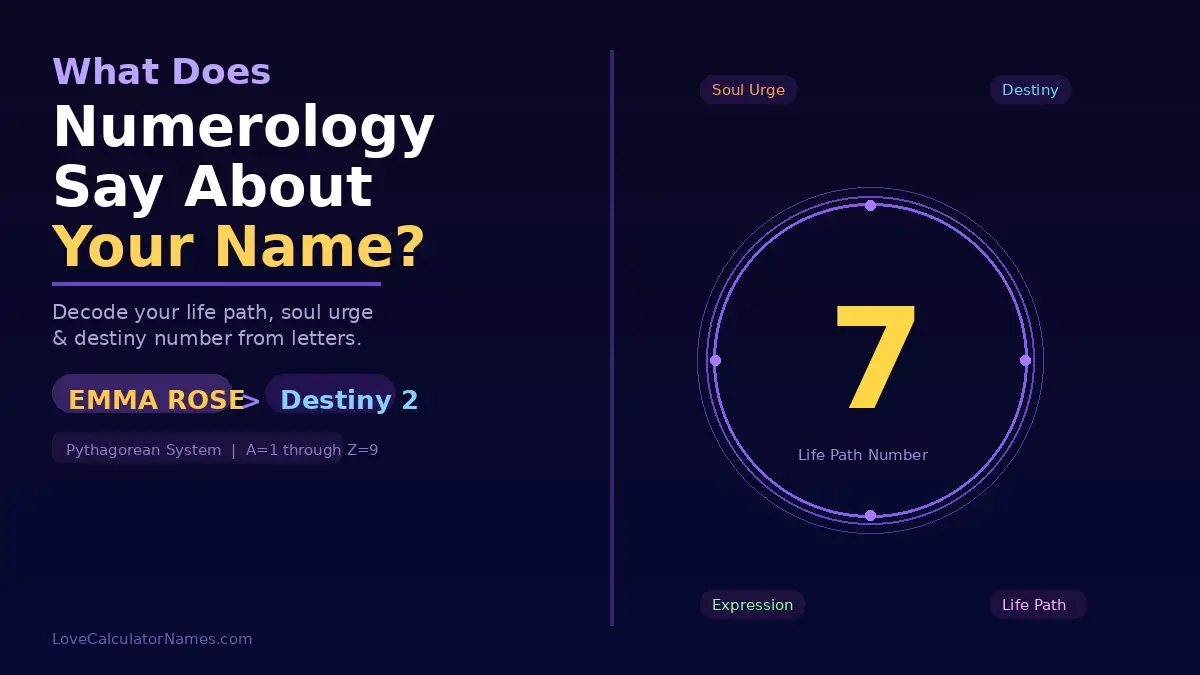
Worked Example — EMMA ROSE JAMES:
- Write out the full name. E M M A R O S E J A M E S
- Assign each letter a value. E=5, M=4, M=4, A=1 / R=9, O=6, S=1, E=5 / J=1, A=1, M=4, E=5, S=1
- Sum all values. 5+4+4+1 = 14 / 9+6+1+5 = 21 / 1+1+4+5+1 = 12. Total: 14+21+12 = 47
- Reduce to one digit. 4+7 = 11. Many numerologists stop here (11 is a master number). Others reduce further: 1+1 = 2.
- Result: Destiny Number 2 — cooperation, diplomacy, sensitivity.
For your Soul Urge number, repeat steps 1–4 using vowels only (A, E, I, O, U).
For your Expression number (also called the Personality or Outer Expression number), use consonants only.
What Do the Five Name Numbers Actually Mean?
Each name number reflects a different layer of who you are, from your inner motivations to how strangers first read you. Here’s a quick-reference breakdown of all five core numbers drawn from a name, what each one measures, and typical traits for each digit.
The Five Core Numerology Numbers from Your Name:
| Number Type | Letters Used | What It Represents | Master Numbers Kept? |
|---|---|---|---|
| Destiny Number | All letters, full name | Life purpose, broad direction | 11, 22, 33 |
| Soul Urge Number | Vowels only | Inner motivation, private desires | 11, 22 |
| Expression Number | Consonants only | Outer personality, how others see you | 11, 22 |
| Personality Number | Consonants only (some systems) | The “mask” you present publicly | 22 only |
| Balance Number | First initials of each name | How you handle stress or crisis | Rarely |
What each single digit (1–9) says about your name:
- 1 — Leadership, independence, originality. You push forward, often alone.
- 2 — Cooperation, sensitivity, diplomacy. You work best alongside others.
- 3 — Creativity, expression, social warmth. Words and art come naturally.
- 4 — Structure, patience, reliability. You build things that last.
- 5 — Freedom, adaptability, curiosity. You thrive when things change.
- 6 — Nurturing, responsibility, community. You care for those around you.
- 7 — Analysis, introspection, spiritual inquiry. You seek meaning beneath the surface.
- 8 — Ambition, authority, material mastery. You’re drawn to achievement.
- 9 — Compassion, wisdom, completion. You see the bigger picture.
Master numbers — 11, 22, 33 — carry the base-digit themes (2, 4, 6) but amplified, with an added emphasis on intuition, large-scale building, or universal service. Whether you reduce them or preserve them depends on which tradition you follow; there is no single “correct” answer.
What Can Numerology Actually Tell You About Your Name?
Numerology offers a reflective framework, not a personality test with scientific backing. What it can do well is prompt genuine self-examination — particularly around the Soul Urge number, which focuses on internal motivations rather than public behavior. Many people find that reading their numbers feels accurate in the same way a good horoscope does: it describes real human themes using broad language that most people recognize in themselves to some degree. Psychologists call this the Barnum effect (or Forer effect) — we accept personality descriptions that could apply to almost anyone when presented as being tailored to us specifically.
That said, the practice has genuine cultural depth. It has roots in Pythagorean philosophy (ancient Greece), Kabbalistic tradition (Hebrew letter-number correspondences), and South Asian naming ceremonies such as namakarana, where the first letter of a newborn’s name is traditionally chosen based on astrological and numerological guidance. In that context, numerology isn’t just entertainment — it’s part of how families have named children for centuries.
So what does it actually “tell” you? Think of it as a structured prompt. Your Destiny number might align with a career direction you’ve been considering. Your Soul Urge number might name something you’ve felt but couldn’t articulate. The value is in the reflection, not in the digits themselves.
Common Myths About Name Numerology (Set Straight)
Many first-time users arrive with misconceptions that lead to frustration or misuse. Here are the five most common, and what’s actually true.
Myth 1: Changing the spelling of your name gives you a “better” number. Technically, yes — a spelling change does alter your calculation. But most numerologists recommend using your birth name as registered at birth for trait-based readings, since that name was fixed before any self-selection bias could influence it. Your preferred name or nickname can be read separately as a “current name energy,” but it’s treated differently.
Myth 2: Certain numbers are lucky or unlucky. No number in Pythagorean numerology is inherently good or bad. Each digit has both strengths and blind spots. A 7 is analytical and introspective, which is great for research but can lead to isolation. An 8 is ambitious and capable, but may struggle with balance. The framing of “lucky numbers” comes from separate cultural traditions (particularly Chinese numerology, where 8 is associated with prosperity and 4 with death due to phonetic similarity to the word).
Myth 3: Numerology and astrology say the same thing. They draw on completely different systems. Astrology uses birth date and time, linked to planetary positions. Numerology uses birth date (for life path) and birth name (for trait numbers). They can be used together, but they’re not interchangeable.
Myth 4: Your destiny number determines your future. Your Destiny number is framed as a direction or theme, not a predetermined outcome. Numerology in its traditional form describes tendencies, not fixed fates. It operates more like a personality framework than a prophecy.
Myth 5: Online numerology calculators all agree. They don’t, and that’s not a bug. Different sites use different systems (Pythagorean vs. Chaldean), handle middle names differently, or count Y as a vowel or consonant depending on their convention. If you get different results from different calculators, that’s expected — check which system the calculator uses before comparing results.
Frequently Asked Questions
What does numerology say about my name for free? You can calculate your name numbers at home with no tools other than the Pythagorean chart above. Write out your full birth name, assign each letter its value (A=1 through Z=9, resetting every 9), total all digits, then reduce to a single digit. That’s your Destiny number. Repeat with vowels only for your Soul Urge, and consonants only for your Expression number. No sign-up required.
What is the most important number in name numerology? Most numerologists prioritize the Destiny number (all letters, full name) because it’s considered the broadest indicator of life direction. The Soul Urge number runs a close second for people more interested in inner motivations than outward expression. Which matters most depends on what question you’re asking.
Does your name actually affect your personality? Research in social psychology suggests names have small but real effects on self-perception and social outcomes — a field called onomastics. Name-matching studies (Pelham, Mirenberg & Jones, 2004) found people show mild preferences for things that resemble their name. Numerology goes further than the research supports, but the basic idea that names carry meaning isn’t entirely without grounding.
Can I use my married name or nickname for numerology? Your birth name is the standard input for trait-based numbers (Destiny, Soul Urge, Expression). A married or chosen name can be read separately as a “current vibration” or “name in use” number. Many practitioners read both and compare them, treating the difference as information about how your energy has shifted.
What is a master number, and do I have one? Master numbers — 11, 22, and 33 — appear when your totals reduce to these values before the final single-digit step. They’re preserved rather than reduced further in most Western numerology traditions. 11 is associated with intuition and inspiration; 22 with large-scale building and vision; 33 with teaching and compassion. They’re relatively common, since any name that sums to 29, 38, 47, or 56 (among others) reduces to 11.
Why does the same name get different numbers on different websites? Two main reasons: system (Pythagorean vs. Chaldean assigns different letter values) and Y-handling (some systems count Y as a vowel, others as a consonant). A third variable is whether the site uses your full birth name or just the name you type in. Stick to one system when comparing results across time.
Is name numerology the same as the FLAMES game or love calculators? No. FLAMES and love percentage calculators typically use letter-frequency cancellation or simple addition to generate a compatibility score. Pythagorean name numerology uses a full letter-value chart, multiple number types, and detailed trait descriptions. They’re both used for fun and self-reflection, but they’re distinct methods. You can use a name compatibility tool and numerology separately and compare what each suggests.
Is numerology a science? No peer-reviewed body of research supports numerology as a predictive system. It belongs to the category of divinatory or symbolic practices — useful for reflection and cultural meaning-making, but not a substitute for psychology, medicine, or counseling. The entertainment-only framing matters: use it as a prompt for conversation or introspection, not as a decision-making tool.
The Takeaway
Name numerology gives you five numbers drawn from the letters of your full birth name, each describing a different layer of character and motivation. The Destiny number covers life direction; the Soul Urge number covers what drives you privately; the Expression number covers how the world sees you. All three use the same Pythagorean letter-value chart (A=1 through Z=9), and the calculation takes about five minutes with a pen and paper.
The practice has centuries of cultural history across Greek, Hebrew, and South Asian traditions. It’s not a science, and no digit is better or worse than any other. Its real value is as a prompt — a structured way to reflect on your name, your tendencies, and how you want to show up.
Curious how your name interacts with someone else’s? Try the free name compatibility test at LoveCalculatorNames.com — no account needed, completely private, and results in seconds.
Our free love test is the most fun way to check name-based compatibility.