Does every letter in your name count when you run a name compatibility test — or does only part of your name matter? The short answer: in most name matching systems, every letter matters, though different methods weigh them differently. Some count total letters to generate a score, others assign numeric values to each letter individually, and a few focus only on first names. The method used — FLAMES, numerology, or letter-value matching — determines how much weight each letter carries. This article breaks down how each system works.
Just a note: name matching is meant for fun and entertainment. It’s not a scientific predictor of romantic success.
Does Every Letter in Your Name Actually Count?
Yes — in nearly every name matching method, every letter in both names contributes to the final score. Whether a system counts total letters, sums numeric values, or cancels shared letters between two names, no letter is ignored or skipped. The full spelling of each name is the input, and changing even one letter changes the result.
Different systems treat those letters in different ways, though.
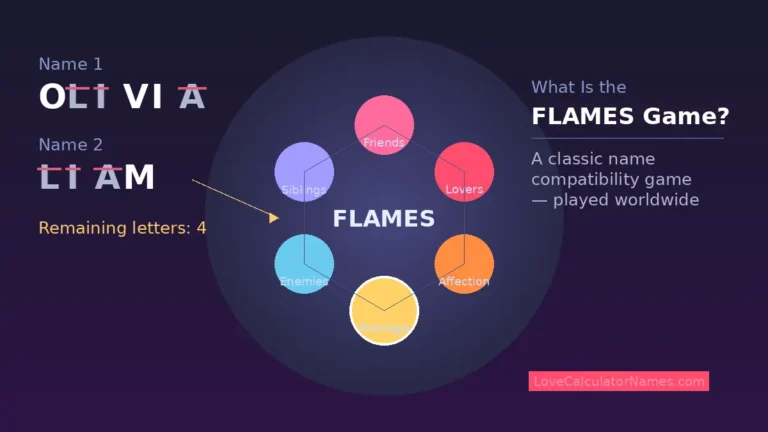
In the FLAMES method, shared letters between two names are crossed out, and what’s left determines the compatibility category. Every letter that appears in both names gets canceled — so a name with more overlapping letters will produce a different outcome than one with fewer.
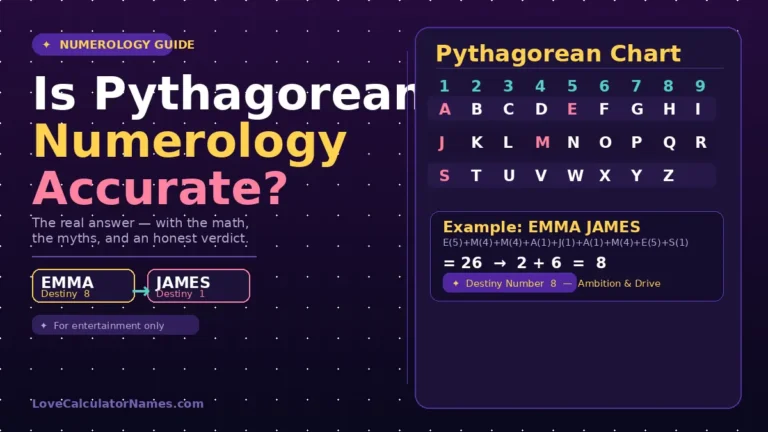
In Pythagorean numerology, each letter is converted to a number from 1 to 9 based on its position in the alphabet. All those numbers are added together, reduced to a single digit, and the digits for both names are compared. Here, every single letter adds to the total — none are skipped.
In basic letter-count matching, the total number of letters in each name is used to generate a percentage. Shorter names and longer names will almost always score differently against the same partner.
How Do Different Name Matching Systems Use Letters?
The way letters are counted and valued depends entirely on the system being used. Most popular name matching tools use one of three methods: letter cancellation (FLAMES), letter-value addition (numerology), or direct letter counting. Each treats the same name differently, which is why two tools can give you two different scores for the same pair of names.
1. The FLAMES Method
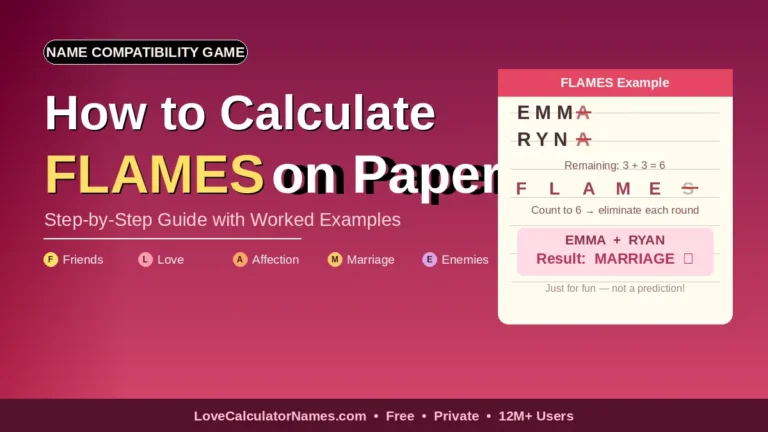
FLAMES stands for Friends, Love, Affection, Marriage, Enemies, Siblings — six possible compatibility outcomes.
Here’s how it works:
- Write out both full first names.
- Cross out every letter that appears in both names.
- Count the remaining uncrossed letters.
- Count down through the FLAMES categories repeatedly, eliminating one each time you hit the total count.
- The last category standing is the result.
Because this method crosses out shared letters, having more letters in common changes the count, which changes the final FLAMES result. Two names with a lot of shared letters could end up in a completely different category than the same names with different spellings.
2. Pythagorean Numerology
In Pythagorean numerology, every letter maps to a number:
| Letter | Value |
|---|---|
| A, J, S | 1 |
| B, K, T | 2 |
| C, L, U | 3 |
| D, M, V | 4 |
| E, N, W | 5 |
| F, O, X | 6 |
| G, P, Y | 7 |
| H, Q, Z | 8 |
| I, R | 9 |
Each letter in both full names gets converted to its value, all values are summed, and the total is reduced to a single digit. The two final digits (one per name) are then compared for compatibility. Every letter in the full name is part of this calculation — including middle names, if you include them.
3. Simple Letter-Count Matching
Some tools just count the total letters in each name, then use a formula to produce a love percentage. This is the simplest method. It treats every character equally — no values, no cancellations, just the raw count. Longer names produce higher totals, which feeds into a different compatibility range.
How Name Length and Letter Overlap Affect Your Score
Name length changes compatibility scores more than most people expect. A one-letter difference can flip the FLAMES result entirely, or shift a numerology total from one digit to another.
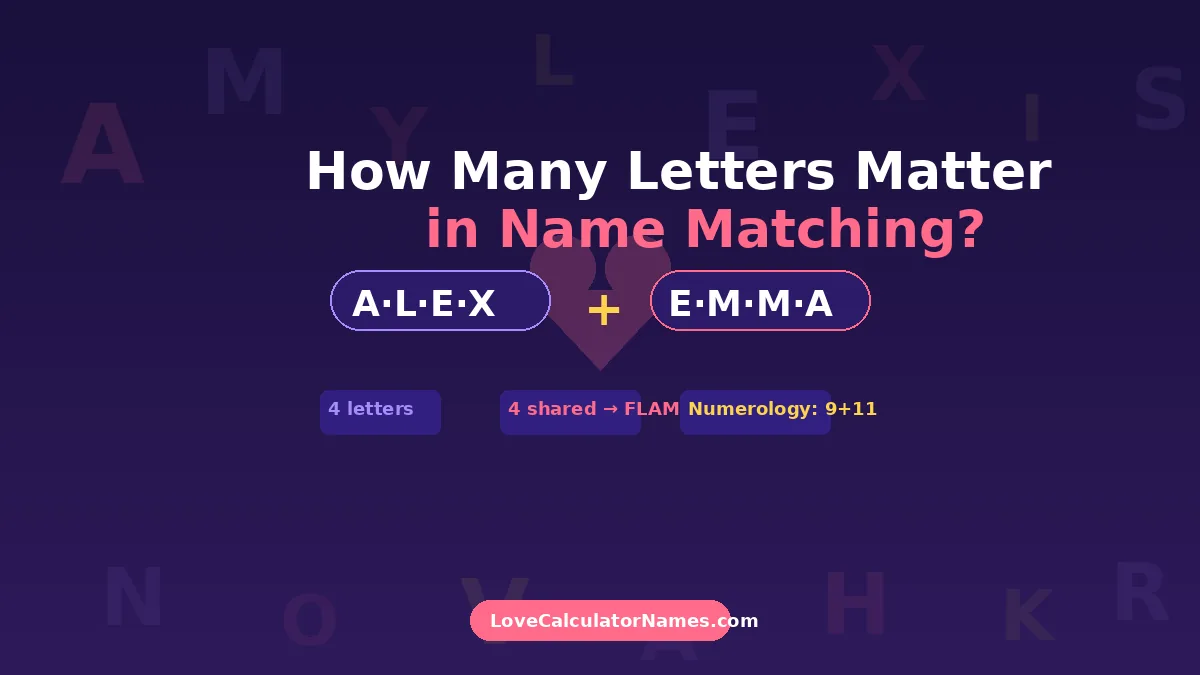
Here’s a comparison of how the same partner name (“Emma”) pairs differently based on name length:
| Your Name | Total Letters Combined | Shared Letters with Emma | FLAMES Count |
|---|---|---|---|
| Alex | 4 | A, E | 4 remaining |
| Alexander | 9 | A, E, A, E | 9 remaining |
| Alexandro | 9 | A, E, A | 10 remaining |
| Ale | 3 | A, E | 2 remaining |
Even small spelling changes — like “Alex” vs. “Alec” — affect which letters cancel out and shift the final count.
Letter overlap matters most in FLAMES. The more letters two names share, the fewer remain to count down through the categories. Two names with almost no letters in common will have a high remaining count, which typically cycles through the FLAMES list more times before landing.
In numerology, letter overlap doesn’t matter — what matters is the cumulative numeric value of each name. A name with many high-value letters (like W = 5, Y = 7, Z = 8) will have a different life path number than a name with lower-value letters.
Common Myths About How Letters Work in Name Matching
Most people who try name compatibility for the first time walk in with a few assumptions that don’t hold up. Here are the most common ones:
Myth 1: Only the first letter matters. Some people think name matching works like initials — that A + J means something fixed. That’s not how any standard method works. The full name, every letter, goes into the calculation.
Myth 2: Longer names always score better. Not true. Longer names have more letters to contribute, but more letters also means more potential for cancellations in FLAMES, which can move you to a completely different outcome. In numerology, a longer name doesn’t guarantee a higher or lower compatibility number.
Myth 3: Nicknames give the same result as full names. They almost never do. “Chris” and “Christopher” have different letter counts, different letter values, and different overlapping letters with any given partner name. If you want consistent results, use the same form of the name every time.
Myth 4: Vowels count more than consonants. No standard name matching system weights vowels more heavily than consonants. In Pythagorean numerology, every letter — vowel or consonant — maps to a value from 1 to 9 based purely on its position in the alphabet. Vowels have no special status.
Myth 5: The result doesn’t change if you add a middle name. It does — sometimes significantly. In FLAMES, adding a middle name increases the total letter count, changes cancellations, and can shift the final category. In numerology, adding a middle name adds more values to the sum, which can change the final reduced digit.
Frequently Asked Questions
Does every single letter in my name count in a compatibility test? Yes. In virtually all name matching systems — FLAMES, numerology, and letter-count methods — every letter in both names contributes to the outcome. No letter is treated as a placeholder or ignored. Even repeated letters count. Changing one letter in either name can shift the result.
Does it matter if I use my full name or just my first name? It depends on the tool. Most name compatibility tools use only first names. Some include middle names or surnames, which changes the result. For consistent comparisons, use the same format every time — either always your full name or always just your first name.
How many letters should both names have for the most interesting result? There’s no magic number. FLAMES tends to produce more varied outcomes when names are different in length, since the cancellations leave a more unpredictable count. Very short names (2–3 letters) can limit the range of possible outcomes because there are fewer combinations to cycle through.
Can two people with very different name lengths still be compatible? Absolutely — in both fun and real life. Name length doesn’t determine real compatibility. In FLAMES or numerology, two names of very different lengths can still land on “Love” or produce matching life path numbers. The math doesn’t penalize length differences.
Does spelling variation change the result? Yes, meaningfully. “Kaitlyn” and “Caitlin” share the same pronunciation but have different letters, different counts, and different values. Most tools treat every spelling as its own unique input. If you want to check a specific person’s name, use the spelling they actually go by.
Do names in other languages or scripts work differently? Name matching as described here applies to names written in the Latin alphabet. Names transliterated from Arabic, Hindi, Chinese, or other scripts will produce results based on their Romanized spelling, which can vary depending on transliteration style. Different cultural traditions also have their own naming numerology systems.
Why do different name calculators give me different scores? Because they use different methods. One tool might use FLAMES letter cancellation; another might use Pythagorean numerology; a third might use a proprietary formula. None of them is more “correct” than another — they’re just different systems, all meant for entertainment.
Is name matching scientifically accurate? No. Name matching is a fun, informal activity with roots in folk traditions, numerology, and word games. It’s not a validated scientific method for predicting relationship success. Use it as a starting point for a laugh or a conversation — not as relationship advice.
What This Means for Your Next Name Compatibility Check
Every letter in your name plays a role in how name matching systems calculate your score. In FLAMES, shared letters cancel each other out and what’s left determines the category. In Pythagorean numerology, each letter adds its numeric value to a running total that gets reduced to a single digit. In letter-count methods, the raw number of letters feeds the formula.
The three things that change your result most are: the spelling of the names, whether you include middle names, and which system the calculator uses. A nickname versus a full name, or “Jon” versus “John,” can give you a completely different outcome.
The real takeaway: name matching is a playful way to look at two names side by side. It doesn’t tell you whether a relationship will work — but it can be a fun way to start a conversation. Try different name combinations, use different spellings, see what comes up.
Ready to see your score? Try the free name compatibility test at LoveCalculatorNames.com — no sign-up, 100% private.
Try our compatibility calculator and get a result you can share with friends.