Have you ever typed two names into a compatibility quiz and genuinely wondered what the score was based on? You’re not alone — and the answer is more interesting than most people expect.
Two names are considered compatible when their letters, sounds, or numerical values align through recognized systems — mainly Pythagorean numerology, phonetic harmony, and methods like FLAMES. Each system converts names into numbers or sound patterns, compares them, and produces a score or outcome. These tools are built for fun and entertainment, but they draw on centuries of cultural and linguistic tradition linking names to personality, destiny, and energy.
This guide breaks down every major framework used in name compatibility testing — and explains precisely what each one is actually measuring.
What Does Name Compatibility Actually Mean?
Name compatibility is the idea that two people’s names can be analyzed together to show how well their energies, personalities, or symbolic values align. Most systems convert each name’s letters into numbers or sound patterns, combine them, and generate a score. It’s designed for entertainment, but it draws from real cultural and numerological traditions with deep historical roots.
The belief that names carry power isn’t a modern invention — it’s ancient. Hebrew Gematria assigned numerical values to every letter of the alphabet over 2,000 years ago, linking names to spiritual meaning and cosmic energy. Greek isopsephy did the same, treating letters as numbers to reveal hidden connections between words and concepts. In Vedic Hindu tradition, a child’s name is chosen based on their birth star (nakshatra), ensuring the first syllable aligns with their astrological destiny.
These aren’t just historical footnotes. They’re the intellectual ancestors of every name compatibility calculator you’ve ever used.
The most common modern framework is Pythagorean numerology, which assigns numbers 1–9 to the letters A–Z in a repeating cycle. Each name is reduced to a single core number — sometimes called a life path name number or expression number. When two people’s core numbers are compared, certain pairings are considered harmonious, dynamic, or challenging based on centuries of numerological tradition.
Beyond numerology, name compatibility can also be measured through phonetic similarity (how names sound when spoken together), shared initial letters, and the cultural weight that specific name-sounds carry in a given tradition.
What all these systems share is a fundamental premise that goes back millennia: names aren’t random labels. They carry rhythm, energy, and meaning — and when two names are placed side by side, something interesting emerges.
All name compatibility tools — including every system described in this article — are designed for entertainment and self-reflection. They are not predictive tools for relationship outcomes.
How Do Name Compatibility Systems Actually Work?
The main systems for measuring name compatibility each follow a clear, learnable process. Pythagorean numerology converts letters to numbers and reduces each name to a single digit. FLAMES counts and eliminates letters to land on a relationship category. Phonetic analysis compares how names sound together. Understanding each method tells you exactly what a compatibility score is measuring.
Here is a detailed walkthrough of each approach:
Method 1: Pythagorean Numerology
This is the engine behind most name compatibility calculators in use today. Each letter of the alphabet maps to a number from 1–9, repeating in sequence:
| Position | A B C D E F G H I | J K L M N O P Q R | S T U V W X Y Z |
|---|---|---|---|
| Value | 1 2 3 4 5 6 7 8 9 | 1 2 3 4 5 6 7 8 9 | 1 2 3 4 5 6 7 8 |
Step-by-step process:
- Write out the first person’s first name.
- Assign each letter its Pythagorean number using the chart above.
- Add all the numbers together to get a total.
- If the total has more than one digit, add those digits together again. Repeat until you have a single number from 1–9.
- Repeat steps 1–4 for the second person’s name.
- Compare the two core numbers using a numerological compatibility guide.
Real example:
- “Emma” → E(5) + M(4) + M(4) + A(1) = 14 → 1+4 = 5
- “Liam” → L(3) + I(9) + A(1) + M(4) = 17 → 1+7 = 8
A 5-and-8 pairing in numerology is traditionally considered dynamic: the adventurous 5 and the driven 8 tend to challenge and energize each other. Neither clashes — they simply bring different strengths.
Some calculators go further, adding the two core numbers together and reducing again to produce a relationship number — a single digit describing the energy the pairing creates as a shared unit.
Method 2: FLAMES
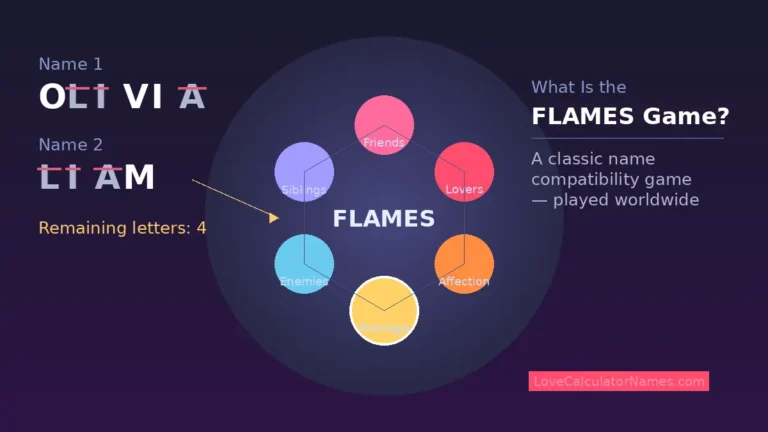
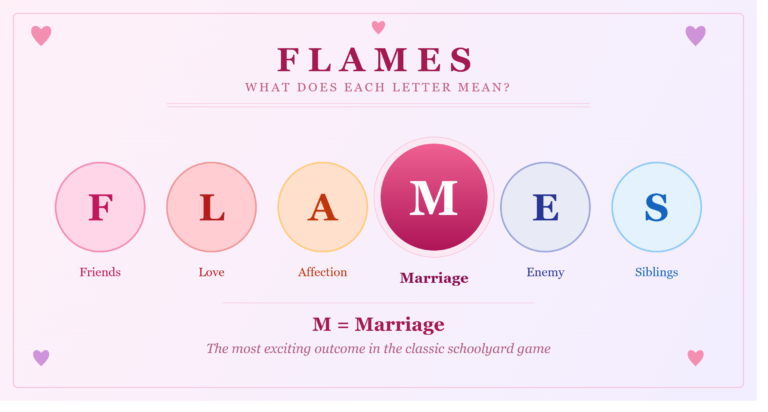
FLAMES stands for Friendship, Love, Affection, Marriage, Enemy, Siblings. It’s a classic game popularized in the 20th century that remains widely used because the result is immediate and story-like rather than numerical.
- Write both names.
- Identify all letters that appear in both names.
- Cross out every occurrence of those shared letters from both names.
- Count the total number of remaining (uncrossed) letters.
- Starting with “F” in the word FLAMES, count clockwise through the letters, eliminating the letter you land on each round.
- The last letter remaining reveals the relationship category.
FLAMES doesn’t produce a percentage — it delivers a narrative outcome. That’s part of why it feels so different from numerology-based tools: it tells you a story rather than giving you a score.
Method 3: Love Percentage / Letter-Count Method
Some tools use a simpler calculation: they count letter overlaps between two names (especially shared vowels and consonants), express the overlap as a fraction of the total unique letters, and convert that fraction to a percentage. It’s quick and intuitive — and it’s what many basic online love calculators use under the hood.
Method 4: Phonetic Harmony Analysis
This is the most linguistically grounded approach, and arguably the most instinctively satisfying. It examines:
- Initial sounds: Do both names begin with the same consonant (alliteration)?
- Vowel patterns: Do the names share similar vowel sounds or rhyme at their endings?
- Syllable rhythm: Are both names similarly paced — both short, both long, or both multi-syllabic?
- Auditory flow: When said aloud as a pair — “Emma and Liam,” “John and Jane” — does the combination feel natural?
Psycholinguistics research has found that people perceive name pairs more positively when the names share phonetic features. This effect — sometimes called implicit egotism in name perception — suggests our brains respond warmly to sounds we already associate with familiarity. When two people’s names share phonetic characteristics, outside observers consistently rate them as a more natural pairing.
Phonetic harmony is one reason alliterative pairings feel culturally memorable. The matching initials create an unconscious sense of cohesion that has nothing to do with the people themselves — only with how the names sound as a unit.
What Do Famous Name Pairs and Cultural Traditions Tell Us?
Looking at real-world name pairs — from literature, history, pop culture, and global naming traditions — reveals consistent patterns. Names with shared phonetic features, matching initials, or aligned numerological values tend to be perceived as naturally compatible, even by people who’ve never encountered formal compatibility systems.
Famous Name Pairs Across Compatibility Frameworks
| Name Pair | Shared Feature | Primary System Strength |
|---|---|---|
| Romeo & Juliet | Open vowels, poetic rhythm | Phonetic harmony |
| John & Jane | Same initial, common cultural pairing | Phonetic + cultural |
| Taylor & Travis | Double T alliteration | Phonetic harmony |
| Victoria & Albert | Formal balance, royal tradition | Cultural naming |
| Emma & Noah | Top US names; open vowel endings | Phonetic + numerology |
| Priya & Rahul | Classic South Asian pairing, cultural phonetics | Vedic tradition |
| Muhammad & Fatima | Traditional Islamic pairing, meaning alignment | Cultural / religious |
| Romeo & Giulietta | Cross-cultural variant; same rhythmic structure | Phonetic harmony |
Notice that alliteration — names beginning with the same sound — appears repeatedly in culturally celebrated pairings. That’s phonetic psychology at work, not coincidence.
How Different Cultures Define Name Compatibility
Different traditions around the world have developed their own frameworks for answering the question of what makes two names compatible:
South Asian (Vedic) tradition: Compatibility is calculated based on the nakshatra (birth star) of each person. The first syllable of an auspicious name is determined by the person’s lunar birth house, and romantic or family matches are made based on compatible nakshatra pairings. This is why naming ceremonies — called namakarana — are treated as sacred events, not just social ones.
Chinese naming tradition: In Chinese culture, the stroke count of the characters used to write a name carries deep symbolic weight. Names are evaluated for lucky stroke totals and tonal harmony. Compatibility between two people is assessed by whether their combined name characters produce a balanced, auspicious stroke count — a practice called (xìngmíngxué), or the study of names and destiny.
Arabic and Islamic naming: Arabic names carry explicit lexical meaning, often referencing divine attributes or virtuous qualities. Compatible name pairings frequently feature names whose meanings complement each other. “Nour” (light) and “Ameen” (trustworthy) are considered harmonious because their meanings form a coherent, positive narrative together.
Western numerological tradition: Most Western compatibility tools use Pythagorean or Chaldean numerology, evaluating name number pairs for harmonic alignment. Number pairings like 1+5, 2+6, 3+9, and 4+8 are traditionally considered strong matches because their symbolic qualities balance rather than compete.
These traditions all reach the same conclusion from different directions: names carry meaning, and meaning can be aligned or misaligned. The framework differs by culture; the underlying instinct doesn’t.
Why Open Vowel Sounds Make Names Feel Compatible
Names with resonant open vowels — long A, long O, long E sounds — tend to pair well in phonetic systems because they create an airy, flowing quality when spoken together.
Compare these two pairings:
- “Ana & Leo” — two open-vowel names that flow naturally when said aloud.
- “Greg & Kris” — two consonant-heavy names that feel clipped and separate when paired.
Neither pairing is “better” in a relationship sense. But in phonetic compatibility analysis, Ana and Leo score noticeably higher simply because of how they sound as a unit. This is one of the hidden mechanisms behind the feeling that certain name pairings just sound right — even to people who’ve never heard of name compatibility systems.
Which Common Myths About Name Compatibility Should You Ignore?
The most widespread myths about name compatibility are that high scores guarantee relationship success, that low scores signal trouble, and that only romantic pairings count. The reality is more nuanced — and understanding these misconceptions helps you use any compatibility tool more thoughtfully.
Myth 1: A High Score Means You’re Meant to Be Together
No name compatibility system — numerological, phonetic, or FLAMES-based — can predict whether two people will build a strong relationship. A score of 95% reflects alignment in letter values and sounds, not emotional depth, communication skills, or shared values. High scores are fun to see. They’re not a green light for major life decisions.
Myth 2: A Low Score Is a Red Flag
A low compatibility score doesn’t mean a relationship is doomed — any more than a high score guarantees success. Many historically celebrated partnerships would score low on standard numerological charts. Real compatibility is built through choices, effort, and time — not calculated from the letters of two names.
Myth 3: Name Compatibility Only Applies to Romance
FLAMES was designed for far more than love — it begins with Friendship and ends with Siblings. Many cultures use name-based compatibility frameworks for business partnerships, friendships, and parent-child naming decisions. If you’re curious about how your name pairs with a close friend’s or a colleague’s, that’s a completely valid use of these tools.
Myth 4: You Must Use Your Full Legal Name
Most tools work just as well with the name you actually use day-to-day — your first name, nickname, or the name the people in your life call you. Some numerological traditions favor the full birth certificate name because it carries the “complete” energetic signature. For entertainment tools, the name that feels most authentically like you is the most relevant input.
Myth 5: Same-Initial Names Always Score Higher
Alliteration does boost phonetic harmony scores — but it doesn’t automatically produce high numerological compatibility. “Kyle and Kate” might score lower in Pythagorean numerology than “Kyle and Sophia,” depending entirely on the letter values involved. Each system operates independently, and a strength in one framework doesn’t guarantee a strength in another.
Myth 6: Name Compatibility Tests Are Just for Teenagers
The FLAMES game has a nostalgic, schoolyard reputation — but name-based compatibility is taken seriously in Vedic astrology, Chinese naming traditions, and Western numerological practice. Adults across every demographic use these tools to satisfy curiosity, reflect on relationships, or explore cultural naming traditions. Age has nothing to do with it.
Frequently Asked Questions About Name Compatibility
What makes two names compatible in numerology?
In Pythagorean numerology, two names are compatible when their core numbers — each calculated by converting letters to digits 1–9 and reducing the total to a single number — produce a harmonious pairing. Combinations like 2+6, 1+5, and 3+9 are traditionally considered strong matches because their symbolic attributes are complementary rather than competing.
Is name compatibility the same as love compatibility?
Not entirely. Name compatibility is one lens within a broader compatibility picture. It focuses specifically on the linguistic and numerical properties of two names. Love compatibility also involves personality type, communication style, values, and shared life goals — none of which names alone can reveal. Name compatibility tools are best used as a fun starting point, not a complete analysis.
Can a name compatibility test predict whether a relationship will last?
No. Name compatibility tests are entertainment tools with roots in cultural and numerological tradition. The scores they produce reflect letter values and sound patterns — not emotional maturity, conflict resolution skills, or shared purpose. Treat the results as a conversation starter, never as a forecast. Real relationships are built, not calculated.
What is the FLAMES method and how does it differ from numerology?
FLAMES (Friendship, Love, Affection, Marriage, Enemy, Siblings) is a game-based elimination process, not a numerical calculation. You write both names, cross out all shared letters, count what remains, and use that count to eliminate letters from the word FLAMES one by one. The last letter reveals the relationship category. It produces a story outcome rather than a percentage — which is why it feels fundamentally different from numerology-based tools.
Does the spelling of a name affect its compatibility score?
Yes. Different spellings produce different letter values, which directly changes numerological results. “Catherine” and “Kathryn” generate different core numbers even though they’re nearly identical in pronunciation. For phonetic compatibility, pronunciation matters more than spelling. For numerological tools, use whichever version of the name you actually use and identify with most.
Are there cultural differences in how name compatibility is calculated?
Absolutely. Western tools typically rely on Pythagorean or Chaldean numerology. South Asian traditions match names based on nakshatra (birth star) syllables. Chinese systems analyze stroke counts and tonal harmony in name characters. Arabic traditions focus on meaning alignment between name concepts. The specific method varies widely, but the underlying belief — that names carry energy worth examining — is near-universal across human cultures.
What kinds of names tend to score well across compatibility systems?
Short, open-vowel names — like “Leo,” “Ana,” “Mia,” “Eli,” or “Kai” — tend to pair well in phonetic systems because of their melodic flexibility. In numerology, compatibility depends entirely on the specific numbers involved, so there’s no universally “most compatible” name type — it always depends on what you’re pairing it with. The relationship between two numbers matters far more than any single number in isolation.
Are name compatibility tests just for entertainment?
Yes — and that’s a completely valid reason to use one. These tests are entertainment tools rooted in real cultural and numerological traditions that span thousands of years. They can satisfy curiosity, provide a fun perspective on a relationship, or introduce you to fascinating naming practices from cultures around the world. Take the score as a lighthearted reflection, not a final verdict.
The Bottom Line
Two names become “compatible” — across any framework — when their letters, sounds, or numerical values align through a recognized system. Pythagorean numerology compares core number pairings. FLAMES turns shared letters into a relationship category. Phonetic harmony analysis measures how names sound together. Cultural traditions from Vedic astrology to Chinese naming science add layers of meaning that pure calculation can’t capture on its own.
What these systems all share is a belief that’s been alive for thousands of years across every human culture: names aren’t just labels. They carry rhythm, energy, and meaning — and placing two names side by side reveals something worth noticing.
The real compatibility between any two people is always built through choice, time, and mutual care. But understanding what makes two names compatible? That’s a genuinely interesting place to begin.
Ready to see your score? Try the free name compatibility test at LoveCalculatorNames.com — no sign-up, 100% private.
Our free love percentage tool makes checking name compatibility quick and easy.