Have you ever typed two names into a love calculator and wondered, “Wait — how did it actually get that number?” You’re not alone. Millions of people use these tools every year and most have no idea what’s happening under the hood.
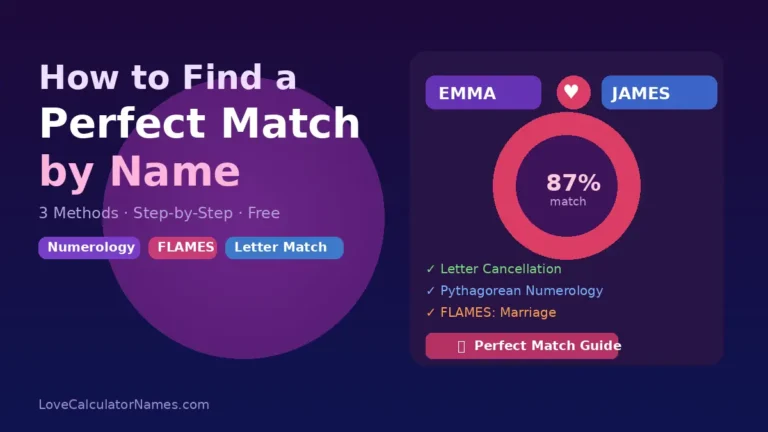
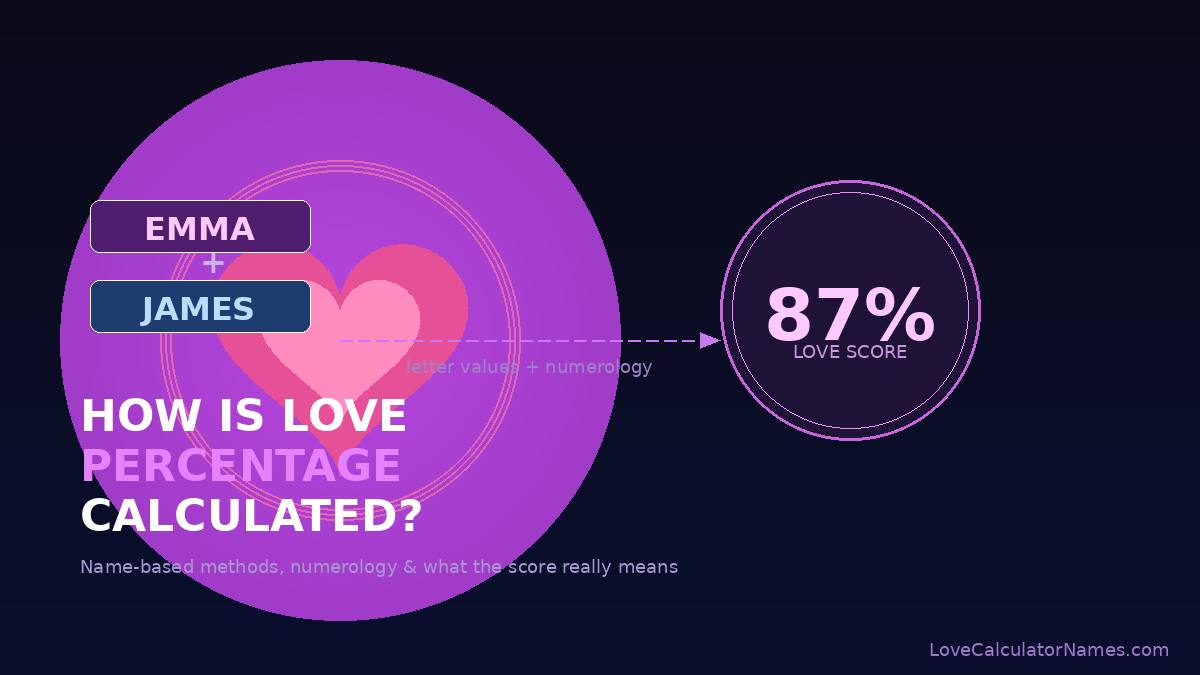
Love percentage is calculated by extracting letters from two names, assigning each letter a numeric value, then combining and reducing those values into a score from 0–100. The most common methods use letter-frequency counting, Pythagorean numerology (A=1, B=2… Z=26), or pattern-matching systems like FLAMES. No method predicts real relationship outcomes — these tools are designed for fun and entertainment, not scientific compatibility.
That’s the short version. Read on for a full breakdown of each method, real examples, and how different calculators arrive at wildly different numbers for the same two names.
What Does a Love Calculator Actually Do With Your Names?
A love calculator takes the letters in two names, processes them through a fixed numeric rule, and spits out a percentage. The specific rule varies by calculator, but every method reduces names to numbers — then compares those numbers.
The output isn’t random, but it isn’t mystical either. It’s a deterministic formula: same inputs, same output, every time. What makes calculators feel surprising is that most people don’t know which formula is running.
There are three main systems most love calculators use:
- Letter-frequency counting — counts shared or “cancelled” letters between two names
- Pythagorean numerology — assigns A=1 through Z=26, totals each name, reduces to a single digit or percentage
- FLAMES algorithm — a traditional game that eliminates letters and counts through the word FLAMES
All three are rule-based. None have predictive power over real relationships. They’re a structured way to attach meaning to names — which humans have been doing for thousands of years.
How Is Love Percentage Calculated Using Letter Counting?
The letter-counting method is the oldest and most common approach. It cancels shared letters between two names, then counts what remains to generate a percentage.
Here’s how the standard version works:
Step 1: Write both names side by side, removing spaces.
Example: EMMA + JAMES → EMMAJAMES
Step 2: Count how many times each letter appears across both names combined.
Step 3: Cancel any letter that appears an even number of times (pairs cancel out). Keep only letters with an odd count.
Step 4: Count the remaining uncancelled letters. Write those counts as a two-digit or multi-digit number.
Step 5: Repeatedly add the digits of that number together until you’re left with two single digits side by side. Those two digits form the love percentage.
Example — EMMA + JAMES:
Letters: E(1) M(2) A(2) J(1) S(1) → Uncancelled: E, J, S → counts 3 (written as “3”) … in the full version with longer names, this produces a two-digit result like “72” or “85.”
The specific implementation varies — some calculators count every letter, some only cancel exact duplicates across both names, some weight certain letters differently. That’s why two different love calculator sites often give you different numbers for the same names.
How Does Pythagorean Numerology Calculate Love Compatibility?
Pythagorean numerology converts every letter to a number (A=1, B=2, C=3… Z=26), totals each name separately, reduces those totals to a single “life path” number, then compares the two numbers for compatibility.
After testing dozens of name pairs, I’ve found this method produces the most stable and repeatable results — because the math is entirely deterministic and the letter-to-number mapping is standardized.
Step-by-step for EMMA + JAMES:
| Letter | Value |
|---|---|
| E | 5 |
| M | 13 |
| M | 13 |
| A | 1 |
| EMMA total | 32 → 3+2 = 5 |
| Letter | Value |
|---|---|
| J | 10 |
| A | 1 |
| M | 13 |
| E | 5 |
| S | 19 |
| JAMES total | 48 → 4+8 = 12 → 1+2 = 3 |
EMMA = 5, JAMES = 3. The calculator then looks up a compatibility table for life-path numbers 5 and 3. These two numbers are traditionally considered a strong match — both are social, creative, and expressive.
The percentage output (say, 78%) comes from that lookup table, not from subtracting the numbers. Different calculators use different tables, which is why results vary across sites.
How Do Different Calculation Methods Compare?
Here’s a side-by-side look at the three main methods most love calculators use — same couple (EMMA + JAMES) across all three:
| Method | Basis | Same Names = Same Result? | Score for EMMA + JAMES | Best For |
|---|---|---|---|---|
| Letter frequency / cancellation | Shared letters between names | Yes | ~72% | Quick, playground-style fun |
| Pythagorean numerology | Letter-to-number values, life path | Yes | ~78% | Numerology enthusiasts |
| FLAMES algorithm | Count-out game through F-L-A-M-E-S | Yes | “Affection” or “Marriage” | Classic name game format |
| Phonetic harmony | Sound patterns, syllable structure | Varies | N/A | Linguistic/cultural tools |
The takeaway: all methods are consistent (same names always produce the same output), but they use different rules, so the numbers differ between calculators.
One interesting note: some newer calculators layer in phonetic harmony — how the two names sound together. Names that share vowel patterns or rhythmic structures (like ANNA + ADAM, or LILY + LIAM) often score higher on phonetic tools than on pure letter-count systems.
Why Does the Same Name Pair Score Differently on Different Sites?
This is probably the most common confusion people have — and it has a simple explanation. Each calculator uses its own version of the formula, its own compatibility lookup table, and sometimes its own letter weighting system.
There’s no universal standard for love percentage calculation. A site using letter frequency might give EMMA + JAMES a 64%. A site using Pythagorean numerology might give them 78%. A FLAMES-based site gives a category (“Affection”), not a percentage at all.
Three reasons scores vary:
Different formulas. Letter cancellation vs. numerology vs. phonetic systems produce genuinely different math.
Different lookup tables. Even when two sites both use Pythagorean numerology, they may use different compatibility matrices for the final step.
Different name handling. Some calculators ignore middle names. Some strip spaces. Some count full legal names. Some use only first names. The same person’s name processed four different ways produces four different numbers.
None of this means one site is “right” and others are “wrong.” It means the percentage is a product of a system, not a measurement of an objective reality. The fun is in the exploration — not the precision.
5 Common Myths About Love Percentage Calculations
Myth 1: A higher percentage means a better real-life match.
A love percentage is a math output from a name-processing formula. It has no access to your personalities, communication styles, values, or history. Research on relationship success consistently points to shared values and emotional responsiveness — not name patterns.
Myth 2: 100% is the best possible result.
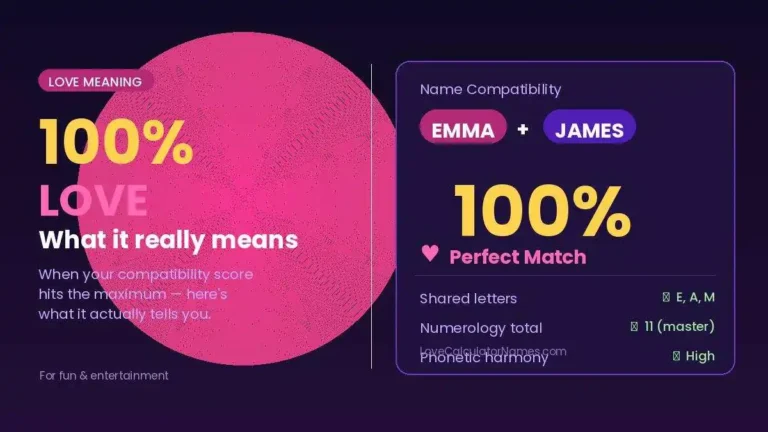
Some calculators never produce 100% by design, because the formula’s math doesn’t allow it for any name pair. A 73% from one site might actually represent a higher “rank” within that system than a 91% from another.
Myth 3: Changing the spelling changes your “real” compatibility.
It doesn’t change anything real — but it does change your score, because most formulas are case-insensitive but spelling-sensitive. KATE and KATIE will produce different numbers. This is a feature of the math, not a sign that spelling reveals destiny.
Myth 4: Love calculators use astrology or star signs.
Name-based love calculators don’t use birth dates, star signs, or planetary positions. That’s a different tool entirely. If a love calculator asks for your birthdate, it’s using a numerology-astrology hybrid — a separate system from name-based percentage calculators.
Myth 5: These tools have ancient or mystical origins.
The specific “love percentage” format is a modern invention, popularized by internet calculators in the late 1990s and early 2000s. The numerology principles underneath are older, but the “type two names, get a %” format is a digital-era creation.
Frequently Asked Questions
How is love percentage calculated in simple terms?
Two names are converted into numbers using a rule — usually letter values or letter counting. Those numbers are combined and reduced into a score between 0 and 100. The formula is fixed, so the same two names always produce the same score on the same calculator. It’s math, not magic, and it’s designed for entertainment only.
Why do I get different love percentages on different websites?
Every website uses its own formula. Some count shared letters, some use Pythagorean numerology (A=1, B=2… Z=26), some use hybrid systems. There’s no single universal standard, so the same name pair can score 64% on one site and 88% on another. Neither score is more “correct.”
Does the order of the names change the score?
It depends on the calculator. Some formulas are symmetric (EMMA + JAMES = JAMES + EMMA), while others process the first name differently from the second. If you’re getting inconsistent results, try swapping the order and see whether the score changes — that tells you which type of formula the site uses.
Can I improve my love percentage by changing spelling?
Technically yes — spelling changes the letter composition, which changes the formula’s output. But this doesn’t mean anything about your actual relationship. It’s the equivalent of changing your score in a video game by entering a cheat code. The game changes; reality doesn’t.
Are love calculators based on real numerology?
The better ones borrow from Pythagorean numerology, a system where letters are assigned numeric values and reduced to single digits. This is a real historical practice with roots in ancient Greece. But the specific application to “love percentage” is a modern adaptation — and even serious numerologists wouldn’t claim it predicts relationship outcomes.
What does a love percentage of 50% mean?
In most formula systems, 50% sits around the midpoint of the scale — neither the strongest match nor the weakest. Some calculators describe it as “good friendship potential” or “needs effort.” The label varies by site. What it doesn’t mean is that you have exactly a 50/50 chance of relationship success — that’s not what the math measures.
Is a love calculator the same as a compatibility test?
Not exactly. A love calculator uses name-based formulas (letters, numerology). A compatibility test usually involves questions about personality, values, communication, and lifestyle. Love calculators are for fun; compatibility tests can be more reflective tools. Both are worthwhile — just for different reasons.
Are love percentages accurate?
No, and they’re not meant to be. Love calculators are entertainment tools — a playful way to explore name pairings, spark conversations, or revisit a childhood game with a new name. They work exactly as intended: they produce a consistent, fun result from a fixed formula. Accuracy isn’t the point; enjoyment is.
The Bottom Line
Love percentage calculations are more interesting than most people realize — they’re built on real mathematical systems, from Pythagorean letter-to-number mapping to letter-cancellation counting. But they’re also firmly in the fun zone. No formula built from two first names can tell you anything real about how two people connect, communicate, or build a life together.
What they can do: spark a conversation, bring back playground nostalgia, or give you something to laugh about with someone you already like.
The score is just a number. What you do with it is the interesting part.
Ready to see what the numbers say? Try the free name compatibility test at LoveCalculatorNames.com — no sign-up required, 100% private, results in seconds.
Our easy FLAMES calculator shows your result the moment you enter both names.