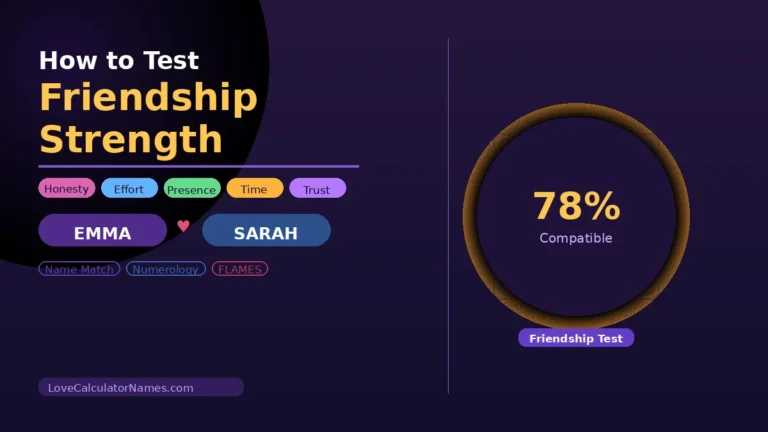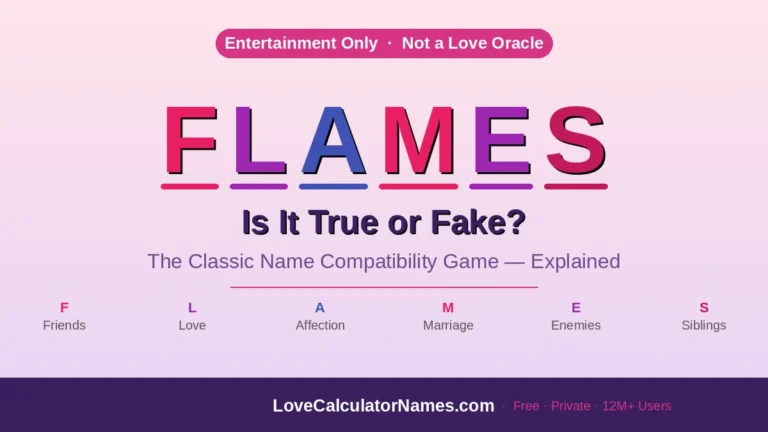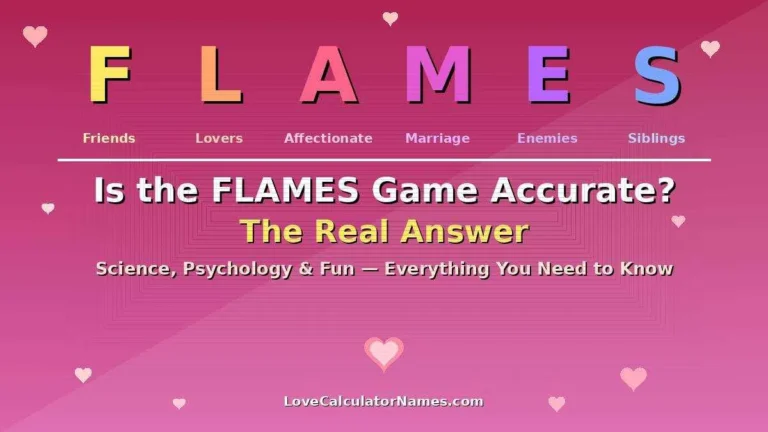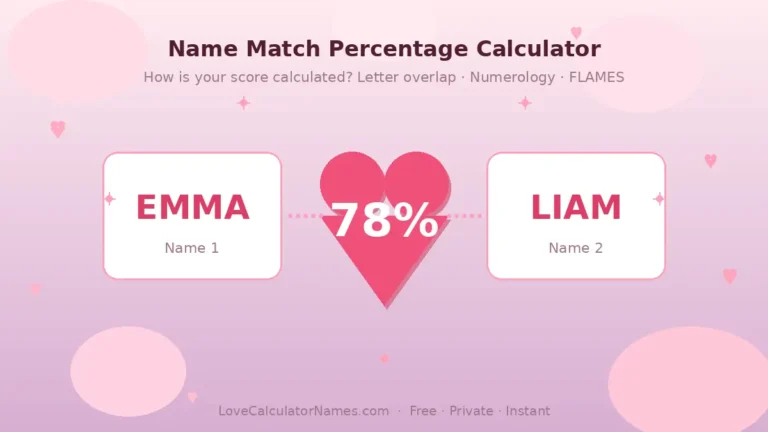
You’ve typed two names into a search bar and wondered: could this actually mean something? It’s one of the most searched compatibility questions on the internet — and for good reason. Name-based matching has been around in some form for centuries, showing up in playground games, wedding astrology, and modern love calculators.
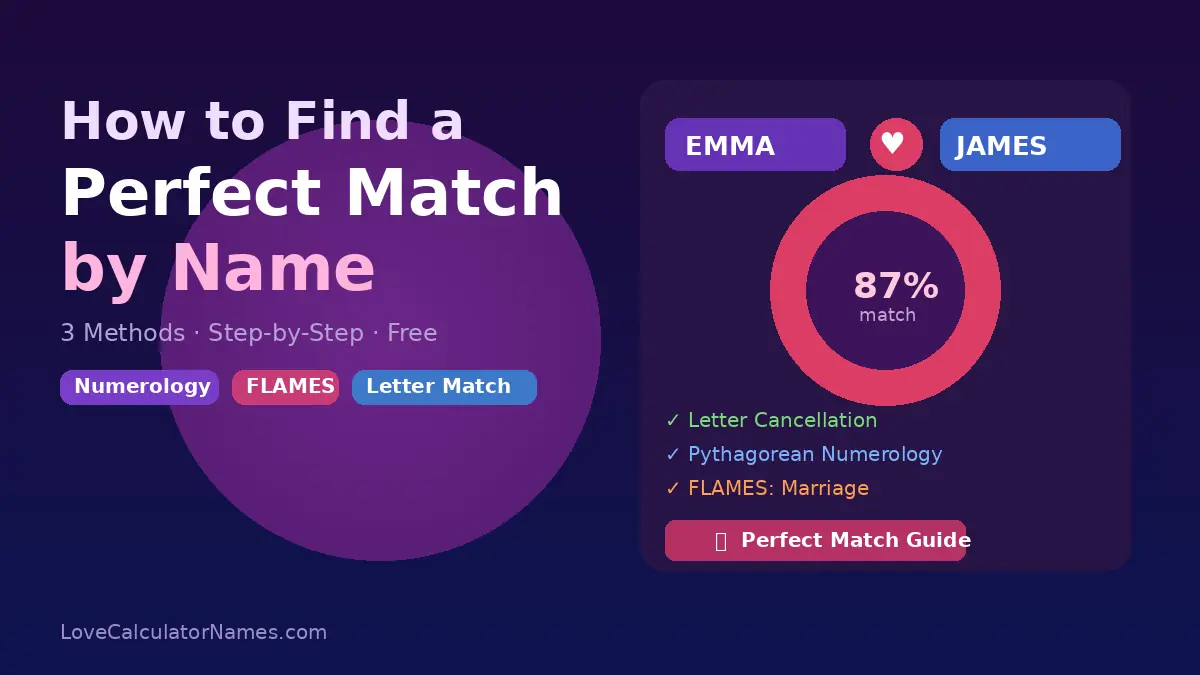
To find a perfect match by name, you compare names using one of three main methods: letter-frequency cancellation (which counts shared letters), Pythagorean numerology (which converts letters to numbers and compares totals), or FLAMES (a count-out game that spells out relationship outcomes). Each method produces a different result. None of them predict the future — but they’re a surprisingly revealing way to spark a conversation or learn something about the numerology behind your names.
This guide walks through each method, shows you exactly how the math works, and explains what the results actually mean.
Quick note: Name compatibility tools are designed for entertainment. They’re a fun framework for exploring connections — not a scientific relationship test.
What Does It Mean to Find a “Perfect Match” by Name?
A perfect match by name means your names score highly on a compatibility method — typically 80–100% on a love calculator, a “Marriage” result in FLAMES, or matching destiny numbers in numerology. It doesn’t mean you’re destined for a relationship. What it does mean is that the letter patterns, phonetic sounds, or numerical values in your names align according to a specific calculation system.
Different methods define “perfect” differently. In letter-cancellation calculators, a 100% score means every letter in one name has a counterpart in the other. In Pythagorean numerology, certain number pairs (like 2 and 6, or 1 and 9) are considered highly compatible. In FLAMES, “Marriage” is often treated as the best outcome — though “Lovers” runs a close second depending on who you ask.
The idea traces back thousands of years. Ancient Indian naming traditions (called namakarana) used letter and sound analysis to match families and partners. Medieval European onomancy assigned number values to names to predict compatibility. The modern love calculator is a digital version of the same impulse: people have always wanted to know if the names fit.
How Do You Calculate Name Compatibility Step by Step?
The simplest method is letter-frequency cancellation — the system most online love calculators use. You write out both names, cross off matching letters one pair at a time, then calculate a percentage from what’s left. It takes about two minutes with a pencil, or two seconds with a calculator.
Here’s how it works for EMMA and JAMES:
Step 1: Write both names in full capitals.
EMMA + JAMES
Step 2: List every letter in both names together.
E, M, M, A, J, A, M, E, S
Step 3: Cross off pairs of matching letters (one from each name at a time).
- E (EMMA) ↔ E (JAMES) ✓
- M (EMMA) ↔ M (JAMES) ✓
- A (EMMA) ↔ A (JAMES) ✓
Step 4: Count the letters remaining after all matches are crossed out.
Remaining: M, J, S = 3 letters
Step 5: Count the total letters in both names combined.
EMMA (4) + JAMES (5) = 9 total
Step 6: Calculate the score.
Score = (1 − remaining/total) × 100 = (1 − 3/9) × 100 = 67%
Some calculators handle this differently — they count matched pairs as a proportion of the longer name, or weigh shared letters by position. That’s why the same names can return 67% on one site and 74% on another. The underlying principle is the same; the formula varies.
What Do the Numbers Actually Tell You About Name Compatibility?
Name compatibility scores reflect letter overlap and numerical patterns — not emotional chemistry. But the numbers aren’t meaningless either. Higher scores generally indicate more shared phonetic and structural patterns between names, which some researchers in onomastics (the study of names) link to how easily people remember and relate to each other.
Here’s how the main methods compare:
| Method | What It Measures | Consistency Across Sites | Best For |
|---|---|---|---|
| Letter-frequency cancellation | Shared letters between names | Low (formula varies) | Quick compatibility check |
| Pythagorean numerology | Destiny number harmony (A=1 to Z=9 system) | Medium | Deep name meaning |
| FLAMES count-out | Relationship category (Friends/Lovers/Affection/Marriage/Enemies/Siblings) | High (fixed rules) | Fun group game |
| Phonetic harmony | Sound and rhythm patterns between names | Low (subjective) | Cultural/wedding matching |
| Life Path numerology | Birth date number vs. name number | Medium | Broader life context |
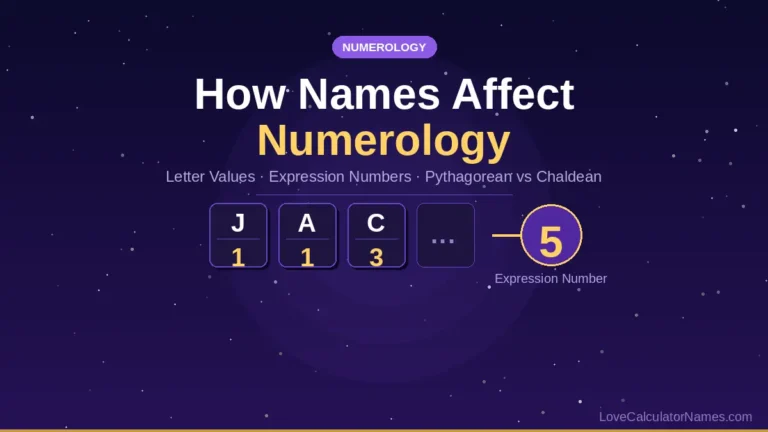
The letter-cancellation method is the most common because it’s fast and intuitive. Pythagorean numerology takes more steps but gives you a richer picture — it can tell you your destiny number (the sum of all letter values in your full name, reduced to a single digit) and compare it to your partner’s.
For example, EMMA = 5 + 4 + 4 + 1 = 14 → 1 + 4 = 5. JAMES = 1 + 1 + 4 + 5 + 1 = 12 → 1 + 2 = 3. The 5 and 3 pairing is considered harmonious in Pythagorean numerology — both are flexible, creative numbers that tend to complement rather than clash.
Famous name pairings people often check: Taylor and Travis, Emma and Ryan, Olivia and Harry. The names don’t determine the relationship, but the patterns people find often get shared because they feel meaningful — which is exactly what makes this kind of matching so hard to put down.
What Are the Biggest Myths About Finding a Match by Name?
Most people assume name compatibility is either completely scientific or completely made up. Neither is quite right. The truth is more interesting — and easier to work with.
Myth 1: A high score means you’re meant to be together. Score percentages reflect letter or number overlap, not emotional chemistry. Two people with a 95% score can be completely incompatible in real life. The score is a starting point for curiosity, not a verdict.
Myth 2: Spelling doesn’t matter. It matters a lot. EMMA and EMMA-ROSE give different numerology results. RYAN and RYAN JAMES are completely different in a letter-cancellation calculation. Always use the name as it’s actually used day-to-day — not a nickname or a full legal name if that’s not how the person goes by it.
Myth 3: The same names always give the same score. They don’t, because different sites use different formulas. One calculator might count total letters; another might only count unique letters. One might use the Chaldean numerology system (where letter values go up to 8); another uses the Pythagorean system (1 through 9). Your results are consistent within one tool — not across all tools.
Myth 4: “Marriage” in FLAMES means you’ll get married. FLAMES is a letter count-out game, not a prediction. The result cycles through outcomes depending purely on how many letters remain after cancellation. There’s no interpretive judgment involved — it’s arithmetic. Getting “Marriage” just means the math landed on M.
Myth 5: A low score means you’re not compatible. Some numerologists would actually argue that contrasting numbers create better balance. A 1 (independent, driven) paired with a 2 (collaborative, sensitive) might “clash” mathematically but work well practically because they fill in each other’s gaps. The score is a lens, not a limit.
Frequently Asked Questions
How do I find my perfect match by name for free? Type both names into a free love calculator — no account needed. The tool uses letter-frequency cancellation or Pythagorean numerology to produce a compatibility score and often a relationship category. Results are instant, private, and work for any two names. Try it at LoveCalculatorNames.com.
What is the best method to find a name match? It depends on what you want. Letter-frequency cancellation is the fastest and most common. Pythagorean numerology gives a deeper picture of name meaning. FLAMES is the most fun for groups. If you want a single number you can compare across names, numerology is the most consistent method.
Can you find a perfect match using first names only? Yes — most love calculators work with first names alone. Adding middle or last names will change the result because they add or remove letters. First-name-only results are perfectly valid for casual compatibility checking. Use whatever version of the name feels natural.
Does the order of names matter in a compatibility test? In letter-frequency cancellation, no — the letters are pooled together regardless of order. In FLAMES, technically no, but the cancellation process starts from the beginning of each name, so very occasionally order affects intermediate steps. In Pythagorean numerology, each name is calculated independently, so order doesn’t change the result.
What score counts as a perfect match by name? Most calculators treat 80–100% as a strong match. A score of 100% means every letter in one name has a counterpart in the other — which is rare for different names. In practice, scores in the 70–85% range are common for name pairs people feel a strong connection with. The score is one signal, not the whole picture.
Why do different websites give different scores for the same names? Every site builds its own formula. Some count all letters; others count unique letters. Some use Pythagorean numerology; others use Chaldean. Some factor in middle names; others don’t. The difference between a 67% and a 78% score for EMMA + JAMES usually comes down to one of these variables — not an error.
Is name compatibility based on science? The calculation methods have roots in ancient numerology and onomastics, not modern peer-reviewed science. Research on implicit egotism (Pelham, Mirenberg & Jones, 2004) suggests people are drawn to those whose names resemble their own — but this is a broad statistical pattern, not a compatibility formula. Name compatibility tools are for entertainment.
What if I get “Enemies” in FLAMES — does that mean bad news? No. FLAMES results are determined by arithmetic — count, cancel, repeat. “Enemies” just means the math landed on E. There’s no psychological or predictive meaning attached. Many couples who “get” Enemies in FLAMES have strong, lasting relationships. If anything, it’s a good excuse to laugh about it together.
What Your Name Compatibility Score Is Really Telling You
Name compatibility methods — whether letter cancellation, numerology, or FLAMES — do one thing consistently: they give you a number (or a word) that you can react to. And that reaction? That’s where the real information is.
If you see 87% and feel a quiet thrill of recognition, you’re not learning something about letters. You’re learning something about how you feel. That’s the honest value of these tools. They’re not predictions. They’re prompts.
The three main takeaways from this guide: the same names score differently across methods, so try more than one; spelling and full name choice affect the result significantly; and a “perfect match” score doesn’t guarantee anything — but a low one doesn’t disqualify anything either.
Ready to run the numbers? Try the free name compatibility test on LoveCalculatorNames.com — no sign-up, 100% private, results in seconds.
See how well your names match with our simple name match tool today.