Ever plugged two names into a love calculator and stared at the result wondering, is that good? You’re not alone. Millions of people get their score and immediately want to know whether to feel thrilled or disappointed.
A good love percentage score is generally anything above 70%. Scores in the 70–89% range suggest strong name compatibility based on the calculator’s algorithm — whether that’s numerology, letter-value matching, or the classic FLAMES method. A score of 90% or higher is considered excellent. Scores below 50% are usually seen as low. These tools are designed for fun and entertainment, not relationship science.
Here’s what every score range actually means — and why the number matters less than you might think.
What Do Love Percentage Scores Actually Mean?
A love percentage score is a number between 0 and 100 generated when you enter two names into a compatibility tool. Most calculators assign it using letter-value systems, numerological formulas, or FLAMES-style logic. The score represents name-based compatibility in a playful, lighthearted way — not a prediction of actual relationship success.
Think of the number as a conversation starter, not a verdict. Like a fortune cookie: fun to read, occasionally thought-provoking, and best taken with a smile.
Name-based compatibility has a surprisingly long history. Numerology — assigning meaning to numbers derived from letters — dates back to ancient Greece and has been woven into Chinese, Indian (Vedic), and Hebrew (Gematria) traditions for centuries. When someone sits down to build a love calculator, they’re drawing on that long cultural thread. The tool might be on your phone screen, but the idea behind it is genuinely ancient.
What a love percentage score doesn’t measure:
- How well you communicate under pressure
- Whether you share the same life goals
- How you handle conflict
- Physical and emotional attraction
- Whether you make each other laugh
Those things only emerge from actual time spent together. No algorithm captures them from a pair of names — and any tool that claims otherwise isn’t being straight with you.
The value of a love percentage score is much simpler: it’s a fun prompt. It gives you a reason to think about someone, something to laugh about with a friend, and sometimes — just sometimes — a result that perfectly captures how you’re already feeling.
What Is Considered a High, Medium, or Low Score?
Most name compatibility tools use a 0–100 scale. Here’s how those ranges are typically interpreted across popular love calculators:
| Score Range | Label | What It Usually Suggests |
|---|---|---|
| 90–100% | Excellent | Very high name compatibility; the algorithm sees strong alignment |
| 70–89% | Good | Solid compatibility; the sweet-spot range most users hope for |
| 50–69% | Average | Mixed signals; neither clearly compatible nor clearly incompatible |
| 30–49% | Low | The names don’t resonate strongly under the formula used |
| 0–29% | Very Low | Poor alignment according to the algorithm’s specific logic |
The 70–89% range is where most users feel satisfied with their result. It’s meaningful without feeling artificially perfect, and it leaves room to believe the connection is real rather than just mathematically convenient.
It’s worth knowing that different calculators will give different numbers for the exact same two names. That’s not a glitch — it’s just a reflection of how many ways there are to interpret name compatibility. One tool might weight vowel sounds heavily; another focuses on the numerological value of each letter; a third runs a FLAMES calculation. Same names, different results. Both are “correct” within their own system.
If you’ve tried multiple calculators and gotten wildly different scores, you haven’t found a contradiction. You’ve found a reminder that the number itself is less important than the fun of checking.
How Are Love Percentage Scores Calculated?
Love calculators generate scores by applying one of several algorithmic methods to the letters in two names. The most common approaches are letter-value numerology, phonetic harmony scoring, and FLAMES — and each one produces a different kind of result from exactly the same input.
Here are the four methods you’re most likely to encounter:
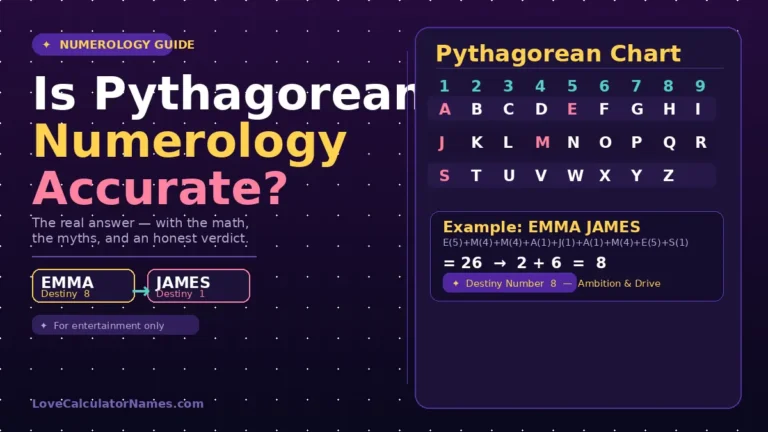
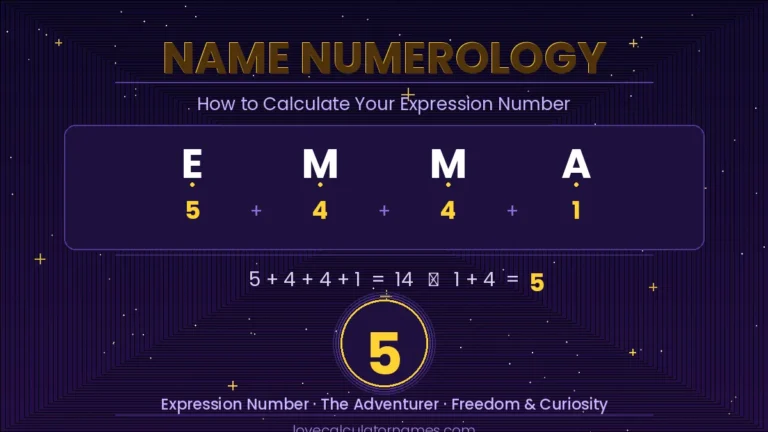
- Letter-value numerology — Each letter gets a number. In the simplest version, A=1, B=2, C=3, and so on. In Pythagorean numerology (the most common system), letters cycle through 1–9: A/J/S=1, B/K/T=2, C/L/U=3, and so on. The values for both names are summed, reduced to a single or double digit, and compared to produce a compatibility figure.
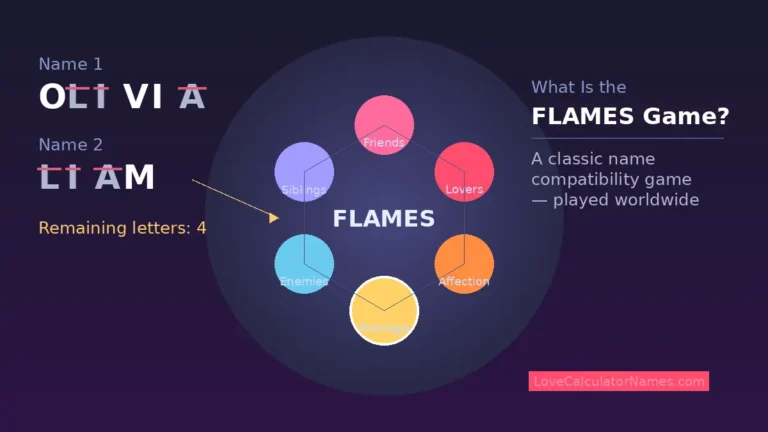
- FLAMES method — This is the old-school pencil-and-paper game many people remember from school. FLAMES stands for Friends, Love, Affection, Marriage, Enemies, Siblings. You write both names, cross out any letters they share, count the remaining letters, and eliminate categories one by one based on that count. Some calculators convert the final FLAMES outcome into a percentage score.
- Phonetic harmony scoring — The sounds in both names are analyzed for rhythmic and tonal compatibility. Names that share vowel sounds or similar consonant patterns tend to score higher. This method draws loosely from the idea that people are naturally drawn to names that feel harmonious when said together — which has some basis in how human names actually work across cultures.
- Combined weighted algorithms — Many modern calculators blend letter values, name length, vowel-to-consonant ratios, and sometimes birth dates into a weighted formula that outputs a single percentage. These tend to feel more sophisticated, though they’re still operating on the same entertainment-first logic.
None of these methods are backed by peer-reviewed relationship science. They’re creative systems built for enjoyment, and they’ve been around for decades because people genuinely like them. There’s something satisfying about a number — even a playful, arbitrary one.
What About Astrology or Birthdate Combinations?
Some calculators go further and incorporate astrological signs or birthdates alongside names. These hybrid tools draw on a wider range of traditional compatibility frameworks — the idea that a Leo and a Sagittarius have natural fire-sign harmony, for example, or that certain life path numbers in numerology align more naturally than others.
If you use a tool like this, your score reflects the combination of name-based and astrology-based inputs. The percentage may shift significantly compared to a name-only calculator. Neither approach is more “accurate” — they’re just measuring different things within their respective frameworks.
Does a Low Score Mean You’re Not Compatible?
A low love percentage score does not mean you and someone aren’t compatible. The score reflects how two names interact within a specific algorithm — not how two people interact in real life.
This is the most important thing to understand about any love calculator result, and it deserves a bit more space than most articles give it.
Think about some famous couples and how their names would play out on a basic letter-value calculator. “Taylor” and “Travis” share multiple letters and a similar rhythmic structure — they’d score reasonably well on a phonetic tool. But “John” and “Yoko” are phonetically quite different and use almost no shared letters. By some metrics, that pair would score low. The actual relationship? One of the most talked-about love stories of the 20th century.
The point isn’t that love calculators are useless — it’s that the score exists in its own playful dimension. It doesn’t overlap with the dimension where real relationships happen.
Five common misconceptions about love percentage scores:
Myth 1: A higher score means a better relationship.
Real compatibility comes from communication, shared respect, and genuine effort over time. A 95% name score doesn’t create chemistry, and a 42% score doesn’t prevent it. The algorithm has no access to any of the things that actually make relationships work.
Myth 2: Different calculators should give the same score.
They won’t — and that’s completely normal. Each tool uses its own formula. Getting an 88% on one calculator and a 61% on another for the same names isn’t a contradiction; it’s just two different algorithms doing their thing.
Myth 3: The tool is measuring something real about you as a person.
It’s measuring your name, not you. Your name is part of your identity, but it doesn’t capture your sense of humor, your loyalty, your capacity for kindness, or any of the qualities that make someone a good partner.
Myth 4: A score of exactly 50% means things are neutral.
Not necessarily. Some calculators weight their scales so that typical results cluster in a certain range. What counts as “average” varies between tools, and a 50% on one might actually be above the median result that tool typically produces.
Myth 5: You should pick a partner based on their score.
This should go without saying, but: please don’t make real relationship decisions based on a name calculator. These tools are entertainment. Use them for fun, laugh at the results, and then go talk to the actual person.
Why Do People Care So Much About Their Score?
There’s real psychology behind why a simple percentage number grabs our attention. Humans are pattern-seekers by nature — we look for signals about compatibility in astrology, personality tests like Myers-Briggs, and yes, name calculators. Getting a concrete number feels meaningful. It gives us something to react to.
Research on interpersonal attraction suggests people often use outside signals to confirm or question feelings they already have. If you’re excited about someone and get an 88%, it feels validating. If you’re uncertain and get a 34%, it can feel like confirmation of your doubts — even if the number came from a formula that has nothing to do with either of you.
That’s not a flaw in how we think. It’s just how humans process uncertainty about something as emotionally charged as romantic compatibility.
After testing dozens of name pairs across different calculators, I’ve noticed something consistent: people almost always remember the score that matched how they felt at the time. The number gets filtered through emotion, not the other way around. We interpret the result through the lens of what we’re already feeling.
That’s actually a useful thing to know. If you get a high score and feel excited, that excitement is real — the calculator just gave it a shape. If you get a low score and feel relieved, that relief is telling you something too. The number is a mirror, not an oracle.
The Cultural Staying Power of Name Compatibility
Name-based compatibility hasn’t stayed popular for decades by accident. In Chinese naming traditions, certain character combinations carry luckier or more harmonious energy than others — parents often consult a naming expert before finalizing a baby’s name. In Vedic astrology, the sounds in a person’s name are believed to carry vibrational energy that can harmonize or clash with another person’s name energy.
In Western contexts, numerology-based name compatibility has been a staple of popular culture since at least the mid-20th century. The FLAMES game was a playground staple long before the internet existed. Love calculators just digitized something people had been doing with pencils and paper for generations.
The fact that a love percentage tool now fits in your pocket and delivers an instant result doesn’t change what it is: a culturally rich, centuries-old idea about the meaning hidden in names, made fun and accessible.
Frequently Asked Questions
What is a good love percentage score on a love calculator?
A score of 70% or above is generally considered good on most name-based love calculators. Scores between 70–89% suggest strong name compatibility within the algorithm’s framework, and 90%+ is typically labeled excellent. These scores are for fun and entertainment — they don’t predict real-world relationship outcomes or measure actual personal compatibility.
Is a 50% love score bad?
Not necessarily. A 50% score sits in the middle of the scale and is typically labeled “average” or “moderate” compatibility. It doesn’t mean a relationship won’t work — it just means the two names didn’t align strongly within that tool’s specific formula. Many real couples with wonderful relationships would land around this range.
Why do different love calculators give different scores for the same names?
Each calculator uses a different algorithm — some rely on Pythagorean letter-value numerology, others use phonetic harmony scoring or FLAMES-based logic. There’s no universal compatibility formula, so two tools will almost always produce different results for the same pair of names. The variation is expected and doesn’t mean one tool is more accurate than another.
Can I trust a love calculator for relationship advice?
Love calculators are entertainment tools, not relationship counselors. They’re a fun way to explore name compatibility through numerology and similar systems, but they shouldn’t influence actual relationship decisions. For genuine relationship guidance, talking with a trusted friend, counselor, or therapist is always more useful than any score.
What does a 100% love score mean?
A 100% score means the two names aligned perfectly within that calculator’s specific algorithm. It’s the highest possible result and is relatively rare on most tools. It’s a great result to celebrate — but it carries the same disclaimer as every other score. It’s measuring name patterns, not real personal chemistry.
What is the FLAMES method and how does it relate to love scores?
FLAMES stands for Friends, Love, Affection, Marriage, Enemies, Siblings. It’s a pencil-and-paper name game where shared letters are crossed out and the remaining count determines a category. Many digital love calculators are built on FLAMES logic or convert its outcome into a percentage. It’s one of the oldest name-matching games and has been popular in schools worldwide for decades.
Does the order of names affect the love percentage score?
On some calculators, yes. If the algorithm processes Name A + Name B differently from Name B + Name A, the scores may differ slightly. Many modern tools are built to return the same result regardless of order, but it’s worth trying both combinations if you’re curious about the difference.
Is a 70% love score good enough for marriage compatibility?
Within the context of a name-based tool, 70% is a solid result that most calculators label as good compatibility. For actual marriage compatibility, however, communication, shared values, emotional maturity, and mutual respect matter far more than any algorithm’s output. Use the score as a fun starting point — not a decision-making framework.
The Bottom Line on Love Percentage Scores
A good love percentage score is one that makes you smile — but the real story is always more interesting than a number.
Here are the key takeaways:
- 70% and above is generally considered good; 90%+ is excellent on most calculators.
- Scores vary between tools because each one uses its own formula — that’s expected, not a flaw.
- Low scores don’t predict relationship failure, and high scores don’t guarantee success.
- Name-based compatibility has deep cultural roots, from Vedic numerology to childhood FLAMES games — modern love calculators are the latest chapter in a very old tradition.
The best thing about love percentage scores is what they make you do: think about someone, laugh with a friend, or just take a moment out of a busy day to wonder about connection. That curiosity is worth something on its own.
Ready to see your score? Try the free name compatibility test at LoveCalculatorNames.com — no sign-up required, 100% private, and completely free.
Use our free name test to explore how two names connect with each other.