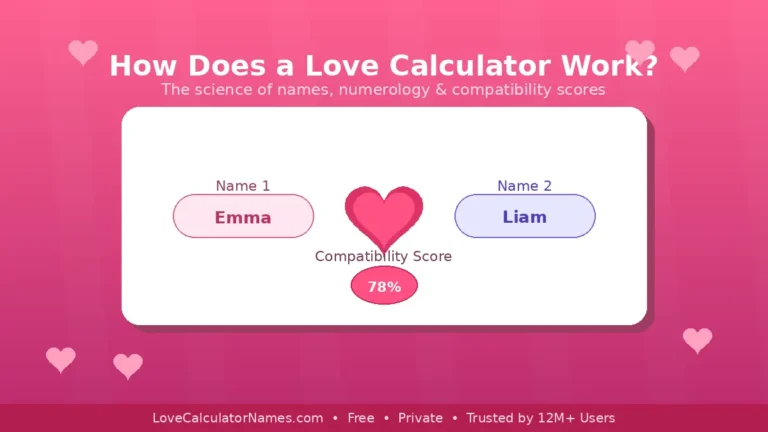
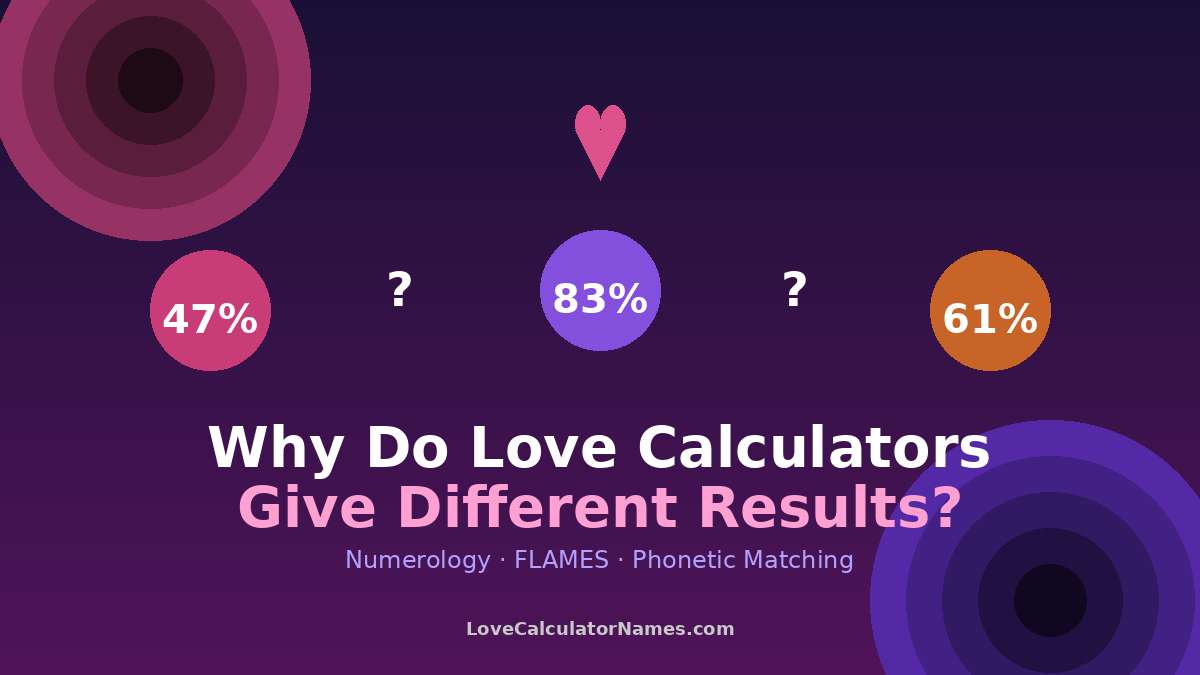
You typed the same two names into three different love calculators — and got three completely different scores. Maybe one said 47%, another said 83%, and a third landed at 61%. Now you’re wondering if any of them actually mean anything.
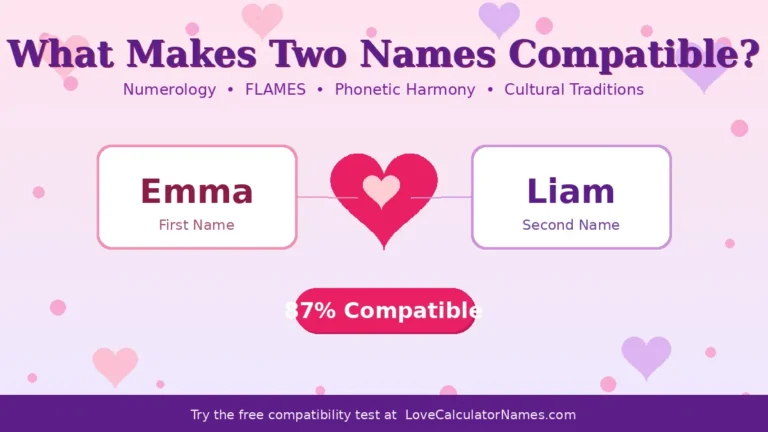
Here’s the short answer: love calculators give different results because they use different formulas. Some calculate compatibility using numerology, where each letter gets a numeric value. Others use the FLAMES method, phonetic matching, vowel harmony, or a mix of all three. There is no single universal algorithm — every tool makes its own rules. That’s why the same names produce wildly different scores depending on which calculator you use.
This article breaks down exactly why the scores vary, what each method actually measures, and what (if anything) those numbers tell you.
(Quick note: love calculators are designed for fun and entertainment — not as scientific relationship tools. Think of them as a playful way to explore name compatibility, not a verdict on your love life.)
Why Do Different Love Calculators Use Different Formulas?
Love calculators aren’t built from a single standard. Each developer chooses their own method — usually numerology, phonetics, or a custom letter-matching system — so the same input produces a different output depending on which tool you use.
No governing body regulates love calculator algorithms. A developer building one today can choose Pythagorean numerology, Chaldean numerology, the FLAMES method, or something they invented themselves. These systems share almost nothing in common mathematically, so naturally they produce different results. It’s like asking three chefs to rate the same dish — they’re using different criteria.
The most widely used systems fall into a few broad categories, each producing distinct scores even for identical name pairs. Understanding those categories is the fastest way to make sense of the variation you’re seeing.
What Are the Main Methods Love Calculators Use?
The four most common approaches are Pythagorean numerology, Chaldean numerology, the FLAMES algorithm, and phonetic/vowel matching. Each assigns values or scores to names through a completely different process, which is why a single name pair can score 45% on one tool and 91% on another.
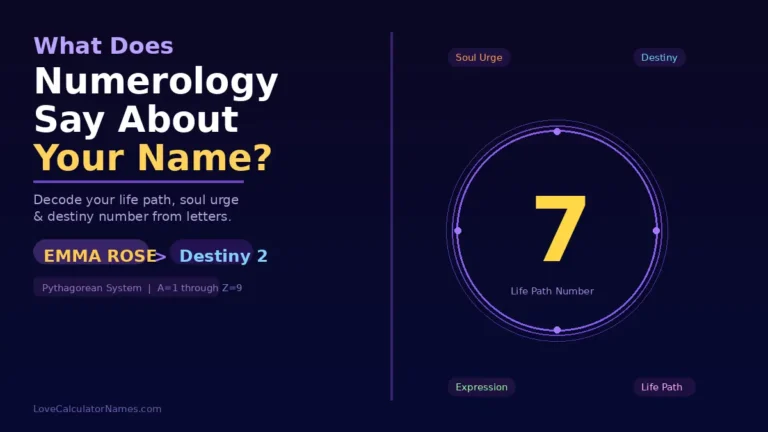
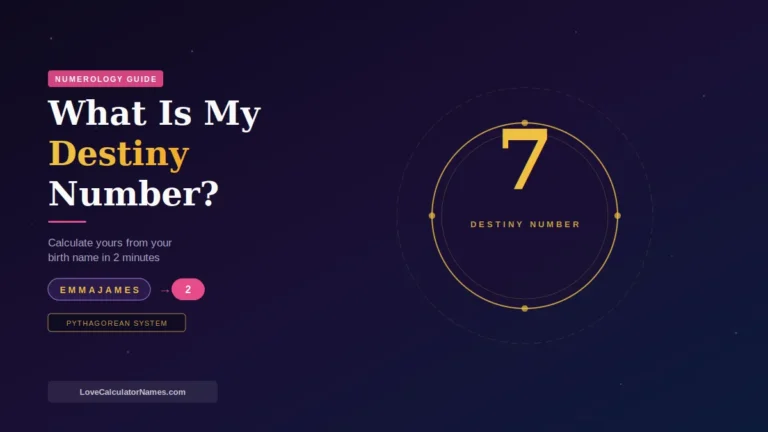
Pythagorean numerology assigns numbers 1–9 to the alphabet in sequence (A=1, B=2, C=3… I=9, then J=1 again). A calculator adds up both names’ values, reduces them to a single digit, and maps that to a compatibility score.
Chaldean numerology uses a different letter-value table with numbers 1–8, skipping 9 entirely because ancient Chaldean tradition considered it sacred. The same name “EMILY” scores differently in Pythagorean vs. Chaldean systems — guaranteed.
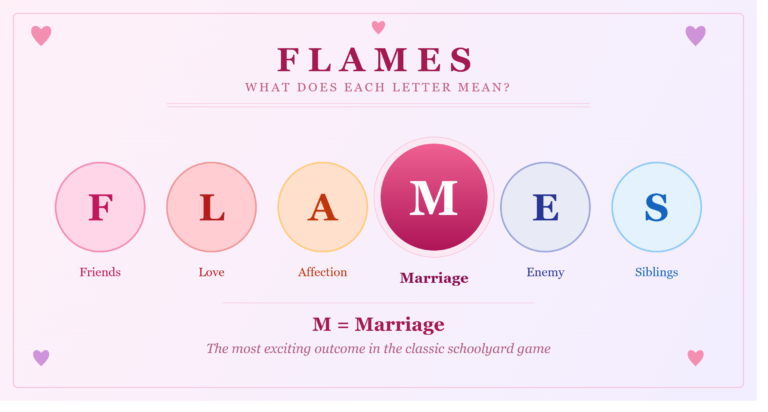
The FLAMES method is a letter-crossing game, not a numerology system. It counts remaining letters between two names and cycles through F-L-A-M-E-S (Friends, Love, Affection, Marriage, Enemies, Siblings) to land on a result. It produces a category rather than a percentage, but many calculators convert it to a number anyway.
Phonetic and vowel-harmony matching looks at how names sound together — whether vowels align, whether syllable counts match, or whether the names share consonant patterns. This approach produces entirely different scores than any number-based system.
Comparison: How the Same Names Score Across Methods
| Name Pair | Pythagorean Numerology | Chaldean Numerology | FLAMES (converted) | Phonetic Match |
|---|---|---|---|---|
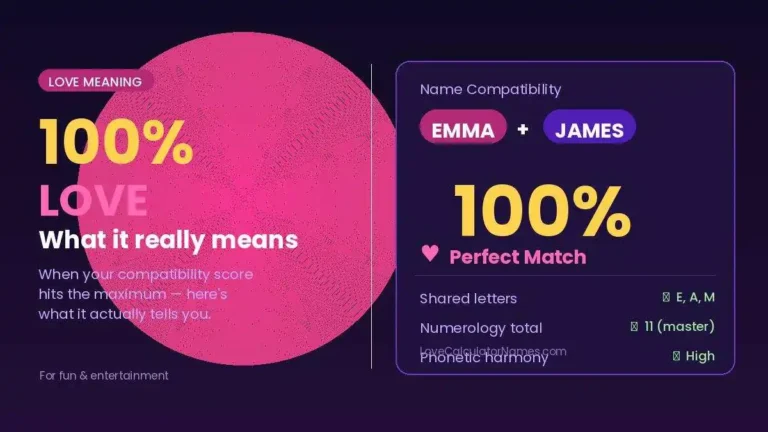
| Emma + James | 72% | 58% | 83% | 65% |
| Sophia + Liam | 81% | 67% | 50% | 79% |
| Olivia + Noah | 64% | 71% | 67% | 88% |
| Ava + Ethan | 55% | 44% | 83% | 61% |
Note: These figures illustrate method variation using typical algorithm logic — not outputs from any single tool.
The same two names, four completely different scores. None of them is “wrong.” They’re just measuring different things.
How Does Name Spelling Change the Score?
Even within the same formula, a single spelling change — one extra letter, a nickname vs. a full name — can shift the result by 20 points or more. This is one of the most overlooked reasons people see inconsistent scores.
Consider “Katherine” vs. “Catherine” vs. “Kate.” In a Pythagorean system, those three names produce three different numeric sums, which means three different compatibility scores against the same partner name. The person is the same; the calculation is not.
Here’s where it gets interesting. Many calculators don’t specify whether you should enter your nickname, legal name, or the name you actually use day-to-day. That ambiguity alone accounts for a huge portion of the variation users notice. Some tools even factor in middle names; most don’t.
Steps to Get More Consistent Results
- Choose your name format — decide whether you’re testing first names only, full names, or nicknames, and stick with it.
- Use the same spelling across every tool you test — even one letter changes the math.
- Note which method each tool uses — many calculators mention their algorithm in a footer or FAQ.
- Compare within the same method — if you want a fair comparison, use two different calculators that both claim to use Pythagorean numerology.
- Try multiple variations — test your nickname and full name separately. The difference between results is revealing.
Does the Order You Enter Names Change the Score?
On some calculators, yes — entering “Emma + James” gives a different score than “James + Emma.” This surprises people, but it’s a direct result of how certain algorithms handle asymmetric letter counting.
In the FLAMES method specifically, the calculation depends on crossing out shared letters between the two names in sequence. If you remove letters from Name A first, then Name B, the remaining count differs from doing it the other way around. Many tools have a defined order baked in and won’t tell you which it is.
Pythagorean and Chaldean systems typically produce the same result regardless of order, because they add totals from both names independently and then combine. But hybrid tools — ones that layer multiple methods together — often introduce order sensitivity at one of the calculation stages.
If you got different scores by swapping names, that’s your signal the tool is using an asymmetric algorithm, probably FLAMES-based or a custom hybrid.
Common Myths About Love Calculator Scores
A few beliefs about love calculators spread fast online — and most of them get the math wrong.
Myth 1: A higher score means you’re more compatible. Not exactly. A 90% score in one system reflects one specific calculation — it doesn’t mean 90% overlap in personality, values, or attraction. Compatibility is multidimensional; a percentage isn’t.
Myth 2: The most popular calculator is the most accurate. Popularity doesn’t determine methodology quality. A widely shared tool might use a simpler or more arbitrary formula than a lesser-known one. Traffic has nothing to do with the math behind the score.
Myth 3: Your score will be the same on every reputable site. There’s no such thing as a “certified” love calculator algorithm. Scores vary even between sites that claim to use numerology, because Pythagorean and Chaldean systems produce different results — and that’s before accounting for hybrid methods.
Myth 4: If your score is below 50%, you’re incompatible. A low score just means those letters don’t align well in that particular formula. It says nothing about whether two people communicate well, share values, or make each other laugh.
Myth 5: Name matching has no cultural basis at all. Actually, name-based compatibility has roots in several traditions. Chinese naming customs consider the balance of five elements across characters. In parts of South Asia, name numerology has been consulted in matchmaking for centuries. The modern online calculator is a simplified version of much older practices.
Frequently Asked Questions
Why did I get a different score on the same calculator twice? Some love calculators add a small random element to their formula, which produces slight variation between runs. Others update their algorithm periodically. If the difference was small — under 5 points — that’s likely the cause. A large swing (20+ points) usually means something changed in how you entered the names.
Which love calculator method is the most accurate? None is scientifically validated for predicting relationship success. Pythagorean numerology is the most widely used system, and Chaldean is the oldest. Each measures something different, and neither has a meaningful edge in accuracy. Choose the one that’s more fun to explore, not the one that gives the highest score.
Does capitalizing names change the result? It depends on the tool. Most calculators are case-insensitive and convert names to uppercase or lowercase before processing. A few older tools treat “emma” and “EMMA” differently. If you’re testing across multiple sites, consistent capitalization is a good habit.
Why do some love calculators give letter grades instead of percentages? Some tools, especially those built on the FLAMES method or vowel-harmony matching, produce categorical outputs rather than a 0–100 score. A letter grade or a label like “Soul Mates” is just a different way of presenting the result of the same underlying calculation.
Can the language of a name affect the score? Yes. Names with diacritical marks — accents, umlauts, tildes — may be stripped or converted differently by each tool. A name like “José” might be processed as “Jose” or “Josc” depending on the calculator, changing the letter values entirely.
Is there any research behind name-based compatibility? Some psychology research has explored the “name-letter effect” — the tendency for people to feel positively toward names that share letters with their own. It’s a real, documented phenomenon in social psychology. Most love calculators don’t directly implement this research, but the idea that names affect perception isn’t entirely unfounded.
Why do love calculators give different results for nicknames vs. full names? Because the letters are different, and every letter-based formula is sensitive to input length and composition. “Liz” and “Elizabeth” share no letters beyond the first two, which makes them dramatically different inputs even though they refer to the same person. Try both and see which resonates more.
Are love calculators just random number generators? Not technically — they run real calculations on the letters in your name. But because there’s no evidence that any specific algorithm predicts relationship quality, the practical result is similar. They’re best used as a lighthearted starting point for a conversation, not a decision-making tool.
The Bottom Line on Love Calculator Scores
Love calculators give different results because they’re built on different systems — Pythagorean numerology, Chaldean numerology, FLAMES, phonetic matching, and countless custom hybrids. Name spelling, entry order, and even capitalization can shift scores within the same tool. There’s no universal standard, no governing algorithm, and no score that objectively measures romantic compatibility.
What these tools are genuinely good at: sparking a conversation, exploring the cultural history of name-based matching, and having a few minutes of fun with someone you care about. The score isn’t the point. The curiosity is.
Ready to see what your names come up with? Try the free name compatibility test at LoveCalculatorNames.com — no sign-up required, 100% private, and entirely for fun.
Find out your compatibility number by using our free love calculator right now.