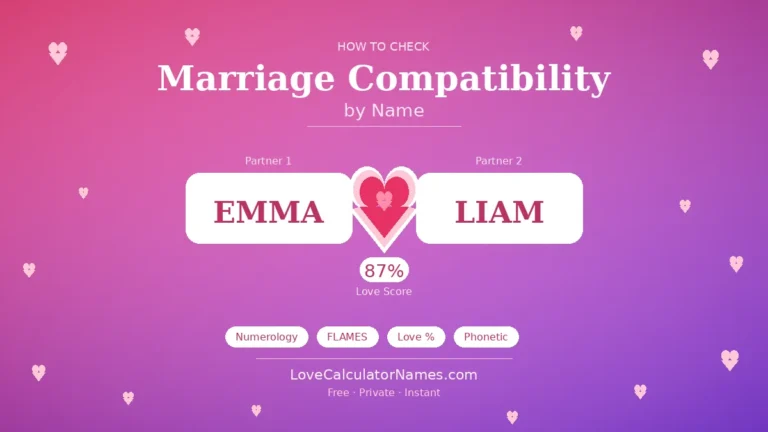
You’ve typed two names into a love calculator and watched the number appear — maybe 47%, maybe 99%. Either way, the same question follows almost immediately: does that number mean anything at all?
No. A calculator cannot measure true love. Love is built on lived experience, emotional depth, shared values, and the kind of trust that takes years to form. No algorithm can capture any of that. But name-based love calculators are not pretending to do so. They use real systems: Pythagorean numerology, the FLAMES method, and phonetic harmony analysis, to generate a fun compatibility score based on two names. The result is entertainment, not prophecy. That is exactly why 12 million people across 150+ countries use tools like these every month.
This article explains what love calculators actually measure, how the math works, and what the numbers are really telling you.
What Does a Love Calculator Actually Measure?
A love calculator does not measure feelings. It analyzes the letters in two names using established mathematical systems to generate a compatibility percentage. Think of it as pattern-matching with a historical pedigree. The tool is not reading your relationship; it is reading your names through a specific numeric lens. Understanding what is behind the score makes the experience more interesting, not less.
Name numerology is the foundation of most love calculators. The system traces back to Pythagoras, the Greek mathematician who believed every number carries an inherent vibrational quality that shapes personality and destiny. In Pythagorean numerology, each letter of the alphabet maps to a number from 1 to 9: A, J, and S equal 1; B, K, and T equal 2; C, L, and U equal 3; D, M, and V equal 4; E, N, and W equal 5; F, O, and X equal 6; G, P, and Y equal 7; H, Q, and Z equal 8; I and R equal 9. A calculator sums all the letter values in each name, reduces the total to a single-digit core number, and compares the two results against a compatibility chart.
The principle is that certain numbers harmonize naturally with each other. The number 2, associated with sensitivity and partnership, is considered highly compatible with 6, associated with nurturing and devotion. Two names that reduce to these numbers will typically produce a high compatibility percentage. This is not mystical; it is a deterministic pattern applied to letters, grounded in a tradition practiced across cultures for over 2,500 years.
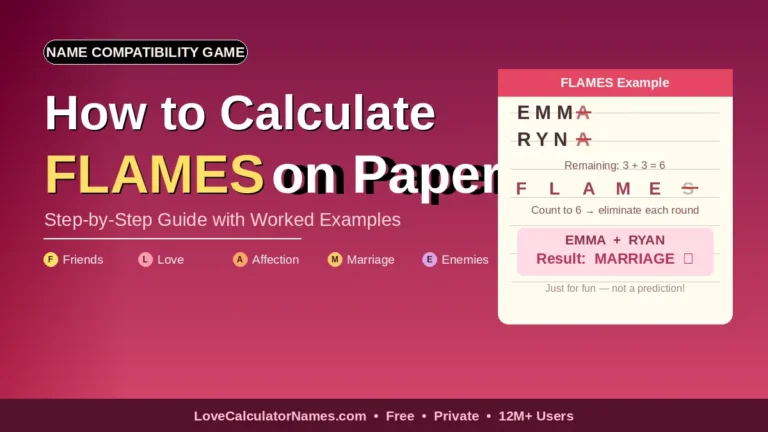
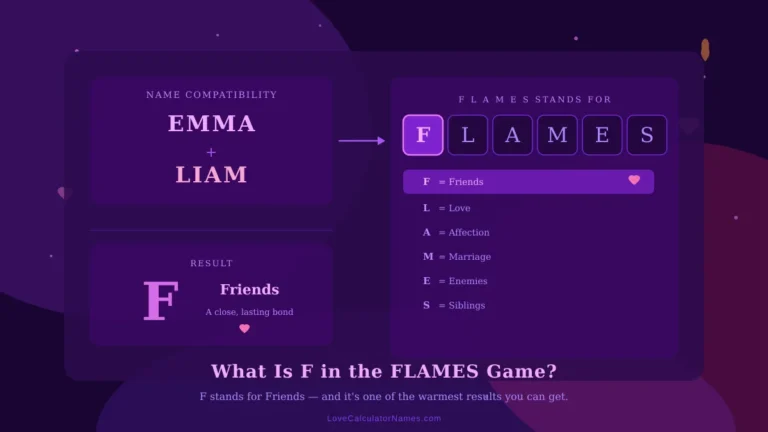
The FLAMES method takes a completely different approach and is one of the most popular formats globally, especially across South Asia, Southeast Asia, and the Philippines. FLAMES stands for: Friends, Love, Affection, Marriage, Enemies, Siblings. The method counts the uncommon letters between two names and uses that count to cycle through the FLAMES categories, eliminating one category at a time until a single one remains.
FLAMES started as a schoolyard game: students scribbled it in notebooks about their crushes. Over decades it spread across cultures, went digital, and became one of the most recognized name-based compatibility formats in the world. What began as a classroom distraction now runs on servers handling millions of queries daily.
Phonetic harmony is a subtler layer that more sophisticated tools layer on top. The sounds of two names, specifically how the vowels and consonants interact when spoken aloud, create either a natural rhythm or a sense of friction. Names ending in open vowel sounds (like “Sofia” or “Maya”) tend to flow smoothly alongside names with strong consonant endings (“James” or “Clark”). Some linguistics research suggests phonetically complementary name pairs feel more natural to say together, which may subtly influence early impressions of a couple. That is a genuine linguistic effect, though a far cry from predicting how a relationship will go.
The question “can a calculator measure true love?” is really asking two separate things at once: Can it assess your actual relationship? No. Does it use a real system? Yes. Both answers matter when evaluating what these tools are worth.
None of these systems are scientific predictors of romantic success. But they are consistent, repeatable, and rooted in traditions that humans have found meaningful for millennia. The real psychology behind their enduring popularity is simple: humans are pattern-seeking. Give someone a number attached to something they care about, and curiosity kicks in immediately. The score becomes a starting point for conversation, and that is its actual value.
How Does a Name Compatibility Calculator Work, Step by Step?
Most name-based love calculators follow a transparent, repeatable process. Two names go in, a compatibility percentage comes out, and the whole calculation takes under a second. The math is internally consistent: enter the same two names tomorrow and you will get the same score. Here is exactly what is happening behind that result.
- Enter both names. The calculator takes the names as typed. Most tools work from first names only; some accept full names for a deeper numerological reading. Capitalization does not matter; the algorithm normalizes all letters before processing.
- Assign letter values. Every letter is mapped to a number from 1 to 9 using the Pythagorean chart. A, J, S = 1; B, K, T = 2; C, L, U = 3; D, M, V = 4; E, N, W = 5; F, O, X = 6; G, P, Y = 7; H, Q, Z = 8; I, R = 9. This chart has been used in numerological practice for centuries.
- Sum the values for each name. All letter values in Name 1 are added together. The same is done for Name 2. Example: “Emma” gives E(5) + M(4) + M(4) + A(1) = 14. “Noah” gives N(5) + O(6) + A(1) + H(8) = 20.
- Reduce to a core number. Multi-digit totals are reduced by adding the digits until a single digit remains. 14 becomes 1+4 = 5. 20 becomes 2+0 = 2. These single digits are the foundation of numerological comparison.
- Compare the core numbers. The two core numbers are measured against a compatibility matrix. In classical numerology, certain pairings are considered harmonious (1 and 5, 2 and 6, 3 and 9, 4 and 8), while others are viewed as challenging. The degree of match determines the percentage output.
- Apply the FLAMES method (if included). Tools that use FLAMES count the letters in both names, remove letters that appear in both names the same number of times, and use the remaining count to cycle through F-L-A-M-E-S, crossing out one category per count cycle until only one remains.
- Display the final result. The algorithm combines all active methods into a single output, typically a percentage from 1 to 99 paired with a short interpretive message. Some tools also generate a brief personalized reading based on the individual numerological profiles of each name.
The entire process is deterministic. There is no randomness involved. The score is always a direct mathematical output from the letters you entered, applied against a fixed compatibility system. That predictability is part of what makes the experience feel satisfying: there is an internal logic to it, even if that logic was never designed to predict real-world relationship outcomes.
Do Famous Couples Score Well on Name Calculators? A Real-World Look
Looking at real couples through a name-compatibility lens is one of the most revealing ways to understand what these tools actually do, and where they fall short. The exercise shows exactly how consistent the systems are internally, and how completely disconnected they are from actual relationship success.
Name numerology assigns each person a core number based on their name. Comparing those numbers for famous couples reveals some interesting patterns and, more honestly, some striking counterexamples.
| Couple | Name Pairing | Numerological Notes | Real-Life Outcome |
|---|---|---|---|
| Barack & Michelle Obama | Barack + Michelle | Complementary 4 & 6 profiles (stability + nurturing) | 30+ years married, widely admired |
| David & Victoria Beckham | David + Victoria | Stable 4 & 6 pairing | 25+ years married |
| Prince William & Catherine | William + Catherine | 7 & 6 (reflective + devoted) | Stable long-term marriage |
| Brad Pitt & Jennifer Aniston | Brad + Jennifer | Mirror 7 & 7 (same core, highly compatible on paper) | Divorced after 5 years |
| Johnny Depp & Amber Heard | Johnny + Amber | Conflicting 1 & 4 energies | High-profile legal split |
| Taylor Swift & Travis Kelce | Taylor + Travis | Expressive 3 & 3 (social, creative) | Recent high-profile couple |
| Paul McCartney & Linda Eastman | Paul + Linda | Harmonious 7 & 3 pairing | Nearly 30 years married until Linda’s passing |
The table makes the real story clear: there is no reliable correlation between name numerology scores and actual relationship outcomes. Brad Pitt and Jennifer Aniston had a mirror match: the same core number, considered highly auspicious. They still ended their marriage after five years. The Beckhams have stayed together through significant public challenges with numbers some systems might flag as complicated.
This is exactly where the entertainment disclaimer applies. Love calculators are playful, culturally rich tools. They are not relationship advisors, and using them as one is a category error, much like asking a horoscope to guide a major business decision.
Cultural depth adds important context. In parts of South Asia, name compatibility is a genuine component of pre-marriage consultations. Families may work with astrologers who compare the numerological profiles of a prospective bride and groom as one element within a much larger framework: astrological charts, family background, and community standing. The pop-culture digital calculator borrows from this tradition but strips away its broader context. Understanding where the practice comes from adds real texture to what might otherwise look like a trivial web app.
Historical naming traditions tell a parallel story. Ancient Chinese naming practices considered the stroke count of characters and their elemental associations when choosing a child’s name to attract favorable energy. In Jewish tradition, gematria, the assignment of numeric values to Hebrew letters, carries spiritual significance in religious texts. Ancient Greek philosophical schools connected the letters of a name to numerical vibrations and personality archetypes. The concept that names carry numeric meaning is not a modern internet invention. It is a persistent thread woven through dozens of cultures and thousands of years of human history.
The modern love calculator is a digital echo of all those traditions, compressed into a single page and accessible in under two seconds. That lineage does not make the score prophetic, but it does make it far more interesting than it first appears.
What Do People Get Wrong About Love Calculators?
Most misconceptions about love calculators fall into two camps: people who take them too seriously, and people who dismiss them too quickly. The honest reality sits squarely between both extremes. Both attitudes miss what makes these tools genuinely interesting, and what makes them genuinely limited.
Myth 1: “A high score means we’re meant for each other.” A compatibility percentage reflects only the letter values in two names. It has no access to your communication style, your shared goals, how you treat each other under pressure, or the history you have built together. A 97% score from a name calculator is not confirmation of a perfect match. Real compatibility is built through choices and actions over time, not calculated from a name.
Myth 2: “The results are completely random.” Name-based calculators use deterministic algorithms. The same two names will always produce the same result on the same tool. The Pythagorean numerology system underlying most calculators is internally consistent and rooted in a centuries-old tradition. The results are not random; they simply carry no real-world predictive power, which is a different thing entirely.
Myth 3: “Only teenagers use love calculators.” Usage patterns on name compatibility platforms tell a much broader demographic story. Adults in their 20s and 30s represent a substantial share of users, particularly in cultures where numerology carries everyday significance, including parts of South Asia, East Asia, and the Middle East. For many users, trying a name calculator connects to a living cultural tradition, not just youthful curiosity.
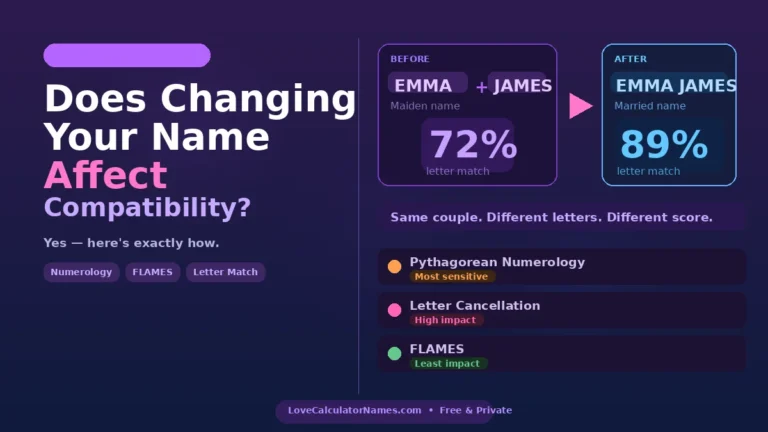
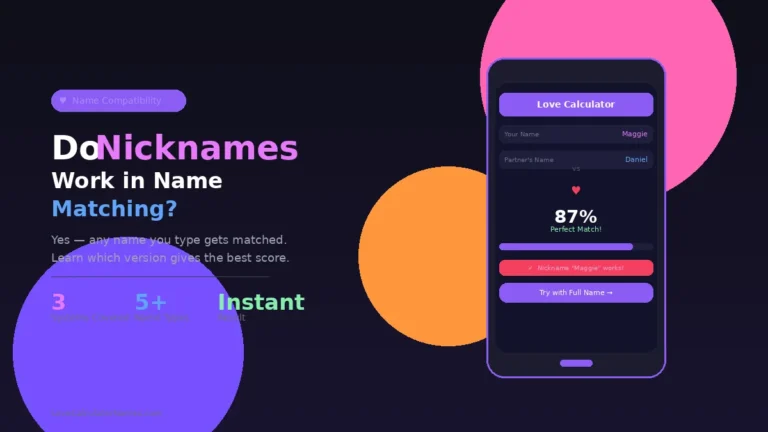
Myth 4: “Your score will be the same regardless of which name version you use.” Because the algorithm operates on actual letters, different name versions produce different scores. “Elizabeth” and “Liz” generate distinct outputs. “William” and “Will” are mathematically different inputs. Some people deliberately experiment with multiple versions (formal names, preferred names, nicknames) to find the result that resonates most, which is part of the playful nature of the experience.
Myth 5: “All love calculators give the same score.” Different platforms use different algorithms, weighting systems, and compatibility matrices. Some tools use Pythagorean numerology; others use the Chaldean system, which assigns slightly different number values to certain letters. Results can vary meaningfully across tools. No single method is definitively “correct”; each reflects a different interpretation of a long numerological tradition.
Frequently Asked Questions
Can a calculator measure true love accurately? No calculator can measure true love accurately. Love involves emotional experience, lived history, shared values, and trust that builds over time, none of which are accessible to a letter-value algorithm. Name compatibility tools use systems like Pythagorean numerology and FLAMES to generate fun scores. They are designed for entertainment. Always treat the result as a playful starting point, never as a verdict on your relationship.
What method do most love calculators use? The most common method is Pythagorean numerology: each letter is assigned a number from 1 to 9, the values in each name are summed and reduced to a single digit, and the two digits are compared on a compatibility chart. Many tools also include the FLAMES method, which generates a relationship category (Friends, Love, Affection, Marriage, Enemies, or Siblings) through a letter-count elimination process applied to both names.
Is there any real science behind name compatibility tools? No peer-reviewed scientific evidence supports name-based compatibility tools as predictors of romantic outcomes. The underlying numerological systems have deep historical roots in Pythagorean mathematics and ancient naming traditions across many cultures, but those traditions were never designed as scientific instruments. The tools work best when approached as culturally rooted entertainment, which is genuinely interesting and worth understanding in its own right.
Why do people enjoy love calculators even though they don’t predict anything? Humans are wired to seek patterns and meaning. A number attached to a relationship, even a playfully generated one, triggers curiosity and invites reflection. Love calculators also function as shared social experiences: something fun to try with a partner, a friend, or a crush. The score becomes a conversation prompt rather than a conclusion, and that social value is very real even when the predictive value is zero.
Does it matter whether I use a nickname or full name? Yes, different name versions produce different scores because the algorithm works on actual letters. There is no single “correct” version to use. Most people prefer the name they genuinely use in daily life with that person, which tends to make the result feel more personal and relevant. Experimenting with both versions is a normal part of the experience.
Are love calculator results kept private? On well-designed platforms, results are generated immediately and not stored or tied to any user identity. LoveCalculatorNames.com requires no sign-up and collects no personal data. Always review the privacy policy of any tool you use; reputable name compatibility sites are built for privacy, not data harvesting.
Can a love calculator predict whether a relationship will last? No. Long-lasting relationships depend on communication, mutual respect, emotional intelligence, and consistent effort over time. None of those factors appear in a person’s name. Any tool claiming to predict relationship longevity is overpromising significantly. Use the score as a fun icebreaker for a real conversation, not a forecast for your future.
The Honest Takeaway
Can a calculator measure true love? No — and any tool that claims otherwise deserves real skepticism.
What name compatibility tools can do is offer a lighthearted, culturally grounded way to bring two names together and see what a centuries-old pattern system produces. They draw on Pythagorean numerology, ancient naming traditions from multiple civilizations, phonetic analysis, and the beloved FLAMES method. The result is consistent, repeatable, and genuinely rooted in history. That is not nothing.
The best way to use any love calculator is as a starting point: something to spark a smile, a laugh, or a conversation. Your relationship’s real compatibility shows up in how you listen, how you grow together, and how you show up for each other when things get hard. No percentage captures any of that.
Ready to see what the numbers say? Try the free name compatibility test at LoveCalculatorNames.com — no sign-up required, completely private, and always just for fun.
Use our free name calculator to explore what your names say about your bond.