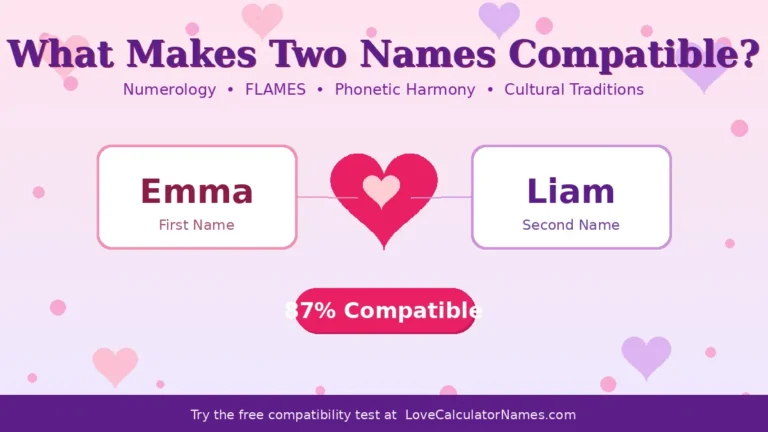
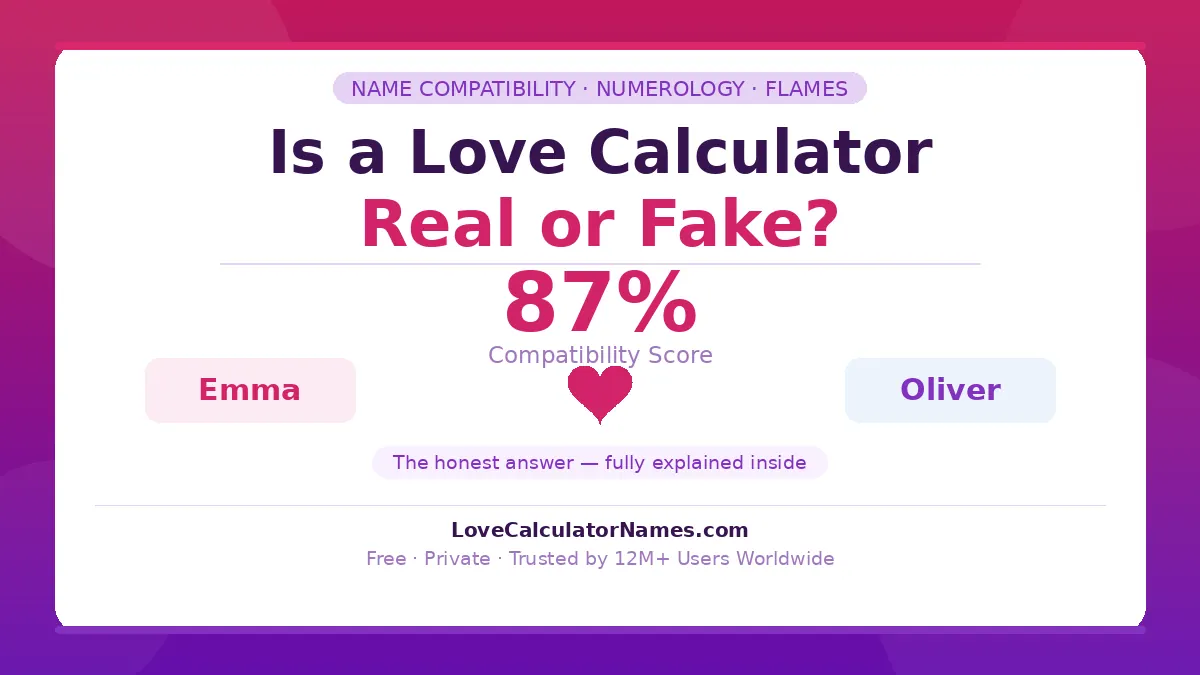
You typed two names into a love calculator and got 87%. Now you’re wondering, did that score mean anything, or did the site just make it up?
Here’s the short answer: A love calculator is neither completely real nor completely fake. Name-based tools run genuine systems: Pythagorean numerology, FLAMES logic, phonetic scoring, to generate consistent, repeatable results. What they don’t do is scientifically predict whether two people will actually work together in a relationship. They’re structured entertainment built on centuries-old cultural traditions around name energy and compatibility.
This article covers exactly how these tools work, what the numbers actually reflect, and where the line sits between genuine cultural tradition and pure fun.
Entertainment disclaimer: Love calculators, including tools like LoveCalculatorNames.com, are designed for fun and cultural exploration, not romantic prediction or professional relationship advice.
What Does “Real” Actually Mean for a Love Calculator?
Love calculators are real tools running real algorithms. They don’t pull random numbers, they apply a structured system to the letters in two names and return a consistent, reproducible output. What they’re not is a scientific predictor of romantic compatibility between the actual people behind those names.
The word “real” does a lot of heavy lifting here. If the question is whether the calculation process is genuine, yes, absolutely. Type the same two names twice and you’ll get the same result. The math runs. The output is deterministic.
If the question is whether that result tells you whether two specific people will fall in love, communicate well, or build a healthy relationship together, no. Love calculators work with letters. They don’t know your personality, your values, your communication style, or any of the things that actually shape whether a relationship thrives.
The confusion makes sense. People often mean: Is this score meaningful? And that’s where it gets genuinely interesting.
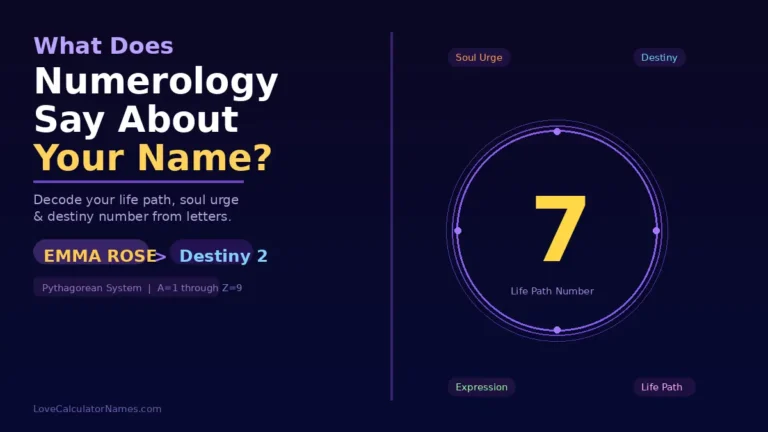
Pythagorean numerology, the backbone of most name-based tools, assigns numeric values to letters using a system documented in ancient Greek mathematical tradition, A=1, B=2, C=3 through Z=26. This isn’t something a developer cooked up recently. It has roots that go back centuries in Western esoteric traditions.
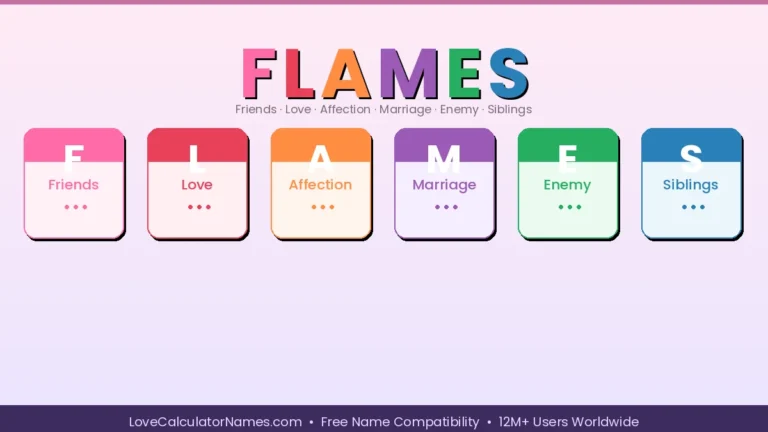
FLAMES — Friends, Lovers, Affectionate, Marriage, Enemies, Siblings — started as a schoolyard game. It’s been played by kids across South Asia, the US, the UK, and dozens of other countries for generations. Older siblings helped younger ones run the calculation on notebook paper long before there was an internet version.
These aren’t random outputs. They’re structured, repeatable, and connected to long-standing naming traditions. Whether that makes them “real” depends entirely on what you’re looking for when you ask.
There’s also a psychological layer worth considering. Research in the field of implicit egotism suggests people feel a slight unconscious pull toward things that resemble their own name, including other people. Someone named “Sara” may, on average, rate other S-names slightly more favorably without realizing it. This doesn’t prove love calculators work, but it does suggest that names carry more psychological weight than most people consciously acknowledge. They’re not neutral labels. They’re loaded with sound, association, and identity, which is exactly why so many cultures developed traditions around them.
How Does a Name-Based Love Calculator Actually Work?
Most name-based love calculators follow a clear process: assign numeric values to the letters in two names, combine and reduce those values through addition, then map the result to a percentage scale. The backbone of most systems is Pythagorean numerology, where each letter holds a specific numeric value based on ancient mathematical tradition.
Here’s the step-by-step process most tools use:
- Enter two names. The calculator takes first names, last names, or full names depending on how it’s built. Some tools accept a birth date as a secondary input.
- Assign letter values. Each letter gets a number, A=1, B=2, C=3 through Z=26. In Pythagorean systems, values above 9 are reduced further (so 10 becomes 1+0=1, and 26 becomes 2+6=8).
- Sum the values. The totals for each name are added separately, then combined.
- Reduce and score. The combined total is simplified and mapped onto a 0–100 percentage scale using the system’s internal formula.
- Generate the result. A score like “74% compatible” appears, often with a short interpretation: “Strong connection” or “Great friends.”
Some calculators layer in FLAMES logic on top of this. Both names are written out, shared letters are identified and crossed off, and the remaining letter count cycles through the FLAMES acronym until one category remains. It’s the same game generations of students played on the back of a notebook.
A third method, less common but worth knowing, is phonetic harmony scoring, analyzing how the sounds in two names work together. This borrows from actual linguistics research: names with complementary vowel and consonant patterns are perceived differently from names that clash phonetically. People consistently rate phonetically smooth name pairs as warmer and more compatible in controlled perception studies.
One important thing to know about the phonetic approach: researchers have found that names ending in softer sounds (“Sophie,” “Leo,” “Luna”) are consistently rated as warmer and more approachable than names with harder endings. Whether that translates to romantic compatibility is unproven, but it does mean phonetic scoring isn’t entirely made up. It reflects real patterns in how humans perceive sound.
What none of these methods does is look at actual personalities. They process letters and sounds, full stop. That’s why the entertainment framing matters. The input is a name, not a person.
What Can a Love Calculator Actually Tell You, and What It Can’t?
A love calculator score tells you how two names interact inside a specific algorithm: numerology, FLAMES, or phonetics. The result is structured and reproducible, rooted in cultural naming traditions. What it cannot tell you is whether two real people will connect emotionally, navigate conflict well, share values, or build something lasting.
Here’s a clear comparison of what falls inside and outside a love calculator’s scope:
| What a Love Calculator Measures | What Actual Compatibility Requires |
|---|---|
| Letter values and name numerology | Personality alignment |
| Phonetic harmony between names | Shared values and life goals |
| FLAMES letter count and cycling | Communication style and skills |
| Consistent, reproducible output | Emotional intelligence |
| Name energy by cultural tradition | Conflict resolution ability |
| No personal data required | Real-world time spent together |
| Same score every time, same inputs | Dynamic — changes as people grow |
The cultural context matters more than most people realize. Name compatibility isn’t some quirky internet trend. Across South Asia, syllable-matching between names has been part of pre-marital traditions for centuries, drawn from Vedic astrological systems where name sounds carry specific energies. In Chinese naming tradition, the number of strokes in a character and its radical components factor into beliefs about fortune and balance. In Western numerology, a name’s “vibration” is thought to shape the kind of life that person leads.
None of these traditions claim to be clinical science. They’re cultural frameworks, ways people have used names and numbers to think about identity, relationships, and the unseen patterns that connect people. Modern love calculators are digital versions of those traditions, built for a browser instead of a village astrologer’s reference book.
A concrete example: Enter “Emma” and “Oliver” into a Pythagorean numerology calculator. You’ll get a result based on the specific letter values in each name. Enter “Emma” and “Jack” and you’ll get a different result. That difference isn’t random, it reflects the actual numeric values of those letters run through the system’s formula. Whether it reflects anything true about the real Emma, Oliver, or Jack is a separate question entirely.
The honest answer: love calculators give you a structured, repeatable result with genuine cultural roots. Use them to explore name energy, start a conversation, or have fun, not to make actual relationship decisions.
Can You Actually Trust a Love Calculator Score?
The biggest myth about love calculators is that they scientifically measure something meaningful about real romantic potential. They don’t, and understanding what they actually do helps you get real value from them. These tools were never built as personality tests or relationship forecasts. They run on naming traditions and are optimized for entertainment, not behavioral assessment.
Myth 1: A high score means you’re meant to be. A 90%+ compatibility score means the two names aligned well inside that calculator’s specific algorithm, not that the people behind those names are a perfect match. Plenty of couples who’d score sky-high on paper don’t work in real life. The score describes your names, not your relationship.
Myth 2: A low score is a bad sign. If you get 34% with someone you genuinely connect with, that number doesn’t describe your relationship, it describes your names, processed through a formula. Many thriving couples would score low in any name-based system. Chemistry, shared history, and how two people actually treat each other don’t show up in letter values.
Myth 3: Love calculators use relationship science. No peer-reviewed research validates name-based love calculators as romantic predictors. They’re built on numerology, FLAMES, or proprietary scoring, disciplines with cultural weight but entirely separate from empirical relationship psychology. That’s not a knock on the tools; it’s just an accurate description of what they are.
Myth 4: All love calculators should give the same result. They won’t. Different platforms use different systems. One might apply classic Pythagorean numerology, another might weight phonetic patterns, another might use a custom-built algorithm with weighted scoring tiers. The same two names can produce 62% on one platform and 89% on another. That variation is expected and is one more reason these are entertainment tools, not instruments.
Myth 5: Love calculators are completely worthless. This swings too far the other way. Dismissing them entirely misses their actual value, which is real, just not the kind people assume. They’re part of a long human tradition of using names, numbers, and patterns to think about the world and the people in it. Used lightly, as a conversation starter, a cultural moment, or an excuse to spend five minutes thinking about a relationship, they do something genuinely useful.
The actual answer to whether is love calculator real or fake sits between both extremes: real as a tool with cultural roots, limited as a relationship predictor.
Frequently Asked Questions
Is a love calculator real or fake? A love calculator is real in the sense that it runs a genuine algorithm: numerology, FLAMES, or phonetic scoring, and returns consistent results. It’s not real as a romantic predictor. The score reflects how two names interact in a naming tradition, not how well two specific people will get along. Treat it as structured entertainment, not a relationship verdict.
Can a love calculator predict my future relationship? No. Love calculators process letters and sounds, they have no access to your personality, your values, how you handle conflict, or the thousand other things that determine whether a relationship works. They produce a score based on names, not on people. Think of them like a horoscope: a structured tradition with cultural meaning, but not a forecast.
Why do different love calculators give different scores for the same names? Each calculator uses a different algorithm. One may use Pythagorean numerology, another FLAMES logic, another a phonetic scoring model. Because the underlying systems differ, the same pair of names can produce very different percentages on different platforms. There’s no universal correct score, which tells you everything about the entertainment-first nature of these tools.
Is there any science behind name compatibility? No peer-reviewed science validates love calculators as romantic predictors specifically. However, phonetics research does show that name sounds affect first impressions, softer names tend to be perceived as warmer, harder consonant names as stronger or more assertive. And numerology has genuine historical and cultural weight, even if it isn’t empirical psychology. The tools draw on real traditions; they just aren’t clinical instruments.
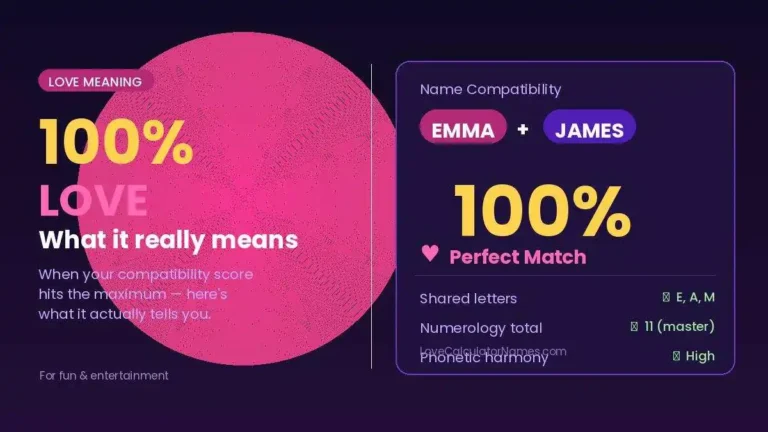
What does it mean if I get 100% on a love calculator? It means those two names produced a maximum result inside that calculator’s specific formula, the letter values, phonetic patterns, or FLAMES count all aligned. It’s a satisfying result. It doesn’t predict a perfect relationship. Plenty of real couples would score nowhere near 100% and still build something great. Enjoy the number, then go have an actual conversation.
Are love calculators safe and private to use? Reputable tools only need names, no email, no account, no payment. Always verify that a site uses HTTPS and doesn’t ask for unnecessary permissions. LoveCalculatorNames.com, for example, runs entirely without requiring sign-up or storing personal data, making it one of the cleaner options available for a quick compatibility check.
What is the FLAMES method in a love calculator? FLAMES stands for Friends, Lovers, Affectionate, Marriage, Enemies, Siblings. You write out both names, count shared letters, remove them, then use the remaining count to cycle through the acronym until one category is left. It started as a classic schoolyard game in South Asia and has since made it into most major love calculator platforms as a secondary layer of output.
Should I make relationship decisions based on a love calculator result? No, and any well-designed love calculator will say the same. These tools exist for fun and cultural exploration. Real relationship decisions should come from real-world experience: how you communicate with someone, what you value together, how you handle the inevitable rough patches. A name score is a conversation starter, not a decision-maker.
The Honest Takeaway
So, is a love calculator real or fake? Both, in different ways.
The tool is real. The algorithm runs a genuine calculation. The traditions behind it: numerology, FLAMES, phonetic harmony, have been part of human culture across dozens of countries for centuries. The output is consistent and reproducible every single time.
What it doesn’t do is predict love. No name-based tool can account for the full complexity of an actual relationship between two actual people. The best couples aren’t built on compatible letters, they’re built on trust, honest communication, and shared experience in real life.
Used the right way, a love calculator does something valuable: it opens a door. It sparks a conversation, introduces someone to the idea of name numerology, or just makes a moment fun. That’s genuinely worth something, just not in the way some people expect.
Take the score with a smile, use it to start talking, and let the real relationship do the rest.
Ready to see your result? Try the free name compatibility tool at LoveCalculatorNames.com, no sign-up needed, 100% private.
Enter your names and get a compatibility result in just a few seconds here.