Your name is more than a label — according to numerology, each letter carries a numeric value, and together those values tell a story about your personality, natural strengths, and even your compatibility with others. This practice has endured for thousands of years, and the math behind it is surprisingly simple.
This guide shows you exactly how to calculate name numerology, what every number from 1 to 9 means, and how to use the result for fun self-reflection or name compatibility.
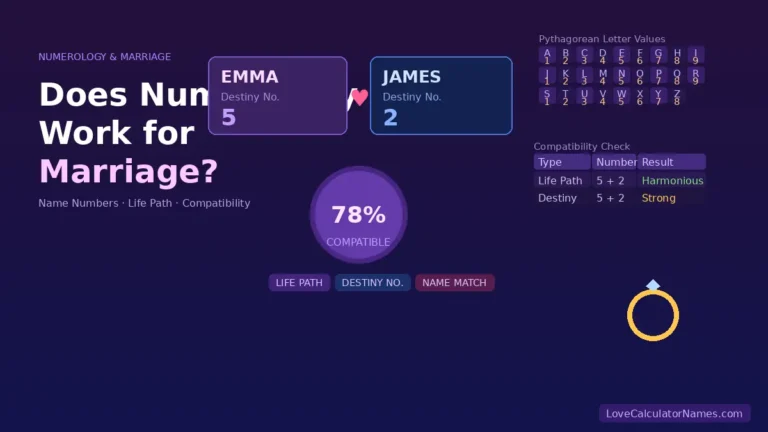
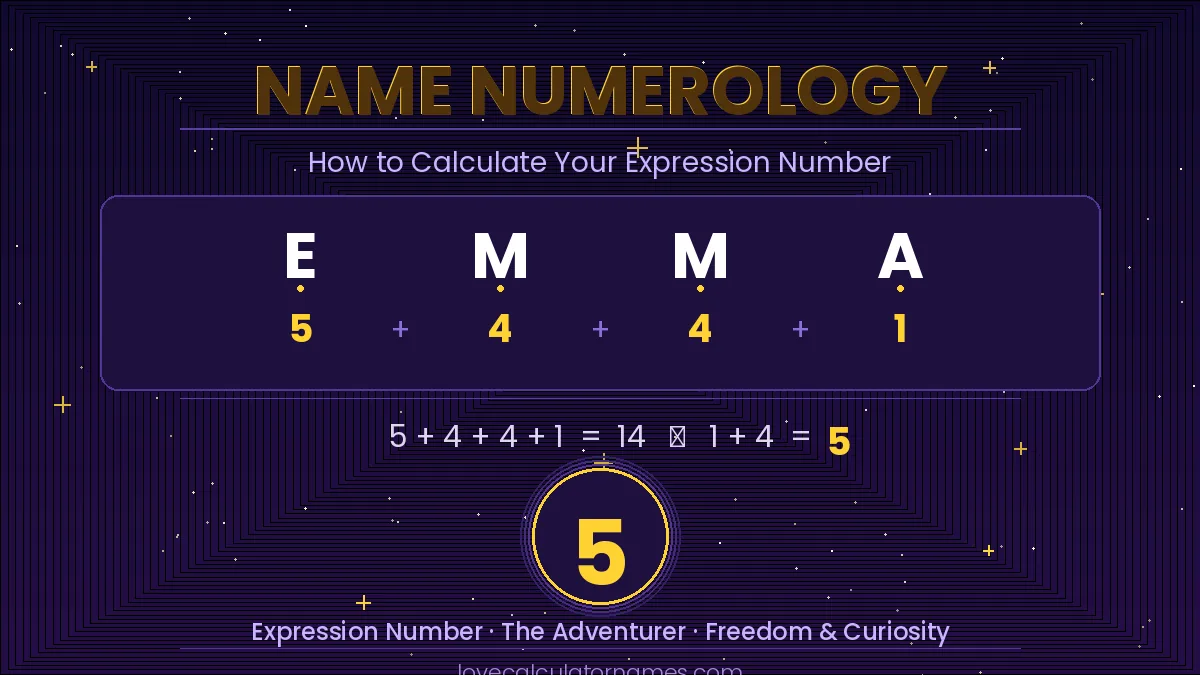
Here’s the short answer: To calculate name numerology, write your name in capitals and assign each letter a number using the Pythagorean chart (A=1, B=2, C=3 … I=9, then J=1 again, cycling through to Z=8). Add all the letter values together, then reduce the total to a single digit by adding its digits. That digit is your Expression Number. Example: EMMA = E(5)+M(4)+M(4)+A(1) = 14 → 1+4 = 5.
Name numerology is intended for fun and personal reflection — not as a scientific predictor of personality or relationships.
What Is Name Numerology and Where Did It Come From?
Name numerology converts the letters of your name into numbers, then interprets the resulting single digit as a symbol of your core character, natural abilities, and life direction. The digit you end up with — most often called your Expression Number or Destiny Number — is considered a kind of energetic fingerprint tied to the name you carry through life.
The roots of this practice go back over 2,500 years. The Greek philosopher Pythagoras, who lived around 570–495 BCE, believed that numbers were the underlying architecture of all reality — not just mathematical tools, but living symbols with meaning. His followers developed systems connecting numbers to letters of the alphabet, and that tradition eventually evolved into what we now call Pythagorean numerology.
At roughly the same time, Hebrew Kabbalah scholars were working on their own letter-to-number system called Gematria, used primarily for spiritual and scriptural analysis. Ancient Babylonian and Egyptian cultures had similar traditions. The impulse to find meaning in the numbers hidden inside names appears in nearly every major civilization independently.
Two systems are widely used today. The Pythagorean method (also called Western numerology) assigns values 1 through 9 to all 26 letters in sequence, repeating the cycle. The older Chaldean system uses a different letter assignment and maxes out at 8, treating 9 as a sacred number that belongs to no letter. Most online name numerology calculators — including name compatibility tools — use the Pythagorean method because it’s transparent, easy to verify by hand, and consistent across name lengths.
Name numerology isn’t purely a Western concept. In Hindu naming tradition, a child’s first letter is often chosen to align with their birth chart — a practice called Naamkaran. In parts of East Asia, the stroke count of characters used to write a name functions similarly to a Western Expression Number. Across cultures, the idea that a name carries numeric significance is remarkably persistent.
How Do You Calculate Name Numerology Step by Step?
To calculate name numerology, write your name in capitals, use the Pythagorean chart to assign a number to each letter, add all the numbers together, and reduce the total to one digit. The process takes under two minutes by hand. The only tools you need are the chart below and basic addition.
The complete Pythagorean letter-to-number chart:
| Number | Letters |
|---|---|
| 1 | A, J, S |
| 2 | B, K, T |
| 3 | C, L, U |
| 4 | D, M, V |
| 5 | E, N, W |
| 6 | F, O, X |
| 7 | G, P, Y |
| 8 | H, Q, Z |
| 9 | I, R |
Step-by-step calculation:
- Choose which name to use. Your full birth name (first + middle + last, as on your birth certificate) gives the most complete Expression Number. Your first name alone gives a quick personality snapshot.
- Write the name in capitals. This keeps the letter assignments clear and avoids confusion. Example: OLIVIA
- Assign each letter its number from the chart. O=6, L=3, I=9, V=4, I=9, A=1
- Add all the values together. 6+3+9+4+9+1 = 32
- Reduce to a single digit. Add the two digits of 32: 3+2 = 5
- Check for master numbers before reducing. If your total is 11, 22, or 33, stop — don’t reduce further. These are master numbers with their own distinct meaning (see the FAQ section below).
- Look up your number’s meaning. A 5 is associated with curiosity, freedom, adaptability, and a love of new experiences.
That’s the complete process. Once you’ve memorized the chart, you can calculate any name in about 60 seconds.
What about middle names and last names?
For a full Expression Number, include every part of your birth name. Calculate each name section separately first, then add the subtotals together and reduce. For example: if your first name totals 14, middle name totals 7, and last name totals 11, your combined total is 32 → 3+2 = 5. Most name compatibility tools let you enter a full name and do this automatically.
Does spelling matter?
Absolutely — and this is one of the most common sources of confusion. “Catherine” and “Kathryn” produce different totals because the letters differ. Always use the exact spelling of the name you’re analyzing. When calculating your own Expression Number, use the spelling on your birth certificate.
What Does Each Name Numerology Number Mean?
Each number from 1 to 9 carries a distinct personality profile built over centuries of numerological tradition. When you calculate name numerology and arrive at your Expression Number, that digit points to your natural strengths, tendencies, and potential growth edges. No number in the system is better or worse than another — each brings its own gifts and challenges.
| Number | Core Identity | Key Strengths | Common Challenges | Often Compatible With |
|---|---|---|---|---|
| 1 | The Leader | Drive, originality, courage | Stubbornness, ego | 1, 5, 7 |
| 2 | The Peacemaker | Empathy, sensitivity, diplomacy | Indecision, self-doubt | 2, 4, 8 |
| 3 | The Creator | Expression, charm, creativity | Scattered focus, exaggeration | 3, 6, 9 |
| 4 | The Builder | Discipline, reliability, loyalty | Rigidity, resistance to change | 2, 4, 8 |
| 5 | The Adventurer | Adaptability, wit, curiosity | Restlessness, inconsistency | 1, 5, 7 |
| 6 | The Nurturer | Warmth, responsibility, care | Over-giving, perfectionism | 3, 6, 9 |
| 7 | The Thinker | Wisdom, depth, analysis | Isolation, overthinking | 1, 5, 7 |
| 8 | The Achiever | Ambition, confidence, power | Materialism, control | 2, 4, 8 |
| 9 | The Humanitarian | Vision, compassion, generosity | Idealism, emotional burnout | 3, 6, 9 |
Worked examples with real names:
- DIANA → D(4)+I(9)+A(1)+N(5)+A(1) = 20 → 2+0 = 2 — Sensitive, diplomatic, a natural harmonizer.
- EMMA → E(5)+M(4)+M(4)+A(1) = 14 → 1+4 = 5 — Curious, adaptable, and drawn to new experiences.
- LUCAS → L(3)+U(3)+C(3)+A(1)+S(1) = 11 → Master Number 11 — Not reduced further; linked to intuition and vision.
- DAVID → D(4)+A(1)+V(4)+I(9)+D(4) = 22 → Master Number 22 — The “Master Builder”; rare and associated with large-scale ambition.
- SARAH → S(1)+A(1)+R(9)+A(1)+H(8) = 20 → 2+0 = 2 — Empathetic and harmony-seeking, just like Diana.
How does this connect to name compatibility?
Name compatibility tools compare two people’s Expression Numbers to see how their energies interact. Numbers in the same “family” — 1-5-7, 2-4-8, and 3-6-9 — tend to resonate because they share underlying qualities. Two 2s often bond deeply but may both avoid necessary conflict. A 1 and a 7 can work beautifully — one leads decisively while the other thinks several moves ahead.
Cultural naming traditions and numerology:
In Vedic astrology, families often consult a numerologist before finalizing a baby’s name to ensure the Expression Number complements the child’s birth-date life path. In parts of the Arab world, the abjad numeral system assigns specific values to Arabic letters, functioning similarly to Western name numerology in purpose. The practice of finding numeric meaning in names crosses borders and centuries — it’s one of the most cross-cultural forms of symbolic thinking in human history.
Is Name Numerology Accurate? Common Myths Cleared Up
Name numerology is widely misread — either dismissed entirely as superstition or overhyped as a precise personality decoder. The honest picture is more interesting than either extreme. It’s a structured symbolic system with a long history, best understood as a creative framework for self-reflection and fun, not a clinical assessment tool.
Myth 1: “My name has to be my legal birth name for this to work.” The birth name is the traditional choice for calculating your Expression Number because it’s fixed and consistent. But you can run numerology on any name — your nickname, married name, pen name, or professional name. Many people calculate all of them and find each version reveals a different facet of how they present themselves.
Myth 2: “Name numerology predicts what will happen in my life.” It describes tendencies, not outcomes. A person with a 4 Expression Number may lean toward discipline and structure — but they’re not locked into that pattern. Think of it as a personality sketch from an unusual angle, not a forecast.
Myth 3: “Some numbers are lucky and others are unlucky.” There’s no unlucky number in the Pythagorean system. Every digit has both strengths and challenges. A 7 might be called introspective or antisocial depending on how you frame it — but the same number produces some of the most perceptive and original thinkers. Context is everything.
Myth 4: “All name numerology systems give the same result.” They don’t. The Pythagorean and Chaldean systems use different letter assignments and will often produce different numbers for the same name. If you’ve seen conflicting results online, that’s likely why. Most mainstream calculators use the Pythagorean method. Always check which system a calculator is based on before comparing results.
Myth 5: “If two people have different numbers, they’re incompatible.” Compatibility in numerology is about balance, not identical scores. Some of the most celebrated pairings in numerology are between complementary numbers — a 1 (the doer) and a 2 (the supporter), or a 3 (the talker) and a 9 (the visionary). Differences can be just as harmonizing as similarities.
Frequently Asked Questions About Name Numerology
How do I calculate name numerology for free? Use the Pythagorean chart in this article — it’s completely free. Write your name in capitals, assign each letter its number (A=1, B=2 … I=9, then J=1 again), add all the values, and reduce to one digit. For two-name compatibility, try a free tool that does the comparison side by side and shows both Expression Numbers instantly.
What is the difference between a life path number and an Expression Number? Your life path number comes from your birthdate — day, month, and year all reduced to a single digit. Your Expression Number comes from the letters of your name. The life path describes your overall journey through life; the Expression Number describes the natural tools and traits you bring to that journey. A full numerology reading uses both together.
What are master numbers in name numerology? Master numbers are 11, 22, and 33. When your name calculation totals one of these before reaching a single digit, you stop and keep the master number as-is. They’re considered to carry amplified or spiritually significant energy in numerological tradition. A name totaling 22, for example, falls under the “Master Builder” profile — associated with large-scale vision and the ability to turn big ideas into reality.
Does numerology work for non-English names? Yes, through phonetic transliteration. Convert the name’s pronunciation into its closest Latin-alphabet spelling, then apply the Pythagorean chart. Practitioners regularly work with names from Arabic, Hindi, Chinese, and other languages this way. The system isn’t about the letters’ origins — it’s about the phonetic sound pattern of the name.
Can I use name numerology to choose a baby’s name? Many parents do exactly this. You can calculate the Expression Number for several name options, then compare each against the baby’s life path number (calculated from their birth date) to find a combination that feels harmonious. It’s a fun creative filter alongside family tradition, sound, and personal meaning.
What is a soul urge number, and how is it different from an Expression Number? Your Expression Number uses every letter in your name. Your Soul Urge Number (also called the Heart’s Desire Number) uses only the vowels (A, E, I, O, U) and is said to represent your inner motivations and private desires. The Personality Number uses only the consonants and reflects how others perceive you. Together, all three form a complete name numerology profile.
Is name numerology the same as astrology? No — they’re entirely separate systems. Astrology is based on the positions of celestial bodies at the time of your birth. Numerology is based on numbers derived from your birth date and name. Some practitioners use both, but the underlying logic is different. Numerology doesn’t require a birth time or location — just a name and a date.
How accurate is name numerology compared to personality tests like Myers-Briggs? Name numerology isn’t a validated psychological instrument and shouldn’t be treated as one. Myers-Briggs and similar tools are built on empirical research into how people actually behave and respond. Numerology is a symbolic framework rooted in ancient tradition — more like a creative lens than a clinical assessment. Many people find meaningful resonance in their results; others don’t. It’s best experienced as an entertaining and reflective exercise.
Your Name Has a Story — Start Reading It
Learning how to calculate name numerology takes about two minutes, and what you find can spark a surprisingly interesting conversation about personality, potential, and the numeric patterns hiding inside everyday names. The Pythagorean method is the clearest starting point: chart each letter, add the values, reduce to a single digit, and sit with what comes up.
Three things to carry with you: spelling always matters, master numbers (11, 22, 33) never get reduced further, and no number in the system is better or worse — only different.
If you want to skip the math and explore name compatibility with someone you care about, try the free name compatibility calculator at LoveCalculatorNames.com — no sign-up required, completely private, and results are instant. It’s a fun way to see two Expression Numbers side by side.
See what your names reveal with our popular free name-based love tool.