You type two names, press calculate, and a number appears: 73%, 91%, sometimes even 99%. But where does that number actually come from? Is it randomly generated, or is there real logic behind it?
Love calculators have entertained millions of people across the globe for decades. Whether you’re testing a crush, checking a celebrity couple, or just curious about name compatibility, that percentage feels oddly compelling. This guide breaks down exactly what happens behind the scenes: the math, the methods, and the clever name-based logic that powers every result.
Here’s the short answer: A love calculator works by assigning numerical values to the letters in two names, applying a fixed mathematical formula, and expressing the output as a compatibility percentage. Most tools use one of three core systems: letter-value addition, the FLAMES elimination method, or Pythagorean numerology. The result is consistent and repeatable, not random. These tools are designed for entertainment and not intended as scientific relationship predictors.
What Exactly Is a Love Calculator — and Where Did It Come From?
A love calculator is a name-based compatibility tool that converts letters into numbers, runs those numbers through a structured formula, and returns a percentage or relationship category. It does not read your personality, analyze your relationship history, or access any personal data. The same two names will always produce the same result on the same tool.
The concept is older than the internet. In the 1970s and 1980s, school kids in the US, UK, India, and Australia were playing a paper-and-pencil game where they’d write two names side by side, cross out shared letters, and count the survivors in a sequence, a method that eventually became the digital FLAMES calculator. Pythagorean numerology, which reduces names to single-digit “core numbers,” has roots going back thousands of years in Western esoteric tradition.
When calculators moved online in the 1990s and early 2000s, developers formalized these playground games into code. The underlying logic stayed the same; only the interface changed.
Today, three primary methods power most love calculators:
- Letter-value systems (convert each letter to a number, sum and reduce)
- FLAMES (eliminate shared letters, count survivors to determine a relationship category)
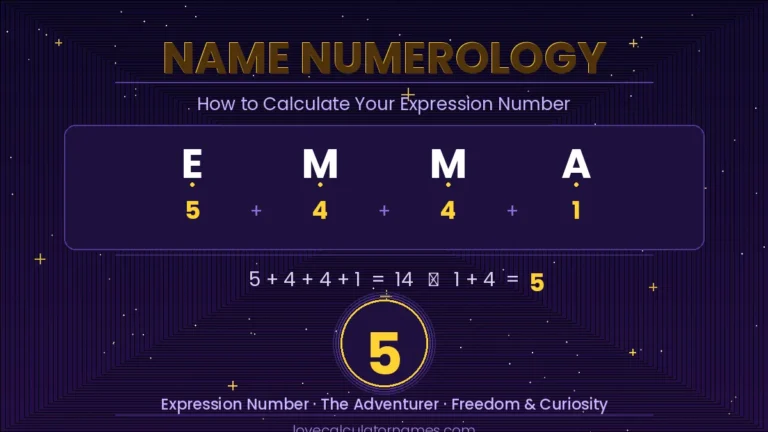
- Pythagorean numerology (reduce names to core numbers, compare for compatibility)
Some advanced tools combine all three for a layered result.
How Does a Love Calculator Calculate the Percentage?
A love calculator calculates a percentage by converting every letter in both names to a number, summing those values, and reducing the total to a figure between 1 and 100. The most common mapping is A=1, B=2 … Z=26. The reduction method varies between tools, which is why two sites can give different results for the same pair of names.
Here is exactly how the letter-value method works, step by step:
- Enter both names. The calculator accepts first names, full names, or nicknames. Consistency is key. “Kate” and “Katherine” will produce different results.
- Assign a number to each letter. Using A=1, B=2, C=3 … Z=26, every letter in both names gets a numeric value.
- Sum all values across both names. Add up every number from the first name and the second name together into a single total.
- Reduce to a two-digit figure. If the total is already between 1 and 100, that becomes the score. If it exceeds 100, the digits are added together and reduced until the result falls within range.
- Display the score with a label. The final percentage is often paired with a compatibility label such as “Perfect Match,” “Strong Connection,” or “Keep Trying.”
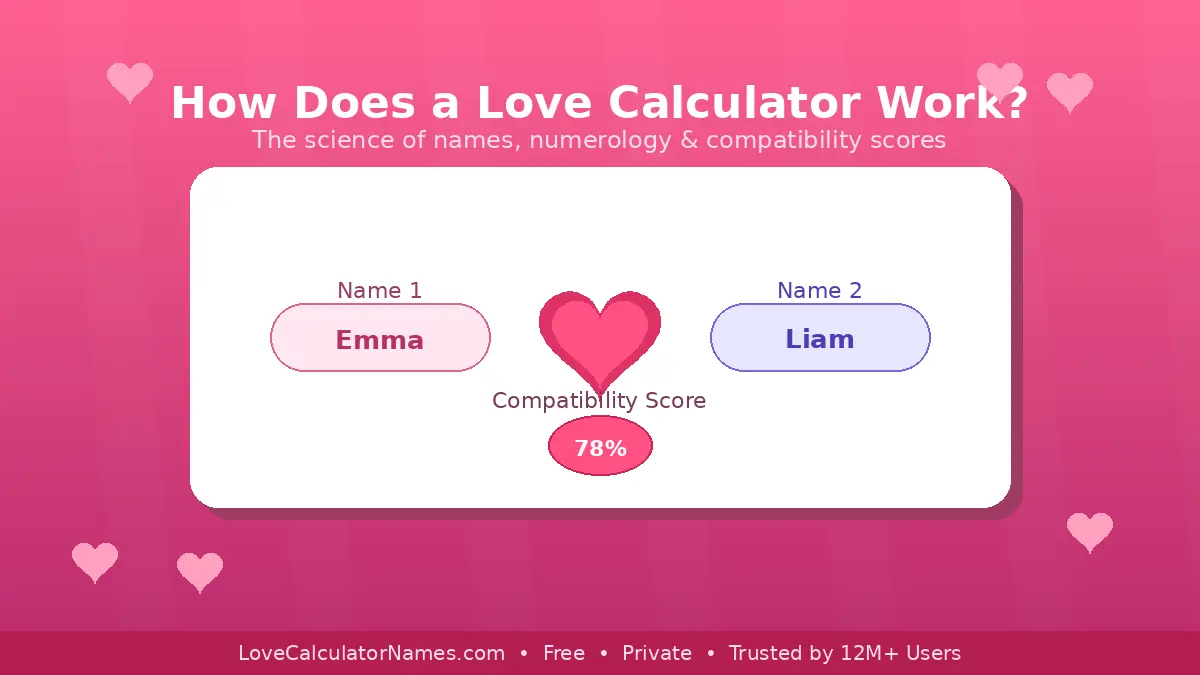
Worked example: Emma + Liam:
- E(5) + M(13) + M(13) + A(1) = 32
- L(12) + I(9) + A(1) + M(13) = 35
- Combined total: 67
- 67 is already within 1–100, so the love score = 67%
Now a higher-total example: “Alexander” + “Charlotte”:
- A(1)+L(12)+E(5)+X(24)+A(1)+N(14)+D(4)+E(5)+R(18) = 84
- C(3)+H(8)+A(1)+R(18)+L(12)+O(15)+T(20)+T(20)+E(5) = 102
- Combined total: 186
- Reduction: 1+8+6 = 15 → some tools stop here; others add again: 1+5 = 6 (6%)
This explains the wide variation in scores across different sites. The formula is fixed per tool, and there is no single universal standard.
What Is the FLAMES Method and How Does It Work?
FLAMES is a name-compatibility game where letters shared between two names are counted and used to eliminate categories one by one from the acronym F-L-A-M-E-S. The last surviving category (Friends, Love, Affection, Marriage, Enemies, or Siblings) is the result. It predates the internet by decades and is still one of the most popular name-matching methods online.
Here is the full FLAMES process, step by step:
- Write both first names side by side. Example: ANNA and JACK.
- Identify and cross out shared letters. A appears in both: cross out one A from each name. Remaining: N-N-A (Anna) + J-C-K (Jack).
- Count the surviving letters. N + N + A + J + C + K = 6 letters.
- Use that count to eliminate FLAMES categories. Start at F and count forward 6 positions: F(1), L(2), A(3), M(4), E(5), S(6). Eliminate S.
- Restart the count from the next letter (back to F after S is removed). Continue until one category remains.
- The final surviving category is the result. If “Love” survives last, the result is “Love.”
The FLAMES method intentionally feels game-like because it is a game, one that traveled from Indian and Australian school notebooks to the internet without losing any of its charm.
A fun cultural note: in South Asia, FLAMES is sometimes extended to FLAMESW or FLAMESS to include “Wedding” or “Sex” depending on the audience and cultural context. The core mechanic stays the same; the categories vary by tradition.
How Does Pythagorean Numerology Power Advanced Love Calculators?
Numerology-based calculators go well beyond simple letter counting. The Pythagorean system reduces each name to a single core number (1–9), then evaluates the relationship between those two numbers based on centuries-old numerological compatibility charts. It produces results that feel more personal because the same letter in a different position can have a different weighted value.
The Pythagorean letter-to-number mapping:
| Letter Group | Value |
|---|---|
| A, J, S | 1 |
| B, K, T | 2 |
| C, L, U | 3 |
| D, M, V | 4 |
| E, N, W | 5 |
| F, O, X | 6 |
| G, P, Y | 7 |
| H, Q, Z | 8 |
| I, R | 9 |
How the reduction works: Each name is reduced to a single digit through repeated digit addition. “David” = D(4)+A(1)+V(4)+I(9)+D(4) = 22 → 2+2 = 4. “Sarah” = S(1)+A(1)+R(9)+A(1)+H(8) = 20 → 2+0 = 2.
The compatibility between 4 and 2 is then evaluated. In Pythagorean tradition, certain number pairs are considered naturally harmonious (1 & 3, 2 & 6, 4 & 8, 5 & 9) while others bring productive tension or challenge. This layer of interpretation is what makes numerology-based calculators feel more layered than a raw percentage.
What Are the Different Types of Love Calculators — and How Do They Compare?
Different love calculator tools use fundamentally different methods, which is exactly why the same two names can produce wildly different results across sites. Understanding the type of calculator you’re using helps you interpret your score correctly, making the experience far more interesting.
| Method | Core Logic | Output Format | Strengths |
|---|---|---|---|
| Letter-Value (A=1…Z=26) | Sums all letter values, reduces to 0–100 | Percentage score | Fast, simple, universally understood |
| FLAMES | Shared-letter elimination, category survival | Relationship label (Love, Friends, etc.) | Interactive, game-like, no math needed |
| Pythagorean Numerology | Reduces names to 1–9, compares charts | Compatibility rating + interpretation | More nuanced, culturally rich |
| Phonetic Harmony | Analyzes vowel patterns and sound resonance | Sound-match score | Interesting for names from the same language |
| Algorithmic Hybrid | Combines 2–3 methods with weighting | Detailed multi-score breakdown | Most comprehensive result |
Most popular tools today use either the letter-value method alone or a hybrid approach. Hybrid calculators typically weight vowels more heavily than consonants (since vowels carry the emotional “sound” of a name) and factor in name length to normalize results.
Are Love Calculator Results Random, or Do They Always Come Out the Same?
Love calculator results are entirely deterministic, not random. The same two names entered in the same order on the same tool will always produce an identical result. Nothing changes between visits: not the time of day, not the number of previous calculations, not who else is using the site.
This surprises many people. The temptation to re-enter names hoping for a better score is natural, but unless you change the spelling, the output won’t change.
Results will differ between tools, though, for three reasons:
- Different letter-to-number mappings produce different base totals.
- Different reduction formulas compress those totals differently.
- Different weighting logic gives more importance to first letters, vowels, or name length.
So scoring 68% on one site and 87% on another does not mean one tool is more accurate. They’re using different formulas. Both are equally valid as entertainment.
One important nuance worth knowing: spelling matters. “Catherine” and “Kathryn” produce completely different results even though they’re the same name phonetically. If your name has multiple common spellings, test both versions; the difference can be striking.
What Are the Biggest Myths About Love Calculators?
The most widespread myths about love calculators involve their accuracy, how consistent their results are, and what they actually measure. Understanding the reality behind each myth makes the tools more fun to use, because you’re no longer frustrated by results that “don’t make sense.”
Myth 1: Love calculators use your birth date or star sign. Pure name-based love calculators use only the letters in the names you enter. No birthdays, no zodiac signs, no personal history. Some hybrid tools let you add a birth date for an astrological layer, but the name calculator itself is entirely letter-driven.
Myth 2: A high score guarantees relationship success. A love percentage reflects a mathematical property of two names, nothing more. Real compatibility research consistently points to communication, shared values, emotional regulation, and mutual respect as the core drivers of relationship success. None of those appear in a name.
Myth 3: The algorithm changes to give different users different results. The formula is fixed. Two users anywhere in the world entering the same two names on the same tool will always see the same number. The tool is not personalized, randomized, or connected to any user data.
Myth 4: A low score means the relationship won’t work. Many deeply compatible couples would score poorly simply because their names share few letters or reduce to numerologically “challenging” number pairs. The score reflects the names, not the people.
Myth 5: Love calculators are a modern internet invention. The letter-elimination method that became FLAMES was played on paper in schoolyards across multiple countries decades before the internet existed. Pythagorean numerology itself dates back to ancient Greece. The internet just made these games faster, shareable, and global.
Why Do Love Calculator Scores Feel So Personally Meaningful?
Love calculator scores feel meaningful because of two well-documented psychological effects working together. The first is confirmation bias — when we already have feelings for someone, a high score feels like evidence we were right all along. A low score gets dismissed as a “bad formula.” Our brains filter results through what we already want to believe.
The second is the Barnum effect — the tendency to accept vague, positive personality descriptions as uniquely accurate. Phrases like “You balance each other beautifully” or “There’s a strong emotional pull between you” resonate because they could apply to almost anyone.
Neither of these effects makes love calculators less enjoyable. Quite the opposite. Knowing why the results feel compelling adds an extra layer of self-awareness to an already entertaining experience. And that’s exactly how these tools are designed to work: not as oracles, but as conversation starters.
Frequently Asked Questions
How does a love calculator work with names?
A love calculator converts each letter in both names into a number using a fixed mapping, typically A=1 through Z=26 or the Pythagorean 1–9 system. It sums all values, reduces the total to a score between 0 and 100, and returns a compatibility percentage. The same names always produce the same result on the same tool.
Is the love calculator percentage actually accurate?
Love calculators are entertainment tools, not scientific instruments. The percentage is a mathematical property of the letters in two names, not a measure of emotional compatibility, personality fit, or relationship potential. Treat the result as a fun conversation starter rather than a verdict on your relationship.
Why do different love calculator websites give different scores?
Each site uses its own formula: different letter-to-number mappings, different reduction steps, different weighting for vowels or name length. There is no universal industry standard for love calculators, so results will always vary across tools. Neither result is more correct; they simply reflect different formulas.
What is FLAMES and how is it different from a percentage-based calculator?
FLAMES (Friends, Love, Affection, Marriage, Enemies, Siblings) is a letter-elimination game where shared letters between two names are crossed out, and the remaining count is used to eliminate categories one by one until one survives. Unlike percentage calculators, FLAMES gives a relationship category rather than a numerical score, and is considered a game rather than a calculation.
Does the order of the two names affect the result?
On most simple letter-value tools, name order does not matter because all letters are summed together. However, some advanced calculators apply directional logic, treating the first name entered as the “initiator,” which can produce asymmetric results. Check the specific tool’s description if this matters to you.
Can love calculators work in languages other than English?
Name-based calculators designed for English use the 26-letter Latin alphabet. For Arabic, Hindi, Chinese, or other scripts, equivalent tools exist that apply analogous letter-value systems within those writing systems. The underlying math is identical; only the alphabet mapping changes to match the language.
What is the Pythagorean method in love calculators?
Pythagorean numerology maps each letter to a number from 1–9 in a repeating cycle (A=1, B=2 … I=9, J=1 again). Each name is reduced to a single core digit through repeated addition, and those two digits are compared against traditional numerological compatibility pairings. It produces a more layered result than simple A=1…Z=26 systems.
Is my name data private when I use an online love calculator?
Reputable name compatibility tools do not store, sell, or share the names you enter. The calculation typically runs in-browser or on a lightweight anonymous server and is not linked to any user profile. Always review a tool’s privacy policy, but most name calculators are fully anonymous and require no sign-up.
The Takeaway
Love calculators work by turning the letters of two names into numbers, running those numbers through a fixed formula, and returning a consistent, repeatable result. The three core methods (letter-value addition, FLAMES elimination, and Pythagorean numerology) each approach the same question from a different angle, which is why your score can vary between sites.
Three things to take away: results are deterministic (same names, same score, every time), methods vary across tools (which explains the differences), and the output is designed for entertainment, not as a measure of real-world relationship potential.
That said, the experience is genuinely fun, and the psychology behind why it feels meaningful is fascinating in its own right.
Ready to try it yourself? Run your own name compatibility test at LoveCalculatorNames.com. No sign-up required, 100% private, and results in seconds.
Check out our name compatibility tool and discover what your names say today.