You typed in two names, hit the button, and got 50%. Now you’re staring at the screen trying to decide if that’s good, bad, or somewhere between. Is it a warning? A coin flip? Or, somehow, the most interesting result you could have gotten?
A 50 percent love score means the two names sit at the exact midpoint of the compatibility scale, neither strongly aligned nor strongly opposed. It represents balance and open potential rather than a verdict. In name-based compatibility tools, the midpoint reflects neutral name energy with no dominant pull in either direction. Think of it less as a grade and more as an open question.
This article breaks down exactly what that score represents, how love percentages are generated, how 50% compares to other score ranges, and what the number might (and definitely doesn’t) tell you.
Love calculators are built for entertainment. No algorithm can determine the outcome of a real relationship. Only the two people in it can do that.
What Does a Love Percentage Score Actually Measure?
A love percentage score measures how two names interact when run through a numeric compatibility system, most commonly one rooted in Pythagorean numerology. The result is not a measurement of real feelings. It reflects how the mathematical and phonetic properties of two names relate to each other on a defined scale.
Each letter in a name carries a number value. Those values are reduced and combined across both names, then mapped to a percentage. When the result lands near the middle of that scale, it signals that the two name energies are in rough equilibrium. They’re not reinforcing each other strongly, but they’re not clashing either.
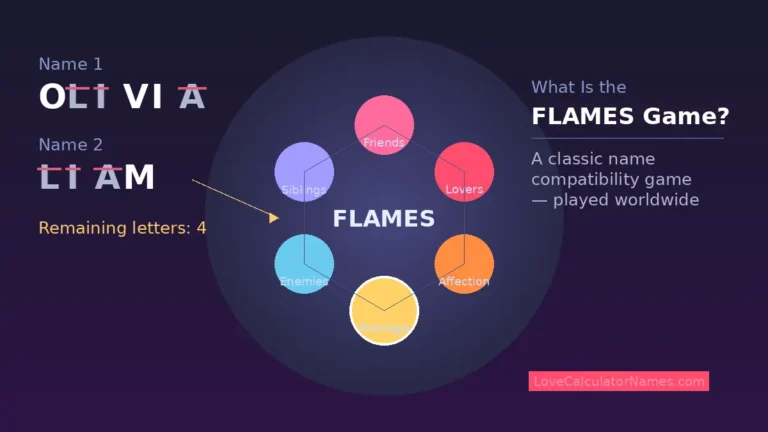
The score is one data point from one system. Different calculators use different formulas. Some factor in first and last names separately. Others pull in birth dates, use the FLAMES method (which stands for Friends, Love, Affection, Marriage, Enemy, Siblings), or apply phonetic weighting. The same two names can produce different results across different tools, which tells you something important about what these scores are for: they’re starting points for reflection, not endpoints for decisions.
Understanding this framing matters before you interpret any result, including 50%. The percentage doesn’t measure love in any emotional or relational sense. It measures a specific numerical relationship between two names using a specific formula. That’s both more limited and more interesting than it first appears.
How Are Love Scores Calculated? (Step by Step)
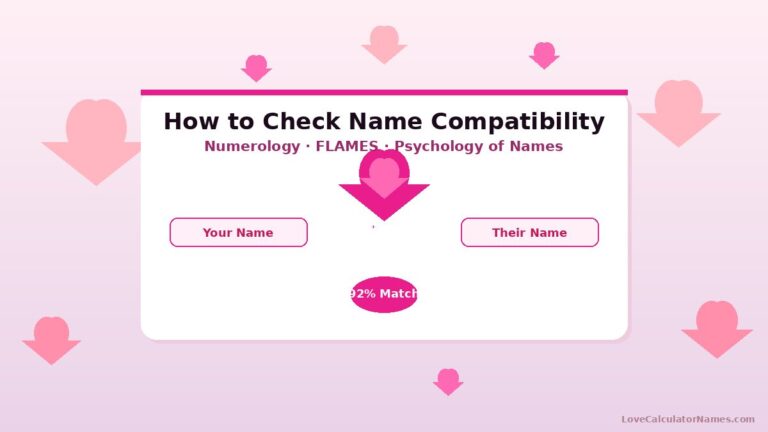
Love scores are generated by assigning numeric values to the letters in each name, reducing those values, combining them across both names, and converting the result to a percentage. The most common system is Pythagorean numerology, but the exact steps vary between calculators.
Here’s how the core process works:
- Assign each letter a number value. In the Pythagorean system: A=1, B=2, C=3, D=4, E=5, F=6, G=7, H=8, I=9. Then the pattern resets: J=1, K=2, L=3, and so on through the alphabet.
- Add up the letter values for each name. For example, “ANNA” gives you 1+5+5+1 = 12. Reduce it by adding the digits: 1+2 = 3. That becomes the name’s core number.
- Do the same for the second name. Get its reduced core number using the same method.
- Combine both numbers and reduce again. Add the two core numbers together. If the result is more than one digit, reduce again.
- Map the result to a percentage scale. Most calculators convert this combined value to a 1 to 100 scale. Some add phonetic harmony weighting based on how the names sound together, including vowel-consonant balance and shared syllable patterns.
- Apply any additional layers. More advanced tools incorporate birth date numerology, astrological matching, or cultural name pattern analysis before arriving at a final score.
When two names produce a result that maps to 50%, their numeric values typically balanced out without a strong lean in either direction. Neither set of name energies dominates the other. That’s exactly why the midpoint is worth examining rather than dismissing.
It’s also worth knowing that nicknames and formal names often produce different scores. “Kate” and “Katherine” don’t land in the same place. Middle names shift outcomes. Cultural naming traditions, particularly in South Asian, East Asian, and Arabic contexts, carry their own compatibility frameworks that don’t always translate cleanly to Western-style Pythagorean tools. The calculation is a specific lens, not a universal measure.
Why Name Compatibility Has Fascinated People for Centuries
Name compatibility thinking is far older than the internet. The idea that names carry energy, destiny, and relational meaning appears in cultures across thousands of years of recorded history.
In ancient Greece, Pythagoras and his followers believed that numbers were the foundation of all reality, and that letters, as representations of numbers, encoded meaning about the things and people they named. This wasn’t fringe thinking: it was a philosophical position held by one of history’s most influential mathematicians.
Jewish gematria, which assigns numeric values to Hebrew letters and finds meaning in the sums, has been practiced for over two thousand years. Names in this tradition weren’t just labels: they were thought to reflect a person’s soul-level qualities. A good naming match, by this logic, wasn’t cosmetic but genuinely significant.
In Chinese tradition, the stroke count of written characters in a name carries compatibility weight. Couples considering marriage would historically consult a scholar to compare the stroke totals of their names against each other and against auspicious numbers. A “balanced” result, rather than a dominant one, was often preferred.
Sanskrit naming traditions in South Asia incorporate nakshatra matching (lunar mansion compatibility) as part of the broader process of pairing names and birth charts before a marriage. Here, too, balance and complementarity are the goals, not mirror-image sameness.
Modern love calculator tools draw loosely from these traditions while simplifying them dramatically for casual use. The Pythagorean letter-to-number mapping is the most common engine. But the underlying human impulse, the desire to find meaning in names and to understand whether two names belong together, is ancient.
This matters for interpreting a 50% score. The frameworks that influenced today’s tools didn’t treat the exact middle as a failure. Many of them treated genuine balance between two name energies as the ideal outcome. A score at 50% might reflect exactly that: two distinct people whose name profiles meet each other in the middle rather than one overwhelming the other.
What Different Score Ranges Mean (And Where 50% Lands)
A score of 50% sits squarely in the moderate range, what most practitioners describe as balanced or open-ended rather than weak. Understanding the full scale puts the number in proper context.
| Score Range | General Interpretation | What It Often Reflects |
|---|---|---|
| 90 to 100% | Exceptionally high compatibility | Strong name-energy alignment, shared vowel and consonant patterns |
| 70 to 89% | Strong match | Good numerological resonance, phonetic harmony between names |
| 50 to 69% | Moderate and balanced | Neutral energy, neither strongly pulling nor pushing apart |
| 30 to 49% | Low match | Contrasting name values, opposing energy patterns |
| 0 to 29% | Very low compatibility | Strong numerological opposition between the two names |
Exactly 50% is a genuinely unusual result. Most pairings land slightly above or below it. When two names hit the midpoint precisely, it often reflects two distinct but equally strong name energies that neither reinforce nor cancel each other. Some numerologists read this as a sign of complementary rather than identical energies: two different personalities who balance each other rather than mirror each other.
Here’s something that surprises a lot of people. Some of the most durable long-term relationships score in the 50 to 70% range on name calculators, not the 90s. Very high scores can sometimes reflect names that are too similar, lacking the contrast that makes a dynamic relationship interesting. Complementary isn’t the same as identical, and that’s true in name compatibility the same way it’s true between people.
In numerology, the number 5 (which 50 reduces to: 5+0=5) carries associations with adaptability, change, freedom, and dynamic energy. A score that reduces to 5 is often read as lively and full of possibility. Those qualities describe a lot of the most interesting relationships.
How 50% Compares to Cultural Compatibility Traditions
Name-based compatibility isn’t unique to Western numerology tools. Several cultural traditions have long histories of name matching, and they offer useful perspective on what a “middle” score might mean.
In certain South Asian naming traditions, names are selected based on the partner’s astrological chart and numerological profile, with the goal of complementing rather than duplicating. A perfect match, by that logic, isn’t identical energy: it’s balanced energy. A result that sits at the midpoint between two people’s name profiles would, in that context, be a positive sign of genuine complementarity.
In Japanese naming traditions, the number of strokes in written characters can be used to determine compatibility. Matching traditions in Chinese naming practices similarly favor balance over sameness. Across these systems, what Western love calculators might score as a 50% match could be interpreted as ideal rather than average.
None of this means that a love calculator score of 50% predicts a culturally compatible match. It means that “middle” results carry more nuance than they first appear, and that the instinct to want higher isn’t universal.
Common Myths About Love Calculator Scores
The most persistent myth about love calculators is that higher is always better. That misses what these scores actually represent, and it sets people up to overthink a number that was never designed to make decisions for them.
Myth 1: 50% means you’re only half in love. The score reflects name-number interaction, not emotional intensity. Two people can feel deeply connected and score 50% on a name tool. Two people can score 95% and barely get along. The number doesn’t measure feelings. It measures a mathematical relationship between letters.
Myth 2: Scores above 80% guarantee a good relationship. High scores feel exciting. But real relationships are built on communication, trust, shared values, and time. None of those appear in letter arithmetic. A 95% name score hasn’t prevented anyone from having a difficult relationship, and a 50% score hasn’t stopped anyone from building something lasting.
Myth 3: Your score is fixed. Names are flexible. “Mike” and “Michael” produce different results for the same person. Trying a nickname, a middle name, or a hyphenated last name can shift the outcome noticeably. This also means you shouldn’t treat any single result as definitive: the score changes based on which version of the name you enter.
Myth 4: These tools are based on random formulas. Pythagorean numerology has a long history, dating to ancient Greek philosophy. The assignment of number values to letters has appeared across cultures, including Jewish gematria and Sanskrit naming traditions, for centuries. The tools are simplified and playful, but the underlying framework isn’t arbitrary.
Myth 5: A 50% result means you’re just friends. The score says nothing about the nature of a relationship. Friendship and romance don’t map to score ranges. Many strong romantic partnerships produce name scores right in the 45 to 60% zone depending on the names and the tool used.
Frequently Asked Questions
What does 50 percent love mean on a love calculator? A 50% love score means the two names sit at the exact midpoint of the compatibility scale: balanced, with no strong pull in either direction. It reflects neutral or complementary name energy. Most calculators treat the 50 to 69% zone as a moderate range suggesting open potential, not incompatibility.
Is a 50% love score good or bad? It’s neither, and that’s what makes it interesting. A 50% score reflects balanced name energy, not a problem to fix or a victory to celebrate. Many people in long, happy relationships score in this range with their partners. It’s best understood as open potential rather than a verdict.
What love percentage is considered a strong match? Most calculators treat 70% and above as a strong match. But “good” is relative. Some numerologists argue that scores in the 50 to 70% range reflect the most realistic compatibility, since very high scores can indicate names that are too similar to create dynamic contrast.
Can I get a different love score by changing the name I enter? Yes. Using a nickname, middle name, or full legal name instead of a common short form can change the result noticeably. “Liz” and “Elizabeth” don’t produce the same score. This variability is a good reminder that the tool is meant for fun exploration, not fixed conclusions.
Why do different love calculators give different scores for the same two names? Each calculator uses its own formula. Some use only Pythagorean letter values. Others add FLAMES calculations, phonetic weighting, birth dates, or astrological data. The underlying method changes the output, which is why results vary across sites. There is no single universally correct love score.
Does a love score below 50% mean we’re incompatible? Not necessarily. A score below 50% reflects a contrast in name energies, but contrast isn’t the same as incompatibility. Some compatibility frameworks actively value opposing name profiles as a sign of complementary balance. The score is one input, not a conclusion.
What is the FLAMES method and how does it affect love scores? FLAMES is a separate calculation method that uses the count of unique letters across two names to assign one of six relationship categories: Friends, Love, Affection, Marriage, Enemy, or Siblings. Some calculators combine FLAMES with numerology to generate a percentage. Others use one or the other. They’re different systems that sometimes appear in the same tool.
Are love calculators accurate predictors of real relationships? No, and that’s not the point. Love calculators are built for entertainment, curiosity, and fun. Real relationships are shaped by communication, shared values, trust, and experience. None of those factors appear in a name. The tool is a conversation starter, not a relationship blueprint.
What Should You Do With a 50% Score?
A 50% result is the most genuinely open-ended outcome a love calculator can produce. It doesn’t push you toward anything. It places the question exactly where it belongs: back with you.
That’s worth something. A 99% score can give you false certainty about something you should still think through carefully. A result in the middle keeps the question alive, and that’s often where the most interesting things begin.
The real takeaways here are simple: name compatibility is a lens, not a law. A balanced score reflects balanced name energies, not a balanced or unbalanced relationship. Anyone who has spent real time with someone they genuinely connect with knows that no number on a screen told them how to feel.
Use results like this as conversation starters. They’re fun to share, surprisingly interesting to debate, and good at getting two people talking. That, more than any specific percentage, might be the whole point of the exercise.
If you want to see your own result and try a few name combinations, the free compatibility tool at LoveCalculatorNames.com runs the numbers instantly with no sign-up required and complete privacy. Try your full name, a nickname, and see how the score shifts.
Our free FLAMES game turns two names into a playful compatibility result.