Thinking about using numerology before a big romantic decision? You’re not alone — millions of people check name compatibility scores every year, especially before marriage. But the question underneath all of it is a fair one: does any of this actually work?
Here’s the direct answer: Numerology doesn’t predict whether a marriage will succeed. No published scientific study supports it as a reliable forecasting tool. What it does do is give couples a structured, culturally meaningful way to reflect on their names and numbers together — and for many people, that ritual carries real emotional weight. Think of it as a fun, thought-provoking lens, not a verdict.
This article covers how marriage numerology works, what the numbers actually mean, and when it’s worth trying.
Numerology compatibility tools are for entertainment and personal reflection, not professional relationship guidance.
What Is Numerology, and Why Do People Use It for Marriage?
Numerology is a system that assigns numerical values to letters and uses the resulting numbers to describe personality traits, life themes, and compatibility between people. For marriage specifically, it most often compares life path numbers (derived from birth dates) and destiny numbers (derived from full names) to see whether two people’s core numbers “harmonize.”
People use it for marriage for a few reasons. In many South Asian cultures — particularly Hindu and Jain traditions — numerological compatibility is a standard part of wedding planning, consulted alongside astrology and auspicious dates. In Western contexts, it’s more of a personal curiosity tool: a way to put a number on something that otherwise feels impossible to quantify.
The appeal isn’t really about predicting outcomes. It’s about the ritual of checking, the conversation it starts, and the satisfaction of seeing “compatible” next to your names.
How Does Numerology Calculate Marriage Compatibility?
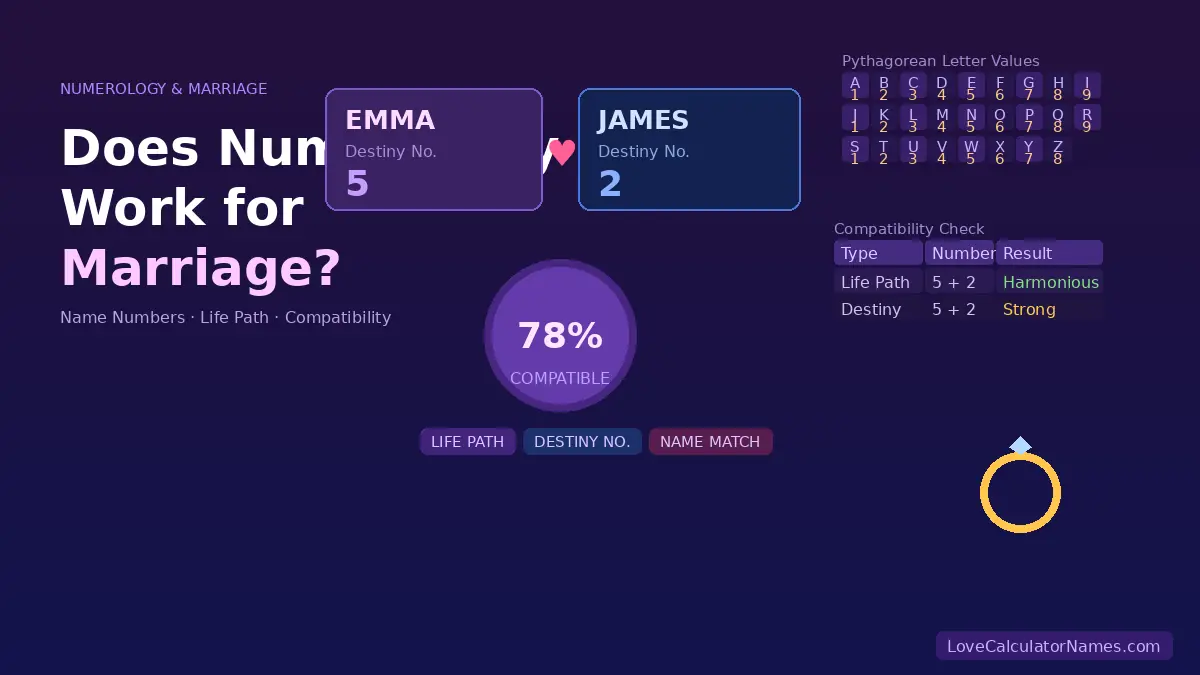
Marriage numerology typically compares two numbers: the life path number (calculated from your date of birth) and the destiny number (calculated from your full name using the Pythagorean letter-value system). A compatibility score is then produced based on how those two numbers interact.
Here’s how each calculation works:
Step 1 — Calculate your Life Path Number
Write out your full birth date as digits. Add every digit together. If the result is two digits, add those together too. Keep reducing until you have a single digit (1–9). Exception: 11, 22, and 33 are “master numbers” and stay as-is in most systems.
Example: Born June 14, 1995 → 6 + 1 + 4 + 1 + 9 + 9 + 5 = 35 → 3 + 5 = 8
Step 2 — Calculate your Destiny Number
Use the Pythagorean chart: A=1, B=2, C=3 … I=9, then restart J=1, K=2, and so on. Write out your full name at birth, convert each letter to its number, add them all up, and reduce to a single digit.
Example: EMMA = 5+4+4+1 = 14 → 1+4 = 5
Step 3 — Compare the two numbers
Some systems compare life path to life path. Others compare destiny to destiny. Many combine all four numbers (both partners’ life path + destiny) and run them through a compatibility matrix.
Step 4 — Apply a compatibility framework
The numbers 1–9 are divided into compatibility groups. Numbers that share root energies (1, 5, 7 are often grouped as “independent”) tend to be rated as harmonious. Numbers seen as opposing forces (2 and 8, for instance) are often rated “challenging.”
Step 5 — Interpret the result
A score or description is returned — usually something like “highly compatible,” “complementary,” or “requires work.” Most tools also include trait descriptions for each number.
What Do the Numbers Actually Mean for Couples?
Each number in the Pythagorean system is associated with a set of traits. When two people’s numbers are compared, compatibility is assessed based on how those traits interact. Here’s a simplified breakdown:
| Life Path Number | Core Trait | Strong Matches | Challenging Matches |
|---|---|---|---|
| 1 (The Leader) | Independent, driven | 3, 5, 7 | 4, 8 |
| 2 (The Partner) | Sensitive, cooperative | 4, 6, 8 | 1, 5 |
| 3 (The Communicator) | Creative, expressive | 1, 5, 9 | 4, 7 |
| 4 (The Builder) | Practical, stable | 2, 6, 8 | 1, 3 |
| 5 (The Explorer) | Adventurous, free | 1, 3, 7 | 2, 4 |
| 6 (The Nurturer) | Caring, responsible | 2, 4, 9 | 5, 7 |
| 7 (The Seeker) | Analytical, private | 1, 5 | 2, 6 |
| 8 (The Achiever) | Ambitious, powerful | 2, 4, 6 | 1, 3 |
| 9 (The Idealist) | Compassionate, wise | 3, 6 | 5, 8 |
Keep in mind that these frameworks vary between systems. One numerologist’s “challenging match” is another’s “growth opportunity.” The table above reflects the most common Pythagorean interpretation, but you’ll find plenty of disagreement in practice.
Name-based compatibility (via destiny numbers) adds another layer. Two people with matching or harmonious destiny numbers are described as having natural alignment in their life purpose — which, for marriage, is sometimes read as a sign that you want similar things long-term.
Cultural context matters here too. In India, namakarana (the naming ceremony) has included numerological considerations for centuries. Couples in some regions still choose wedding dates based on the numerological values of the month and year, and name changes after marriage are sometimes calculated to improve a couple’s combined number.
What Are the Biggest Myths About Numerology and Marriage?
Skepticism about numerology is healthy, and a lot of it comes from genuine misconceptions about what the system claims to do. Here are the five most common ones, straightened out.
Myth 1: Numerology can predict divorce.
No numerology system claims this, and none can do it. Life path compatibility describes tendencies, not outcomes. Plenty of “challenging” number pairs have lifelong marriages; plenty of “ideal” matches don’t last five years.
Myth 2: You need a perfect compatibility score to have a good marriage.
Completely false. There’s no published research linking high numerology scores to marriage success rates. A low score tells you nothing predictive about your relationship — it’s one interpretation within an ancient symbolic framework.
Myth 3: Changing your name after marriage changes your compatibility.
It changes your destiny number, yes. Whether that means anything is a matter of belief, not fact. Some numerologists say your birth name is your “true” number; others say your current name is what matters. There’s no consensus.
Myth 4: Only certain number combinations can have a happy marriage.
This is the most harmful misconception, particularly in cultural contexts where families pressure couples based on “incompatible” numbers. Every numerology system is a symbolic framework built by humans — none of them have clinical validity as relationship predictors.
Myth 5: Numerology and astrology say the same things.
They’re separate systems. Astrology is based on the positions of celestial bodies at birth. Numerology is based purely on numbers derived from names and dates. They often reach different conclusions about the same couple.
Frequently Asked Questions
Does numerology actually work for predicting marriage success?
No scientific evidence supports numerology as a predictor of marriage outcomes. Studies on relationship success consistently point to communication, shared values, and conflict resolution as the key factors — none of which show up in a number calculation. Numerology works as a personal reflection tool and a cultural tradition, not a forecasting method.
What is the best numerology number for marriage?
In the Pythagorean system, the number 6 is most often associated with marriage, domesticity, and family. Life path 6s are described as natural nurturers who thrive in committed relationships. That said, every number can have a successful marriage — the “best” number depends entirely on which system you’re using and how you interpret it.
Can two people with incompatible life path numbers have a good marriage?
Yes, absolutely. Numerology compatibility frameworks describe general tendencies, not fixed outcomes. Numbers rated as “challenging” together are sometimes interpreted as growth pairings — two people who push each other to develop in ways they wouldn’t alone. Treat any incompatibility rating as a conversation starter, not a red flag.
How do you calculate marriage compatibility using numerology?
Calculate each partner’s life path number (reduce your full birth date to a single digit) and destiny number (convert each letter of your full birth name to its Pythagorean value, then reduce the total). Compare the two sets of numbers using a compatibility matrix, or use a name-based compatibility tool that does the math automatically.
Is numerology used in real wedding planning?
In several cultures, yes. In Hindu traditions, numerology is often consulted alongside astrology when choosing a wedding date or evaluating a match. In Chinese culture, certain number combinations (like two 8s, associated with prosperity) are preferred for wedding dates. These are genuine cultural practices with deep roots, even if they’re not scientifically validated.
What happens if both partners have the same life path number?
Same life path numbers are typically rated as highly compatible in most systems, because the two partners are said to understand each other’s core drives. However, some interpretations flag this as potentially creating a “mirror” dynamic — both people have the same blindspots, which can cause friction if neither naturally compensates for the other’s weaknesses.
Does your name spelling affect numerology compatibility?
Yes, in name-based systems. Each letter maps to a specific number, so changing even one letter shifts the destiny number. This is why nicknames, maiden names, and hyphenated names can produce different results than full legal names. Most numerologists recommend using the full name as it appears on your birth certificate.
Is numerology different from a love calculator?
Partly. A love calculator typically uses letter-frequency cancellation or a simplified scoring formula based on the letters in two names. Numerology goes deeper — it assigns each letter a value (1–9 on the Pythagorean scale), totals them into a single-digit destiny number, and then compares those numbers using a compatibility framework. Both are entertainment tools, but numerology has a much longer cultural history.
So, Should You Try It?
Numerology won’t tell you whether your marriage will work. No number system can do that, and it would be dishonest to suggest otherwise.
What it can do: give you a structured way to think about your names and numbers together, connect you to a tradition that billions of people have found meaningful, and maybe spark a conversation with your partner about what you actually value and want.
The couples who find numerology useful tend to treat it that way — as a starting point, not a verdict. They check the score, talk about what the traits sound like, and laugh about the ones that are eerily accurate. That’s the actual value: not prediction, but reflection.
If you’re curious what your names produce together, try the free name compatibility test at LoveCalculatorNames.com — no sign-up, 100% private, and the result comes back in seconds.
Enter two names and let our love meter show you the score right away.