Can two names tell you something real about a relationship? It sounds like a question for a fortune teller — but name-based compatibility has been a serious cultural practice across centuries and continents, from ancient Greek numerology to South Asian astrology to modern love calculators trusted by millions worldwide.
This guide walks through every major method used to check marriage compatibility by name: Pythagorean numerology, the FLAMES game, love percentage scoring, and phonetic harmony. You’ll see real worked examples, a method comparison table, cultural context from five traditions, and five common myths — busted.
To check marriage compatibility by name, assign each letter a number using the Pythagorean numerology chart, add up the values for each name, reduce to a single digit, then compare the two results. You can also use the FLAMES letter-elimination game or a free online love calculator for an instant percentage score. These methods are culturally rooted and enjoyable to explore — though they’re not a scientific measure of relationship success.
Disclaimer: All name compatibility methods in this article are for entertainment and personal reflection. They are not substitutes for professional relationship or counseling advice.
What Is Name-Based Marriage Compatibility, and Why Do People Check It?
Name-based marriage compatibility is the practice of comparing two people’s names using structured numerical, phonetic, or pattern-based systems to produce a compatibility score or outcome. These aren’t modern inventions — they’re cultural tools refined over thousands of years and adapted for anyone to access today.
The most recognized foundation is Pythagorean numerology, developed around 500 BCE by Greek philosopher Pythagoras. He believed numbers were the underlying structure of reality — including human personality. Later scholars extended this: if numbers reflect traits, and traits determine compatibility, then a name converted into numbers could reveal how well two people might pair together.
In South Asian traditions, name compatibility is often part of Kundali matching — a comprehensive astrological comparison performed before Hindu weddings. A quick version checks the first letter of each person’s name against its corresponding lunar mansion (Nakshatra) for an initial compatibility read. Families across India, Pakistan, and the wider South Asian diaspora use this practice today.
Chinese and Japanese naming traditions look at something different: the number of brushstrokes in written characters and the tonal balance of syllables. A name with too many strokes from the same elemental category is sometimes considered unbalanced for a couple. Naming specialists are still consulted for major life decisions in some families.
West African traditions approach names through meaning rather than math. Names carry ancestral identity, and compatibility is assessed by whether two names from complementary lineages or meanings — “strength” paired with “grace,” for example — create balance rather than clash.
What runs through all these systems is a single conviction: names are not arbitrary labels. They carry cultural weight, historical meaning, and patterned energy — and comparing that energy can be illuminating. Today, those traditions have evolved into free digital tools that process any two names in seconds. The curiosity, it turns out, is universal.
How to Check Marriage Compatibility by Name: 4 Methods Explained
There are four main methods: Pythagorean numerology (letter values + root number comparison), the FLAMES game (letter elimination → relationship category), love percentage calculators (algorithm-based 0–100% score), and phonetic harmony (how names sound together). Each produces different outputs and suits different purposes.
Method 1: Pythagorean Numerology — The Most Structured Approach
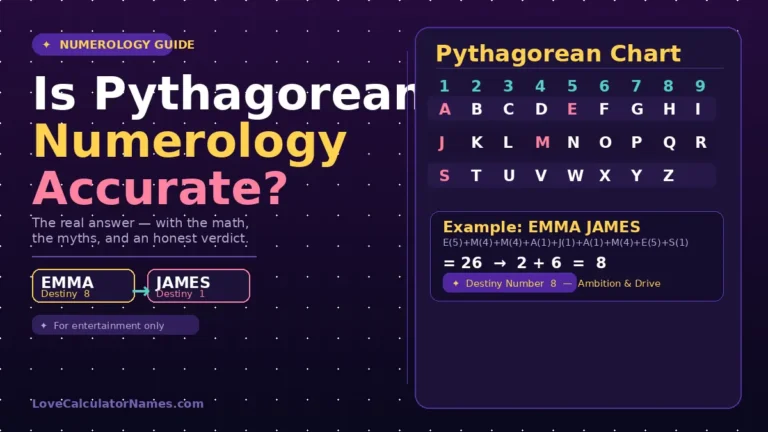
Pythagorean numerology is the most widely used name compatibility system globally. It assigns every letter a number from 1 to 9, totals the values in a name down to a “root number,” then interprets how two people’s root numbers relate to each other.
Step 1: Write both names — first names for a quick check, full legal names for a deeper reading.
Step 2: Assign each letter its Pythagorean value:
| Number | Letters |
|---|---|
| 1 | A, J, S |
| 2 | B, K, T |
| 3 | C, L, U |
| 4 | D, M, V |
| 5 | E, N, W |
| 6 | F, O, X |
| 7 | G, P, Y |
| 8 | H, Q, Z |
| 9 | I, R |
Step 3: Add all the letter values for each name. If the result is two digits, add those digits together. Keep reducing until you reach a single digit (1–9). Note: Numbers 11, 22, and 33 are “master numbers” in many systems and are not reduced further.
Step 4: Work a real example.
Try Emma and Liam:
- Emma: E(5) + M(4) + M(4) + A(1) = 14 → 1+4 = 5
- Liam: L(3) + I(9) + A(1) + M(4) = 17 → 1+7 = 8
In Pythagorean numerology, 5 carries the energy of freedom, adaptability, and social curiosity. 8 represents ambition, structure, and long-term focus. Practitioners often describe this as a complementary pairing — 5 brings variety and spontaneity while 8 provides direction and stability. The tension between those energies is real, but so is the balance they can create.
Step 5: Consult a numerology compatibility reference for your two numbers. Most guides agree on core themes: numbers with similar drives (both creative, both practical) tend toward harmony; opposite numbers create friction but also potential for growth.
Method 2: The FLAMES Game — Fast and Universally Known
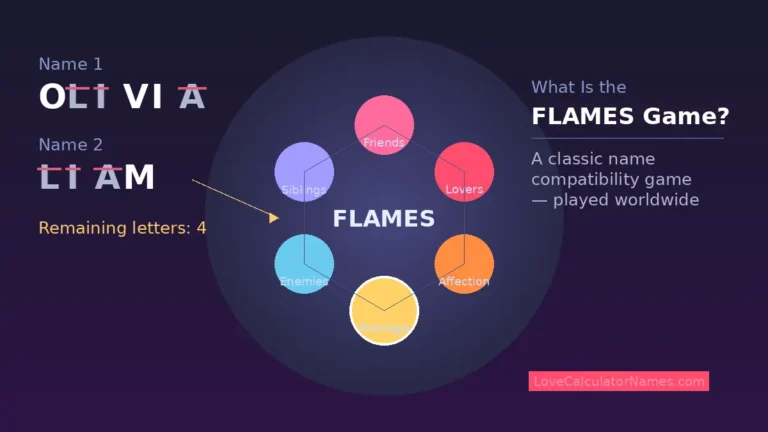
FLAMES is one of the most recognized name compatibility games in the world — popular across the US, UK, India, Australia, and beyond since at least the 1980s. The acronym stands for Friends, Lovers, Affection, Marriage, Enemies, Siblings.
Step 1: Write both first names.
Step 2: Cross out every letter that appears in both names — one matching pair at a time. If “A” appears twice in one name and once in the other, you cancel only one pair.
Step 3: Count all the remaining (uncanceled) letters across both names combined.
Step 4: Starting at F, count cyclically through the letters of FLAMES using your total. The letter you land on gets eliminated. Continue from the next remaining letter, counting again, until one letter survives.
Step 5: The surviving letter is your result — F = Friends, L = Lovers, A = Affection, M = Marriage, E = Enemies, S = Siblings.
Quick example — Emma and Jake:
- Emma: E, M, M, A / Jake: J, A, K, E
- Common letters: E (one each) + A (one each) → cancel both pairs
- Remaining: Emma → M, M | Jake → J, K → 4 letters total
- Count of 4 through FLAMES eliminates letters in sequence until one survives
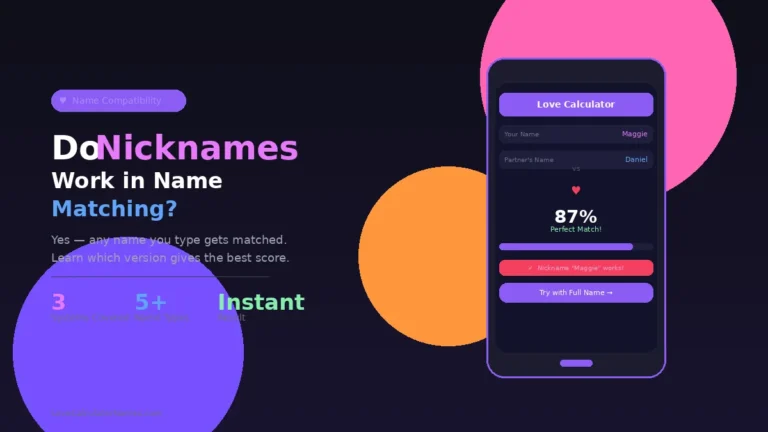
FLAMES is best used as a social game. Results shift entirely depending on whether you use a nickname or full name — which is part of the fun. Most online calculators handle the counting automatically, so you don’t need to do it by hand.
Method 3: Love Percentage Score — Instant Results
This is the method behind most free online name compatibility tools. Two names are processed through an algorithm — typically combining letter value overlap, frequency patterns, and positional matching — to output a score from 0% to 100%.
How to use it:
- Enter both names into a love calculator.
- The tool runs the algorithm instantly.
- Scores above 70% are generally labeled “strong compatibility.” Scores below 40% are flagged as low match.
The exact formula varies between tools, which is why the same two names may score 72% on one calculator and 58% on another. None is definitively “correct” — each is one consistent interpretation of the same name patterns.
This method is the most popular because it requires no manual math, gives an immediately shareable result, and lets you test multiple combinations quickly.
Method 4: Phonetic Harmony — The Linguistic Angle
Phonetic harmony evaluates how two names sound together rather than what their letter values calculate to. Names that share vowel patterns, matching syllable counts, or complementary consonant sounds score higher.
Consider “Emma and Ethan” — both names open with a soft vowel and carry two syllables with a flowing rhythm. Or “Jack and Jill” — identical syllable count, matching short vowel, and near-rhyming ending consonants. Linguistic research on phonetic similarity suggests that names perceived as harmonious in sound are also perceived as more naturally paired in everyday conversation and social settings.
Phonetic harmony is the least formalized of the four methods and is rarely offered as a standalone score in online tools — but it’s worth thinking about when you consider how a couple’s names will sound together for years to come.
Name Compatibility Across Cultures: Examples, Traditions, and What to Expect
Name compatibility methods vary widely by culture, calculation system, and tradition. What one method flags as a perfect match, another may rate differently — and knowing why helps you read results with more context.
Here’s a side-by-side comparison of the major methods:
| Method | Cultural Origin | What It Analyzes | Output | Best For |
|---|---|---|---|---|
| Pythagorean Numerology | Ancient Greece / Modern West | Letter number values | Root number pairing | Detailed personality-based analysis |
| Chaldean Numerology | Ancient Babylon | Alt letter-number chart | Root number pairing | Traditional numerology enthusiasts |
| FLAMES | Global (1980s–present) | Letter overlap + elimination | One of 6 categories | Quick social game |
| Love % Calculator | Modern digital | Algorithm-based scoring | 0–100% score | Instant, shareable result |
| Nakshatra (South Asian) | Vedic astrology | First letter + lunar mansion | Compatibility grade | Pre-marital traditional check |
| Stroke Count (East Asian) | Chinese/Japanese tradition | Written character complexity | Elemental balance | Traditional naming decisions |
What Real Name Pairings Look Like Across Systems
Let’s look at how four well-known name pairs score across different methods:
| Couple Names | Pythagorean Root Pair | Phonetic Harmony | FLAMES (common result) |
|---|---|---|---|
| Emma & Liam | 5 & 8 (complementary) | High — soft vowels, 2 syllables each | Love / Affection |
| Taylor & Travis | 7 & 4 (growth pair) | Very High — matching stress + T consonance | Love |
| Victoria & David | 3 & 6 (creative harmony) | High — flowing, formal register | Marriage |
| Jennifer & Brad | 8 & 2 (power + support) | Medium — different rhythm and length | Affection |
Note: Results differ based on which numerology system is used, whether nicknames or full legal names are entered, and which tool processes them. These are illustrative, not definitive.
Cultural Angles Worth Understanding
South Asian traditions: Kundali matching across eight compatibility factors (Ashtakoot) is the comprehensive standard — but a quick name-letter check against the Nakshatra chart is widely used for an initial read. This remains a standard part of many Hindu wedding preparations.
West African and diaspora traditions: Name compatibility is assessed through meaning and lineage rather than sound or number. Two names representing complementary ancestral qualities — one meaning “strength,” another meaning “wisdom” — are considered a well-matched pairing.
East Asian traditions: Some Chinese families still consult naming specialists to ensure that the stroke count and elemental balance of both partners’ names create harmony rather than conflict. This is taken seriously in traditional contexts and is not purely decorative.
Modern Western practice: Most digital tools draw on Pythagorean numerology and love percentage algorithms. They’re secular, accessible, and built for entertainment — which is precisely why they’ve spread to 150+ countries and hundreds of millions of users.
5 Myths About Name Compatibility You Should Stop Believing
Many people either dismiss name compatibility as complete nonsense or treat it as a definitive verdict. Both reactions miss what these tools actually are. Here are five widely held myths — and a more accurate picture of each.
Myth 1: “A low score means the relationship is doomed.” A name compatibility score reflects letter patterns and numerical values — not personality, shared history, emotional intelligence, or the effort two people invest in each other. Two people with a 25% love percentage can build a lasting, deeply connected relationship. A score is an input for reflection, not a forecast for your future.
Myth 2: “Only certain cultures take name compatibility seriously.” Name compatibility is searched and practiced across 150+ countries representing every major religion and cultural tradition. The specific systems differ — Pythagorean in the Western world, Nakshatra in South Asia, stroke counts in East Asia, meaning-based analysis in Africa — but the curiosity is universal. No single tradition has ownership of this idea.
Myth 3: “Changing your name after marriage improves compatibility.” A new name does change the letter values and therefore the calculated output of any numerology tool. But relationship quality is not driven by name math. Many people change their names after marriage and find that the pre-change results still feel relevant to them. The name reflects a label; the relationship is lived every day regardless.
Myth 4: “All online tools use the same formula.” They don’t. Different calculators use different algorithms, different numerology systems (Pythagorean vs. Chaldean), and different approaches to scoring. The same two names can get a 74% on one tool and a 51% on another — both are internally consistent, but neither is more “true.” They each offer one valid interpretation.
Myth 5: “A ‘Marriage’ result in FLAMES means you’re getting married.” FLAMES is a letter-elimination game that has been played in schoolyards since the 1980s. Try the same two people using a nickname instead of a full name — the result often changes completely. The game is a fun conversation starter with zero predictive power for actual relationships.
Frequently Asked Questions
How do I check marriage compatibility by name for free?
The simplest method is a free online name compatibility calculator — no sign-up, payment, or personal data required. Enter both first names and the tool returns a love percentage, numerology root pair, or FLAMES result instantly. LoveCalculatorNames.com is one of the most-used free tools, trusted by 12M+ users across 150+ countries, with results in seconds.
Is name compatibility based on science?
No. Numerology, FLAMES, and love percentage calculators are not based on peer-reviewed science. They draw on centuries of cultural tradition and pattern-based mathematical systems. These tools are best used for entertainment, curiosity, and personal reflection — not as serious predictors of relationship success or as a basis for major life decisions.
Does it matter if I use a first name or full name?
Yes — results differ significantly between the two. First names are used for quick, casual compatibility checks. Full legal names are used in deeper numerology readings, as more letters produce a more complete numerical profile. Many people run both versions and compare to see which result resonates most with how they feel about the pairing.
What does a 100% love score actually mean?
It means those two names produced the maximum possible score within that tool’s specific algorithm. It does not mean the relationship is guaranteed to succeed. Name compatibility tools measure letter and number patterns, not personality alignment, communication skills, shared values, or the mutual effort that actually sustains a lasting relationship.
Why does FLAMES give different results on different websites?
Different platforms implement the FLAMES counting rule differently — some restart counting from the letter after the one eliminated, others from the top of the remaining letters. How “common letters” are counted and matched also varies. Results are consistent within one tool but may differ across platforms. Use one tool consistently if you want to compare multiple name pairs.
What is a “master number” in numerology?
In Pythagorean numerology, master numbers are 11, 22, and 33. Unlike all other two-digit totals, they are not reduced to a single digit — they carry amplified significance in the tradition. If a name’s letter values add up to 11, 22, or 33, many numerologists treat this as a special reading in a compatibility analysis rather than reducing it to 2, 4, or 6.
Can name compatibility predict whether a marriage will last?
No. Name compatibility tools offer a fun, culturally rich way to explore a pairing — they cannot predict relationship outcomes. A lasting marriage depends on communication, trust, shared values, mutual respect, and consistent daily choices made by both people. Use these tools as a lighthearted conversation starter, not a verdict on your relationship’s future.
Are there name compatibility methods that don’t involve numbers?
Yes. Phonetic harmony analysis looks at how two names sound together — matching vowel patterns, syllable counts, and rhythmic stress. Names that flow naturally when spoken side by side are considered more harmonious. This approach has roots in linguistic research on how phonetic similarity affects social perception, and it adds a dimension that purely numerical systems miss.
Name compatibility has engaged people for thousands of years — from Pythagorean numerologists in ancient Greece to families performing Kundali matching before weddings in South Asia today. The methods are diverse, the traditions are deep, and the results are always worth a second look.
Three things to take away: Pythagorean numerology gives the most structured analytical framework. FLAMES is the fastest and most social. Love percentage tools deliver instant, shareable scores. No method can replace the real ingredients of a lasting relationship — but all of them offer a fresh, thoughtful way to look at two names together.
Ready to see your score? Try the free name compatibility test at LoveCalculatorNames.com — no sign-up required, completely private, and results in seconds.
Try the love calculator that millions of people use just for the fun of it.