Name matching has been around far longer than most people realize. The question of whether two names belong together has shown up in ancient numerology texts, South Asian marriage traditions, and school notebook games passed around playgrounds for decades. The curiosity is genuine, and so are the methods.
Quick answer: To match two names, the five most common approaches are: (1) FLAMES, where you cancel shared letters and count what’s left to land on a six-option result; (2) Pythagorean numerology, where you convert letters to numbers 1-9 and reduce to a single digit; (3) letter-value scoring, where A=1 through Z=26 and both names combine into a percentage; (4) phonetic harmony, where you compare how the names sound together; and (5) life path number matching, using birth dates. All five are for fun and entertainment only.
This guide explains each method in plain terms, with worked examples, so you can try any of them yourself or understand exactly what an online calculator is doing behind the scenes.
What Does It Mean to Match Two Names for Compatibility?
Name matching assigns a compatibility score or outcome to two people based on the letters, sounds, or numerical values in their names. The result might be a category (like FLAMES), a reduced number (like a numerology digit), or a percentage. No system is scientifically validated, but each draws on real cultural traditions that have been in use for centuries.
The core idea is ancient. Early Greek philosophers, Hebrew scholars, and Hindu astrologers all treated letters as carriers of numerical energy. The Pythagorean system, probably the most widely used approach today, assigns a number 1 through 9 to each letter of the alphabet in a repeating sequence. Chaldean numerology, which predates Pythagorean and is sometimes considered more precise by practitioners, runs on a 1-through-8 chart instead. Both traditions treated a person’s name as a kind of numerical fingerprint.
That idea has traveled across cultures in different forms. In many South Asian communities, name matching before marriage (part of a broader process called Kundali Milan) carries real social weight. In East Asian traditions, the stroke count of the characters forming a name is analyzed for elemental balance. In Western folk traditions, shared letter counting has been a playground ritual for generations.
Modern name compatibility tools take all of these older ideas and turn them into instant, shareable scores. Knowing what’s happening underneath makes the experience more interesting, and it helps you choose which method feels right for you.
How Do You Match Two Names? Five Methods Explained
To match two names, pick one of five approaches: FLAMES, Pythagorean numerology, letter-value scoring, phonetic harmony, or life path number comparison. Each uses a different type of input, from letter cancellation to birth dates, and each produces a different kind of result. Here is exactly how each one works, with clear steps and worked examples.
Method 1: FLAMES
FLAMES stands for Friends, Love, Affection, Marriage, Enemy, Siblings. It is the method most people encounter first, usually in a school setting, and it remains the most recognizable name-matching game worldwide, especially across South Asia, Southeast Asia, and parts of the United States.
Step-by-step:
- Write out both first names on paper.
- Cross out every letter that appears in both names. Each letter can only cancel once: one letter from Name A cancels one matching letter from Name B.
- Count all the uncrossed letters remaining across both names combined.
- Write out the letters F-L-A-M-E-S in sequence and count through them using your total from Step 3. When you reach your count, eliminate that letter.
- Start the count again from the next letter, continuing to eliminate until only one letter remains.
- That final letter is your result: Friends, Love, Affection, Marriage, Enemy, or Siblings.
Worked example — Amy and Tom:
- Amy: A, M, Y
- Tom: T, O, M
- Shared letter: M (cancel one M from each name)
- Remaining letters: A, Y from Amy, plus T, O from Tom = 4 letters total
- Count to 4 through F-L-A-M-E-S: F(1), L(2), A(3), M(4). Eliminate M.
- Remaining: F-L-A-E-S. Count to 4: F(1), L(2), A(3), E(4). Eliminate E.
- Remaining: F-L-A-S. Count to 4: F(1), L(2), A(3), S(4). Eliminate S.
- Remaining: F-L-A. Count to 4: F(1), L(2), A(3), F(4). Eliminate F.
- Remaining: L-A. Count to 4: L(1), A(2), L(3), A(4). Eliminate A.
- Result: L = Love.
One practical note: different online tools apply slightly different counting rules for edge cases. If two calculators give different results for the same pair of names, this is almost always why.
Method 2: Pythagorean Numerology
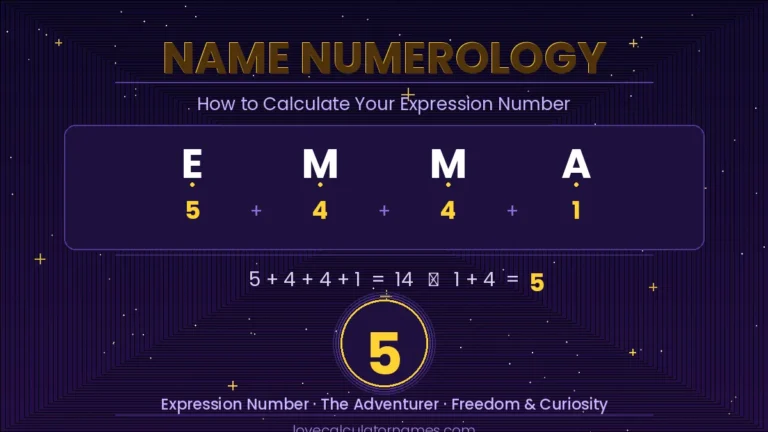
Pythagorean numerology assigns a number 1 through 9 to each letter of the alphabet in a repeating cycle. You total all the letter values in each name, reduce the total to a single digit, and then compare the two resulting digits for compatibility.
The Pythagorean letter chart:
| Number | Letters |
|---|---|
| 1 | A, J, S |
| 2 | B, K, T |
| 3 | C, L, U |
| 4 | D, M, V |
| 5 | E, N, W |
| 6 | F, O, X |
| 7 | G, P, Y |
| 8 | H, Q, Z |
| 9 | I, R |
Step-by-step:
- Write out both names.
- Replace each letter with its number from the chart above.
- Add all the numbers for Name 1 to get a total. Repeat for Name 2.
- Reduce each total to a single digit by adding the individual digits together. Keep reducing until you reach one digit. (Master numbers 11, 22, and 33 are left unreduced in some traditions.)
- Compare the two final digits using a numerology compatibility table.
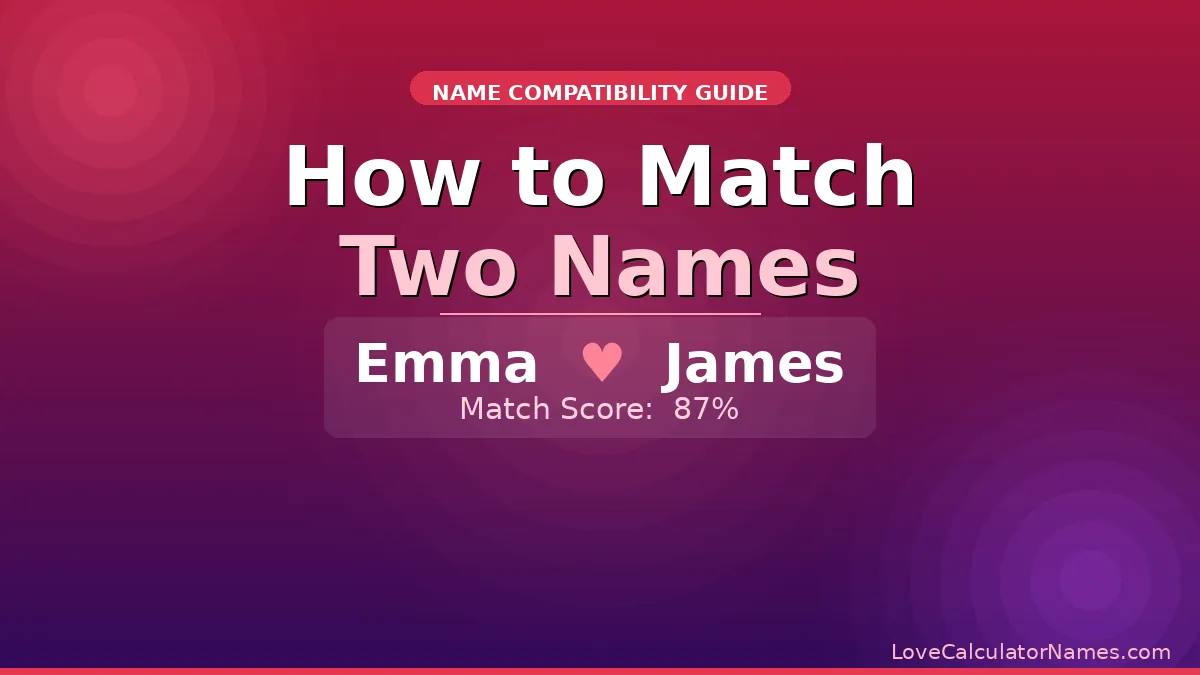
Worked example — James and Emma:
- JAMES: J(1) + A(1) + M(4) + E(5) + S(1) = 12, then 1+2 = 3
- EMMA: E(5) + M(4) + M(4) + A(1) = 14, then 1+4 = 5
In Pythagorean tradition, 3 and 5 are considered a compatible pairing. Both numbers are associated with expression, social energy, and a draw toward new experiences. This says nothing about the actual people named James and Emma, but it illustrates how the math works.
Method 3: Letter-Value Scoring
This is the system behind most online love calculators. It assigns each letter a value equal to its position in the alphabet: A=1, B=2, C=3, all the way to Z=26.
Step-by-step:
- Assign each letter in Name 1 its alphabetical value (A=1 through Z=26).
- Add up all the letter values for Name 1.
- Repeat for Name 2.
- Combine both totals.
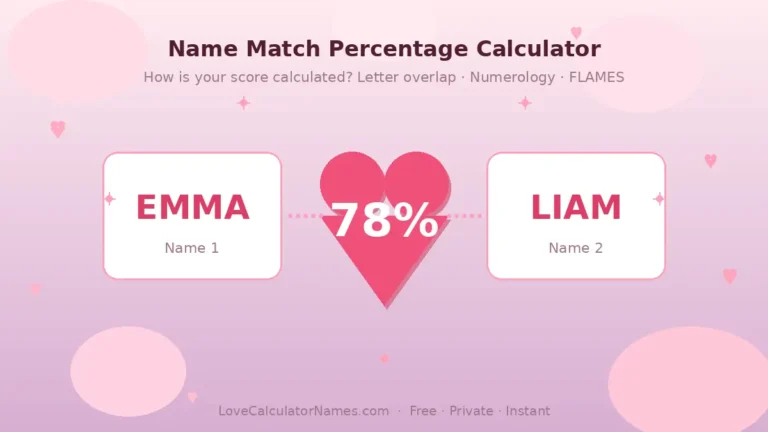
- Apply the calculator’s formula to produce a percentage, usually in the range of 1 to 100.
The exact percentage varies from one tool to the next because different calculators use different formulas in Step 5. Two sites can give different scores for the same pair of names and both be internally consistent. The underlying logic, that letters carry numerical weight, is consistent across all of them.
Method 4: Phonetic Harmony
Phonetic harmony is the most intuitive of the five methods and the least mathematical. The idea is that some pairs of names sound naturally balanced together, sharing vowel patterns, complementary consonant textures, or rhythmic symmetry.
Linguists refer to this quality as sound symbolism. Names with matching long vowels often feel harmonious when paired: Kate and Jake share the long-A sound; Lily and Oliver both have soft, open tones. Names with contrasting hard and soft consonants, like Max and Lily, can feel balanced rather than clashing.
To try this yourself, say both names aloud in different combinations (first names together, name one first, name two first) and notice which arrangement feels most natural. There is no numerical score here; the result is entirely subjective. But phonetic fit does influence how couples and close friends present themselves in social settings, which is why many people find this method more personally resonant than a percentage.
Method 5: Life Path Number Matching
Life path numbers come from birth dates rather than names, but they are closely paired with name numerology in many traditions and often used together for a fuller picture.
Step-by-step:
- Write each person’s full birth date as individual digits: day, month, and four-digit year.
- Add all the digits together to get one total.
- Reduce the total to a single digit by adding its digits. Repeat until you reach one number. (Again, 11, 22, and 33 stay as master numbers in some traditions.)
- Compare the two life path numbers using a compatibility framework.
General compatibility patterns recognized in numerological tradition: life path 1s (independent, driven) pair well with 3s and 5s; life path 2s (cooperative, emotionally attuned) mesh naturally with 6s and 8s; life path 7s (reflective, analytical) often find balance with 3s. These are traditional associations, not findings from any scientific study.
Name Matching Methods at a Glance
Different approaches answer different questions. Some are letter-based and fast, others require birth dates, and one relies entirely on feel. The table below puts all five side by side so you can choose what fits your situation.
| Method | Core Input | What You Get | Best For |
|---|---|---|---|
| FLAMES | Letters in both names | One of six categories (F/L/A/M/E/S) | Quick, playful result |
| Pythagorean Numerology | Letters converted 1-9 | A single digit, 1-9 | Deeper symbolic reading |
| Letter-Value Scoring | A=1 through Z=26 | Compatibility percentage | Shareable score |
| Phonetic Harmony | How the names sound together | Subjective fit rating | Social and aesthetic fit |
| Life Path Matching | Birth dates | Two paired numbers | Long-term angle |
Real examples help make these methods concrete. Take Taylor and Travis as a cultural reference point. In Pythagorean numerology, “Taylor” reduces to an 8 (ambition, structure) and “Travis” reduces to a 3 (expression, creativity). Numerology tradition considers 8 and 3 a productive pairing: one brings stability, the other brings spark.
Cultural context adds another layer. In South Asian wedding traditions, name matching is one component of Kundali Milan, a process that compares eight different attributes including temperament, health outlook, and planetary alignment alongside names. The name piece carries weight, but it is one part of a larger picture. In Chinese and Taiwanese naming traditions, the stroke count of the written characters making up a name is analyzed for balance across the five elements: water, wood, fire, earth, and metal. Neither tradition treats this as simple entertainment. Both communities embed name compatibility within larger belief systems that carry genuine personal significance.
Western name numerology sits somewhere between those poles. It has formal roots in Chaldean and Pythagorean schools, but most people use it today out of curiosity rather than as part of a formal pre-marriage process.
Five Common Myths About Matching Names
Name matching has picked up a lot of misinformation over the years. Here are five claims that come up often and deserve a clear answer.
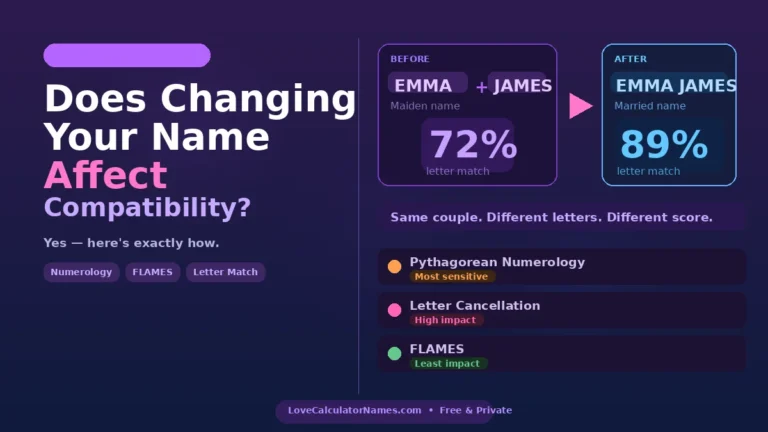
Myth 1: A low score means the relationship won’t work. No name-matching system predicts relationship success. Research on what actually makes relationships last points to communication patterns, shared values, and practical life compatibility. None of those appear in a name. A low compatibility percentage is a product of the formula being used, not a judgment about two people.
Myth 2: You must use legal names. There is no official rule. Nicknames, common shortened forms, and full legal names all produce different results. The practical standard is consistency: use the same type of name for both people, whichever version each person is actually called in daily life.
Myth 3: One method is more accurate than the rest. FLAMES and Pythagorean numerology are equally valid as entertainment systems. The difference between them is cultural origin and personal preference, not precision. Choosing one over the other is like choosing between two board games: one isn’t objectively better, they just play differently.
Myth 4: Two calculators should always give the same result. They often don’t, and that is not an error. Different tools use different letter assignments, different counting rules for FLAMES, and different percentage formulas. Two calculators can be internally consistent while producing truly different results for the same pair of names.
Myth 5: Name numerology and astrology are the same thing. Astrology generates a compatibility reading from birth charts based on date, time, and location of birth. Name numerology works from the letters of a person’s name. Both use symbolic frameworks to reflect on personality and compatibility, but the inputs, the traditions behind them, and the methods are entirely separate.
Entertainment note: All name-matching systems covered in this article, including FLAMES, numerology, letter-value scoring, and phonetic harmony, are cultural traditions and entertainment tools. They are not scientifically validated indicators of romantic or social compatibility.
Frequently Asked Questions
How do you match two names for love compatibility? The most common approach is letter-value scoring: assign A=1 through Z=26 to each letter, total both names, combine the scores, and run the result through a percentage formula. FLAMES is the other popular method: cancel matching letters, count what remains, and cycle through the F-L-A-M-E-S acronym until one letter is left. Both take under five minutes by hand and are purely for entertainment.
What does FLAMES stand for in name matching? FLAMES stands for Friends, Love, Affection, Marriage, Enemy, Siblings. Each letter represents a possible relationship outcome. You reach your result by writing out both names, crossing out shared letters in matched pairs, counting what’s left, and counting through F-L-A-M-E-S repeatedly, eliminating one letter per round, until only one letter remains. That letter is your result.
What is Pythagorean numerology and how does it work for names? Pythagorean numerology assigns each letter a number 1 through 9, cycling: A=1, B=2… I=9, then J=1 again and so on. You add up all the letter values in a name and reduce the total to one digit by summing its digits repeatedly. Comparing two people’s final digits using a compatibility chart is the core of name-based numerology matching.
Can name matching actually predict relationship compatibility? No. Name-matching systems are entertainment tools rooted in cultural tradition, not scientific instruments. No published research has established a link between name letters or numerological values and actual relationship outcomes. These methods work best as conversation starters, curiosity exercises, and playful ways to explore something most people find surprisingly interesting.
Does it matter which version of your name you use? Yes, because different versions produce different results. “Alex” and “Alexander” will return different scores in every method. The key is consistency: use the same type of name for both people. Most people use the name they’re actually called day to day, which tends to produce the result that feels most personally meaningful.
What is the best free tool to match two names online? LoveCalculatorNames.com is one of the most widely used free name compatibility tools, trusted by over 12 million users across 150 countries. It uses a letter-value system, returns results instantly on any device, requires no account or sign-up, and keeps all inputs private. It’s a clean, simple option with no promotional pressure.
What do life path numbers mean for compatibility? In numerological tradition, life path 1s (independent, goal-oriented) pair well with 3s and 5s; life path 2s (relational, empathetic) work naturally with 6s and 8s; life path 7s (analytical, private) often find balance with 3s and 9s. These pairings come from numerological practice, not empirical data, and should be treated as symbolic frameworks for reflection rather than predictions.
Is name matching done the same way in all cultures? No. South Asian traditions use Kundali Milan, which pairs name compatibility with birth chart analysis across eight attributes. Chinese and Taiwanese traditions analyze the stroke count of name characters in relation to the five elements. Western numerology draws from Pythagorean and Chaldean systems. How seriously these results are treated also varies: from purely lighthearted curiosity in Western use to a meaningful step in pre-marriage evaluation in other traditions.
Putting It All Together
Name matching has stayed interesting for a simple reason: names feel personal, and people are curious about connection. Whether you run a FLAMES calculation by hand or work through a Pythagorean numerology chart, each system gives you a slightly different angle on the same playful question.
A few things worth keeping in mind. The method you choose shapes the result, so trying two approaches on the same pair of names and comparing them is half the fun. None of these results carry scientific weight, so hold them lightly. And the cultural history behind these systems is truly worth knowing, separate from whatever score comes out at the end.
Ready to see your number? Try the free name compatibility test at LoveCalculatorNames.com — no sign-up required, 100% private, results in seconds.
Our fun FLAMES tool tells you if it is friendship, love, or something more.