You’ve met someone special. The chemistry is real, the conversations don’t end, and maybe you’ve already started picturing the future. Then someone brings up name compatibility, and suddenly you’re wondering if your names actually say something about your relationship.
Is name compatibility important for marriage? The short answer: it isn’t a scientific predictor of marital success, and no numerologist can tell you whether your relationship will last. But it isn’t meaningless either. Across cultures, numerology systems, and psychological research, names carry symbolic weight that many couples find genuinely meaningful, as a fun lens, a conversation starter, or a cultural tradition worth honoring. This article explains what name matching actually measures, where the idea comes from, and how to use it wisely.
This article is for entertainment and cultural exploration purposes only. Name compatibility is not a substitute for real relationship advice or counseling.
Does Your Name Actually Affect Your Marriage?
Name compatibility doesn’t predict whether a marriage will succeed or fail, but it can reflect shared symbolic energy, phonetic harmony, and cultural meaning that many couples find personally significant. Numerology, astrology, and ancient naming traditions all suggest that the letters and sounds in our names carry patterns worth exploring.
Names shape identity in more subtle ways than most people realize. Research in social psychology, sometimes called the “name-letter effect”, shows that people tend to prefer things that share their initials. Partners with names that share letters or sounds often report feeling an instinctive familiarity with each other. Whether that’s meaningful coincidence or something deeper is up for debate. What isn’t debatable is that names carry meaning, and meaning matters in relationships.
Consider how much a name tells you before you even meet someone. It hints at cultural background, generation, family tradition. When two names come together in a relationship, they bring those histories with them. Name-based compatibility tests try to surface that intersection, to ask, symbolically, whether these two histories rhyme.
Phonetic similarity is another angle researchers have explored. Studies in psycholinguistics suggest that people rate name pairs as more harmonious when they share consonant sounds, vowel patterns, or syllable counts. This might explain why some couples report that their names just “feel right” together, even before they run any formal test. It’s partly aesthetic, partly psychological, and entirely human.
A name is also one of the first things you share with someone. The way two names sound together, the initials you’d share on a monogram, the combined numerology of your birth names, these details feel small, but they spark genuine curiosity. Couples who explore name matching aren’t necessarily looking for a verdict. They’re looking for connection, reflection, and a little fun.
How Does Name Compatibility Work in Numerology?
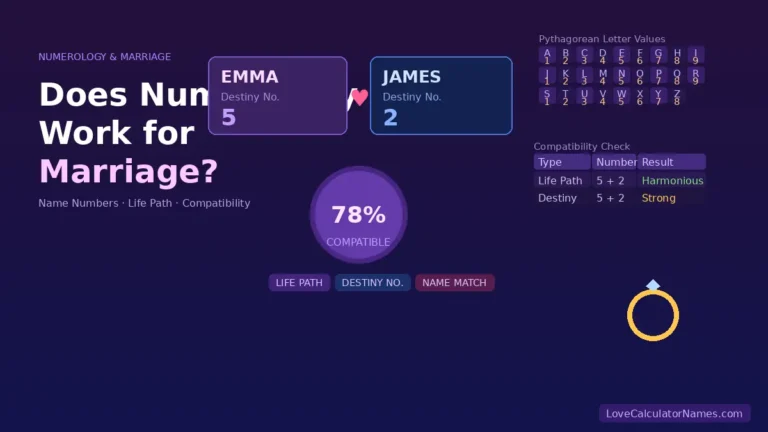
In numerology, name compatibility works by converting each letter of a name into a number using the Pythagorean system, then reducing those numbers to a single digit. Comparing two people’s name numbers reveals whether their energies harmonize, clash, or complement each other, giving couples a symbolic lens for understanding their dynamic.
Here’s how the process works step by step:
- Write out both full names, typically the names given at birth, not married names or nicknames.
- Assign each letter a number using the Pythagorean chart: A=1, B=2, C=3 … I=9, J=1, K=2, and so on cycling back to 1.
- Add all the numbers in each name to get a total for each person.
- Reduce to a single digit by adding the digits of the total together (e.g., 28 becomes 2+8=10, then 1+0=1).
- Compare the two core numbers. Certain pairings are considered harmonious (like 2 and 6, or 1 and 9), while others indicate friction that requires conscious effort from both partners.
- Look at the full expression number as well as vowel-only (soul urge) and consonant-only (personality) numbers for a more complete reading.
Most name compatibility tools do all of this automatically. What matters is understanding what the output represents, symbolic resonance, not a binding verdict on your future.
A few notes on the Pythagorean system specifically: it’s the most widely used method in Western numerology, but it’s not the only one. The Chaldean system, which originated in ancient Babylon, assigns different values to letters and is considered by many numerologists to be older and more precise. The two systems often produce different results for the same names, which is worth knowing if you’re comparing readings from different tools.
The soul urge number deserves special attention in relationship readings. It’s derived only from the vowels in a name and is thought to represent a person’s inner desires and emotional needs. When two soul urge numbers are compatible, it often suggests that partners share core emotional values, which many relationship counselors would argue matters far more than surface-level chemistry.
The personality number, by contrast, comes from the consonants only and is said to represent how a person presents themselves to the world. Looking at both numbers together gives a fuller picture: how you feel inside versus how you come across. For couples, the combination can spark useful conversation about whether their inner selves and outer expressions complement or challenge each other.
What Do Cultural Traditions Say About Name Matching Before Marriage?
Across Asia, the Middle East, and parts of Europe, families have consulted name matching before marriage for centuries. In many traditions, a name mismatch isn’t just considered unlucky, it’s grounds for postponing or reconsidering an engagement.
Here’s a comparison of how different cultures approach name compatibility for marriage:
| Culture / Tradition | Method Used | What They’re Looking For |
|---|---|---|
| Hindu / Vedic | Kundli matching, nakshatra charts | Astrological compatibility by birth name and star sign |
| Chinese | BaZi (Four Pillars), stroke count | Balance of the Five Elements; lucky stroke numbers in characters |
| Japanese | Kanji stroke numerology | Auspicious total strokes in married name combinations |
| Western Numerology | Pythagorean letter-to-number | Life path and expression number harmony |
| Islamic tradition | Istikhara and name meaning | Meaning of names and family lineage alignment |
| Hebrew / Kabbalistic | Gematria | Numeric value of names in Hebrew letters |
| Celtic tradition | Sound symbolism | Phonetic harmony and nature-based name meanings |
What stands out across all of these is consistency of purpose: people want assurance that two lives are compatible at a symbolic level. The method varies, but the instinct doesn’t.
After exploring dozens of name pairings across these systems, I’ve noticed that the names which “score well” tend to share a complementary rhythm. Names like Emma and Ethan carry soft, balanced sounds. Names like Victoria and James carry formality and historical weight. Whether that matters to you depends entirely on how much symbolic meaning you bring to the question.
Vedic kundli matching is particularly detailed and worth understanding on its own terms. It uses a 36-point system called the “Guna Milan,” which scores compatibility across eight different categories including health, emotional compatibility, temperament, and spiritual alignment. Name and birth star are both factored in. A score of 18 or above is generally considered acceptable for marriage; below 18 raises concerns that astrologers will discuss with the families involved.
Chinese stroke-count numerology works differently. In Chinese, characters are written with a set number of strokes, and the total strokes in a person’s written name carry symbolic meaning. When two people marry and a woman takes her husband’s surname, the stroke count of the new name is calculated for auspiciousness. Some families consult a feng shui master to identify which combined name would bring the most favorable energy to the new household.
Common Myths About Name Compatibility and Marriage
Many people either over-trust name compatibility (expecting it to predict the future) or dismiss it entirely (assuming it’s pure superstition). Both extremes miss the point. Here are five misconceptions worth clearing up.
Myth 1: A bad name score means you shouldn’t get married. No numerology reading, compatibility percentage, or letter-matching system can tell you whether a relationship will succeed. Thousands of couples with “incompatible” names have long, happy marriages. Name compatibility is a symbolic framework, not a forecast. It works best as a reflection tool, not a decision tool.
Myth 2: You need to use your legal name. Many systems specifically use the birth name, not a changed or married name. The idea is that your given name at birth carries the energy you were born into. Some practitioners use both the birth name and the current name to compare how a person’s energy has evolved over time.
Myth 3: Only certain cultures take this seriously. Name matching tools are popular across the US, UK, India, UAE, and dozens of other countries. The specific method varies by culture, Western numerology in North America, Vedic matching in South Asia, stroke-count analysis in East Asia, but the curiosity is genuinely universal. Over 12 million users from 150+ countries have explored this question.
Myth 4: Name compatibility is the same as horoscope matching. They overlap but aren’t the same. Astrology focuses on birth dates and planetary positions. Numerology focuses on the letters and numbers in your name. Some compatibility readings combine both into a single score, which is why people sometimes confuse them.
Myth 5: The score is fixed and permanent. Names change, through marriage, legally, or by personal choice. Numerologists often recalculate scores when a name changes, since the symbolic energy shifts. Some couples choose married surnames specifically to improve their combined numerology. Others keep their birth names precisely to preserve their individual numerical identity.
Frequently Asked Questions
Is name compatibility important for marriage? Name compatibility isn’t scientifically proven to predict marital success, but it holds genuine cultural and symbolic importance for millions of couples worldwide. Across Vedic astrology, Chinese numerology, and Western letter-value systems, name matching has been used for centuries as one lens among many when considering marriage. For most couples, it’s a meaningful ritual rather than a binding verdict.
What is the best name compatibility test for couples? The most commonly used methods are Pythagorean numerology (which assigns letter values to calculate a compatibility score), FLAMES (a popular game-based method using name letters), and Vedic kundli matching (which uses birth name and star sign together). The “best” test depends on your cultural background and what kind of insight you’re hoping to gain.
Can name compatibility predict if a marriage will last? No. Name compatibility cannot predict whether a marriage will last. Relationship longevity depends on communication, trust, shared values, and ongoing effort, not the letters in your name. Compatibility scores are best used as a fun conversation starter or cultural ritual, not as a decision-making tool for something as serious as marriage.
Do names really affect relationships? Social psychology research on the “name-letter effect” shows people tend to feel more favorably toward things associated with their own initials. Partners who share initials or phonetic patterns sometimes report stronger feelings of familiarity. That said, this is a psychological tendency, not a relationship rule, and it’s a long way from predicting long-term compatibility.
What happens to name compatibility when someone changes their name after marriage? Many numerologists recalculate compatibility scores after a name change since the letter values shift. Some couples deliberately choose a married surname that improves their combined name number. Others keep their birth names specifically to preserve their individual numerological identity. There’s no universal rule, it depends on the tradition you follow and what feels right to you.
Is FLAMES a real name compatibility method? FLAMES (Friends, Lovers, Affectionate, Marriage, Enemies, Siblings) is a game-based method popular in South Asia and among younger audiences globally. It works by counting letters and eliminating them alternately until one category remains. It isn’t a serious numerological system, it’s a lighthearted playground tradition, but millions of people use it as a fun first step in exploring name matching.
How many letters should match for good name compatibility? This depends entirely on the system you use. Western numerology doesn’t count matching letters; it converts all letters to numbers and compares totals. Some cultural traditions look at shared initials. FLAMES counts and cancels letters. There’s no universal “right” number of matches because the method matters more than a raw count.
Are there any scientific studies on name compatibility for marriage? No peer-reviewed scientific evidence directly supports name compatibility as a predictor of marital success. However, research on the name-letter effect (published in peer-reviewed psychology journals) does confirm that names influence self-perception and social preferences. Name matching remains in the domain of cultural tradition and entertainment rather than clinical relationship science.
What Name Compatibility Can, and Can’t, Tell You
Name matching is one of the oldest ways humans have tried to understand romantic connection. It won’t tell you whether to get married. It won’t predict arguments, financial stress, or how well your families will get along. No system of letters and numbers can do that.
What it can do is give you a moment of reflection. A reason to laugh together, wonder together, or explore your cultural roots together. Some of the best conversations couples have start with something playful, and name compatibility, done right, is exactly that kind of spark.
Treat the score as a starting point, not an endpoint. Ask what it means in your cultural tradition. Compare how different systems read the same names differently. Notice whether certain results feel resonant and why. That process of noticing is where the real value lives, not in the number itself. And if the score surprises you, that reaction itself tells you something worth paying attention to in your relationship.
The couples who get the most out of these tools aren’t the ones who take the scores as gospel. They’re the ones who use the score as a question: What does this tell us about how we see ourselves and each other?
If you’re curious what your names say when you put them together, try the free name compatibility test at LoveCalculatorNames.com, no sign-up required, 100% private, and results in seconds. See what the numbers say. Then trust your gut.
Our healing space is always open and always ready for you inside our peaceful gentle library right now.