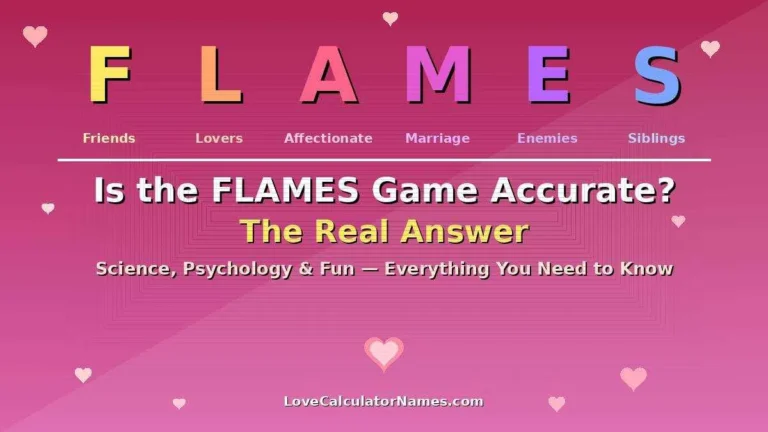
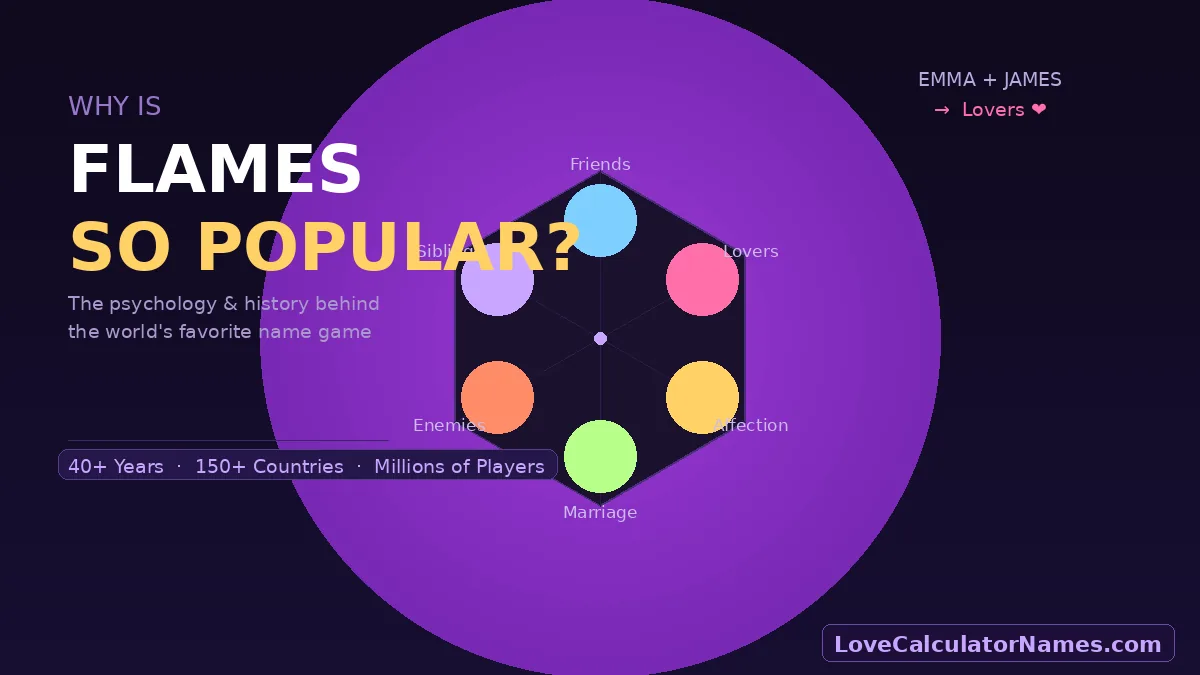
You scribble two names. You count letters, cross them out, count syllables around a circle. Then one word survives: Friends. Lovers. Affection. Marriage. Enemies. Siblings. And somehow — even when you’re twelve, even when you’re thirty-two, even when you absolutely know it’s not real — you care what it says.
That’s the FLAMES game. And the real question isn’t how to play it. It’s why it still works on us.
FLAMES is popular because it sits at the crossroads of name psychology, social bonding, and low-stakes hope. The game takes two real names — things people are emotionally attached to — and produces a result that feels personal. It’s fast, free, shareable, and offers a gentle excuse to think about someone you like without openly admitting it. That combination has kept it alive across generations and cultures for over four decades.
For the record: FLAMES is entertainment only. It’s not a scientific compatibility tool — and that’s actually part of why it works.
What Makes a Simple Name Game Last 40+ Years?
The FLAMES game has outlasted countless playground fads because it solves a real human need: a low-pressure, socially acceptable way to explore romantic curiosity. You can play it without confessing feelings, without risking rejection, and without anyone taking it too seriously. That’s rare.
Most trend-driven games burn out because they need equipment, rules knowledge, or a group. FLAMES needs a pencil and two names. That simplicity is a feature, not a limitation. Research on childhood rituals and social play consistently shows that the games with the longest legs are those requiring the least setup and the highest personal relevance. FLAMES delivers both.
Consider what FLAMES asks of you: nothing. No purchase, no app, no team. Just two names and thirty seconds. Compare that to popularity-tracking games from the same era — most are completely forgotten. FLAMES survived because the barrier to entry is nearly zero, and the emotional payoff (however arbitrary) feels immediate.
There’s also an oral-tradition quality to FLAMES. Nobody “reads the manual.” You learn it from a friend, teach it to a sibling, and it spreads person-to-person. That transmission pattern builds cultural stickiness — the game feels like shared knowledge rather than a product, which makes people feel ownership over it. Ownership breeds loyalty. Loyalty breeds longevity.
The game also adapts effortlessly to new formats. In the 1980s it was pencil and paper. In the 1990s it moved into SMS. By the 2010s, FLAMES calculators were embedded in websites with instant results and social sharing. TikTok brought it back again in the early 2020s as a nostalgia trend, with creators playing it on-screen and reacting live. The mechanics never changed — only the medium did.
And then there’s the internet’s role. What was once a schoolyard secret became a global phenomenon when search engines and social media made it searchable. Millions of people who played FLAMES in the 1990s Googled it again in the 2010s to show their own kids. Every new generation discovers it fresh while older generations rediscover it with nostalgia. That cycle has no obvious endpoint.
How Does FLAMES Actually Hook People Emotionally?
FLAMES hooks people because it uses real names — and names are among the most emotionally loaded words in any language. Unlike a random quiz or generic horoscope, FLAMES takes something personal (your name, someone else’s name) and feeds it into a system that produces a specific outcome. That specificity triggers genuine emotional investment.
Psychologists call the underlying mechanism apophenia — the tendency to find meaningful patterns in random data. When the FLAMES result lands on “Lovers,” your brain doesn’t automatically file it under “coincidence.” It files it alongside the other details you already like about that person. The result doesn’t create the feeling; it gives the feeling somewhere to land.
There’s also what researchers call the Barnum effect (or Forer effect): people tend to accept vague or general statements as uniquely personal. FLAMES amplifies this by being name-specific. Two ordinary words — your name, their name — produce a singular result. The brain treats singular results as significant, even when the math is entirely mechanical.
I’ve found that this effect is strongest when the result surprises you. A FLAMES result of “Friends” when you hoped for “Lovers” produces a specific kind of mild disappointment that feels oddly real — which is itself proof of how invested the player has become. You weren’t supposed to care, and yet. That emotional oscillation is part of the hook.
The role of anticipation matters too. The counting process itself — cross out shared letters, circle through F-L-A-M-E-S, eliminate one letter each round — is slow enough to build genuine suspense. You can see the circle narrowing. You start routing for certain letters to survive. That active suspense is neurologically similar to watching a close sports game: the outcome is meaningful because the process involved you.
And the social context matters. FLAMES is almost never played alone. It’s played in front of friends, in class notes, in group chats. The audience creates accountability — now the result is witnessed, shared, discussed. That shared moment becomes a memory, which is one reason so many adults remember their first FLAMES result with surprising clarity decades later. The game produces social experiences, not just answers.
Where Did the FLAMES Game Come From — and Why Did It Spread So Fast?
FLAMES originated in South and Southeast Asia, most credibly in India, during the 1980s. It spread to the UK, US, and Australia largely through diaspora communities and the natural migration of playground culture. By the mid-1990s, it was being played in school notebooks across multiple continents with almost no formal media coverage.
The name-based letter-elimination format has loose ancestors in older folk numerology traditions — particularly Pythagorean name-value systems, where letters correspond to numbers and number patterns carry meaning. FLAMES isn’t technically numerological, but it operates on the same emotional logic: your name encodes something real about you.
How FLAMES Spread Across Cultures
| Region | Approximate Arrival | Common Format | Cultural Fit |
|---|---|---|---|
| South Asia (India, Pakistan) | 1970s–1980s | 6-outcome FLAMES wheel | Strong numerology + naming traditions |
| Southeast Asia | 1980s–1990s | Standard FLAMES, some 5-outcome variants | Widespread in school culture |
| UK & Commonwealth | Early 1990s | Standard FLAMES | Playground games travel with diaspora |
| United States | Mid-1990s | Standard FLAMES, Love Calculator crossover | Social media accelerated late-2000s revival |
| Latin America | Late 1990s–2000s | Spanish adaptation (LLAMAS) | Adapted acronym, same elimination method |
The key to its cross-cultural spread: FLAMES requires zero translation of its mechanics, only its acronym. The letter-elimination counting system works identically in any language. Different cultures adapted the word that each letter represented while keeping the structure intact. That adaptability is unusual — most schoolyard games don’t survive cultural translation this cleanly.
After 2010, FLAMES exploded online. YouTube tutorials, TikTok nostalgia videos, and dedicated love calculator websites brought it to users in countries it had never physically reached. Today, name-based compatibility tools derived from FLAMES logic receive tens of millions of searches per month globally.
Isn’t FLAMES Just Random? Why Do People Still Believe In It?
No one seriously claims FLAMES predicts relationship outcomes — and yet people consistently feel something when the result appears. That’s not gullibility. It’s ordinary human psychology operating exactly as designed.
Here are five reasons people still engage with FLAMES even knowing it’s not scientific:
1. It’s not about belief — it’s about permission. FLAMES gives you a socially acceptable excuse to focus on a specific person. You’re not confessing a crush; you’re “just playing a game.” That plausible deniability is enormously valuable, especially for younger players navigating early romantic feelings.
2. Confirmation bias does the rest. If the result matches what you hoped, you remember it. If it doesn’t, you play again. People don’t consciously cheat — they just, often unconsciously, keep testing until the result fits. The game accommodates this with zero judgment.
3. The ritual itself has value. Psychologists studying ritual behavior have found that ritualized actions (counting, crossing out, circling) reduce anxiety around uncertain outcomes — even when the action has no causal relationship to the outcome. The FLAMES counting process acts like a structured waiting room for feelings you haven’t named yet.
4. Low stakes = low risk of disillusionment. Because nobody truly believes FLAMES is scientifically valid, a “wrong” result costs nothing. You don’t lose anything. Compare that to an astrology reading or personality test, where some users genuinely stake decisions on the outcome. FLAMES never carries that weight, which makes it perpetually safe to try — and to try again.
5. Shared experience builds connection. Playing FLAMES with a friend is more than the result — it’s the conversation, the reactions, the laughter. The game is a social lubricant, not an oracle. And that social function works regardless of what the letter says. Two people who play FLAMES together have a shared moment. That’s the actual product the game delivers.
It’s worth remembering: FLAMES is entertainment, full stop. No letter-counting system has been shown to predict relationship outcomes. If your result says “Enemies,” that’s comedy material, not a forecast. The value is in the fun, the conversation, and what you do after the game is over.
Frequently Asked Questions About Why FLAMES Is Popular
Why do adults still play the FLAMES game? Adults play FLAMES for the same reasons they rewatch childhood movies or revisit old playlists — nostalgia mixed with low-stakes fun. The game also works as an icebreaker or party game for groups. There’s no age limit on a harmless compatibility guessing game, and its simplicity makes it just as accessible at 30 as at 13.
Is the FLAMES game popular in the US? Yes. FLAMES became widespread in the US through school playground culture in the mid-1990s and has had a continuous online presence since the early 2000s. American users consistently rank among the top audiences for FLAMES-related searches and online name compatibility tools, alongside India, the UK, and the Philippines.
Why did FLAMES become so popular online? The internet removed every remaining barrier — no paper, no pencil, no friend to teach you. Online FLAMES calculators deliver instant results, allow users to test unlimited name combinations, and share results on social media. That shareability turned a private game into a viral moment, and mobile accessibility made it available 24/7.
Does the FLAMES game work the same in different countries? The mechanics are identical everywhere, but the acronym varies. In Spanish-speaking countries, “LLAMAS” is commonly used. Some Southeast Asian versions use only 5 outcomes (dropping one letter). The letter-elimination counting system itself is universal — only the words each letter represents change by culture and language.
Is FLAMES based on numerology? Not technically, but the emotional logic is similar. Pythagorean numerology assigns number values to letters to reveal personality traits or compatibility. FLAMES uses letter counting and elimination rather than numerical values, but both operate on the idea that names contain hidden information about identity and relationships. It’s a folk numerology tradition more than a formal one.
Why is the FLAMES game popular with kids specifically? Children and teenagers are in an active phase of identity formation and social exploration. FLAMES offers a structured, judgment-free way to process new feelings about friends and crushes. The game’s low stakes, simple rules, and shareable results make it perfectly calibrated for school-age social dynamics — which is why it’s been a classroom staple for decades.
Can playing FLAMES actually affect how people feel about each other? There’s evidence that anticipating a positive outcome — even from a random game — can subtly prime positive feelings. A favorable FLAMES result doesn’t create attraction, but it may give existing interest a small boost of confidence or an excuse to act on it. The effect is psychological, not predictive, and entirely harmless.
Is there a scientific explanation for why name games like FLAMES are popular? Yes — several. Apophenia (finding patterns in randomness), the Barnum effect (personalizing general outcomes), and behavioral confirmation bias all contribute. Additionally, the social ritual of playing with others, the emotional weight of names, and the universal human desire to understand relationships make FLAMES a near-perfect convergence of psychology and play.
FLAMES Has Lasted Because It Understands People, Not Names
Here’s the honest answer: FLAMES is popular not because it’s accurate, but because it’s human.
It understands that we want an excuse to think about someone. It understands that ritual reduces anxiety. It understands that shared games build connection, that names feel personal, and that a result — any result — is more satisfying than uncertainty.
The game hasn’t survived four decades and spread to every continent by predicting relationships. It’s survived by giving people something to do with feelings they don’t quite have words for yet.
Three things worth keeping from this:
- FLAMES works because of social function, not predictive accuracy — it’s a vehicle for connection, not a verdict.
- The psychology behind it (apophenia, Barnum effect, ritual comfort) is real and well-documented, even when the game itself is pure entertainment.
- Its cross-cultural adaptability — keeping the mechanics, changing the words — is why it spread when other schoolyard games didn’t.
Curious what your names actually produce? Try the free name compatibility test at LoveCalculatorNames.com — no sign-up, 100% private, and as seriously as you want to take it.
Our fun love tool is trusted by millions of users across more than 150 countries.