You’re about to marry someone. Or maybe you’re in the early stages of wondering. Either way, the question “do our names actually match?” has crossed your mind — and you’re not alone. Millions of people search this every year.
Short answer: Name matching in marriage doesn’t predict relationship success, but it’s not meaningless either. Names carry cultural weight, psychological resonance, and in numerology, specific numerical energy. For many couples, exploring name compatibility is a way to reflect on identity, shared values, and the symbolic start of a new chapter — not a science exam. This article covers what research says, how numerology approaches it, what different cultures believe, and how to use name matching as a fun, meaningful ritual rather than a verdict.
This article is for entertainment and reflection. Name compatibility tools are not scientific predictors of relationship outcomes.
Does Name Compatibility Actually Affect a Marriage?
Name compatibility doesn’t determine whether a marriage will succeed — but names do shape how partners are perceived, how they introduce themselves as a couple, and how they feel about their shared identity. Studies in social psychology show that names carry subconscious associations affecting first impressions, and that couples often report a sense of “fit” or “friction” when they say their names together.
That’s a real psychological phenomenon, even if it isn’t destiny.
Name matching gained cultural traction for a reason. When two people share initials, a similar rhythm in their names, or numerological alignment, it can create a sense of symmetry — and humans are wired to find meaning in patterns. Whether you treat that as a cosmic signal or a fun coincidence is entirely up to you.
What name matching genuinely helps with:
- Thinking about your post-marriage name — Will you hyphenate? Will one partner take the other’s last name? Does the new combination feel good to say?
- Numerological reflection — Some couples use name number analysis to spark conversations about their personalities and compatibility.
- Cultural traditions — In many cultures, name matching is a formal pre-marriage ritual with deep social meaning.
How Does Name Matching Work in Marriage Compatibility?
Name matching for marriage compatibility typically uses one of three methods: numerology (assigning numbers to letters), phonetic analysis (how names sound together), or letter-based systems like FLAMES. Each gives a different “reading” of two names and what they might mean as a pair.
Here’s how the most common method — Pythagorean numerology — works:
Step 1: Assign a number to each letter
Each letter maps to a number from 1 to 9 using the standard Pythagorean chart (A=1, B=2, C=3… I=9, then J=1 again, and so on).
Step 2: Add the values in each name
Write out the full name and add up every letter’s value.
Step 3: Reduce to a single digit
If you get 23, add 2+3 = 5. This is the name number. (11, 22, and 33 are “master numbers” and aren’t reduced in most numerology systems.)
Step 4: Compare the two name numbers
Certain number pairings are considered harmonious — 1 and 5, for example, are often described as energetically compatible.
Step 5: Combine for a couple’s expression number
Some systems add both partners’ name numbers together and reduce again to find a “relationship number” that describes the union’s energy.
Step 6: Interpret the result
This is where culture and personal belief come in. A “3” relationship might be described as creative and communicative; a “4” as stable and grounded. There’s no universal truth here — the interpretation is a starting point for conversation, not a conclusion.
What Do Different Cultures Say About Name Matching in Marriage?
Name matching before marriage isn’t a fringe idea — it’s a mainstream practice in several of the world’s largest cultures, each with its own system and level of seriousness.
| Culture | Practice | Name Used | Taken Seriously? |
|---|---|---|---|
| Hindu (India) | Kundali Milan / Rashi matching | Birth name + star sign | Very — often required by families |
| Chinese | Ba Zi (Four Pillars) | Birth name + date/time | Yes, consulted with astrologers |
| Korean | Saju (Four Pillars) | Full birth name | Common, especially older generations |
| Western | Numerology / FLAMES | First or full name | Casual / for fun |
| Islamic | Istikhara prayer | Names used informally | Spiritual, not formulaic |
| African (Yoruba) | Oriki (praise names) | Family lineage names | Cultural identity, not compatibility scoring |
In Hindu tradition, Kundali Milan is one of the most detailed pre-marriage rituals in the world. It compares 36 “gunas” (attributes) of the prospective couple — and name and birth star alignment is a significant piece of that. Families may consult a pandit (priest) before agreeing to a match.
Chinese Ba Zi analysis looks at the five elements (wood, fire, earth, metal, water) associated with both partners’ names and birth data. A couple whose elements clash — say, fire and water — might be advised to take precautions or choose a wedding date that balances the energy.
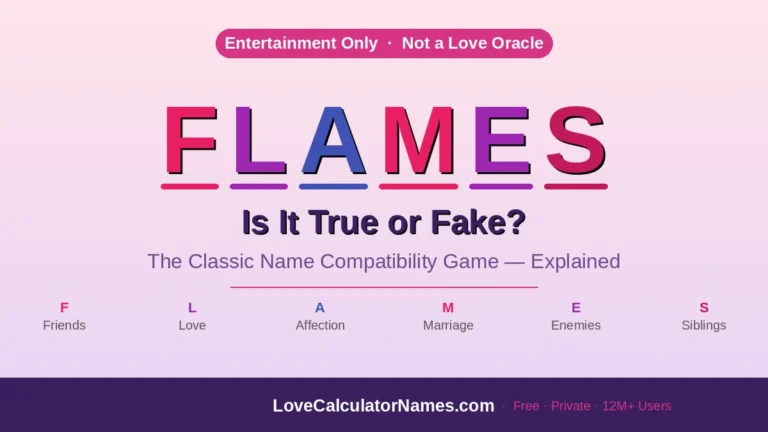
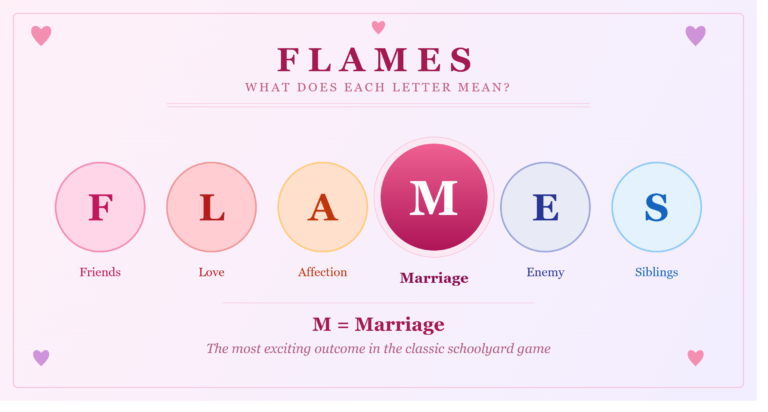
In the West, the approach is much lighter. FLAMES (Friends, Love, Affection, Marriage, Enemies, Siblings) is a childhood game that persists into adulthood because it’s quick, a little silly, and oddly satisfying. Numerology-based name matching is more serious but still firmly in the “fun and reflective” category for most people.
The takeaway: nearly every major culture has some form of name or birth-based compatibility ritual. The form changes; the impulse doesn’t.
Common Myths About Name Matching and Marriage
People tend to fall into one of two traps with name compatibility — believing it’s everything, or dismissing it as worthless. The reality is more nuanced.
Myth 1: Matching names guarantee a happy marriage.
No tool, numerological or otherwise, can guarantee that. What name matching can do is prompt self-reflection and create a shared ritual. The conversation it starts can be valuable even if the score isn’t.
Myth 2: Mismatched names are a red flag you should take seriously.
They’re not. Plenty of deeply compatible couples have names that don’t align numerologically at all. Name compatibility is one lens, not a verdict. Use it accordingly.
Myth 3: You need your full legal name for name matching to work.
Different systems use different versions of your name. Pythagorean numerology typically uses the full birth name. FLAMES uses first names. Some tools use the name you actually go by. There’s no single “correct” approach — pick the one that feels right to you.
Myth 4: Name matching is the same thing as marriage compatibility testing.
Name matching is one small part of the broader compatibility picture. Emotional intelligence, shared values, communication styles, and life goals matter far more in determining whether a relationship thrives.
Myth 5: Only certain cultures take this seriously.
As the table above shows, name and birth-data matching before marriage is common across Hindu, Chinese, Korean, and other traditions involving billions of people. It’s not a niche belief.
Frequently Asked Questions
Does name matching really matter for marriage?
It matters symbolically and culturally for many people, but not scientifically. Name matching doesn’t predict relationship success. What it does provide is a reflective ritual — a chance to think about identity, compatibility, and what you’re building together. Treat it as a meaningful starting point, not a pass/fail test.
What is name matching in marriage?
Name matching in marriage is the practice of comparing two people’s names — using numerology, phonetic analysis, or letter-based systems — to assess symbolic compatibility. It ranges from casual fun (like the FLAMES game) to formal pre-marriage rituals in Hindu and Chinese traditions.
Is name matching in marriage backed by science?
No. There’s no peer-reviewed evidence that name matching predicts marital outcomes. However, psychology research does show names affect perception and self-concept, and that couples who share a sense of symbolic “fit” may feel more connected. The ritual has value; the predictive claim doesn’t.
What is the FLAMES name compatibility method?
FLAMES stands for Friends, Love, Affection, Marriage, Enemies, Siblings. You write both names, cross out shared letters, then count through remaining letters using the FLAMES acronym to land on a result. It’s a popular, lighthearted game — not a serious compatibility system.
Which numerology method is most common for name compatibility?
Pythagorean numerology is the most widely used in Western name compatibility tools. Each letter is assigned a value from 1 to 9, the letters in each name are totaled, and the result is reduced to a single digit. Those digits are then compared or combined to describe the couple’s “energy.”
What do Hindu traditions say about name matching in marriage?
Hindu Kundali Milan compares 36 attributes between prospective partners, with name and birth star alignment playing a key role. Families often consult a pandit before agreeing to a marriage. A score of 18 or above out of 36 is generally considered acceptable; 36 is considered perfect.
Should I be worried if our names don’t match?
Not at all. Name matching is one of dozens of ways couples explore compatibility, and none of them — numerological, astrological, or otherwise — should override your own judgment, lived experience with your partner, and the quality of your relationship. Mismatched names have nothing to do with mismatched people.
Can I check my name compatibility online for free?
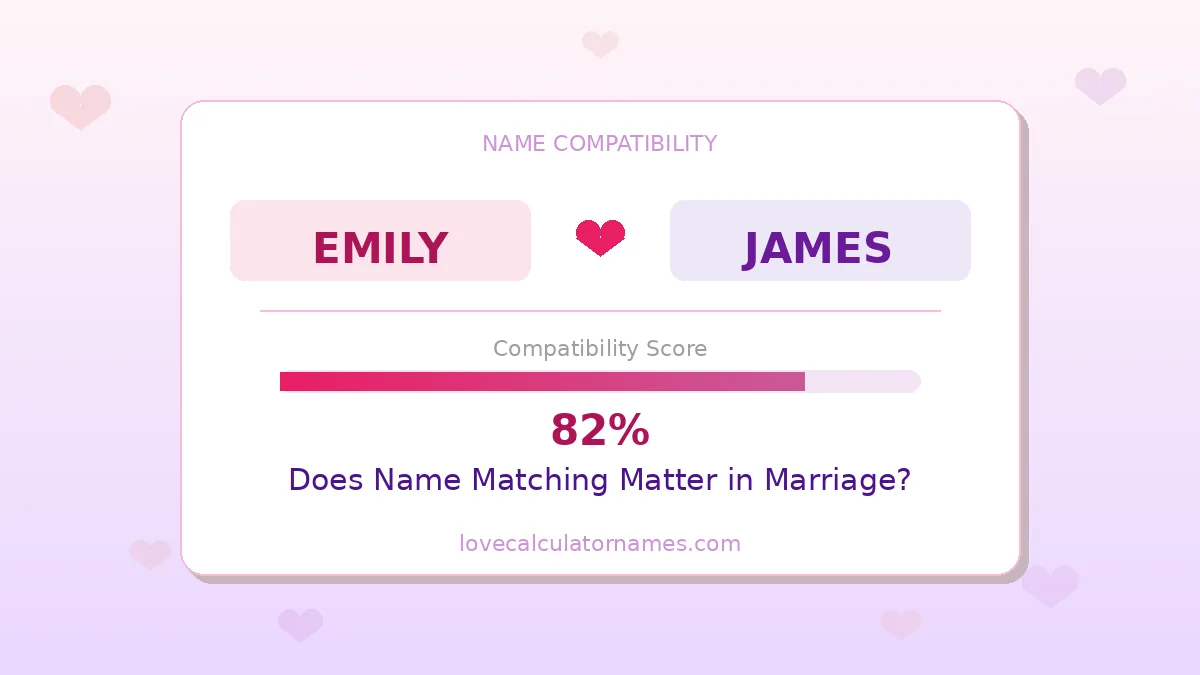
Yes. There are several free name compatibility tools available. LoveCalculatorNames.com is one of the most widely used — it’s private, requires no sign-up, and gives you an instant result based on your names. It’s built for fun and reflection, not prediction.
The Bottom Line on Name Matching and Marriage
Name matching in marriage doesn’t hold the keys to a successful relationship — your communication, respect, and shared life do. But it’s not nothing, either. Across cultures and centuries, people have found meaning in names, and that meaning shapes how couples see themselves and each other.
The most useful way to approach name compatibility is as a conversation starter. Run the numbers. See what comes up. Talk about what resonates and what doesn’t. That conversation — honest, curious, a little playful — is exactly what healthy relationships are built on.
If you want to explore your name compatibility for fun, try the free test at Love Calculator Names. No account needed, completely private, and results in seconds. Think of it as a mirror, not a map.
Run both names through our love test and see what comes up for you.