Millions of people calculate their “destiny number” or run a name compatibility check every day. But somewhere in the middle of adding up letters, a fair question pops up: is any of this actually accurate?
Here’s the short answer: Pythagorean numerology is not scientifically validated as a predictor of personality or relationships. No peer-reviewed study has confirmed that letter values consistently map to human traits. What it is accurate at is producing a consistent, repeatable result from a fixed set of rules — which makes it a fun, structured way to reflect on names, numbers, and connections. Think of it as a mirror, not a measuring tape.
This article is for entertainment purposes. Numerology is not a scientific tool.
What Is Pythagorean Numerology and How Does It Assign Numbers?
Pythagorean numerology assigns each letter of the alphabet a number from 1 to 9 using a repeating grid. A=1, B=2, C=3 … I=9, then J=1, K=2, and so on, cycling back through 1–9 until Z=8. You add those values together, reduce to a single digit, and get a “core number” that numerologists use to describe personality, destiny, or compatibility.
The system is named after the Greek philosopher Pythagoras, though historians note the letter-value practice developed long after his death. The core idea — that numbers carry meaning beyond quantity — comes from a broader ancient tradition called numerology, present across Greek, Hebrew (Gematria), and Indian Vedic systems.
Modern Pythagorean numerology, as used in name compatibility tools today, runs on that same A=1 grid. Every calculator using this method will produce the same number for the same name. That consistency is real. What those numbers mean about a person is where the debate starts.
How Does the Pythagorean System Actually Work? (Step-by-Step)
The calculation itself is straightforward. Here’s how to get a destiny number from a full name in five steps.
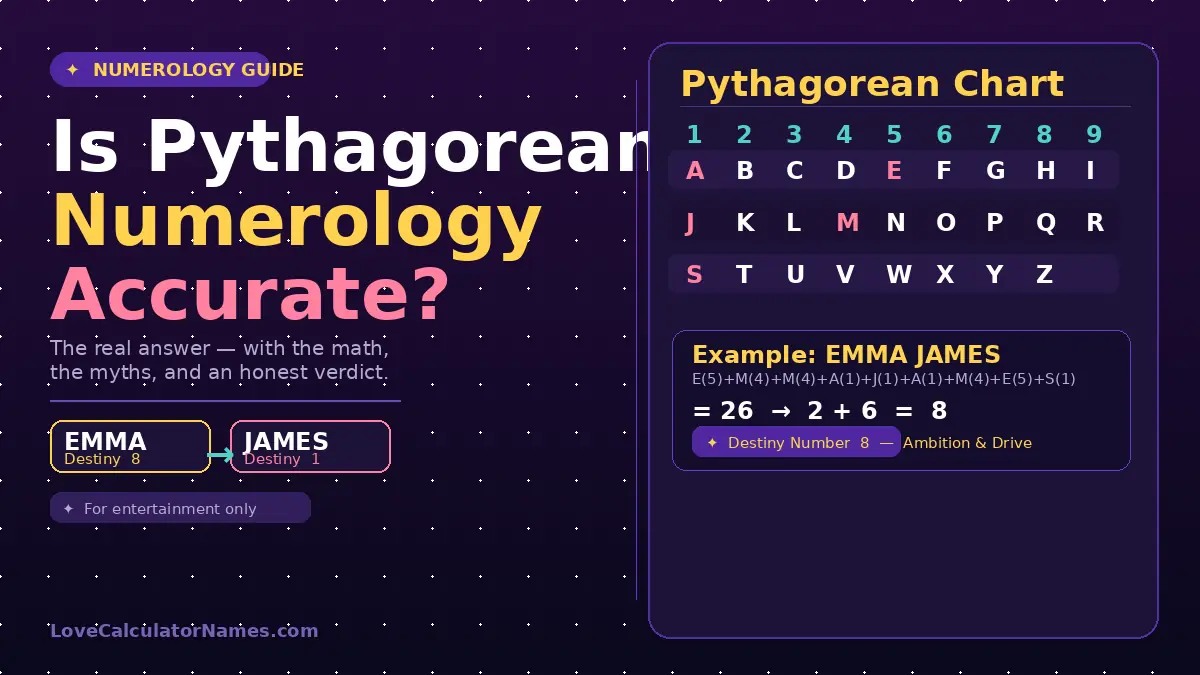
Step-by-step: EMMA JAMES
- Write out the full name: E-M-M-A J-A-M-E-S
- Assign each letter its Pythagorean value using the chart below:
| Letter | A | B | C | D | E | F | G | H | I |
|---|---|---|---|---|---|---|---|---|---|
| Value | 1 | 2 | 3 | 4 | 5 | 6 | 7 | 8 | 9 |
| Letter | J | K | L | M | N | O | P | Q | R |
|---|---|---|---|---|---|---|---|---|---|
| Value | 1 | 2 | 3 | 4 | 5 | 6 | 7 | 8 | 9 |
| Letter | S | T | U | V | W | X | Y | Z |
|---|---|---|---|---|---|---|---|---|
| Value | 1 | 2 | 3 | 4 | 5 | 6 | 7 | 8 |
- Map the name: E(5) + M(4) + M(4) + A(1) + J(1) + A(1) + M(4) + E(5) + S(1) = 26
- Add the digits: 2 + 6 = 8
- Result: Destiny Number 8 (associated with ambition, leadership, and drive)
If you get a two-digit result that isn’t 11, 22, or 33 (the “master numbers”), keep reducing. 29 → 11 (stop, master number). 37 → 10 → 1 (keep going).
That’s the whole engine. Name compatibility tools run this for two names, compare the resulting numbers, and report a match score or outcome. The math is always accurate. Whether the meaning behind the number reflects real personality is a different question entirely.
Is There Any Evidence That Pythagorean Numerology Predicts Personality?
Honestly? Not the kind of evidence that holds up to scrutiny. No controlled study has shown that people born with high-value Pythagorean names score differently on personality tests, earn more, or form stronger relationships.
What research does show is something related but different: the Barnum/Forer effect. In a classic 1948 experiment, psychologist Bertram Forer gave students a personality profile — supposedly personalized — and asked them to rate its accuracy. Average rating: 4.26 out of 5. The catch: every student received the exact same profile, full of vague, widely applicable statements.
Numerology descriptions tend to have this quality. Number 8 people are “ambitious and capable.” Number 3 people are “creative and expressive.” These are statements most people can find themselves in. That’s not proof of inaccuracy — it’s more that the descriptions are written to resonate broadly.
There’s also a related phenomenon called apophenia — the human tendency to find patterns and meaning in random data. We’re wired to connect dots. A name calculator that spits out “you value deep connection” after a long day of feeling lonely lands very differently than it would on a day when everything’s fine. Same number, wildly different perceived accuracy.
Pythagorean vs. Chaldean Numerology: Which Is More Accurate?
This is one of the most common questions, and the answer is messier than either camp wants to admit. Here’s a side-by-side comparison:
| Feature | Pythagorean | Chaldean |
|---|---|---|
| Origin | Greek-influenced Western tradition | Ancient Babylonian/Semitic tradition |
| Letter-value system | Sequential: A=1 through I=9, repeating | Frequency-based: 1–8 only, no 9 assigned to letters |
| Name used | Full birth name (legal) | Name commonly used (nickname counts) |
| Master numbers | 11, 22, 33 | 11, 22 (sometimes 33) |
| Consistency | Very high — same name always = same number | Slightly lower — depends on which “name” you use |
| Popularity | Most widely used globally | Preferred by some traditional practitioners |
| Scientific validation | None confirmed | None confirmed |
Neither system has scientific backing. Pythagorean wins on consistency and global adoption. Chaldean wins on tradition depth and the argument that the “name you actually use” matters more than your birth certificate.
From a pure compatibility-tool perspective, Pythagorean is the dominant standard because it’s fully deterministic — type the same name twice, get the same number. That makes it easier to build tools around, easier to explain, and easier to compare across platforms.
Why Do So Many People Find Pythagorean Numerology Accurate?
Even without scientific proof, millions of people feel their numerology reading fits. There are a few real reasons for this — and none of them require the system to be literally true.
Confirmation bias. We remember the hits and forget the misses. If your number-7 description says “you’re introspective and analytical” and that resonates, you remember it. If it also says “you sometimes struggle with authority,” and that one doesn’t fit, you move on.
Self-reflection value. Running through a numerology calculation forces you to think about your name, your traits, and what you value. That reflection itself is useful, regardless of whether the number “caused” anything.
Social ritual. Compatibility tools, numerology charts, and name games serve a social function — they give two people something fun to do together, a starting point for conversation, a shared moment of “wait, what did we get?” That experience has real value.
Implicit egotism research. A 2004 study by Pelham, Mirenberg, and Jones found people are statistically more likely to live in cities, choose careers, and marry people whose names resemble their own. Names carry psychological weight. Numerology taps into that, even if indirectly.
None of this means the system is bogus as an experience. It means the accuracy question is more complex than yes or no.
5 Common Myths About Pythagorean Numerology Accuracy
Myth 1: “If numerology were accurate, everyone with the same number would be identical.”
Not what numerology actually claims. It describes tendencies, not destinies. Two people with destiny number 5 (linked to freedom and adaptability) will express that differently based on culture, upbringing, and circumstance. The number is more like a lens than a blueprint.
Myth 2: “My score changes between sites, so the system must be broken.”
Sometimes, yes. Different sites handle middle names, spaces, and accented characters differently. Some use only vowels (Soul Urge number) or only consonants (Personality number). The variation comes from which number type is being calculated — not from a flaw in Pythagorean math itself.
Myth 3: “Changing your name will change your destiny.”
The birth name is fixed in traditional Pythagorean numerology. Adopted names and nicknames can be calculated separately for comparison, but most practitioners treat the legal birth name as the primary anchor. A name change doesn’t rewrite your numerology profile — it adds a layer.
Myth 4: “High compatibility scores mean a couple will stay together.”
No name-based tool can predict relationship outcomes. Compatibility scores reflect mathematical relationships between letter values, nothing more. Real relationships are shaped by communication, shared values, timing, and effort — none of which show up in a number.
Myth 5: “Pythagorean numerology is the same as astrology.”
Different systems entirely. Astrology maps personality and events to planetary positions at birth. Pythagorean numerology maps to letter and number values in a name or birth date. The philosophical root — that patterns in the universe reveal meaning — overlaps, but the inputs, methods, and outputs are completely different.
Frequently Asked Questions
Is Pythagorean numerology accurate for predicting the future? No. Pythagorean numerology doesn’t predict future events. It assigns meaning to numbers derived from names or birth dates, and those meanings describe tendencies or themes — not specific outcomes. Treat any “prediction” framing as metaphorical, not literal. It’s a reflective tool, not a forecast.
Why do I get different numerology scores on different websites? Most sites use the same Pythagorean letter chart, but differ in what they calculate. Some use your full legal name, others use just your first name. Some compute your Destiny number, others your Soul Urge or Life Path. Same system, different inputs = different numbers. Always check which number type a site is using.
Is Pythagorean numerology the same as life path number calculation? Not quite. Life path numbers come from your birth date (day + month + year, reduced to one digit). Destiny numbers come from your full name using the Pythagorean chart. Both use the same 1–9 framework and reduction rules, but they draw on different source information and are interpreted differently.
What do the numbers 11, 22, and 33 mean in Pythagorean numerology? These are called master numbers. When your name or birth date reduces to 11, 22, or 33, you don’t reduce further. Master numbers are said to carry amplified energy — 11 for intuition, 22 for building, 33 for teaching and compassion. Not all numerologists recognize 33; 11 and 22 are universal across systems.
Can Pythagorean numerology be used for baby name selection? Many parents use it for exactly that — checking a proposed name’s destiny number before finalizing. It’s a lighthearted extra layer in the naming process. Some South Asian traditions (namakarana) formally incorporate name numerology into newborn naming ceremonies. Whether it influences outcome is unproven, but as a meaningful ritual it’s widely used.
Does Pythagorean numerology work for non-English names? The standard Pythagorean chart is built for the Latin alphabet. For names in Arabic, Hindi, Chinese, or other scripts, you’d need a transliterated version or a system built for that language’s phonetics. Most online tools accept only Latin characters, so non-English names are typically romanized first, which can alter the result.
Is Pythagorean numerology the same as the FLAMES game? No, though both use name letters as input. FLAMES (Friends, Lovers, Affection, Marriage, Enemies, Siblings) works by counting remaining letters after cancellation — it doesn’t assign numeric values to letters. Pythagorean numerology sums letter values and reduces them. Both are name-based compatibility traditions, but the mechanics are entirely different.
Should I make major life decisions based on Pythagorean numerology? No. Numerology is a form of entertainment and self-reflection, not a decision-making framework. Most practitioners say the same thing: use it as a conversation starter, a moment of introspection, or a fun ritual — not as a substitute for real research, professional advice, or your own judgment.
The Bottom Line on Pythagorean Numerology Accuracy
Pythagorean numerology is mathematically consistent and culturally rich. It will always give you the same number for the same name, and those numbers come loaded with centuries of interpretive tradition. What it won’t do is predict your future, guarantee compatibility, or tell you something about a person that their name couldn’t also suggest through a dozen other lenses.
The honest answer to “is it accurate?” is: accurate at what? At producing a repeatable result — yes, completely. At describing human personality — maybe, in a Barnum-effect kind of way. At predicting relationship outcomes — no evidence for that at all.
The most useful thing numerology tends to do is give people a structured reason to think about names, identity, and connection. That’s genuinely valuable, even if the numbers themselves are doing less heavy lifting than the tradition claims.
If you want to try it for yourself, the free name compatibility tool at LoveCalculatorNames.com runs Pythagorean-based calculations on any two names in seconds — no sign-up, completely private. Use it for fun. See what comes up. Think about what resonates and what doesn’t. That reflection is the real point.
Discover your love score by entering two names into our free calculator.