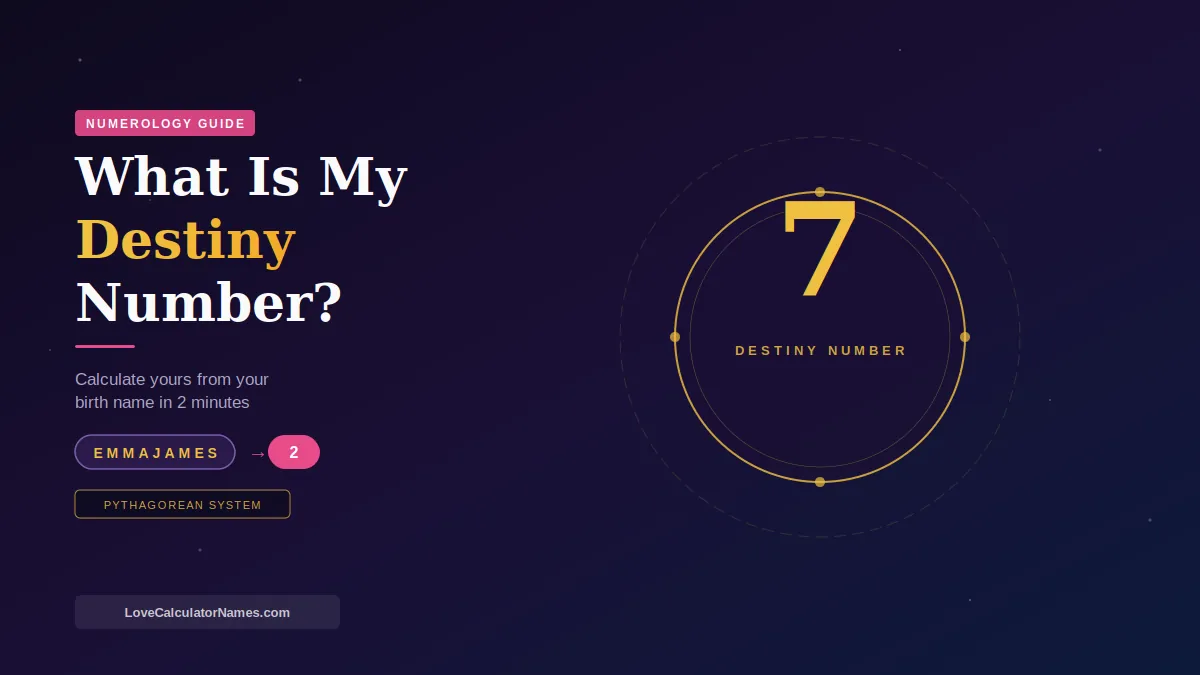
Your destiny number is a single digit calculated from your full birth name using a simple letter-to-number system. Add up the numerical values of every letter, reduce the total to one digit, and you have it. In numerology, this number is said to reflect your natural abilities, life purpose, and the kind of relationships you tend to build. It takes about two minutes to find yours — and the math is genuinely straightforward.
Disclaimer: Destiny numbers are a form of numerological entertainment. They’re a fun way to reflect on your name and personality — not a scientific predictor of your future or relationships.
What Exactly Is a Destiny Number in Numerology?
Your destiny number — sometimes called the Expression Number — is derived from the full name on your birth certificate. It represents the traits and tendencies you carry through life: your communication style, your natural strengths, and the kinds of connections you’re drawn to. Think of it as a personality sketch written in numbers.
Numerology assigns a value (1 through 9) to each letter of the alphabet using the Pythagorean system, the most widely used method in English-language numerology. Each letter maps to a number:
| Letters | Number |
|---|---|
| A, J, S | 1 |
| B, K, T | 2 |
| C, L, U | 3 |
| D, M, V | 4 |
| E, N, W | 5 |
| F, O, X | 6 |
| G, P, Y | 7 |
| H, Q, Z | 8 |
| I, R | 9 |
Sum the values for every letter in your full birth name, then reduce the total to a single digit by adding the individual digits together. That final result is what you’re looking for.
The idea has roots in ancient Greek philosophy — Pythagoras himself believed numbers held the key to understanding the universe and human nature. Modern numerology adapted his ideas into the letter-value system most people use today.
How Do I Calculate My Destiny Number? (Step-by-Step)
To find your destiny number, convert every letter in your full birth name to its Pythagorean value, add everything together, and reduce to a single digit. The process takes about two minutes.
Here’s how to do it:
Step 1: Write out your full birth name.
Use the name exactly as it appears on your birth certificate — first, middle (if any), and last. Do not use a married name, nickname, or shortened version.
Step 2: Assign a number to each letter.
Use the Pythagorean chart above. Spaces and hyphens are ignored; only letters count.
Step 3: Add up all the numbers.
Sum every value across your entire name.
Step 4: Reduce to a single digit.
If your total is, say, 47, add 4 + 7 = 11, then 1 + 1 = 2. Keep reducing until you reach a number between 1 and 9.
Exception: If your running total reaches 11, 22, or 33 at any reduction step, some numerologists treat these as “master numbers” and stop there. Most casual systems reduce all the way to a single digit — either approach is fine for a fun exercise.
Worked example — EMMA ROSE JAMES:
- E(5) M(4) M(4) A(1) = 14
- R(9) O(6) S(1) E(5) = 21
- J(1) A(1) M(4) E(5) S(1) = 12
- Total: 14 + 21 + 12 = 47
- 4 + 7 = 11 → 1 + 1 = 2
Emma Rose James has a destiny number of 2.
What Does Each Destiny Number Actually Mean?
Each number from 1 to 9 has a distinct personality profile in numerology tradition. These aren’t fortunes — they’re broad character sketches that people often find useful as a reflection exercise, the same way personality tests like Myers-Briggs or the Enneagram can prompt self-awareness.
Here’s a quick comparison:
| Destiny Number | Core Theme | Strengths | Challenge |
|---|---|---|---|
| 1 | Leadership | Confidence, drive, originality | Can be stubborn |
| 2 | Partnership | Empathy, diplomacy, harmony | Avoids confrontation |
| 3 | Expression | Creativity, warmth, humor | Scatters energy |
| 4 | Foundation | Discipline, loyalty, reliability | Resists change |
| 5 | Freedom | Adaptability, curiosity, energy | Impatient |
| 6 | Nurturing | Compassion, responsibility, care | Over-gives |
| 7 | Wisdom | Analytical, spiritual, private | Hard to reach |
| 8 | Ambition | Determination, business acumen | Work-life imbalance |
| 9 | Humanitarianism | Idealism, generosity, vision | Difficulty letting go |
A few highlights worth knowing:
Destiny 1 tends toward independence and initiative. People with this number often end up leading teams or starting things from scratch — not always by choice, just by how they naturally operate.
Destiny 2 is about connection. These are the people who remember everyone’s birthday, smooth over arguments before they escalate, and genuinely enjoy working in pairs. Their risk is giving too much and burning out.
Destiny 5 is restless in a productive way. Strong 5s need variety — in work, travel, people, ideas. A routine that doesn’t shift every few months starts to feel like a trap.
Destiny 7 might be the most misunderstood. People assume it’s purely spiritual, but it’s really about depth of thinking. 7s need time alone to process, and they often come across as reserved until you get past the surface.
Destiny 9 carries a reputation for idealism that sometimes tips into naivety. The 9s who do well are the ones who pair their big-picture vision with practical partners (often a 4 or 8) who can execute the details.
How Does My Destiny Number Connect to Compatibility?
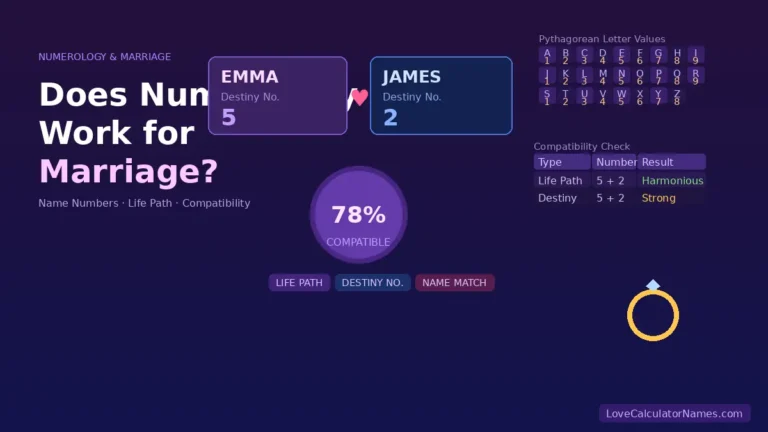
Your destiny number is one of the oldest tools in name-based compatibility work — and it’s the piece that connects most directly to the kind of partner or friendship dynamic you tend to create. Two people with complementary numbers often describe an instant sense of ease; two people with clashing numbers may find they have to work a little harder to understand each other.
The pairings below reflect traditional numerology interpretations — not scientific relationship research. Treat them as conversation starters, not verdicts.
Naturally harmonious pairings:
- 1 + 5: Mutual independence and energy. Neither tries to cage the other.
- 2 + 6: Both care-givers. Deep warmth, sometimes at the cost of directness.
- 3 + 9: Shared creativity and idealism. Conversations never go stale.
- 4 + 8: Shared drive for stability and achievement. A builder pair.
- 7 + 7: Two private people who actually understand each other’s need for quiet.
Pairings that require more intentional communication:
- 1 + 1: Both want to lead. Works beautifully when there’s a shared goal; generates friction when goals diverge.
- 5 + 4: Freedom-seeker meets stability-builder. Can balance each other out or frustrate each other constantly.
- 8 + 2: High ambition meets high sensitivity — the 2 can feel sidelined if the 8 defaults to work mode.
None of this means a “difficult” pairing can’t work. Plenty of numerologically mismatched couples have long, happy relationships because compatibility involves a thousand things numbers can’t capture.
If you want to explore name-based compatibility further — including your love percentage, FLAMES result, and name harmony score — the free tool at LoveCalculatorNames.com runs all of those calculations in seconds and doesn’t require an account.
Common Myths About Destiny Numbers
People who are new to numerology often walk in with a few misconceptions. Here are five that come up constantly:
Myth 1: Your destiny number predicts your future.
It doesn’t — and any numerologist worth listening to will say so plainly. It’s a framework for reflection, not a crystal ball. The number describes tendencies, not outcomes.
Myth 2: You need a “good” number to have a good life.
Every number from 1 to 9 includes real strengths and real challenges. There is no objectively superior destiny number. A 4 isn’t luckier than a 3 — they’re just different.
Myth 3: Married names change your destiny number.
Traditional numerology uses only the birth name. If you’ve changed your name legally, some people calculate both and compare — but the birth-name number is considered the base identity.
Myth 4: Your destiny number and life path number are the same thing.
They’re related but distinct. Your life path number comes from your birthdate. Your destiny number comes from your birth name. Both are used in numerology; they’re measuring different things.
Myth 5: A low number means low potential.
Number 2 is not “less powerful” than number 8. A highly developed 2 — empathetic, collaborative, genuinely connecting with people — can do more in the world than a poorly developed 8 who only chases material results.
Frequently Asked Questions
What is my destiny number?
Your destiny number is a single digit calculated from your full birth name using the Pythagorean numerology system, where A=1 through Z=26 (then cycling). Add every letter’s value across your first, middle, and last name, sum the digits, and keep reducing until you reach a number between 1 and 9.
Is the destiny number the same as the Expression Number?
Yes. “Destiny number” and “Expression Number” refer to the same calculation. Both terms describe the single digit derived from your full birth name in Pythagorean numerology. Some practitioners prefer one term over the other, but the math and interpretation are identical.
What is the most powerful destiny number?
No destiny number is objectively more powerful than another. Each number from 1 to 9 has strengths and blind spots. The “master numbers” 11, 22, and 33 are sometimes treated as especially significant if they appear before final reduction, but this varies by numerology tradition and is considered an entertainment perspective.
Can I calculate my destiny number from a nickname?
Traditional numerology uses only your birth certificate name. A nickname or chosen name will produce a different number. Some people calculate both for comparison as a personal reflection exercise, but the birth name is considered the foundational number.
Does my destiny number affect my love compatibility?
In numerology traditions, certain destiny number pairings are considered more harmonious than others. This is a fun framework for thinking about personality dynamics — not scientific relationship research. Many factors shape real-world compatibility, and no number pairing is a guarantee of success or failure.
What if my total reduces to 11 or 22?
Some numerologists treat 11, 22, and 33 as “master numbers” and don’t reduce them further. Others reduce to 2, 4, and 6. There’s no single correct rule — both approaches are accepted in different traditions. For a simple fun exercise, reducing all the way to a single digit works fine.
How is the destiny number different from the life path number?
Your life path number comes from your birthdate (day + month + year, reduced to one digit). Your destiny number comes from your birth name. They’re separate calculations in numerology that are said to describe different aspects of your character and life purpose.
Does spelling matter when I calculate my destiny number?
Yes. The exact spelling on your birth certificate is what traditional numerology uses. “Sara” and “Sarah” produce different totals. Middle names are included if they appear on your birth certificate, even if you never use them day-to-day.
Ready to Try It?
Your destiny number takes about two minutes to calculate by hand — write out your full birth name, assign each letter its Pythagorean value using the chart above, add everything up, and reduce to a single digit. The number you land on is your starting point for exploring what numerology says about your natural strengths and relationship style.
Destiny number 2 leans into partnership and empathy. Destiny number 8 is built for ambition and structure. Neither is better — they’re just different ways of moving through the world.
The real value in exercises like this isn’t predicting the future. It’s using an outside framework to notice things about yourself you might not have articulated yet. Sometimes seeing “you’re a natural leader who struggles with delegation” written in black and white is just the nudge that makes something click.
Ready to see how your name pairs with someone else’s? Try the free name compatibility test at LoveCalculatorNames.com — no sign-up, 100% private, results in seconds.
Find your compatibility percentage by trying our name calculator for free.