So you typed two names into a love calculator and got a score. Maybe it was 87%. Maybe it was 42%. Now you’re wondering: can two names actually decide love — or is this just a fun game dressed up as fate?
The short answer: No, two names can’t decide love on their own. But name compatibility tests aren’t random noise either. They use real systems — Pythagorean numerology, letter-frequency counting, phonetic analysis, and the FLAMES method — to generate scores that are meant to be playful, not predictive. Think of them as a conversation starter, not a verdict.
This article explains exactly how these methods work, what they can and can’t tell you, and why millions of people find them surprisingly fun to explore.
(All name compatibility tests, including those on LoveCalculatorNames.com, are for entertainment only.)
Does a Love Calculator Actually Use a Real System?
Yes — most name-based love calculators use at least one real mathematical or linguistic system to generate their scores. They aren’t pulling random numbers. The three most common methods are letter-frequency cancellation, Pythagorean numerology, and the FLAMES algorithm. Each produces a different result for the same two names, which is why scores vary from site to site.
Here’s what’s actually happening under the hood.
Letter-frequency cancellation compares the two names and removes matching letters in pairs. The remaining letters are counted and reduced until a single number (or percentage) appears. It’s the same core logic used in the classic FLAMES paper game that’s been played on school notebooks since the 1980s.
Pythagorean numerology assigns a number to each letter of the alphabet (A=1, B=2 … I=9, then the cycle repeats: J=1, K=2, and so on). The digits in each name are added together and reduced to a single root number called a Life Path equivalent. The compatibility between the two root numbers — whether they’re harmonious, neutral, or in tension — determines the score.
Phonetic harmony analysis is newer and used by some calculators to measure how well two names sound together. Names with similar vowel patterns, matching syllable counts, or complementary stress rhythms tend to score higher. This is grounded in the academic field of onomastics — the study of names — and it’s where the line between game and genuine linguistic science starts to blur.
How Do Name Compatibility Tests Calculate a Score?
Most calculators run two or three of the methods above simultaneously, then average or weight the results into a single percentage. Here’s a step-by-step look at the most common approach — letter-frequency cancellation — using two example names.
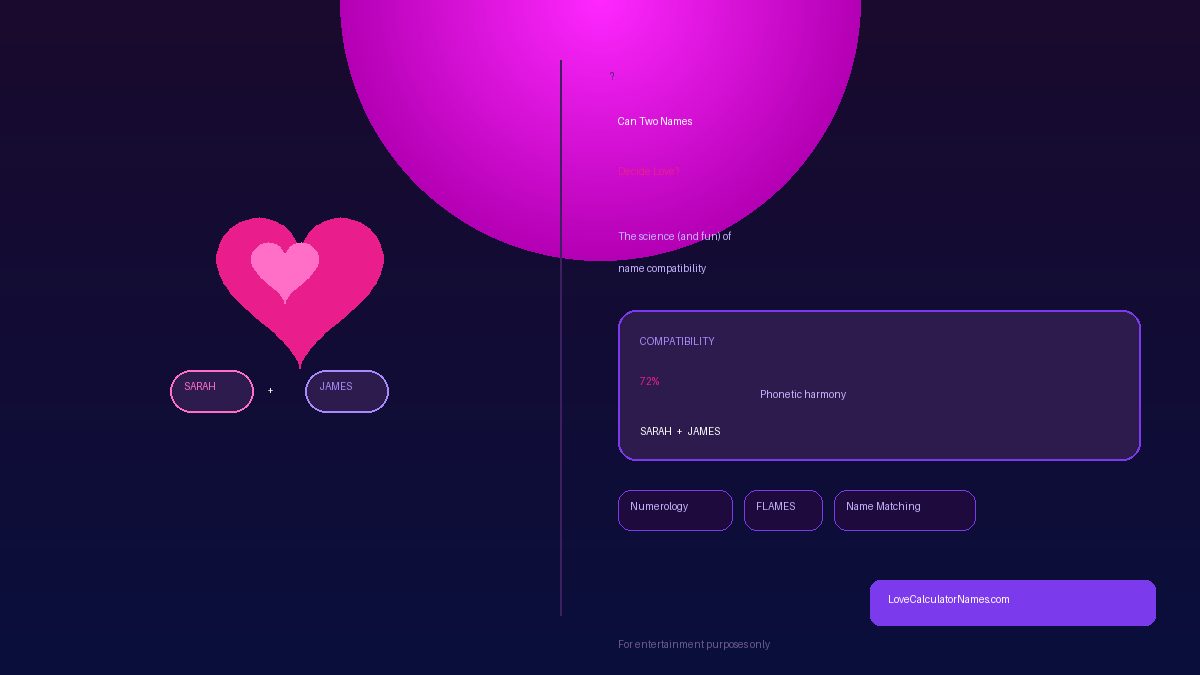
Example: SARAH + JAMES
- Write both names side by side: SARAH JAMES
- Count shared letters. Both names contain: A (appears in SARAH twice and JAMES once), S (appears in both).
- Cancel matching pairs: one A from SARAH cancels with the A in JAMES. One S from SARAH cancels with the S in JAMES.
- Remaining letters: R, A, H, J, M, E (6 letters left)
- Add the digits of 6 (just 6 in this case) and reference the compatibility scale.
- The calculator maps the result to a percentage — typically 60–75% for a six-letter remainder.
The exact percentage varies because different sites use different mapping tables. That’s a feature, not a bug — it’s why comparing scores across calculators is half the fun.
What Do Different Scoring Methods Actually Measure?
Each method captures something different about two names. Understanding what you’re measuring helps you read the result more honestly.
| Method | Based On | What It Reflects | Consistency |
|---|---|---|---|
| Letter cancellation | Shared letters | Literal name overlap | High within same site |
| Pythagorean numerology | Letter-to-number values | Numerological root harmony | Moderate |
| FLAMES algorithm | Count-out game logic | Relationship category (not %) | High |
| Phonetic harmony | Sound patterns, vowel rhythm | Linguistic compatibility | Low (varies by tool) |
| Life Path matching | Birth dates + name reduction | Combined destiny number | High if inputs match |
A few things stand out from this comparison. Letter cancellation is the most consistent method — the same inputs always return the same result on the same site. Phonetic harmony is the least standardized, which is why two reputable calculators can give wildly different scores for the same names.
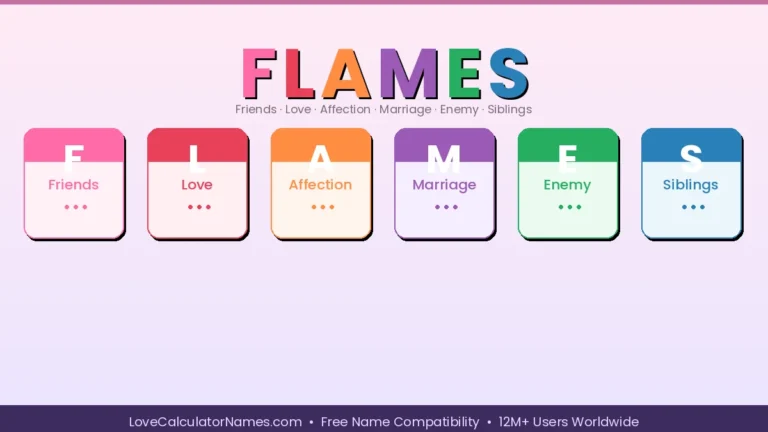
FLAMES deserves a special note: it doesn’t return a percentage at all. It returns one of six relationship categories — Friends, Lovers, Affection, Marriage, Enemies, or Siblings. Whether that’s better or worse than a number is a matter of taste, but it’s a fundamentally different kind of output.
Is There Any Real Science Behind Name Compatibility?
There’s genuine research adjacent to name matching — just not a controlled study proving that name scores predict relationship success. Here’s what actually exists.
Research in social psychology has found that people tend to be attracted to others whose names begin with the same letter as their own. Studies on implicit egotism suggest we unconsciously favor things that resemble ourselves — including names. A 2004 paper by Pelham, Mirenberg, and Jones found measurable name-letter effects in partner selection across large datasets. That’s real. It’s also subtle, and it’s a statistical pattern across populations, not a predictor for any individual couple.
Phonetic research in onomastics does show that names with similar vowel sounds and stress patterns feel more harmonious when spoken together aloud. “Jake and Jade” sounds cohesive. “Bartholomew and Bea” feels mismatched in rhythm. Whether that affects attraction is an open question — but it’s not nothing.
Numerology is a different story. Pythagorean letter-value systems have a long history — they appear in ancient Greek, Hebrew (gematria), and Sanskrit traditions. They’re meaningful within those cultural frameworks. As a predictive tool for modern relationships, the evidence isn’t there. As a reflective or meditative exercise, some people find genuine insight in the patterns they surface.
The honest take: name compatibility tests borrow from real linguistic and numerological traditions. They can’t tell you whether two people will fall in love. What they can do is give you something concrete to react to — and reactions, it turns out, are often more revealing than the score itself.
5 Myths About Name-Based Love Tests
People bring a lot of assumptions to these tests. Most of them miss the point in both directions — either expecting too much or dismissing too quickly.
Myth 1: A higher score means a better relationship. Not really. The score reflects the mathematical relationship between two names, not the people behind them. Two names that cancel perfectly in the letter method might belong to strangers, and two names with a 43% score might belong to a couple who’ve been happily married for decades.
Myth 2: The same two names always return the same score. Only on the same site using the same method. Different calculators use different algorithms, different letter-value tables, and different weighting systems. Sarah + James might score 72% on one site and 58% on another — both are “correct” within their own system.
Myth 3: Spelling doesn’t matter. It matters a lot. SARA and SARAH return completely different results in every method. JAMES and JAMIE are treated as entirely different names. Always use the exact spelling you actually go by — it changes the outcome.
Myth 4: Low scores are bad omens. They’re not omens at all. The entertainment-only framing on every reputable love calculator exists for a reason. A 38% score for two names that belong to a happy, committed couple is just a number generated by a counting algorithm. It says nothing about the people.
Myth 5: The FLAMES result tells you your relationship “type.” FLAMES is a paper game with roots in South Asian and Southeast Asian school culture from the 1980s. It’s beloved precisely because it’s playful and random. If your result says “Enemies,” that’s the game working as intended — not a forecast. Most people just play again with a nickname.
Frequently Asked Questions
Can two names decide love? No — names can’t decide love. A love calculator generates a score based on the mathematical or linguistic relationship between two strings of letters. That’s a useful starting point for a fun conversation, but it says nothing about real emotional compatibility, shared values, or the actual chemistry between two people. Always treat the result as entertainment.
Why do I get different scores on different love calculator sites? Every site uses its own algorithm. Some use letter-frequency cancellation, some use Pythagorean numerology, and some combine both with phonetic weighting. There’s no universal standard, so the same two names can legitimately score 60% on one site and 81% on another. Neither result is wrong — they’re just measuring different things.
Does name spelling affect my love calculator result? Yes, significantly. A single letter changes the entire calculation. EMMA and EMMY return different results. MICHAEL and MIKE are treated as completely different names. Use the spelling you actually go by day-to-day for the most consistent — and personally meaningful — result.
What does 100% mean on a love calculator? A perfect score means the two names produced a mathematically ideal result within that calculator’s system. In letter-cancellation methods, it usually means all letters cancelled perfectly. In numerology-based tools, it means the two root numbers are considered maximally compatible. It’s a fun result — it doesn’t mean the relationship is guaranteed to succeed.
Is the FLAMES game the same as a love calculator? Not exactly. FLAMES (Friends, Lovers, Affection, Marriage, Enemies, Siblings) uses a count-out algorithm to assign one of six relationship categories, not a percentage. It’s one of the oldest name-based compatibility games, with roots in South Asian school playgrounds from the 1980s. A love calculator typically returns a numerical score instead.
Can numerology actually predict relationship compatibility? Pythagorean numerology assigns numerical values to letters and reduces them to root numbers, then compares the harmony of those numbers. It’s a structured system with a long cultural history. Whether it predicts compatibility is a matter of personal belief — there’s no scientific evidence it does. Many people use it as a reflective tool rather than a predictive one.
Should I use my full name or nickname in a love calculator? Use whatever name you actually go by — the name you’d introduce yourself with, not necessarily your full legal name. If you go by “Sam” rather than “Samuel,” use Sam. Name compatibility tools are measuring the name as a lived identity, not a legal document. Using your real everyday name gives you the most personally resonant result.
Are love calculator results private? On reputable sites, yes. LoveCalculatorNames.com runs entirely in-browser — the names you enter aren’t stored, transmitted to a server, or linked to your identity. Always check a site’s privacy policy before entering personal information, but established name compatibility tools are generally designed to be fully private.
The Bottom Line on Names and Love
Two names can’t decide love — but that was never really the point. The appeal of name compatibility tests isn’t that they reveal a hidden truth. It’s that they give you something to react to.
When you see a 72% score, you either think “that feels right” or “that seems low” — and both reactions tell you something about how you’re already thinking about that relationship. The score is a mirror, not a verdict.
The methods behind these tests — numerology, phonetic analysis, letter matching — are real systems with real histories. They just weren’t designed to predict love. They were designed to make you think, laugh, and maybe send a screenshot to someone you’re curious about.
Ready to see your score? Try the free name compatibility test at LoveCalculatorNames.com — no sign-up, 100% private, and as the tool itself will tell you, entirely for fun.
See your score now by using our free name compatibility calculator today.