Remember folding notebook paper in class and running a friend’s name through a calculation you half-remembered? FLAMES was everywhere in school notebooks for a reason — it is quick, simple, and just mysterious enough to feel satisfying.
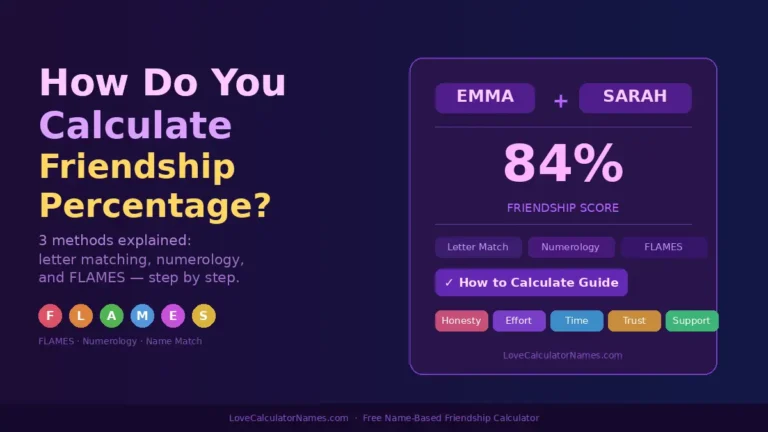
To calculate FLAMES on paper: write both names in capitals, cross out letters shared by both names, count what is left, then use that count to eliminate letters from F-L-A-M-E-S one at a time — looping back when you reach the end. The last letter standing is your result: Friends, Love, Affection, Marriage, Enemies, or Siblings. The whole thing takes under two minutes with no math beyond counting.
This guide covers every step in order, works through two full examples, explains what each result means, and flags the mistakes that throw off the count.
FLAMES is a fun paper game played purely for entertainment. Results are determined by letter arithmetic, not relationship science.
What Does FLAMES Stand For, and Where Did It Start?
FLAMES stands for Friends, Love, Affection, Marriage, Enemies, and Siblings — six relationship categories that form the backbone of this counting game. You use two people’s names to arrive at one of the six through a systematic letter-elimination process.
The game predates smartphones by decades. It was already widespread in South Asian classrooms through the 1980s and became a global school staple by the late 1990s, spreading alongside other playground forecasting games like MASH. Nobody holds a patent on it. FLAMES emerged from the same tradition as fortune teller origami and “he loves me, he loves me not” petal counting — simple, tactile, group-friendly rituals that let you think about relationships without talking about them directly.
That combination — mechanical process, personal outcome, plausible deniability — is what makes FLAMES enduringly appealing. You are not saying you like someone. You are just calculating.
What each FLAMES letter means in full:
- F — Friends: Natural platonic compatibility. Easy, comfortable, mutual understanding.
- L — Love: Romantic attraction or deep emotional feeling.
- A — Affection: Genuine warmth and care — closeness that does not have to be romantic.
- M — Marriage: Long-term partnership energy. Deep-rooted connection.
- E — Enemies: Friction or opposing energies. (More on why this is not actually alarming, below.)
- S — Siblings: Familiar, protective, teasing bond — the dynamic of people who feel like family.
The psychology here is worth noticing. None of the six outcomes is neutral — each describes a real emotional category that people care about. That is not an accident. Games like FLAMES persist because they give a vocabulary to something people want to think about but do not always know how to name.
In South Asian classrooms where the game originated, Marriage is traditionally the most celebrated result. In Western school settings, Love tends to get the biggest reaction. The mechanics are identical; the cultural weight placed on each letter differs by region and by who is in the room.
How Do You Calculate FLAMES on Paper, Step by Step?
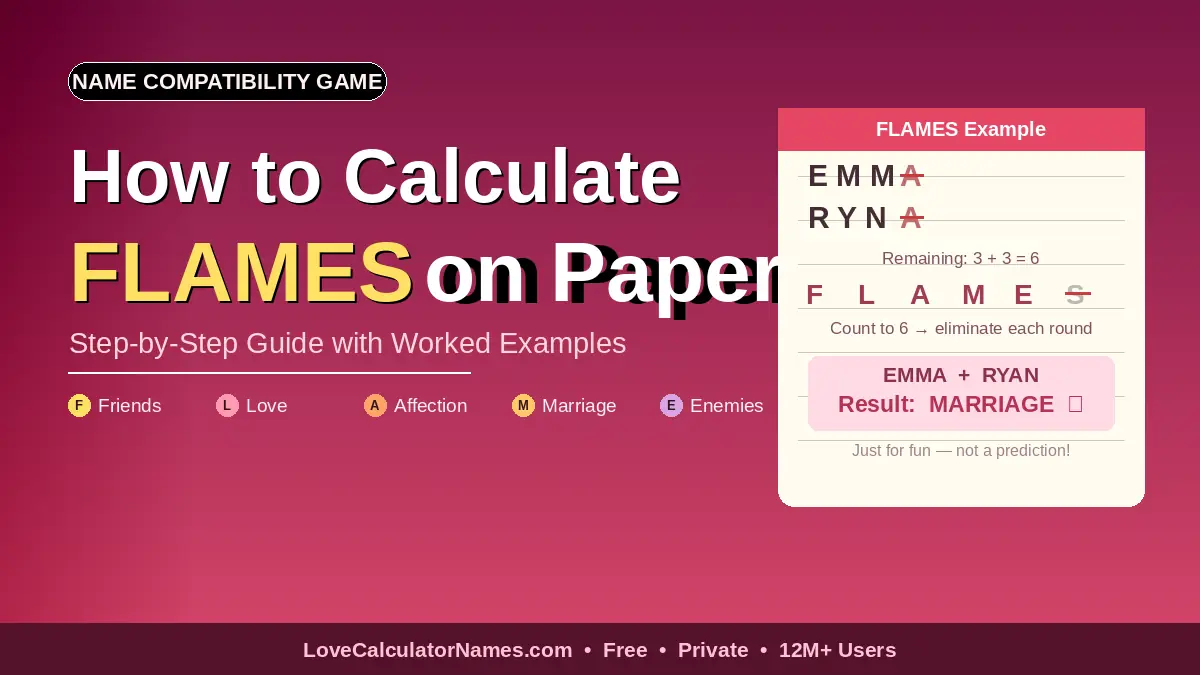
To calculate FLAMES on paper, write both names in capitals, cross out letters that appear in both names one-to-one, count the remaining letters, then count through F-L-A-M-E-S in a loop, eliminating each letter you land on. After each elimination, restart counting from the next remaining letter. The survivor is your result.
Here is a complete walkthrough using EMMA + RYAN.
Step 1: Write both names in capital letters.
EMMA
RYAN
Step 2: Find letters that appear in both names and cross them out — one match at a time.
Go through each letter in the first name and look for its match in the second name. Cross out one from each side per matched pair.
- E → not in RYAN
- M → not in RYAN
- M → not in RYAN
- A → in RYAN ✓ → cross out A from EMMA and A from RYAN
After crossing out:
- EMMA → E, M, M (3 letters remain)
- RYAN → R, Y, N (3 letters remain)
Step 3: Count the remaining letters.
3 + 3 = 6
Step 4: Write out FLAMES as a row.
F – L – A – M – E – S
Step 5: Count through the letters to your number. Cross out the letter you land on.
F(1) – L(2) – A(3) – M(4) – E(5) – S(6) → S eliminated.
Remaining: F – L – A – M – E
Step 6: Start the next count from the letter immediately after the one you just eliminated.
S was last in the row, so wrap back to F. Count to 6 again:
F(1) – L(2) – A(3) – M(4) – E(5) – F(6) → F eliminated.
Remaining: L – A – M – E
Step 7: Keep going until one letter is left.
Next count starts from L (the letter right after the eliminated F):
L(1) – A(2) – M(3) – E(4) – L(5) – A(6) → A eliminated.
Remaining: L – M – E
Next starts from M (after eliminated A):
M(1) – E(2) – L(3) – M(4) – E(5) – L(6) → L eliminated.
Remaining: M – E
Next starts from M:
M(1) – E(2) – M(3) – E(4) – M(5) – E(6) → E eliminated.
Remaining: M — Marriage. 💍
EMMA + RYAN = Marriage.
The one rule that trips everyone up: after you eliminate a letter, the remaining letters form a loop. When you reach the last one, wrap back to the first remaining letter and keep your count going. Forgetting the loop is the single most common reason two people get different results from the same name pair.
Second Example: TAYLOR + JAMES
Let us run a second pair so the method becomes automatic.
- TAYLOR: T, A, Y, L, O, R (6 letters)
- JAMES: J, A, M, E, S (5 letters)
- Common letter: A — cross out one A from each side
- Remaining: T, Y, L, O, R (5) + J, M, E, S (4) = 9
Count to 9 through FLAMES:
F(1)–L(2)–A(3)–M(4)–E(5)–S(6)–F(7)–L(8)–A(9) → A eliminated.
Remaining: F–L–M–E–S. Continue from M:
M(1)–E(2)–S(3)–F(4)–L(5)–M(6)–E(7)–S(8)–F(9) → F eliminated.
Remaining: L–M–E–S. Continue from L:
L(1)–M(2)–E(3)–S(4)–L(5)–M(6)–E(7)–S(8)–L(9) → L eliminated.
Remaining: M–E–S. Continue from M:
M(1)–E(2)–S(3)–M(4)–E(5)–S(6)–M(7)–E(8)–S(9) → S eliminated.
Remaining: M–E. Continue from M:
M(1)–E(2)–M(3)–E(4)–M(5)–E(6)–M(7)–E(8)–M(9) → M eliminated.
Remaining: E — Enemies.
That is not a judgment on Taylor and James as a pair — it is just the count. This example exists to show that the method is fully mechanical. The letters do not know anything about the people.
What Does Each FLAMES Result Actually Mean?
Each FLAMES result describes a relationship energy or dynamic, not a guaranteed outcome. Here is the full breakdown, including how to read the result that worries people most.
| Letter | Result | Relationship Vibe | How to Read It |
|---|---|---|---|
| F | Friends | Comfortable, easygoing | Natural chemistry and mutual understanding |
| L | Love | Romantic, emotional | A spark, deep attraction, or genuine feeling |
| A | Affection | Warm, caring | Genuine fondness and emotional closeness |
| M | Marriage | Stable, long-term | Deep-rooted connection and partnership energy |
| E | Enemies | Tense, conflicting | Friction or opposing energies (or just a number) |
| S | Siblings | Familiar, teasing | Protective, comfortable, family-like dynamic |
On getting Enemies: People catastrophize this one. E comes up because a specific number of uncanceled letters led the count to land there — nothing more meaningful than that. Some playground versions of the game have players re-run the calculation using a nickname or shortened name if they get E, which tells you everything about how seriously the result is designed to be taken.
On Siblings: This surprises people who wanted Love or Marriage. In practice, S often describes the people you are most genuinely comfortable with — the ones you tease directly, trust completely, and feel no need to perform around. Several people who get S say it is the most accurate result they have ever received in FLAMES, which is saying something for a letter-counting game.
Famous name pairs for illustration (purely for fun):
Running “ROMEO + JULIET” through the calculation — which everyone expects to give L for Love — actually produces a different result depending on name format. With ROMEO (R, O, M, E, O) and JULIET (J, U, L, I, E, T), the common letter is E. Cancel one E from each. Remaining: R, O, M, O (4) + J, U, L, I, T (5) = 9. Counting to 9 through FLAMES gives… S — Siblings. Not what Shakespeare intended, but a reminder that the game counts letters, not feelings.
What Mistakes Mess Up Your FLAMES Calculation?
Most errors when calculating FLAMES on paper come down to three things: mishandling the letter cancellation, forgetting the loop, or being inconsistent with which name format you use. Getting any one of these wrong changes your final result.
Mistake 1: Batch-canceling letters instead of matching one-to-one.
If one name has two M’s and the other has one M, you cancel only one M from each side — not both M’s from the first name. The rule is one-to-one matching. Each letter in the first name can only cancel one corresponding letter in the second name. This matters most with names containing repeated letters like ANNA, EMMA, LILLY, or MOHAMMED.
Mistake 2: Stopping the count at the end of the remaining letters.
The remaining FLAMES letters form a circle, not a line. When you reach the last letter in the row without hitting your target number, you keep counting from the first remaining letter. Forgetting this turns every calculation after the first elimination into guesswork, and it is why people sitting next to each other doing the same names get different answers.
Mistake 3: Using inconsistent name formats.
“Tom” and “Thomas” give completely different uncanceled letter counts. Choose one format — first name only, full birth name, or common nickname — and apply it to both people. Most people default to the first name as typically spelled and written, all in capitals. Switching formats mid-calculation, or using a nickname for one person and a full name for the other, skews every result.
Mistake 4: Including spaces, hyphens, or apostrophes.
FLAMES counts letters only. “Mary-Jane” = M, A, R, Y, J, A, N, E — the hyphen does not exist to the game. Same with apostrophes in names like O’Brien or D’Angelo. Strip all punctuation before you start.
Myth: The order you write the names in changes the result.
It does not. The total count of uncanceled letters is the same whether you write your name first or the other person’s. Swap the order freely.
Myth: Getting Enemies means something is genuinely wrong with the relationship.
The result is purely arithmetic. People in strong, lasting relationships “calculate” as Enemies all the time. If the E result bothers you, try the calculation with a different name format — first name only versus full name, or a commonly used nickname. Different inputs give different results, which is itself the most useful thing to know about how FLAMES works.
Are There Different Versions of FLAMES You Should Know About?
The method described above is the most widely played version globally, but FLAMES has a handful of regional and creative variations worth knowing — especially if someone in your group plays it differently and you cannot figure out why your results do not match.
Version 1: Full name instead of first name only.
Particularly common in South Asian traditions, this version uses the complete name — first and last — for what players consider a more thorough result. The calculation is identical; you just have more letters to work with, which changes the uncanceled count and can flip the outcome. Neither version is more “correct.” Full name tends to give larger counts, which affects which FLAMES letter gets eliminated first.
Version 2: Numerical value scoring.
A less common variation replaces the simple letter count with a weighted sum: A=1, B=2, C=3, through Z=26. You add the values of all uncanceled letters from both names and reduce to a single digit (by adding the digits of any two-digit result). That single digit becomes your FLAMES count. This version takes longer but feels more personalized because it incorporates the actual identity of the letters, not just how many survived cancellation.
Version 3: Birthday hybrid.
Some groups add a numerological step: sum all the digits in both people’s birth dates, reduce to a single digit, and use that as your FLAMES count instead of the letter count. This blends the name-based game with numerological compatibility thinking and produces results that have nothing to do with the spelling of the names at all.
Version 4: FLAMESC (adding Crush).
A few playground variants extend the acronym by one letter — C for Crush — making it seven letters to cycle through: F-L-A-M-E-S-C. The calculation runs identically; the pool of possible outcomes is just wider. This version was popular in some Indian schools through the 2000s.
The standard six-letter version remains by far the most widely played. If an online calculator gives you a different result from your paper calculation, the most likely cause is a different interpretation of the cancellation step — not an error in your arithmetic.
Frequently Asked Questions
What does FLAMES stand for in the name compatibility game?
FLAMES stands for Friends, Love, Affection, Marriage, Enemies, and Siblings — six relationship categories. You use two people’s names and a counting-out elimination process to arrive at one of the six. The game originated in South Asian school culture during the 1980s and spread globally through the 1990s as a popular classroom and recess activity.
Should I use my first name or full name to calculate FLAMES on paper?
Most people use just the first name, written in all capitals. Some prefer the full name (first plus last) for what they feel is a more complete result. Either method works as long as you are consistent — use the same name format for both people. Mixing a nickname for one person with a full name for the other skews the uncanceled letter count and changes the result.
What happens if the two names share no common letters at all?
If the names share no letters, skip the cancellation step entirely. Your count equals the combined total of all letters in both names. The rest of the calculation runs normally from there. Having no common letters does not break the game — it just means the count will be higher than usual, which affects which FLAMES letter gets hit first.
Is the FLAMES game accurate for predicting real relationships?
No — and it was never meant to be. FLAMES produces results based on how many letters happened to survive cancellation between two names. That number is entirely a function of spelling, not personality, compatibility, or feelings. Use it as entertainment. For any meaningful insight into a real relationship, shared values, communication patterns, and real-life experience are what actually matter.
What does getting Enemies in FLAMES mean for the relationship?
It means the counting process landed on E after working through the eliminations — nothing more. E is not a warning, a red flag, or a prediction of conflict. It is an arithmetic outcome determined by the spelling of two names. Plenty of close friends and happy couples produce an Enemies result when they run FLAMES. If it bothers you, try the calculation with a nickname or alternate name spelling.
Can you use FLAMES for a friendship, not just a romantic relationship?
Absolutely. FLAMES works for any two people. The game does not require romantic context — it just uses two names. Results like Friends, Affection, and Siblings come up often in non-romantic pairings and frequently feel accurate to people who try it. Many friend groups use FLAMES to settle playful debates about “what kind of friends” two people are.
Why do I get a different FLAMES result than my friend for the same two names?
Almost always one of three reasons: different handling of the cancellation step (batch-canceling vs. one-to-one matching), forgetting to loop the remaining letters when counting, or using different name formats (first name vs. full name, different spellings). All three steps need to be identical for two people to get matching results. Go through the worked example in this guide together and compare where your methods diverge.
Is there a digital FLAMES calculator that uses the same method as the paper version?
Yes. LoveCalculatorNames.com runs the same letter cancellation and counting process automatically — enter two names and it gives you a result instantly. It is useful for checking your paper math, running multiple name combinations quickly, or sharing results with friends. The underlying logic is the same as the handwritten version described above.
The Short Version, If You Need It
FLAMES is a two-minute paper game that has been passed around school notebooks for over forty years. The mechanic is simple: cancel shared letters, count what is left, use that count to knock out letters from FLAMES one by one until one survives.
Three things make or break the accuracy of your calculation: cancel letters one-to-one, treat the remaining FLAMES letters as a loop, and use the same name format for both people. Get those three right and your result will match every time.
The result itself? Take it lightly. It is a counting exercise that happens to land on something emotionally meaningful — which is exactly why it has been copied onto the backs of notebooks in every country where kids have had five minutes to spare.
Ready to try it online? Enter any two names at LoveCalculatorNames.com — free, instant, and completely private.
Use the free love compatibility test to explore your name-based result today.