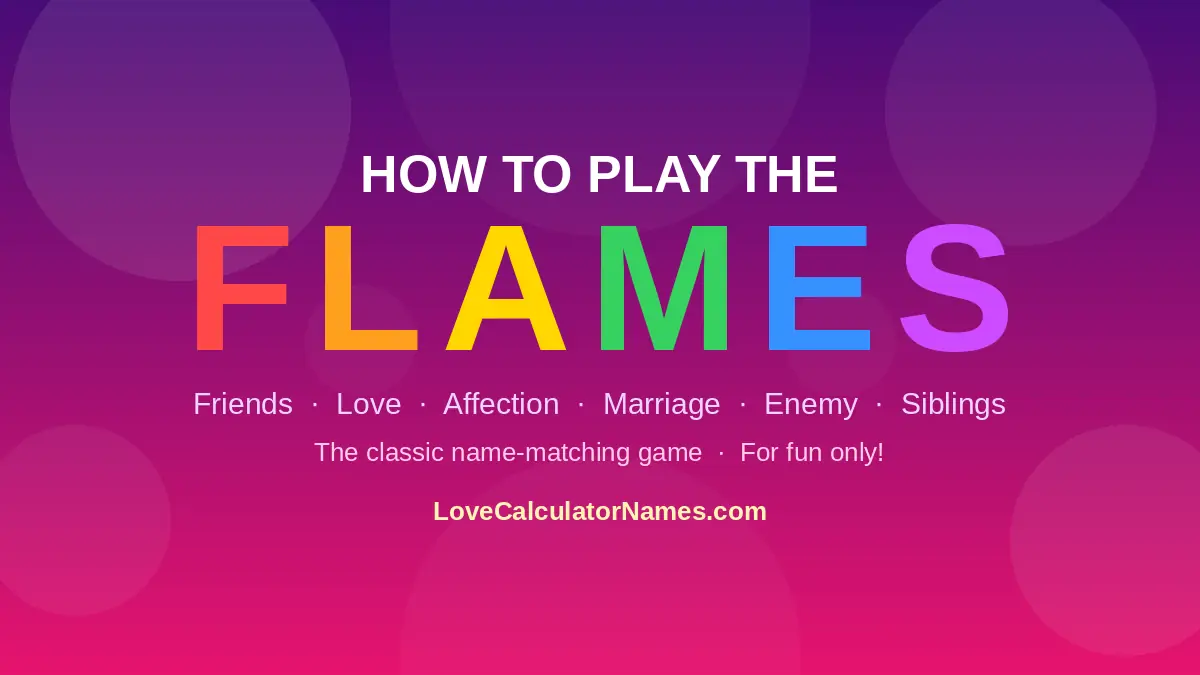
FLAMES is a classic name-based word game that “predicts” your relationship with someone using a simple letter-elimination method. To play: write both names, cross out letters they share one-to-one, count the remaining letters, then cycle through F-L-A-M-E-S — eliminating one letter at each count until only one remains. That surviving letter is your result: Friends, Love, Affection, Marriage, Enemy, or Siblings. The whole game takes under two minutes.
Note: The FLAMES game is 100% for entertainment. Results depend on letter counting, not personality, psychology, or relationship science.
What Does FLAMES Stand For in the Game?
FLAMES is an acronym where each letter names a possible relationship outcome: F = Friends, L = Love, A = Affection, M = Marriage, E = Enemy, S = Siblings. Each outcome gives a lighthearted “verdict” about how two names connect — though the result depends entirely on which letters those names happen to share, nothing more.
The game has been a classroom staple for at least four decades. Before smartphones, kids would fold notebook pages and pass FLAMES results across desks like fortune slips. Its appeal is pure simplicity: any two people with names and a pencil can play it anywhere, in any language, at any age.
Here is what each letter means:
F — Friends: The game says you two are best suited as close friends.
L — Love: A hint of romantic potential, according to the letter count.
A — Affection: A warm, caring bond — somewhere between friendship and love.
M — Marriage: The game’s top compatibility outcome — long-term potential.
E — Enemy: Playful rivalry or tension. Don’t read into this one.
S — Siblings: A brotherly or sisterly dynamic between the two names.
Getting E for Enemy sounds alarming — and it always gets a laugh. After playing through hundreds of name combinations, I’ve noticed that some of the closest real-life pairs end up with E precisely because their names share so few letters. That’s a reminder the game is chance with extra steps, not a relationship verdict.
There’s a loose parallel to Pythagorean numerology, where each name carries a numerical value based on its letters. FLAMES doesn’t use that system formally, but both share the same core idea: something about you is somehow encoded in your name. That intuition is what gives the game its emotional pull across dozens of cultures and school systems worldwide.
How Do You Play the FLAMES Game? (Step-by-Step)
To play FLAMES, write two names, cancel every shared letter one-to-one, count the leftover letters, then use that count to eliminate one FLAMES letter per round until only one survives. That letter is your result. The game is deterministic — the same names always produce the same outcome when the steps are followed correctly.
Here are the full rules, step by step:
Step 1: Write both names Write Person A’s name on one line and Person B’s name directly below it. Most players use first names only, though full names work too — just stay consistent every time you play.
Step 2: Cross out shared letters, one-to-one Identify every letter that appears in both names. Cancel one copy from each name per shared letter. Critical rule: if a letter appears twice in Name A but once in Name B, you cancel one copy from each — never cancel all instances of a letter at once. This one-to-one matching is the step where most players go wrong.
Step 3: Count the remaining uncanceled letters After all canceling is done, count every uncanceled letter across both names combined. This total becomes your count number for the elimination round.
Step 4: Cycle through FLAMES using your count Write out F, L, A, M, E, S. Starting from F, count through each letter. When you reach your count number, cross that letter off. Begin the next count from the letter immediately after the one you just eliminated — skipping any already crossed out. Wrap around if you reach the end: go back to the first remaining letter.
Step 5: Read the surviving letter Keep eliminating until exactly one letter remains. Match it to its meaning: F = Friends, L = Love, A = Affection, M = Marriage, E = Enemy, S = Siblings.
The step where most players go wrong is Step 2. Getting the one-to-one canceling exactly right gives you a correct count, which makes every other step fall into place automatically.
How Do the FLAMES Steps Work in a Real Example?
The fastest way to understand how to play the FLAMES game is to see it in action. Once you watch the counting and elimination play out with actual letters, the logic clicks and stays with you — and you can replicate it with any two names immediately.
Worked Example: Lucy and Jack
Step 1 — Write the names: LUCY and JACK
Step 2 — Find and cancel shared letters: Both names share only the letter C. Cancel one C from each name.
- LUCY → remaining: L, U, Y (3 letters)
- JACK → remaining: J, A, K (3 letters)
Step 3 — Count remaining letters: L + U + Y + J + A + K = 6 letters total
Step 4 — Cycle through FLAMES, eliminating at count 6 each round:
| Round | Starting From | Count 6 Lands On | Eliminated |
|---|---|---|---|
| 1 | F | F, L, A, M, E, S | S |
| 2 | F | F, L, A, M, E, F | F |
| 3 | L | L, A, M, E, L, A | A |
| 4 | M | M, E, L, M, E, L | L |
| 5 | M | M, E, M, E, M, E | E |
Surviving letter: M
Step 5 — Read the result: M = Marriage 🎉
According to FLAMES, Lucy and Jack are long-term compatible. Whether they’d agree is a separate question — but that’s the game.
One detail to notice: in Round 2, the count wraps back to F because S was the last letter in the sequence. That circular wrap-around is the key mechanic of the game. Once you get comfortable with it, you can follow along with any count and any number of remaining letters.
FLAMES Outcomes: Quick Reference
| Letter | Meaning | Relationship Tone |
|---|---|---|
| F | Friends | Strong platonic connection |
| L | Love | Romantic spark or chemistry |
| A | Affection | Warm, caring bond |
| M | Marriage | High long-term compatibility |
| E | Enemy | Strong contrast or rivalry |
| S | Siblings | Brotherly or sisterly dynamic |
Are There Different Versions of the FLAMES Game?
Yes — FLAMES has several regional and digital variations. The core mechanics stay the same everywhere: letter canceling, counting, and elimination. What changes is the name format used, how zero counts are handled, and whether tiebreaker rules apply — all of which can significantly shift the outcome.
The most common version in the United States and United Kingdom uses first names only. In South Asia — particularly India and Pakistan — it is standard to play with full names including surnames, which creates a larger letter pool and often produces a completely different result than first-name play.
In Southeast Asian schoolyard traditions, some players add a tiebreaker rule: if the count would eliminate the last remaining letter (creating a tie), the player restarts with a count of 6. This prevents edge cases from stalling the game indefinitely.
| Version | Common Region | Key Difference |
|---|---|---|
| First Name Only | USA, UK, Australia | First names only; the most common form |
| Full Name | South Asia (India, Pakistan) | Includes surname; produces a larger count |
| Extended FLAMES | Southeast Asia | Adds tiebreaker rule for edge cases |
| Nickname Version | Online communities | Any name form accepted; very flexible |
| Digital Calculator | Global | Automates all steps; same core logic |
Online FLAMES calculators follow the exact same elimination logic as the paper game. If your manual result differs from an online tool, the discrepancy almost always comes down to a mistake in your letter-canceling step — not the calculator.
In my experience, switching from first names to full names is the single biggest factor that flips a result. What lands on M with first names can flip to F or E with surnames included. That alone makes it worth trying both formats when you’re curious about a particular pair.
What Are the Most Common Mistakes Players Make?
Most FLAMES errors happen in the letter-canceling step. Players cancel too many letters, miss shared ones entirely, or miscount the remaining total. A wrong count changes everything downstream — so getting the canceling right is essentially the entire game.
Mistake 1: Canceling all instances instead of one-to-one
If Name A has two M’s and Name B has one M, you cancel one M from each — not both M’s from Name A. Always match the minimum count of the shared letter across both names. This is the single most common error, and it almost always gives a wrong count.
Mistake 2: Restarting from F after each elimination
Some players reset to F at the start of every new round. In standard FLAMES, you continue counting from the letter immediately after the one you just eliminated. Restarting from F each time is a popular informal house rule, but it isn’t the standard mechanic and changes the result.
Mistake 3: Using inconsistent name formats
Playing with “Alex” on one try and “Alexander” on another gives completely different results because the letter count changes. Decide on a format — first name only or full name — and stick with it across every round you compare.
Mistake 4: Treating the result as meaningful
Research on name-based attraction does suggest people are drawn to names that sound similar to their own — an interesting psychological quirk. But that’s entirely separate from FLAMES. The game is arithmetic: the count landed where it landed. E for Enemy between two close friends says nothing real about their bond.
Mistake 5: Worrying about “Enemy” or “Siblings” results
E and S trigger the biggest reactions, but they’re just as mathematically likely as M or L. Play the same two names in different formats — first name, full name, nickname — and you’ll see different letters come up each time. It’s a game, not a compatibility verdict. No friendship has ever ended because of an E result.
Frequently Asked Questions About the FLAMES Game
How do you play the FLAMES game with full names? Combine first and last name into one string (e.g., LUCYSMITH), then follow the same steps: cancel shared letters one-to-one with the other full-name string, count what’s left, and cycle through FLAMES. Full names produce a higher count, which changes the elimination pattern and often flips the result compared to first-name play.
What does it mean if I get “M” in FLAMES? M stands for Marriage — the game’s suggestion that two names have strong long-term compatibility. It’s generally seen as the best possible outcome. That said, it’s purely arithmetic: M means the count eliminated all other letters first. It carries no predictive value about real relationships, chemistry, or compatibility.
Can you play FLAMES by yourself? Absolutely. Most people play solo — you only need your own name and the name of someone you’re curious about. The other person doesn’t need to know or participate at all. It’s as much a solo puzzle as a social game, which is part of why it has stayed popular across generations.
What happens if all letters cancel out and the count is zero? When every letter cancels perfectly, the most common house rule is to default to a count of 6 — the length of FLAMES itself. Some players declare a zero result an automatic “perfect match.” There’s no universal rule, so just agree on one approach before you start playing.
Is there a free online version of the FLAMES game? Yes. Several free FLAMES calculators are widely available. The name compatibility tools at LoveCalculatorNames.com combine FLAMES logic with additional name-matching features — no sign-up required and completely private. These tools automate the letter-canceling and elimination steps so you can test multiple pairs in seconds.
Why do I get different results each time I play the same names? FLAMES is fully deterministic: the same two names always produce the same result when steps are applied correctly. If results vary, the error is almost always in the letter-canceling step. Even a one-letter miscounting changes the count number and therefore the entire elimination sequence.
Can you play FLAMES with more than two people? The standard game is designed for exactly two names. For groups, many players run informal bracket tournaments — pairing names and comparing results across multiple rounds. There’s no official multiplayer version, but creative adaptations are part of what has kept the game alive and flexible across decades.
What age group is the FLAMES game for? FLAMES is most popular with preteens and teens (roughly ages 10–16) and nostalgic adults who grew up playing it. It’s completely family-friendly, requires no devices or special materials, and works across cultures. Adults often rediscover it as a lighthearted party icebreaker — especially fun when someone in the group has never heard of it before.
The FLAMES Game: Simple Rules, Big Reactions
FLAMES has survived decades of changing trends because it’s fast, universally accessible, and endlessly repeatable with new names. The rules are easy to learn: write two names, cancel shared letters one-to-one, count what remains, cycle through F-L-A-M-E-S, eliminate one letter per round, and read your final result.
Three things worth remembering as you play: the letter-canceling step is where accuracy matters most — one-to-one, never all-at-once. The same names always produce the same result when the steps are followed correctly, so consistency is the key to fair play. And the game is for fun, full stop — not a measure of real compatibility, attraction, or relationship potential.
Ready to skip the paper and pencil? Try the free name compatibility tool at LoveCalculatorNames.com — instant FLAMES results, no sign-up required, and 100% private.
Try our love calculator tool and see what result your name combination gives you.