You scribbled two names in a notebook margin. You counted off letters. And then you crossed out the matching ones, going around the word F-L-A-M-E-S until only one letter was left. Sound familiar?
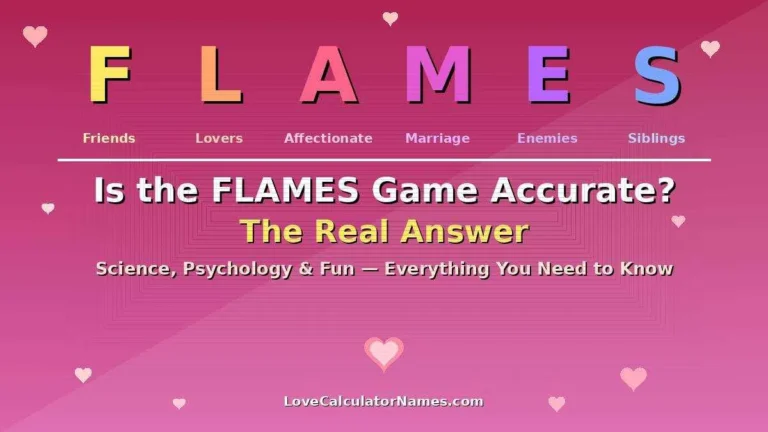
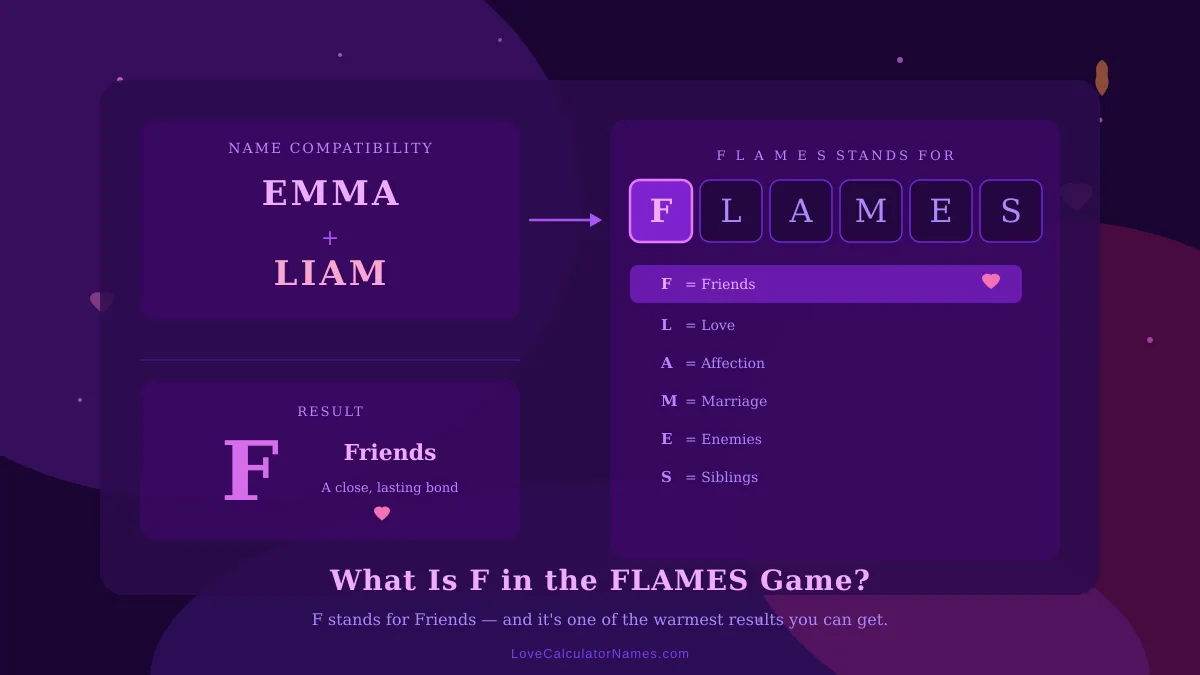
F in the FLAMES game stands for “Friends.” If the game lands on F, it means the two people being tested are best suited as close friends rather than romantic partners. FLAMES is a classic paper-and-pencil name compatibility game where each letter represents a different relationship outcome: Friends, Love, Affection, Marriage, Enemies, and Siblings. The game uses the letters in two names to determine which relationship “wins” — purely for fun.
This article is for entertainment purposes only. FLAMES is a playful game, not a scientific relationship tool.
What Does Each Letter in FLAMES Stand For?
Each letter in FLAMES represents a possible relationship outcome between two people. F = Friends, L = Love, A = Affection, M = Marriage, E = Enemies, S = Siblings. Together, they cover the six most common ways people imagine their connection with someone they have a crush on or care about.
Here’s the full breakdown:
| Letter | Meaning | What It Suggests |
|---|---|---|
| F | Friends | A close, platonic bond |
| L | Love | Romantic feelings or a love match |
| A | Affection | Warmth and care, less intense than love |
| M | Marriage | Long-term commitment or soulmate energy |
| E | Enemies | Rivalry or strong tension |
| S | Siblings | A family-like, protective bond |
Getting an F result doesn’t mean anything negative. In fact, many people who play the game are secretly hoping for F because it means a comfortable, lasting bond. The game is lighthearted and the “Enemies” result produces just as many laughs as “Marriage” does.
The word FLAMES itself was cleverly designed. The six outcomes cover the full emotional range of how two people might relate to each other — from the warmth of siblings to the spark of love to the cool comfort of friendship. It’s a small piece of wordplay with a surprisingly satisfying emotional map.
How Do You Play the FLAMES Game Step by Step?
To play FLAMES, write both names, cross out shared letters, count the remaining letters, then eliminate letters from FLAMES by counting around until one remains. That final letter is your result. The whole game takes about two minutes and needs nothing but a pen and paper.
Here’s how to play it correctly:
- Write both full names. Use first names only, or full names — players can decide, but be consistent.
- Cross out all shared letters. Look for letters that appear in both names. Cross out one matching letter from each name for every match. Do this carefully — this step is where most people get confused.
- Count the remaining uncrossed letters. Add up all the letters left in both names after the crossing-out step.
- Start counting around FLAMES. Say the total number from step 3 is 7. Write F-L-A-M-E-S and count to 7, looping back to F after S if needed. Cross out the letter you land on.
- Repeat with the remaining letters. Now count from where you crossed out, skipping the crossed-out letter. Keep going until only one letter remains.
- The last letter standing is your result. That’s your FLAMES outcome.
Quick example: Say you get a count of 4 after removing shared letters. Count F(1), L(2), A(3), M(4) — cross out M. Then continue from E with your count of 4: E(1), S(2), F(3), L(4) — cross out L. Keep going until one letter survives.
Some players restart the count at 1 each time from the crossed-out position rather than continuing from where they left off. Both versions exist, and neither is “official” — it’s a playground game, not a sport.
Where Did the FLAMES Game Come From — and Why Does It Still Spread?
FLAMES has been traced to schoolyard culture in South Asia, particularly India, in the 1980s and 1990s, though similar letter-counting love games existed earlier in other countries. Its spread through schools across Asia, the UK, and the US happened the old-fashioned way: kids taught other kids.
The game has no single inventor. It belongs to that category of cultural artifacts — like rock-paper-scissors or MASH — that seem to have always existed once you encounter them. Researchers who study playground culture note that letter-counting divination games have appeared across many languages and naming traditions for at least a century.
What makes FLAMES different from other name games is its elegant structure. Most love-prediction games from school culture rely on counting with a rhyme or a simple number. FLAMES introduced a word with six meaningful, emotionally resonant outcomes and a rule system just complex enough to feel like it “works.”
The game exploded online in the early 2000s when web-based FLAMES calculators started appearing on personal websites. By the time social media arrived, it had already become a nostalgic artifact for older millennials — and a fresh discovery for every new generation of middle schoolers.
Here’s how FLAMES compares to similar name games:
| Game | Method | Outcomes | Origin Region |
|---|---|---|---|
| FLAMES | Letter crossing + counting | 6 (Friends to Siblings) | South Asia / Global |
| MASH | Spiral counting | Future life scenario | North America |
| Love Calculator | Name numerology | Percentage score | Global / Online |
| 4-Pic Love Test | Photo-based | Percentage | Social media |
The reason FLAMES keeps spreading is its perfect balance of simplicity and surprise. Anyone can learn the rules in 30 seconds. The counting step takes just long enough to feel meaningful. And the result lands on one of six options that map directly to feelings young people actually have.
Common Myths About the FLAMES Game (And What’s Actually True)
The biggest myth about FLAMES is that it produces accurate results about real relationships. It doesn’t — and that’s not the point. FLAMES is a structured guessing game. The fun comes from the ritual and the reaction, not the prediction.
Here are the most common misconceptions:
Myth 1: The letter F is the “worst” result.
Not true. Friends is widely considered a warm, positive outcome. Many players who get F laugh about it — but quite a few are actually relieved, especially when playing the game about someone they genuinely like as a person.
Myth 2: You have to use full legal names for it to “work.”
There’s no correct version. Some players use nicknames, some use first names only, some include middle names. The game doesn’t have official rules because it was never officially invented. Use whichever name form you prefer.
Myth 3: The game is based on numerology.
FLAMES shares the “letter counting” mechanics with some numerology systems, but it’s not numerology. Numerology assigns numerical values to letters based on systems like Pythagorean or Chaldean methods. FLAMES simply counts remaining letters after eliminations — no letter values are assigned.
Myth 4: Getting “Enemies” means you’ll actually conflict with someone.
Of course not. The E result is the funniest outcome at most slumber parties. It’s entertainment, not prophecy.
Myth 5: Online FLAMES calculators are more “accurate” than doing it by hand.
Online calculators just automate the same counting process. There’s no additional input or data — they apply the same game mechanics faster. The result is the same whether you use paper or a website.
The honest truth: FLAMES is beloved because it gives people a low-stakes, playful excuse to think about a person they have feelings for — not because it tells them anything real.
Frequently Asked Questions About the FLAMES Game
What does F mean in the FLAMES game?
F stands for “Friends.” If the FLAMES game lands on F, it suggests the two people have a strong friendship bond. It’s one of the six possible outcomes in the game, alongside Love, Affection, Marriage, Enemies, and Siblings. Getting an F result is considered positive — a close, comfortable connection.
What is the full meaning of FLAMES?
FLAMES is an acronym: Friends, Love, Affection, Marriage, Enemies, Siblings. Each letter represents a different type of relationship outcome. The word FLAMES is used because you count around the six letters, eliminating one at a time until only your result remains.
Is the FLAMES game accurate for predicting relationships?
No. FLAMES is a fun paper-and-pencil game, not a real relationship predictor. The outcome is determined by counting remaining letters after crossing out shared ones — essentially a structured counting exercise. It’s meant for entertainment only and has no scientific basis.
Can you play FLAMES with nicknames?
Yes. There are no official rules about which name form to use. Players use first names, full names, nicknames, or even names in other languages. The game works the same way regardless — just pick a consistent format before you start crossing out shared letters.
What happens if you get “Enemies” in FLAMES?
The E result means “Enemies” in the game, suggesting tension or rivalry between the two people. In practice, this is often the funniest outcome — most people burst out laughing. It carries no real meaning and is just one of six possible landing spots in the game.
How do you calculate FLAMES step by step?
Write both names, cross out shared letters (one from each name per match), count remaining letters, then eliminate letters from FLAMES by counting to your total and repeating until one letter survives. That final letter is your result. The full steps are covered in detail in this article.
Does the order of names matter in FLAMES?
Technically no — the shared letters are the same regardless of order, and the total remaining count stays the same. In practice, some players feel order matters for superstitious reasons. Others deliberately write their name first. The math comes out the same either way.
Are there variations of the FLAMES game?
Yes. In some regions, the meanings shift slightly — for example, S is sometimes interpreted as “Secret Admirer” rather than Siblings. Some online versions use additional letters or different acronyms. The core mechanic of letter elimination and counting is consistent across versions.
Wrapping Up: What F Really Means in FLAMES
The letter F in FLAMES means Friends — a warm, platonic, lasting bond. But the bigger takeaway is what the whole game actually represents: a clever, low-stakes ritual that lets people express and explore feelings without putting themselves fully on the line.
FLAMES has survived for decades across cultures precisely because it’s harmless fun. Getting F, L, A, M, E, or S produces the same result: a laugh, a raised eyebrow, or a quiet smile — and a reason to think about someone a little more.
The game doesn’t predict your future. But it does capture something real: the very human habit of searching for signs in small things when feelings are involved.
Ready to try a more personalized compatibility check? Visit LoveCalculatorNames.com for a free name-based compatibility test — no sign-up required, 100% private, and genuinely fun to try with any two names.
Use our free compatibility tool to see the score your two names produce now.