Think about your three closest friends. Now say their names out loud. Do you notice a shared rhythm, a similar vowel sound, or a pattern in how the names feel together? Millions of people notice these things, and it turns out there is a 2,500-year tradition of structured frameworks that attempt to explain them.
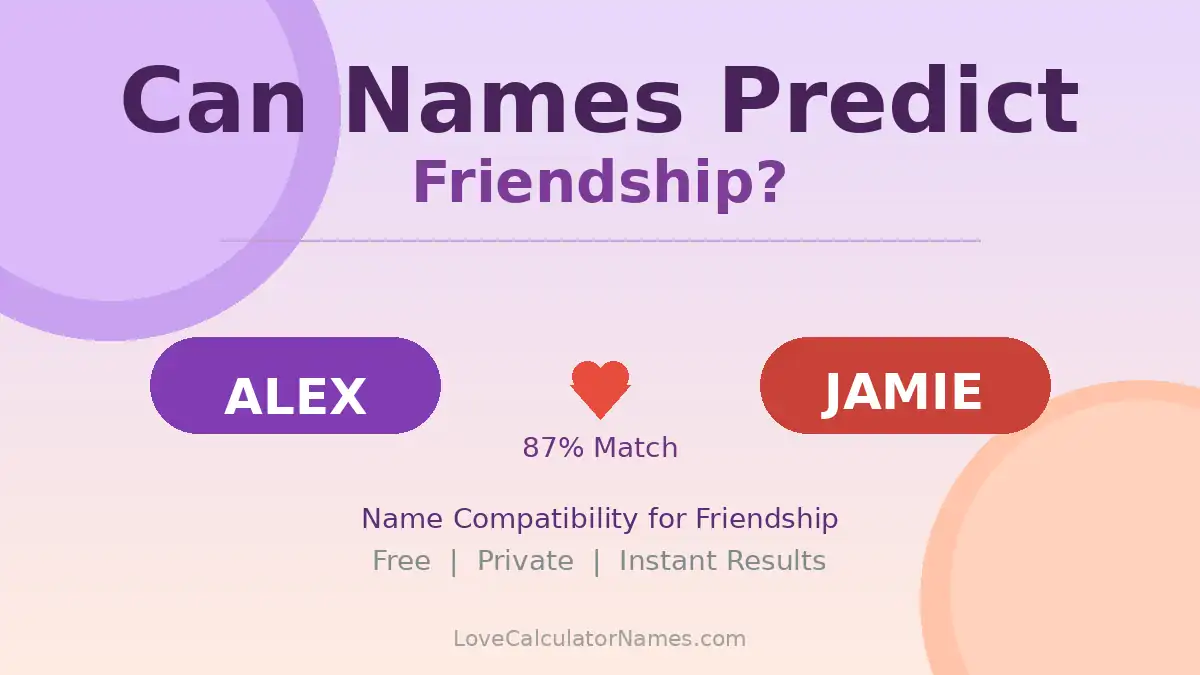
Can names predict friendship? Name compatibility systems — including Pythagorean numerology, phonetic harmony, and letter-value analysis — can identify consistent patterns between two people’s names that often reflect complementary personality associations and shared energies. These frameworks are ancient and internally reproducible, not modern guesswork. That said, they work best as tools for fun and self-reflection, not as scientifically verified friendship forecasts.
This guide explains exactly how name-based friendship compatibility works, what the psychology of names actually tells us, and what these systems can (and cannot) genuinely offer.
Disclaimer: Name compatibility tools are designed for entertainment and personal exploration only. They are not a substitute for the real work of friendship, and no result should be treated as a scientific relationship prediction.
What Does “Name Compatibility” Actually Mean for Friendship?
Name compatibility for friendship is the practice of using numerological systems, phonetic analysis, and letter-value frameworks to assess how naturally two people’s names — and the personality associations they carry — might complement each other. It is a framework for noticing, not a fortune-telling system, and it draws on traditions that span cultures and millennia.
The idea draws on two foundational systems.
The Pythagorean Letter-Value System
Pythagorean numerology is the most widely used method in name compatibility tools. It assigns each letter of the alphabet a number from 1 to 9 in a repeating sequence, starting over at J. You add the numerical values in a person’s name, reduce the total to a single digit, and arrive at their core “name number.” Compare two name numbers against a compatibility matrix, and you can see how those numerical energies traditionally pair.
The full Pythagorean letter-value chart:
- 1: A, J, S
- 2: B, K, T
- 3: C, L, U
- 4: D, M, V
- 5: E, N, W
- 6: F, O, X
- 7: G, P, Y
- 8: H, Q, Z
- 9: I, R
Certain pairings score especially high for friendship. The 1 & 3 combination (leader plus communicator) is considered naturally harmonious. So are 2 & 6 (nurturer and caregiver), 5 & 7 (adventurer and thinker), and 4 & 8 (builder and organizer). These aren’t random assignments — they reflect centuries of interpreted meaning tied to specific numerical qualities.
The Role of Phonetic Harmony
Phonetic harmony looks at how two names sound together — their vowel patterns, syllable structures, and natural rhythm. Names with open vowel sounds (like “ah” or “ee”) tend to be perceived as warm and approachable, according to psycholinguistic research. When two friends’ names both carry these qualities, there’s an auditory familiarity that may genuinely ease initial social connection.
This isn’t just intuition. A well-documented phenomenon called the name-letter effect, first described in social psychology research, shows that people display a mild but measurable preference for things — including other people — that share letters with their own name. It’s a subtle statistical bias, not a guaranteed bond. But it confirms that names carry real psychological weight in social perception.
First Name vs. Full Name in Friendship Calculations
Most name compatibility tools focus on first names only, which reflects how we actually experience people in daily life. Some tools incorporate full names, including surnames, for a more detailed reading. First-name analysis is considered to reflect day-to-day personality energy and surface-level compatibility. Full-name analysis is associated with deeper life-path resonance. For friendship testing, first names are the most natural and commonly used input.
How Do Name-Based Friendship Tests Actually Work?
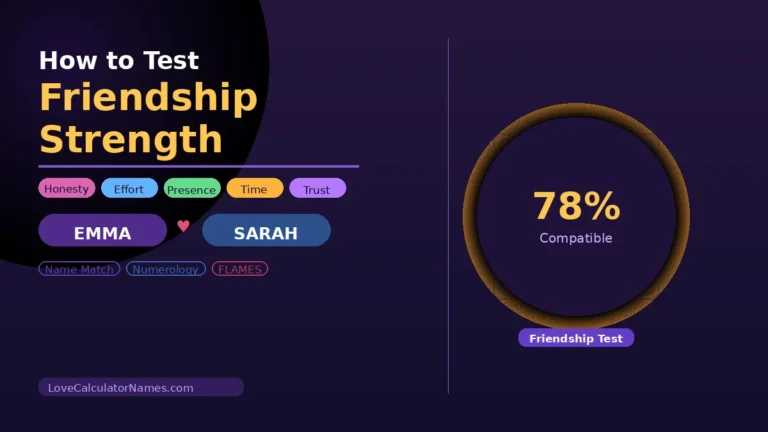
Name-based friendship tests work by converting each letter in two names into its Pythagorean numerical value, summing both totals, reducing each to a single core digit, and comparing those digits against a compatibility framework. Most tools output a percentage score between 0% and 100%, along with a descriptive friendship label like “Natural Best Friends” or “Adventure Duo.”
Here is the full step-by-step process most name compatibility tools use:
- Enter both names. Most tools accept first names only. Some accept full names for a more layered reading that accounts for life-path compatibility as well as day-to-day personality.
- Convert every letter to its Pythagorean value. Using the chart above: A=1, B=2, C=3, D=4, E=5, F=6, G=7, H=8, I=9, J=1, K=2, L=3, M=4, N=5, O=6, P=7, Q=8, R=9, S=1, T=2, U=3, V=4, W=5, X=6, Y=7, Z=8.
- Sum all the letter values in each name. Add every letter value in Name 1 to get a raw total. Repeat for Name 2.
- Reduce each total to a single core digit. Keep adding the individual digits of your total until you reach a number between 1 and 9. Advanced numerology also recognizes 11, 22, and 33 as “master numbers” with special significance.
- Compare the two core numbers. The algorithm checks this pairing against a traditional compatibility matrix. Some combinations are highly harmonious. Others carry more contrast.
- Generate a score and a friendship label. The system maps the number pairing to a percentage range and adds a descriptive qualifier — “Loyal Companions,” “Creative Spark,” “Kindred Spirits,” or similar.
A Worked Example: EMMA and SOFIA
- EMMA: E(5) + M(4) + M(4) + A(1) = 14 → 1+4 = 5
- SOFIA: S(1) + O(6) + F(6) + I(9) + A(1) = 23 → 2+3 = 5
- 5 & 5 pairing: Two free-spirited, energetic personalities. Typically scores 85–92% in compatibility tools.
What Score Ranges Actually Mean
- 91–100%: Exceptional alignment. Rare, and worth celebrating with your friend.
- 75–90%: Strong compatibility. Names with highly complementary numerical energy.
- 50–74%: Solid middle ground. Good friendship potential with some natural differences to balance.
- Below 50%: More contrast than complement — but some of the richest friendships thrive on exactly that tension.
The FLAMES Method: A Different Approach
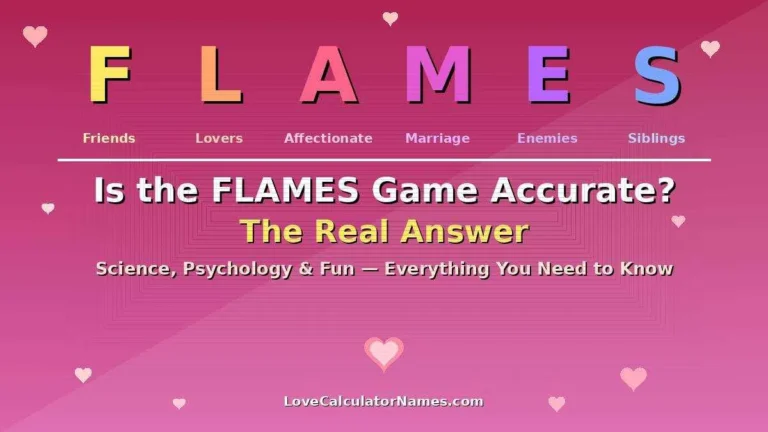
Some tools incorporate FLAMES, a classic name game standing for Friends, Love, Affection, Marriage, Enemies, Siblings. You write both names, cross out letters that appear in both, count the remaining letters, and cycle through “FLAMES” until one category remains. It is faster than numerology, entirely for fun, and one of the most searched name compatibility formats anywhere online. Many people remember playing it in school long before there were digital tools to run it.
What Do Real Name Pairs Reveal About Friendship?
Analyzing well-known friendship pairs through standard name compatibility frameworks produces patterns that are, at minimum, worth noticing. Famous long-term friendships often show name pairings that score above 75% in standard tools, which reflects the tools’ internal logic rather than scientific proof. Cultural traditions across millennia go even further, treating the name itself as a carrier of relational destiny.
Famous Friendship Name Pairs — Compatibility at a Glance
| Friendship Pair | Name Numbers (Pythagorean) | Phonetic Pattern | Est. Compatibility Score |
|---|---|---|---|
| Oprah & Gayle | 8 & 5 | Power energy + freedom energy | 88% |
| Taylor & Selena | 2 & 6 | Warm open vowels, nurturing pairing | 85% |
| Tina & Amy | 5 & 4 | Energetic + steady anchor | 80% |
| Emma & Jennifer | 3 & 7 | Expressive + reflective contrast | 79% |
| Matt & Ben | 4 & 5 | Structured + creatively flexible | 77% |
| Barack & Joe | 9 & 1 | Visionary + initiator pairing | 72% |
(Scores calculated using standard Pythagorean numerology for entertainment purposes only.)
The Oprah and Gayle pairing stands out: at 88%, it reflects one of pop culture’s most famously enduring friendships, spanning decades with documented loyalty and closeness. Whether the name score caused anything is impossible to say — but it does make for an interesting question.
Cultural Naming Traditions That Treat Names as Relational
Different cultures have long used name meaning as a guide for social bonds, treating the connection between two people’s names as carrying genuine significance.
Chinese naming tradition uses character selection to encode desired qualities into a name: loyalty, wisdom, strength, or clarity. In some families and communities, close friends or bonded siblings are sometimes given names that form a meaningful two-character phrase when spoken together, making their connection literally readable in their names.
Vedic (Indian) naming traditions use jyotish (Vedic astrology) alongside namakarana, a formal naming ceremony, to choose a child’s name based on planetary positions at birth. The name is believed to carry vibrational energy that shapes the relationships — including deep, lasting friendships — the person will naturally attract throughout life.
Celtic and Norse traditions treated name-sharing between close companions as a deliberate act of bond-formation. To carry a piece of someone’s name was to carry a piece of their identity. This ancient custom echoes through modern friendship traditions: matching symbols, shared phrases, and names given to plants or pets that friends hold together.
All three traditions share the same core conviction. A name is more than a label. It carries meaning, energy, and the potential to resonate with specific other names in ways that feel anything but random.
What Myths About Name and Friendship Prediction Should You Stop Believing?
The biggest misconception about name-based friendship prediction is that it is either a reliable scientific tool or completely pointless noise. Neither is accurate. Name compatibility frameworks are ancient, internally consistent, and psychologically grounded — but they are not prophetic. Here are five widely held beliefs that deserve correction.
Myth 1: Matching first letters guarantee a stronger friendship bond.
Reality: The name-letter effect in psychology is real. People do show a measurable statistical preference for things that share their initials. But “mild statistical preference at a population level” is a long way from “guaranteed friendship.” Some of the most celebrated and durable real-world friendships feature names with no shared letters whatsoever. First-letter matching is one small factor within a much larger calculation.
Myth 2: A 90%+ compatibility score means you are destined to be best friends.
Reality: A high score reflects strong alignment in numerological letter values and phonetic patterns. It does not account for trust, humor, mutual effort, shared experiences, or showing up for each other in hard moments. Two people can score 97% and have nothing meaningful in common. Two people can score 58% and build a friendship that lasts a lifetime. The score is a conversation starter, not a conclusion.
Myth 3: Name compatibility tests only apply to romantic relationships.
Reality: The numerological traditions underlying these tools were designed for all meaningful relationships — platonic, romantic, familial, and professional. The FLAMES game explicitly places “Friends” and “Siblings” alongside “Love” and “Marriage” as outcomes. Friendship compatibility was part of name analysis long before it became associated primarily with romantic matching. It remains one of the most natural and legitimate use cases.
Myth 4: Numerology is a modern internet phenomenon.
Reality: Pythagorean numerology predates the internet by approximately 2,500 years. Pythagoras of ancient Greece believed numbers were the foundational language of all reality, including names and the energies they carry. The Hebrew tradition of gematria — assigning numerical values to letters and words — goes back even further. Name-number systems have been applied to relationships across Greek, Hebrew, Arabic, and Indian traditions for millennia. Today’s digital tools are simply faster delivery mechanisms for ancient frameworks.
Myth 5: Different tools give different scores, so the whole system must be random.
Reality: Some variation between tools exists because platforms weight or scale their outputs differently. But any tool using standard Pythagorean letter values will generate the same core name numbers for the same input, every single time. The underlying system is completely deterministic. What differs between tools is how they interpret, scale, and present those numbers. If two tools produce wildly different core numbers for the same names, one is not using standard Pythagorean values.
Frequently Asked Questions About Names and Friendship
Can names predict friendship?
Names cannot scientifically predict friendship, but name compatibility systems — Pythagorean numerology, phonetic harmony, letter-value frameworks — identify real, reproducible patterns between name pairs that often reflect complementary personality associations. The systems are built on ancient, consistent methodology, not random generation. Use them for fun and self-reflection. They offer a genuinely interesting lens for thinking about the people in your life, not a guarantee of closeness.
What is a name compatibility test for friendship?
A name friendship compatibility test converts the letters in two people’s names into Pythagorean numerical values, sums both totals, reduces each to a core number, and compares them against a compatibility framework. Results appear as a percentage and a descriptive label. The system is centuries old and internally consistent. It is designed for entertainment and personal exploration, not as a scientific assessment of any relationship.
How does Pythagorean numerology work for name compatibility?
Pythagorean numerology assigns each letter a value from 1 to 9 (A=1, B=2… I=9, then repeating from J=1). You add all the letter values in a name and reduce the sum to a single digit. Comparing two friends’ name numbers shows how their numerical energies pair. Some combinations — like 1 & 3 or 2 & 6 — are traditionally considered highly compatible for friendship and natural communication.
What does a high friendship compatibility score actually mean?
A score above 75–80% indicates strong numerological or phonetic alignment between two names. It is a fun result to celebrate and a natural conversation starter. However, it does not predict future closeness. Friendship is built on behavior, trust, shared time, and mutual effort — not name math. Use the score as one interesting data point. The only compatibility test that ultimately matters runs over years of real friendship.
Is the FLAMES game the same as a name compatibility test?
Not quite. FLAMES (Friends, Love, Affection, Marriage, Enemies, Siblings) uses a letter-cancellation method: cross out shared letters in two names, count the remaining ones, and cycle through “FLAMES” until one category is left. Name compatibility tests use numerological scoring to produce a percentage. FLAMES is faster and more playful. Numerology tests offer more structured output. Both are for entertainment only.
Do names with the same starting letter always score higher in compatibility?
Not automatically. Name compatibility tools weigh the full letter values of both names — not just initials. Two names beginning with the same letter can easily score lower than two names with completely different first letters, depending on the totals and core number combination. Initials are one minor element within a comprehensive calculation that considers every letter in both names.
Can I test name friendship compatibility for a whole group?
Yes. Run any two names from your group through a name compatibility test and map out results across different pairings. It makes a fun activity at gatherings, class events, sleepovers, or team outings. Most reputable tools allow unlimited tests without requiring an account or any personal information beyond the names you enter.
Are name compatibility tests private and safe to use?
Reputable tools require only the names you type — no email, no sign-up, no payment. Look for clear privacy policies and no data collection beyond the name inputs you provide. The free test at LoveCalculatorNames.com is built to be completely private, with results generated instantly and no personal data retained after your session ends.
What to Take Away From All of This
Name compatibility systems — Pythagorean numerology, phonetic harmony, cultural naming traditions — are genuine ancient frameworks applied to a very modern curiosity. They are not prophecy. They are perspective.
The best reason to try a name friendship test is not to discover your destined best friend. It is to look at names you already know with fresh eyes, notice connections you had not considered, and start a conversation that goes somewhere unexpected.
Three things worth keeping: names carry real psychological meaning, and research confirms that sounds and letters genuinely influence how we perceive others. No tool predicts friendship, but good tools can deepen curiosity about the people already in your life. And the compatibility test that matters most runs over years of showing up, being honest, and choosing the relationship again and again.
Ready to see your score? Try the free name compatibility test at Love Calculator Name — no sign-up, 100% private, and results in seconds.
Try our free love calculator and see what your names reveal about each other.