Wondering if your friendship is built to last? Most people feel it intuitively — but there are real signals you can look for. To test friendship strength, watch for five key markers: honesty under pressure, consistency over time, mutual effort, support through hardship, and comfort with silence. Name-based compatibility tools can add a lighthearted layer on top, using letter-frequency matching or Pythagorean numerology to generate a “friendship score” between two names. Think of it as a fun starting point, not a final verdict — because real friendship is always more than any number.
What Does “Friendship Strength” Actually Mean?
Friendship strength is the measure of how reliably two people show up for each other — not just when it’s easy, but when it costs something. It covers emotional honesty, shared history, consistency of contact, and whether each person genuinely invests in the other’s wellbeing. Strong friendships have a baseline of trust that survives disagreements, distance, and long silences.
Psychologists who study close relationships tend to define friendship quality along a few consistent axes: reciprocity (both people giving and receiving), self-disclosure (the willingness to be real), companionship (the enjoyment of spending time together), and support (showing up in hard moments). A friendship that scores well on all four is genuinely strong.
What it is not: the number of years you’ve known someone, the frequency of your texts, or how much fun you have together on a good day. Length and laughs are signals, not proof. Some five-year friendships are hollow; some two-year friendships are unshakeable.
How Do You Test Friendship Strength? (Step-by-Step)
The most reliable way to test friendship strength is to look for evidence across several categories — not to run a single experiment. Here’s a structured five-step process you can apply to any friendship right now.
Step 1: Assess honesty. Think of the last time you told this person something uncomfortable, or they told you something you didn’t want to hear. Did it happen? Did the friendship survive it? Friends who never push back are acquaintances with better packaging. The ability to disagree — respectfully, and without the relationship fracturing — is one of the clearest signals of depth.
Step 2: Check consistency. Has this person shown up in roughly the same way over time, regardless of external circumstances? Consistency doesn’t mean constant contact. It means that when you reach out, the response is recognizable. You know what you’ll get. Inconsistent friendships — where someone is intensely present one month and completely absent the next — tend to be situational rather than deep.
Step 3: Measure mutual effort. Run a quick mental audit: who initiates plans? Who follows up after a hard conversation? Who remembers the things the other person mentioned in passing? In strong friendships, effort flows in both directions, even if it doesn’t balance perfectly every week. If you’ve been the one doing all the reaching for six months straight, that’s information.
Step 4: Recall hardship moments. The clearest test of a friendship is what happens during a genuinely bad period — job loss, a breakup, a health scare, a family crisis. Did this person engage? Did they check in more than once, or just send a single supportive text and move on? Presence during hard times is almost impossible to fake and is the single best predictor of friendship longevity.
Step 5: Notice what silence feels like. Comfortable silence is one of the most underrated markers of a strong friendship. Can you spend time together — in a car, at a kitchen table, watching something on a screen — without either of you scrambling to fill the quiet? Needing to perform or entertain each other constantly is actually a sign of surface-level closeness.
Name-Based Compatibility: What Can It Tell You?
Name compatibility tools give you a playful, low-stakes way to explore a friendship — and they work differently from what most people expect. These tools don’t analyze psychology; they apply mathematical systems to the letters in two names and generate a score. For friendship testing specifically, the results are best treated as an icebreaker or conversation piece, not a diagnosis. But understanding what’s actually being calculated makes them more interesting.
The three main methods used by name compatibility tools:
| Method | How It Works | What It Measures | Best For |
|---|---|---|---|
| Letter-frequency cancellation | Shared letters between two names are crossed out; remaining letters are counted | Phonetic overlap between names | Quick fun score |
| Pythagorean numerology | Each letter is assigned a number (A=1, B=2… I=9, then repeating); digits are summed to a single number | Numerological resonance of names | Deeper “life path” comparison |
| FLAMES | Letters in both names are cancelled; remaining count determines outcome (Friends/Lovers/Affection/Marriage/Enemies/Siblings) | Predicted relationship type | Friendship vs romance angle |
| Phonetic harmony | The sound patterns of two names are compared for tonal compatibility | How names feel together linguistically | Cultural/aesthetic pairing |
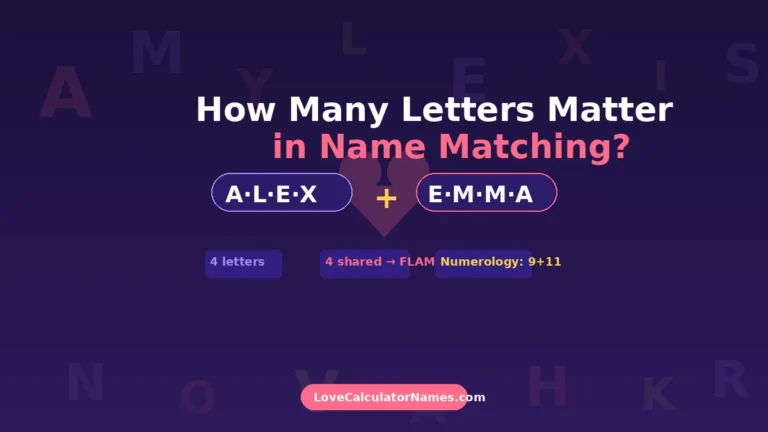
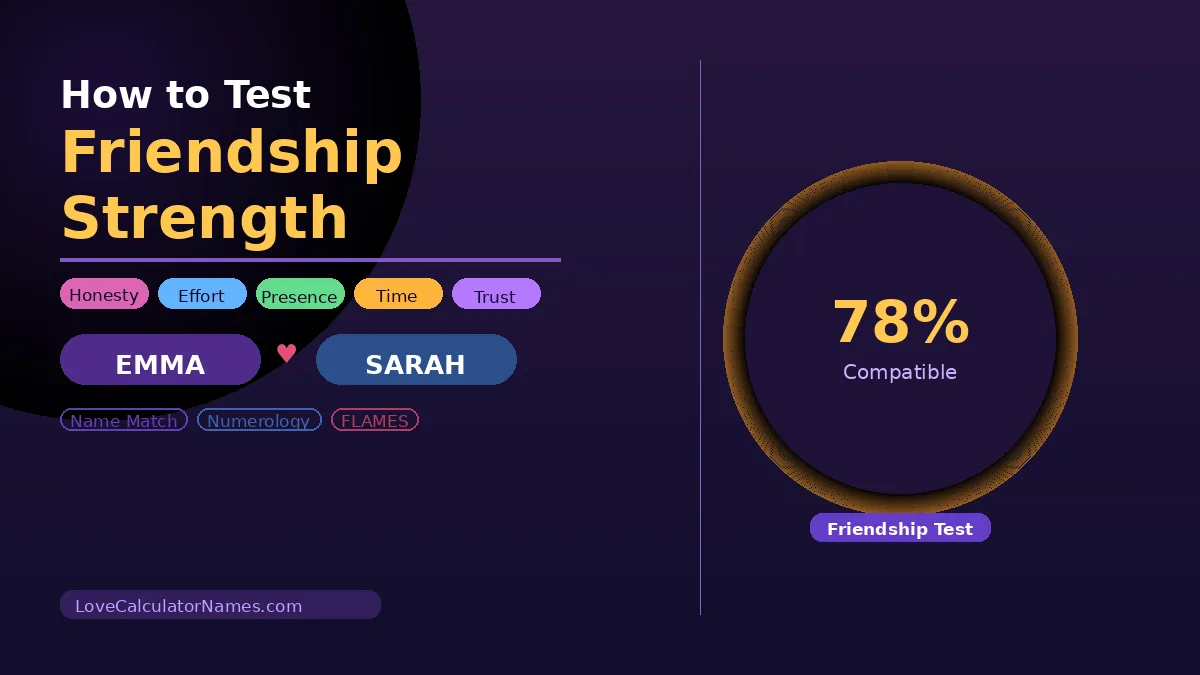
When you test “EMMA” and “SARAH” using the letter-cancellation method, for example, the shared letters E, A, A are removed, and the remaining letters are counted. The result feeds into a percentage score. Two names with many overlapping letters tend to score higher — which is why names like “ANNA” and “HANNA” often generate very high compatibility numbers.
This is entertainment — not science. But the system has a logic to it, and understanding that logic makes the exercise more enjoyable. Many friendships start with “let’s run our names through the calculator,” and that’s a completely legitimate use.
Common Myths About Testing Friendship Strength
People hold some surprisingly firm beliefs about how friendships work — and most of them don’t hold up under scrutiny.
Myth 1: Long friendships are automatically strong ones. Duration is a signal, not a guarantee. A 20-year friendship built on habit and proximity can be shallower than a 3-year friendship built on genuine mutual understanding. The question isn’t how long — it’s how deep.
Myth 2: High name compatibility scores mean you’ll be great friends. Name-based tools are fun and they generate real numbers using real mathematical systems. But they can’t account for timing, life circumstances, communication styles, or shared values. A 95% compatibility score with someone you’ve never met means less than a track record of showing up for each other.
Myth 3: Friendships should feel effortless. The “effortless” idea is one of the most harmful myths in friendship culture. The best friendships do have an ease to them — but they also require deliberate investment. Scheduling time, checking in, showing up when it’s inconvenient: none of that is effortless, and that’s exactly what makes it meaningful.
Myth 4: If you haven’t talked in months, the friendship is dead. Life interrupts. Careers, relationships, children, grief — all of it can pull close friends apart for stretches of time. The friendships that matter tend to survive these gaps. You pick up where you left off. The silence wasn’t indifference; it was just life.
Myth 5: A friendship test can give you a definitive answer. No quiz, calculator, or psychological scale can tell you with certainty whether a friendship is strong. What these tools can do is prompt reflection. The value of any friendship assessment — including a name compatibility score — is the conversation it starts, not the number it produces.
Frequently Asked Questions
How do I know if my friendship is strong? Look for honesty, mutual effort, and presence during hardship. Strong friendships survive disagreements and long gaps. If both people consistently show up — not just when it’s easy — that’s the clearest signal. Name compatibility tools can add a fun supplemental layer, but the behavioral evidence is what actually counts.
Can a name compatibility test measure friendship strength? Not in a clinical sense, but it can add a lighthearted angle. Name-based tools use mathematical methods like letter-frequency matching or Pythagorean numerology to generate a score. Think of it as entertainment — a conversation starter, not a verdict. The score reflects the relationship between two names, not the depth of two people’s bond.
What is the most reliable way to test a friendship? The most reliable test is behavior over time, especially during difficult periods. Does this person check in when things get hard? Do they follow through? Do they tell you honest things even when it’s uncomfortable? These behavioral markers are far more reliable than any quiz or compatibility percentage.
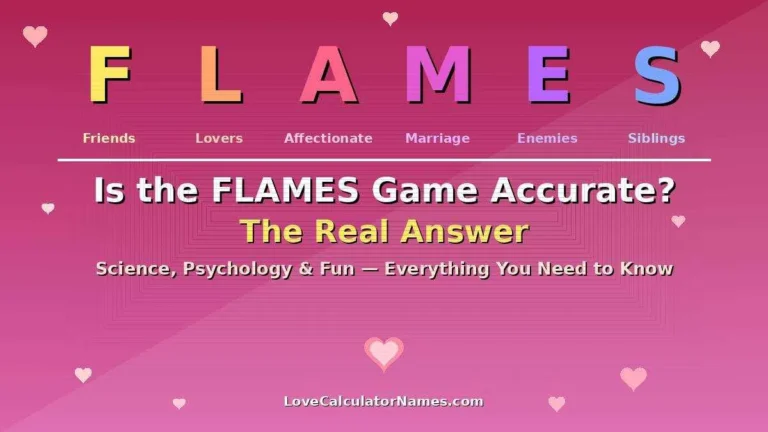
How does the FLAMES game relate to friendship? FLAMES is a letter-cancellation game that assigns one of six outcomes to two names: Friends, Lovers, Affection, Marriage, Enemies, or Siblings. It’s a playground tradition with roots in South and Southeast Asia and has been popular across the globe since the 1980s. Getting “Friends” as your result is one of the six possible outcomes — though the result is primarily entertainment.
Is a 100% friendship compatibility score meaningful? A 100% score from a name calculator means the mathematical formula produced a perfect result for those two names — typically because the names share many letters or their numerological values align. It’s a fun outcome, not a relationship guarantee. Many strong real-world friendships score in the 60–80% range; some weak ones score perfectly.
What are the signs of a toxic friendship? Signs include consistent one-sidedness (you always initiate, they never follow through), feeling worse about yourself after spending time together, a pattern of broken commitments, or a sense that the relationship runs on competition rather than support. If honesty is met with hostility rather than engagement, that’s a reliable warning signal.
Does numerology say anything about friendship compatibility? Pythagorean numerology assigns values to each letter (A=1 through I=9, then repeating) and reduces names to single digits called destiny numbers. Some numerology traditions identify certain number pairings as naturally harmonious. For example, 3 and 9 are often cited as complementary — both creative, expressive numbers. This is a cultural and entertainment framework, not a predictive science.
Can friendships be tested online for free? Yes — name-based compatibility tools let you enter two names and generate a compatibility score instantly, with no sign-up required. These tools use letter-frequency or numerology methods and are best used for fun and reflection rather than as a definitive friendship assessment.
The Real Measure Is Always Behavior
Testing friendship strength comes down to one question: does this person actually show up? Not on good days when it costs nothing, but on the difficult ones — when showing up requires time, energy, or honesty they’d rather not give. That’s the test that matters, and it can’t be captured in a single number.
Name compatibility is a genuinely fun angle on any relationship. Seeing how two names interact through letter matching or numerological systems can spark great conversations and add a playful dimension to a friendship you already value. Three takeaways worth keeping: look at behavioral patterns, not duration; mutual effort matters more than similar personalities; and any score you generate — from a quiz or a name calculator — is a starting point for reflection, not a final answer.
Ready to see how your names match up? Try the free name compatibility test on LoveCalculatorNames.com — no sign-up, 100% private.
Get your compatibility score instantly with our free name-based tool.