Have you ever typed two names into a love calculator, watched the percentage rise to something like 94%, and thought: does this actually mean something? You’re not alone. Millions of people run name compatibility tests every week, and the core question almost never gets a straight answer.
Here it is: a love calculator cannot predict marriage with scientific accuracy. These tools use systems like Pythagorean numerology, letter-value scoring, and the FLAMES method to generate a compatibility percentage. They are built for entertainment, not relationship forecasting. That said, they draw on centuries of naming tradition and symbolic thinking, and for many people, the experience is surprisingly meaningful.
This article walks through exactly how love calculators work, what their scores reflect, and why millions of people find them compelling even when the result is based on name math rather than lived experience.
Love calculators are entertainment tools. Nothing in this article constitutes romantic or relationship advice.
What Does a Love Calculator Actually Measure?
A love calculator measures letter-based or number-based patterns between two names — not emotional compatibility, shared values, or relationship history. Most tools use numerology, the FLAMES counting method, or phonetic scoring to produce a percentage. The output reflects a mathematical interaction between name characters, not any aspect of your real relationship.
This distinction is the one most people skip past. It’s also the one that matters most.
The most widely used underlying system is Pythagorean numerology, where every letter in the English alphabet maps to a number between 1 and 9. A through I get values 1 through 9, then the cycle restarts: J equals 1, K equals 2, and so on through Z. Once each name is converted into a string of numbers, the tool adds them up, reduces the total to a single digit, and compares the two core numbers using a compatibility chart built into the algorithm.
Numbers carry symbolic meaning within the numerology tradition. The number 1 is associated with leadership and independence. The number 2 connects to partnership and sensitivity. The number 5 is tied to adaptability and freedom. When a calculator compares a “5-name” with a “2-name,” it applies a relationship template from the numerology system, one that knows nothing about either person beyond the letters in their name.
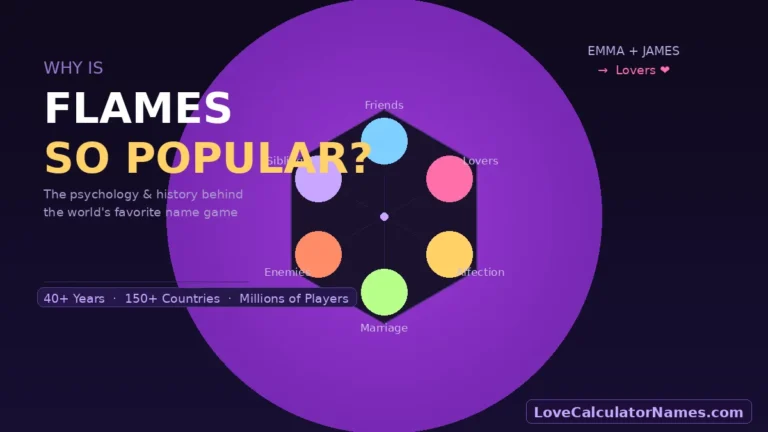
FLAMES is the second major method you’ll encounter. The acronym stands for Friends, Love, Affection, Marriage, Enemies, Siblings. Users eliminate letters that appear in both names, count the remaining letters in a loop, and remove one FLAMES category at a time until only one category survives. This method predates the internet by generations. It was written in notebook margins and chalked on blackboards long before anyone digitized it. Today it runs inside apps used by millions.
A third approach is phonetic harmony: some tools attempt to measure how well two names sound together when spoken aloud. The theory draws from Vedic sound principles and Eastern naming traditions, where a name’s phonetic quality is thought to carry its own energetic character. Whether two names “resonate” harmonically is analyzed through vowel and consonant combinations rather than numerical values.
What all three systems share: they operate entirely from the text you input. They have no access to your communication style, your conflict patterns, your shared history, or your emotional attunement. A love calculator is, at its core, a name pattern analyzer wrapped in romantic language.
How Does a Love Calculator Generate Your Score? (Step by Step)
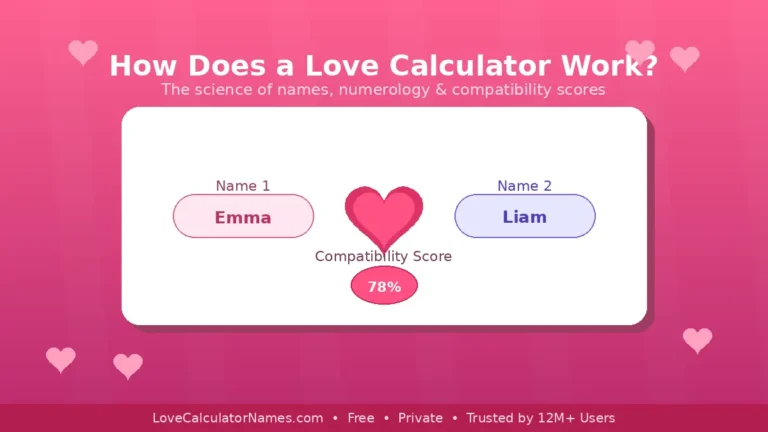
A love calculator produces a compatibility score by running two names through a fixed algorithm in under a second. The process is deterministic: the same names always produce the same result on the same tool. Understanding the steps behind the score makes it easier to interpret what you’re actually seeing on screen.
Here’s how a standard numerology-based love calculator works:
- Enter two names. First names, full names, or nicknames. The tool accepts whatever you type. Spelling matters; “Sara” and “Sarah” produce different totals.
- Assign letter values. Using the Pythagorean system: A=1, B=2, C=3, D=4, E=5, F=6, G=7, H=8, I=9, then J=1, K=2, and so on through Z.
- Sum each name separately. All letter values for Name 1 are added together, and all values for Name 2 are added separately, producing two raw totals.
- Reduce to a core number. Multi-digit totals are reduced by adding their digits. For example, 27 becomes 2+7=9; 38 becomes 3+8=11, which further reduces to 1+1=2. Some systems treat 11 and 22 as “master numbers” and keep them unreduced.
- Compare the core numbers. The two single digits are checked against a compatibility matrix built into the tool. Some pairings are rated highly compatible, others flagged as challenging or complementary.
- Convert to a percentage. The algorithm translates the compatibility level into a number between 0 and 100, typically shown on a color-coded progress bar.
- Generate a description. Most tools add a short interpretive phrase, something like “A natural connection with strong chemistry” or “A dynamic pairing that thrives on contrast.”
Tools with additional layers might also calculate soul urge numbers (based on vowels only) or run FLAMES as a secondary check. Some incorporate birth date numerology alongside the name inputs, though the name calculation remains the primary variable.
One practical note worth knowing: because the calculation is deterministic, you can experiment. Enter your full name, then just your first name, then a nickname, and compare how the scores shift. Try alternate spellings of either name. Traditional numerology actually encourages this: professional practitioners sometimes recommend adjusting a name’s spelling to bring its core number into better alignment with a partner’s number. On a casual tool, it mainly reveals how sensitive the algorithm is to small input changes.
How Do Different Love Calculator Methods Compare?
Different methods approach name compatibility from entirely different angles. Numerology focuses on the symbolic value of letters. FLAMES uses a counting tradition that functions more like a game than a formula. Phonetic systems analyze sound patterns. Vedic matching draws on astrological frameworks dating back millennia. No method has been validated by relationship science, but each has genuine cultural history behind it, and different methods regularly produce dramatically different results for the same pair of names.
| Method | What It Analyzes | Cultural Roots | Result Format | Ideal For |
|---|---|---|---|---|
| Pythagorean Numerology | Letter-to-number values (1–9 cycle) | Ancient Greek and Hebrew traditions | Love percentage | General name compatibility |
| FLAMES | Letter elimination counting game | Western schoolyard tradition | Relationship category | Quick, fun results |
| Chaldean Numerology | Alternate letter values (1–8 system) | Ancient Babylonian tradition | Compatibility reading | Deeper symbolic exploration |
| Phonetic Harmony | Sound patterns of combined names | Eastern and Vedic naming traditions | Sound compatibility score | Cultural name matching |
| Vedic Name Matching | Syllables and planetary correspondences | Hindu astrology (Jyotish) | Guna score / percentage | Traditional marriage guidance |
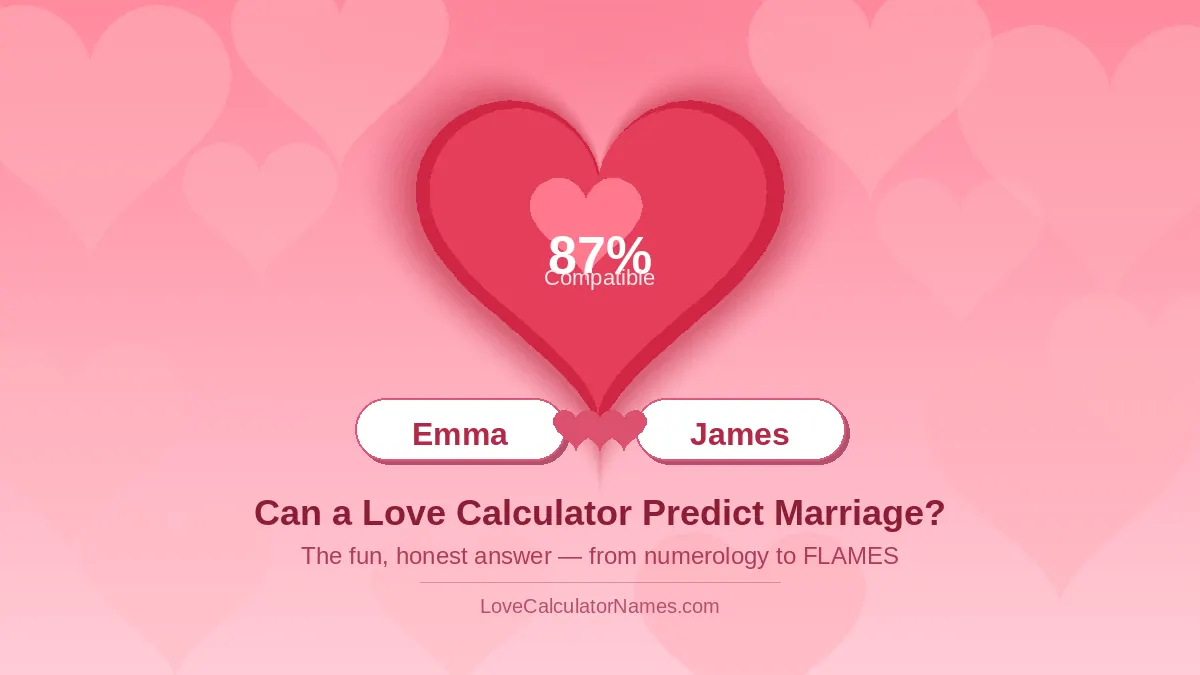
To see how dramatically the methods diverge, consider the names Emma and James.
In Pythagorean numerology: E(5)+M(4)+M(4)+A(1) = 14 → 1+4 = 5 for Emma. J(1)+A(1)+M(4)+E(5)+S(1) = 12 → 1+2 = 3 for James. A 5 and a 3 is considered one of the more compatible pairings in most numerology frameworks, both being associated with creativity, communication, and social energy. Many tools would return a 70–90% score for this combination.
Run the same two names through a FLAMES calculator and you get a completely different output. The tool would cross out every letter that appears in both names (in this case, the letters E, M, and A), count the remaining letters, and cycle through Friends → Love → Affection → Marriage → Enemies → Siblings until one category survives. The result depends on how many letters remain after elimination, a process that has nothing to do with numerology.
Run Emma and James through a Chaldean system, where the letter values differ from Pythagorean, and the core numbers change again, producing yet another outcome.
The historical grounding here is worth understanding. Pythagorean number symbolism traces back to at least the 6th century BCE. The Hebrew Kabbalistic tradition, which influenced Western numerology heavily, has used letter-to-number associations called gematria for millennia. Vedic name matching has guided marriage decisions in South Asian communities for centuries. These are not trivial systems invented for a website. They carry genuine cultural weight and represent real traditions of human meaning-making through naming.
What they don’t do is predict how two specific, complex human beings will navigate a relationship across years and changing circumstances.
What Are the Biggest Myths About Love Calculators and Marriage?
The most persistent myth is that a high score is a green light for commitment and a low score is a warning to walk away. Neither is true. A love calculator score reflects how two names interact inside a specific algorithm — not how two people interact in real life. Understanding where these misconceptions come from makes the experience of using these tools more grounded and more genuinely fun.
Myth 1: A 90%+ score means the relationship is meant to work. This is the most common misreading of a love calculator result. A 95% score means the two names align well in one particular calculation system. It doesn’t factor in how you navigate conflict, whether your long-term goals are compatible, or how you show up for each other when things get hard. Decades of relationship research point to communication, trust, and emotional flexibility as the pillars of lasting partnerships, none of which are encoded in any name formula.
Myth 2: A low score means you should end things, or avoid someone. Some of history’s most enduring couples would score poorly on any numerology-based tool. A 28% love percentage has no predictive relationship to real-world outcomes. Many people who’ve found deep, lasting partnerships scored low on every compatibility test they tried. The score sees your name characters, not your chemistry, your history, or your ability to make each other feel understood.
Myth 3: All love calculators use the same formula. They often don’t, and the differences can be dramatic. As the comparison table shows, at least five distinct systems are in common use, each drawing from different traditions and producing different numerical outputs. The same two names can score 20% on one site and 88% on another. Comparing scores across platforms without knowing which method each uses isn’t meaningful. It’s like comparing the output of a thermometer and a barometer and expecting them to agree.
Myth 4: Changing the spelling of your name can “fix” a low result. This idea has some cultural grounding. Traditional numerology, and Vedic naming conventions specifically, holds that a name’s spelling carries energetic weight, and deliberate adjustments to spelling (often made with the guidance of a trained numerologist) can shift a person’s core number. But that’s a considered personal practice, not a trick for gaming a website. Changing one letter to lift a score from 35% to 82% doesn’t change anything real about the relationship.
Myth 5: Results that match your feelings must be based on something real. This is the Barnum effect at work — one of the most well-documented phenomena in psychology. Named after P.T. Barnum’s observation that there’s something for everyone, this tendency describes why vague or broadly positive statements feel personally and specifically accurate. When a love calculator says “this couple shares a deep natural connection and complementary energy,” it sounds specific. But those phrases apply to many name combinations. When a result aligns with how you already feel about someone, your brain reads it as confirmation rather than coincidence. The algorithm didn’t predict your feelings; your feelings made the algorithm feel accurate.
None of this makes love calculators less enjoyable. Understanding the myths just means you can enjoy the experience without letting a number do something it was never designed to do.
Frequently Asked Questions
Can a love calculator predict marriage? No love calculator can predict marriage with scientific accuracy. These tools generate a compatibility score based on name patterns, using numerology, FLAMES, or phonetic methods. They have no access to the emotional, psychological, or relational factors that shape long-term compatibility. Use them for entertainment, cultural exploration, and lighthearted conversation, not for relationship decisions.
What does a 100% love calculator score actually mean? It means two names aligned perfectly within that tool’s specific algorithm. A 100% result is fun to see and worth celebrating, but it doesn’t indicate romantic destiny or guarantee any relationship outcome. Real compatibility depends on communication, emotional intelligence, shared values, and mutual effort. None of these appear in a name-based formula, however high the score climbs.
Are love calculators based on real science? No love calculator method has been validated by relationship psychology or peer-reviewed research. They draw on numerology systems, cultural naming traditions, and mathematical pattern-matching. Some frameworks (like Vedic kundali matching) carry deep traditional and spiritual authority in specific cultures. But these traditions are distinct from empirical relationship science, which focuses on psychological and behavioral factors rather than name characters.
Do different love calculator sites give different results for the same names? Yes, and often dramatically so. The same two names can produce a 20% on one site and a 90% on another, depending on whether the tool uses Pythagorean numerology, Chaldean numerology, FLAMES, phonetic scoring, or another method entirely. The algorithm shapes the result as much as the names themselves. This is why comparing scores across platforms, and without knowing which system each uses, the comparison produces nothing meaningful.
Is there any psychology behind why love calculator results feel accurate? Yes. The Barnum effect, our well-documented tendency to accept general or flattering statements as specifically accurate, which explains much of it. Research on name association also shows that people do form real emotional impressions from names alone, which can make name-based results feel intuitively resonant even without scientific grounding. When a result aligns with existing feelings, the brain registers confirmation rather than coincidence.
Can a love calculator be used for marriage matching in South Asian cultures? Name-based compatibility is part of the broader kundali matching process used in many Hindu communities before marriage. However, professional Vedic astrologers work with systems involving 36 gunas (compatibility qualities), full birth charts, and planetary positions, which makes them significantly more complex than any web-based calculator. A love tool can spark cultural curiosity, but it is not a substitute for traditional Jyotish practice and should not be treated as one.
Does the spelling of a name affect my love calculator score? Yes. Because most calculators assign values to individual letters, any change in spelling changes the numerological totals. “Sara” and “Sarah” produce different results. “Jon” and “John” differ by one letter and therefore one digit in the calculation. Some numerology traditions view this as meaningful: deliberate spelling choices are seen as ways to align a name’s energy. On a casual tool, it mainly shows how sensitive the algorithm is to small input variations.
What’s the best way to enjoy a love calculator without over-reading the result? Treat it as a conversation prompt, not a verdict. Many couples try love calculators as a playful ritual, and the point is the moment of shared curiosity, the comparison, the laugh, or the question it opens between you. Test a few different name variations, try more than one tool, and let the number be a starting point rather than a conclusion. The fun lives in the exploration, not the final percentage.
The Real Takeaway on Love Calculators and Marriage
So, can a love calculator predict marriage? No — and it was never designed to. But that might be the wrong question to bring to these tools in the first place.
What love calculators actually do is create a moment of focused attention on someone you care about. The act of typing two names, watching a meter move, and then looking at the result together, laughing, comparing, wondering, and that is real and often genuinely fun. The tool didn’t predict anything; it gave you a prompt, and you brought the meaning.
The traditions these tools draw from go back further than most users realize. Pythagorean numerology has shaped human thinking about names for over two thousand years. FLAMES has passed between generations of schoolchildren across multiple continents. Vedic name matching still guides marriage decisions for hundreds of millions of families worldwide. These aren’t shallow games. They’re surface-level windows into traditions that carry real cultural weight.
Three things worth keeping in mind: a love percentage is a name-pattern score, not a relationship verdict. Different tools use different traditions and often produce very different results for the same inputs. And the most interesting thing about running a love calculator isn’t the number it produces; it’s the conversation it starts and the feelings it invites you to notice.
Ready to see your score? Try the free name compatibility test at LoveCalculatorNames.com. No sign-up required, 100% private.
Find your name match score and see where you land on the compatibility chart.