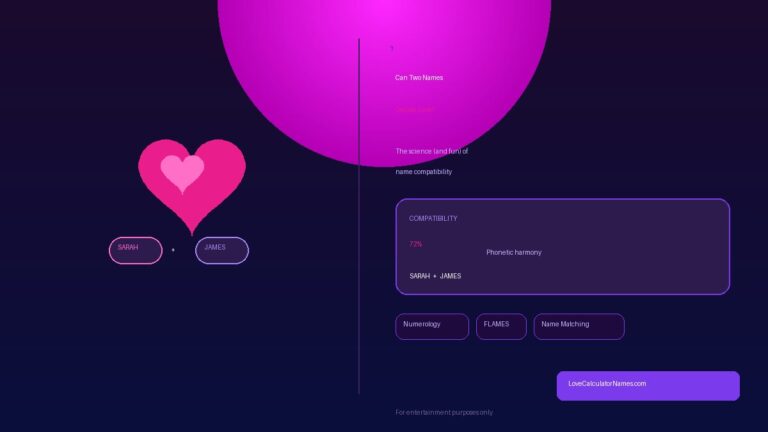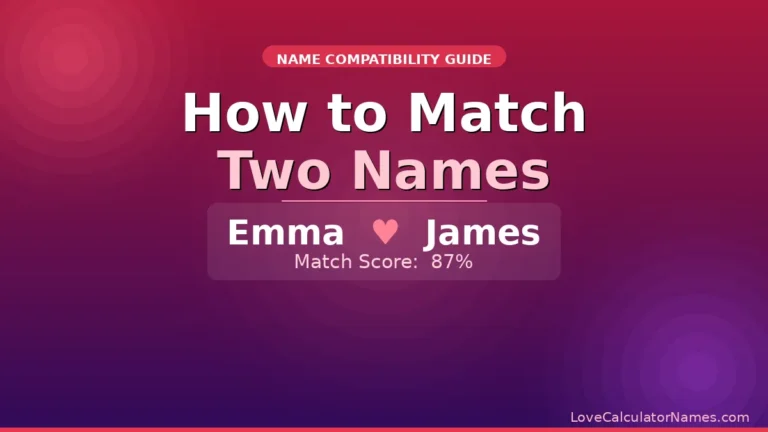
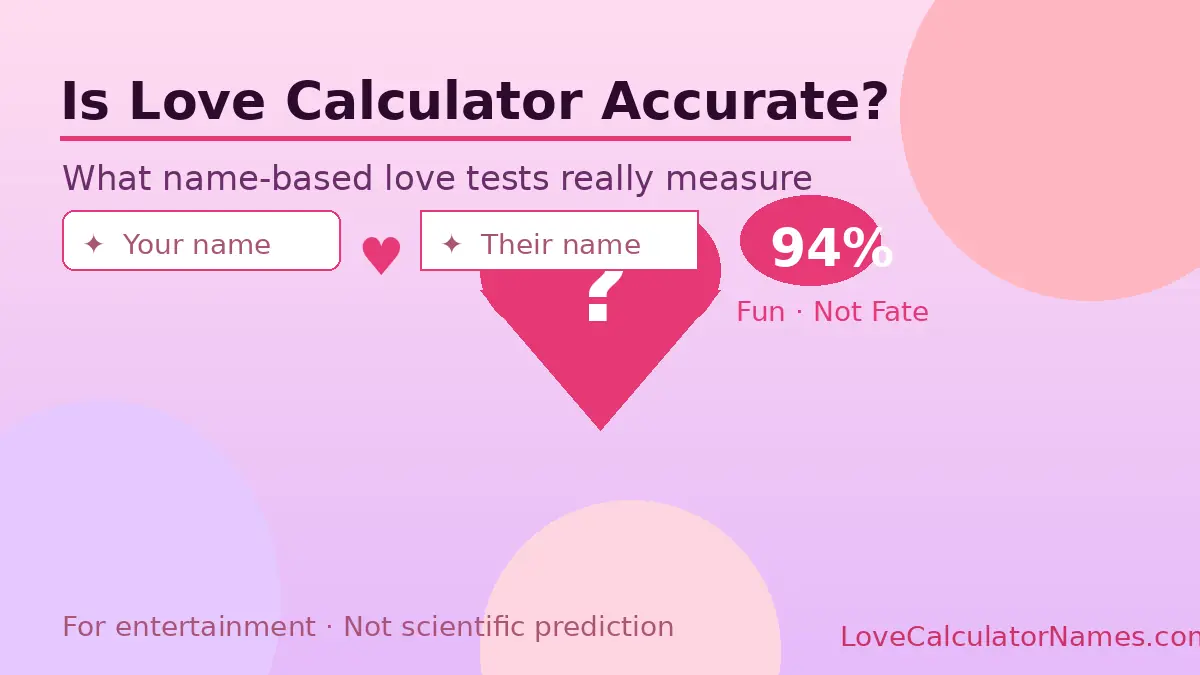
Have you ever typed two names into a love calculator and stared at the result wondering: does this actually mean anything? You’re not alone — millions of people ask this every day after seeing a “94% compatible” or a heartbreaking “23%.”
The short answer: love calculators are not scientifically accurate predictors of romantic success. They use name-based algorithms — drawing from numerology, letter-value systems, or phonetic patterns — to generate a compatibility score. These results are meant for fun and entertainment, not relationship advice. That said, there’s more going on beneath the surface than pure randomness, and understanding how they work makes the experience far more interesting.
This article breaks down exactly what love calculators measure, why the results vary across tools, and what you can actually learn from them.
What Does “Accurate” Even Mean for a Love Calculator?
A love calculator cannot be “accurate” in the scientific sense because human compatibility is not reducible to names alone. However, the algorithms behind name-based tools are consistent, rule-based, and repeatable — meaning you’ll get the same result every time you enter the same two names.
Name-based love calculators use structured systems — most commonly Pythagorean numerology or a letter-value index — to convert names into numbers and compare them. The output is deterministic: input A always produces output B. What the number means for your real relationship is a different question entirely.
Think of it this way: a horoscope compatibility chart is “accurate” in the sense that it follows the rules of astrology consistently. Whether astrology itself predicts love is a separate debate. Love calculators work the same way — consistent within their own logic, but not a substitute for lived experience or emotional chemistry.
The tools that earn the most trust are the ones that are transparent about this. The best name compatibility tests will tell you upfront that results are for entertainment, while still explaining the system behind the score so you understand what you’re actually seeing.
How Do Love Calculators Actually Work?
Most name-based love calculators follow one of three main calculation methods, and knowing which one you’re using helps you interpret your result intelligently.
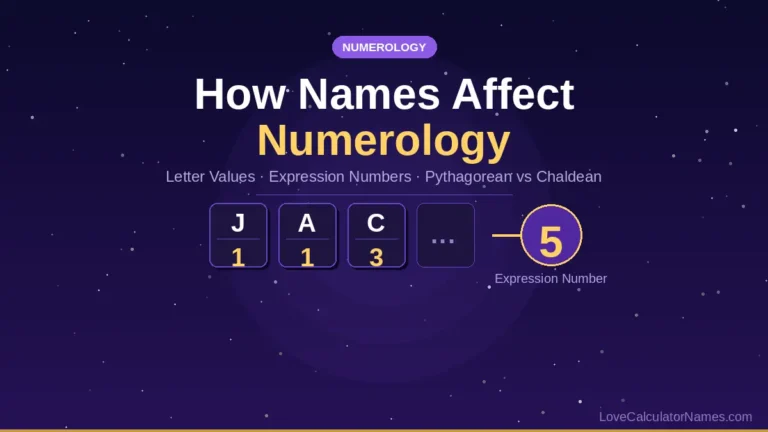
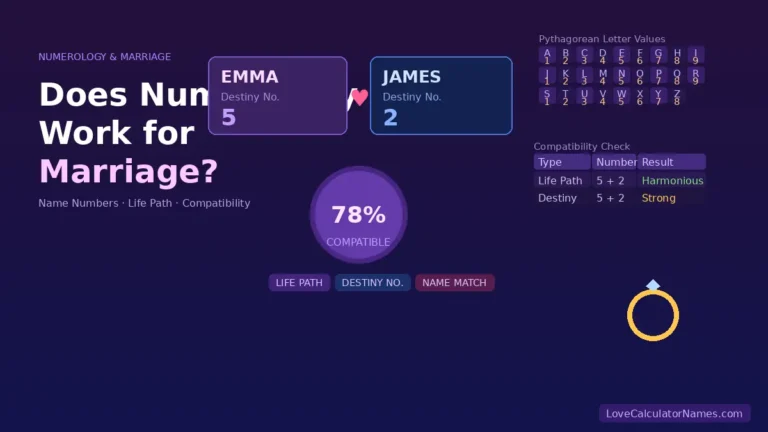
The most common method is Pythagorean numerology, which assigns each letter a number from 1 to 9 based on its position in the alphabet. The name’s digits are then reduced to a single “life path” number. Two names are compared by how their reduced values interact — certain number pairings are considered harmonious, others less so.
Here’s how a typical name-based love calculator works, step by step:
- Convert each letter to a number. Using the Pythagorean chart: A=1, B=2, C=3 … I=9, J=1, K=2, and so on, wrapping at 9.
- Add all digits in the first name together. Keep adding until you reach a single digit (or a master number: 11, 22, 33).
- Repeat for the second name.
- Compare the two resulting numbers. The algorithm checks whether the pairing falls into a “compatible” or “challenging” category based on pre-built compatibility grids.
- Generate a percentage. The tool converts the compatibility finding into a score — often 0–100% — for easy reading.
- Return the result with an interpretation. Better tools explain why the numbers pair the way they do, not just what percentage appeared.
Some calculators also incorporate phonetic harmony — how the sounds of two names flow together — or use a FLAMES-style system (Friends, Love, Affection, Marriage, Enemies, Siblings) that dates back to schoolyard tradition.
None of these methods predict the future of a relationship. They reflect naming patterns and number theory, not psychology or neuroscience.
What Do Real Results Tell You? Examples and Patterns
When you run different name pairs through a love calculator, patterns emerge quickly — and they reveal exactly what the tool is and isn’t measuring.
A 40–60 word direct answer here: Love calculator results reflect the mathematical relationship between two names in a given system. High scores tend to appear when names share vowel sounds, similar letter values, or numerologically compatible life numbers. Low scores reflect mismatches in those same patterns — nothing more, and nothing less.
Here’s a comparison of what different name-pair characteristics tend to produce:
| Name Pair Type | Common Score Range | What the System Is Detecting |
|---|---|---|
| Matching vowel sounds (e.g., Anna & Lara) | 75–95% | Phonetic harmony between names |
| Matching life path numbers (e.g., both reduce to 6) | 80–100% | Pythagorean numerological alignment |
| Very different letter lengths | 40–65% | Digit-sum imbalance in the algorithm |
| Names from different language roots | 30–60% | Letter-value distribution differences |
| Identical names (e.g., Jordan & Jordan) | Varies widely | Depends entirely on the algorithm logic |
Interesting patterns show up when you look at cultural naming traditions. Names common in South Asian cultures — often longer, with more vowels — tend to score differently on Western letter-value systems than on tools built with Sanskrit or Urdu phonetics in mind. This is why region-aware tools, or those that simply use FLAMES, tend to feel more universally “fair.”
Famous name pairs, for context: “Romeo & Juliet” scores high on phonetic symmetry (both names end in vowel sounds and share an open-syllable structure). “Harry & Meghan” scores in the mid-range on most Pythagorean tools. Neither tells you anything about whether those relationships succeeded or struggled — which proves the entertainment point perfectly.
Common Myths About Love Calculator Accuracy
People hold some surprisingly firm beliefs about love calculators. Most of them don’t hold up — and clearing them up makes the whole experience more enjoyable.
Here are five myths worth setting aside before you put too much weight (or dismiss too quickly) on your score:
Myth 1: A high score means you’re meant to be together. No name-based tool has predictive power over your actual relationship. Chemistry, shared values, communication, and timing all matter infinitely more than any percentage a calculator generates.
Myth 2: A low score means you should break up — or never start. A 30% score means two names didn’t align well in one particular numbering system. It says nothing about your emotional connection, long-term compatibility, or the quality of your relationship.
Myth 3: All love calculators use the same method. They don’t. A Pythagorean numerology tool will give you a different result than a FLAMES calculator or a phonetic harmony scorer — even for the exact same names. The system matters.
Myth 4: More expensive or “advanced” tools are more accurate. Accuracy in the scientific sense isn’t what any name-based tool offers. A free, transparent tool that explains its method is more trustworthy than an expensive one that doesn’t.
Myth 5: If you change the spelling of your name, you can change your compatibility. Technically, yes — in a numerology system, “Caitlin” and “Katelyn” will generate different scores. But changing how you spell your name won’t change how you and another person interact in real life.
The healthiest way to use a love calculator: treat it like a personality quiz. It’s a structured prompt for reflection and conversation — not a verdict.
Frequently Asked Questions
Is a love calculator accurate for real relationships? No love calculator can accurately predict real relationship outcomes. They use rule-based algorithms — typically numerology or phonetic matching — to generate a score from two names. The results are consistent within their own system but are intended purely for fun and entertainment. They don’t account for personality, values, or lived experience.
Why do different love calculators give different results for the same names? Each tool uses a different algorithm. A Pythagorean numerology calculator assigns letter values differently than a FLAMES-based tool or a phonetic harmony scorer. So “Emily & James” might score 88% on one platform and 47% on another — both are internally consistent, just using different rules.
Can name numerology reveal anything real about compatibility? Numerology is a centuries-old tradition used in many cultures to interpret names and dates. Some people find genuine meaning in it. Most researchers treat it as symbolic rather than empirical. If a numerology reading sparks self-reflection or meaningful conversation between two people, that’s real value — just not scientific prediction.
Is it safe to enter real names into a love calculator? On reputable, privacy-first tools, yes. Look for sites that process names locally (without storing them on servers) and don’t require sign-up. Always review a site’s privacy policy if you’re unsure. Avoid tools that ask for email addresses or other personal information just to get a score.
Why do I keep getting low scores with my partner’s name? Low scores reflect a mismatch in the tool’s specific number or phonetic system — nothing else. Try a different calculator type (FLAMES vs. numerology vs. phonetic) and you’ll likely see different results. No single score is “the” answer.
Are love calculators based on astrology? Some compatibility tools incorporate astrological signs, but most name-based love calculators use numerology or phonetic systems instead. They’re related fields — both interpret patterns in names or dates symbolically — but they use different frameworks and produce different results.
Do love calculators work for same-sex couples or non-romantic relationships? Yes. Name-based calculators simply process two sets of letters — they don’t assign gender or relationship type to the inputs. Many people use them for friendship compatibility, sibling relationships, or even business partner matching. The algorithm treats all name pairs equally.
What’s the most accurate type of love calculator? No type is “most accurate” in a scientific sense. The most useful type is one that’s transparent about its method, explains what the score means, and frames results as entertainment rather than prediction. Tools that use Pythagorean numerology and explain each step tend to feel more credible — not because the results are more valid, but because the reasoning is visible.
Final Thoughts: Enjoy the Score, Trust Your Heart
Love calculators have been around for decades — from playground FLAMES games to digital name compatibility tools — because they tap into something genuinely fun: the curiosity about whether two people “match.”
The honest answer to “is love calculator accurate?” is: not in a scientific sense, but that’s never really been the point. These tools are a playful way to explore a name pair, spark a conversation, or just see what the numbers say. Millions of people use them exactly that way — and enjoy the experience precisely because they’re lighthearted.
A few things to remember: results vary by tool because methods differ; a low score means nothing about your actual connection; and a high score is a fun moment, not a guarantee. Use the score as a conversation starter, not a conclusion.
Ready to see what your names say? Try the free name compatibility test at LoveCalculatorNames.com — no sign-up required, 100% private, and results in seconds.
Check your name score and see what your names reveal about your connection.