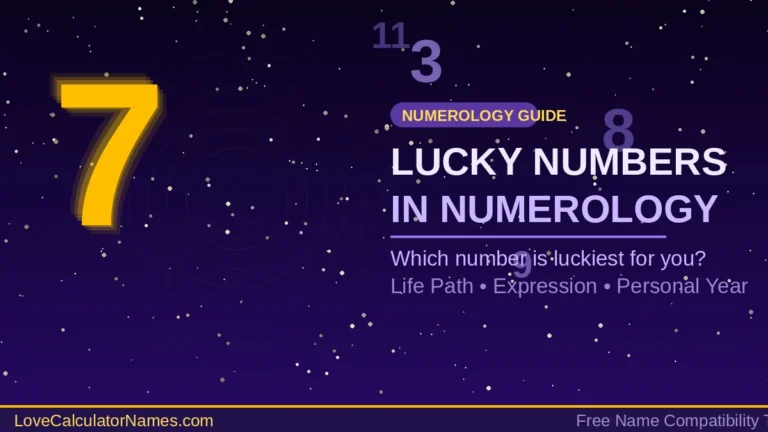
Millions of people check their life path number before a major decision. Others laugh the whole thing off. So which side is right?
The honest answer is: both sides are oversimplifying. Numerology is a 4,000-year-old symbolic tradition practiced across virtually every major civilization — not a fringe obsession, and not a validated science. It occupies the same fascinating middle ground as astrology or personality typing: ancient, culturally significant, and genuinely useful for self-reflection even without peer-reviewed proof.
This article covers what numerology actually is, how the most popular system works step by step, what researchers have found, and why billions of people have engaged with it across history.
Is numerology real? Numerology is not scientifically proven as a predictive system. No peer-reviewed study confirms that name or birth date numbers reliably forecast personality or life outcomes. However, it’s a legitimate ancient tradition with documented psychological value for self-reflection, naming decisions, and cultural meaning-making. It’s best approached as thoughtful entertainment — meaningful, but not science.
Note: This article is for informational and entertainment purposes only. Numerology is not a substitute for professional advice in any area of life.
What Is Numerology, Really?
Numerology is the belief that numbers derived from a person’s name or birth date carry symbolic meaning about their personality, relationships, and life path. It’s practiced globally as a self-reflection framework, not a scientific measurement tool. It is approximately 4,000 years old, appears in multiple independent civilizations, and remains actively practiced today on every inhabited continent.
The Core Idea
The foundational claim of numerology is philosophically simple: everything in the universe can be reduced to a number, and numbers carry inherent meaning. Your name and birth date, converted to numbers through an established system, reveal tendencies about your character and life purpose.
This isn’t a hypothesis you can test in a laboratory — it’s a philosophical and symbolic framework. Think of it the way you’d think about Jungian archetypes or the Chinese concept of five elements: an interpretive lens on human experience, not an empirical theory.
What makes numerology striking is how independently it developed across cultures. Babylonian, Egyptian, Greek, Hebrew, Indian, and Chinese civilizations each built their own number-meaning systems without apparent cross-pollination. That near-universal human tendency to find significance in numbers says something real about how the mind works — even if what it says is about psychology rather than the cosmos.
The Two Major Western Systems
The most widely used systems in the English-speaking world are:
- Pythagorean numerology — assigns values 1–9 to the Western alphabet. Developed from ancient Greek philosophical traditions and formalized in the 19th–20th centuries. Most common in North America, Europe, and Australia.
- Chaldean numerology — an older system tracing to ancient Babylon, uses values 1–8. Many practitioners consider it more spiritually precise. Chaldean assigns letters to numbers differently and is considered the older of the two.
A third major tradition — Vedic numerology (Jyotish) — is widely practiced across South Asia and is commonly used in baby-naming ceremonies and major life decisions. Each system produces different results for the same name or birth date.
Numerology in Modern Life
Numerology has seen a significant revival in the social media era. On TikTok and Instagram, numerology content generates hundreds of millions of views. Life coaches, wedding planners, and naming consultants regularly incorporate numerological frameworks into their practice.
The appeal makes sense. Numerology offers a quick, highly personalized lens on the question people find most compelling: Who am I, and why do I keep making the same choices? That question doesn’t need to be answered by science to be worth asking.
How Does Pythagorean Numerology Actually Work?
In Pythagorean numerology, each letter of the alphabet is assigned a number from 1 to 9. You add those values together from your full name or birth date, reduce to a single digit, then look up the meaning. The entire process takes about two minutes and requires nothing more than a simple chart and basic arithmetic.
The Pythagorean Letter Chart
| Number | Letters |
|---|---|
| 1 | A, J, S |
| 2 | B, K, T |
| 3 | C, L, U |
| 4 | D, M, V |
| 5 | E, N, W |
| 6 | F, O, X |
| 7 | G, P, Y |
| 8 | H, Q, Z |
| 9 | I, R |
How to Calculate Your Expression Number (Name Number)
- Write out your full birth name — first, middle, and last, exactly as it appears on your birth certificate.
- Assign each letter its number using the chart above.
- Add all the numbers together into one total.
- Reduce to a single digit — add the individual digits of your total together. Repeat until you reach a number from 1 to 9. Exception: if you reach 11, 22, or 33, stop — these are “master numbers” and aren’t reduced further.
- Look up your result in the core number table below.
Worked example — the name SOPHIE:
S=1, O=6, P=7, H=8, I=9, E=5
Total: 1 + 6 + 7 + 8 + 9 + 5 = 36 → 3 + 6 = 9
Expression Number 9: The Humanitarian — compassionate, globally minded, idealistic.
Core Number Meanings at a Glance
| Number | Title | Core Traits |
|---|---|---|
| 1 | The Leader | Independent, ambitious, original, driven |
| 2 | The Diplomat | Cooperative, sensitive, harmonious, patient |
| 3 | The Communicator | Creative, expressive, optimistic, social |
| 4 | The Builder | Practical, disciplined, reliable, grounded |
| 5 | The Explorer | Adventurous, flexible, curious, freedom-loving |
| 6 | The Nurturer | Caring, responsible, family-focused, protective |
| 7 | The Seeker | Analytical, spiritual, introspective, perceptive |
| 8 | The Achiever | Ambitious, powerful, business-minded, strategic |
| 9 | The Humanitarian | Compassionate, wise, idealistic, globally aware |
Life Path Number vs. Expression Number
Your Expression Number comes from your name. Your Life Path Number comes from your birth date — and it’s considered the most important number in Pythagorean numerology.
To calculate it: add every digit of your full birth date (day + month + year), then reduce to one digit.
Example — born March 7, 1994:
0 + 3 + 0 + 7 + 1 + 9 + 9 + 4 = 33 → master number. Life Path 33: The Master Teacher.
Or born October 15, 1990:
1 + 0 + 1 + 5 + 1 + 9 + 9 + 0 = 26 → 2 + 6 = 8. Life Path 8: The Achiever.
Name numerology compatibility — comparing two people’s core numbers — is one of the most engaging applications today. Tools like the free name compatibility calculator at LoveCalculatorNames.com make this instant and accessible without needing to do any math yourself.
What Does Research and Culture Actually Reveal About Numerology?
Numerology has not been scientifically validated as a predictive system. No large controlled study confirms that a name number or life path number reliably forecasts personality traits, relationship success, or career outcomes with statistical significance. That is the honest scientific position, and any fair treatment of this topic must say it clearly.
But that’s only part of the picture.
The Psychology Behind Why Numerology “Works”
The Barnum Effect (also called the Forer Effect) is one of the most reliably replicated findings in psychology. People readily accept vague, broadly positive personality descriptions as uniquely accurate to themselves — even when those descriptions are generated randomly or shared identically with hundreds of strangers.
Numerology readings are typically written to be broad enough to resonate with a wide range of people. That’s why a reading for “Expression Number 5 — adventurous, freedom-loving, curious” might feel startlingly accurate to many different people with the number 5 and to some who don’t.
Does this make numerology worthless? That conclusion is too quick. The same psychological mechanism applies to horoscopes, tarot, and even the widely popular Myers-Briggs Type Indicator, which research has also criticized for limited predictive validity. Yet psychologists who study these systems consistently find that engaging with personality frameworks — even imperfect ones — can produce genuine self-insight. The reflection is real, even when the framework isn’t scientifically proven.
Sound symbolism research adds a compelling dimension. Linguistics studies have shown that people make consistent subconscious associations between phonetic sounds in names and personality characteristics. Names with hard consonants (K, T, D) are perceived as stronger and more confident. Names with soft sounds (M, L, N) feel warmer and more approachable. This is not numerology — but it confirms that names carry psychological weight that many people underestimate. The idea of name-based character analysis is less strange than it first appears.
How Numerology Compares to Other Personality Systems
| System | Scientific Validity | Cultural Longevity | Self-Reflection Value |
|---|---|---|---|
| Pythagorean Numerology | Low | Very High (4,000+ yrs) | High |
| Astrology | Low | Very High (3,000+ yrs) | High |
| Myers-Briggs (MBTI) | Mixed — limited test-retest reliability | Medium (~80 yrs) | High |
| Big Five (OCEAN) | High — well-validated | Medium (~50 yrs) | High |
| FLAMES compatibility | None | Medium | Fun / High |
The pattern here is worth noting: scientific validity and cultural or personal resonance are genuinely different things. People don’t abandon astrology because astronomers reject it. They use it as a lens, a conversation starter, a framework for self-questioning. Numerology functions the same way.
The Global Cultural Reality
Number-meaning systems are not a Western fringe belief — they’re embedded in the mainstream traditions of the world’s largest civilizations.
| Culture / Tradition | Number System | Active Today? |
|---|---|---|
| Pythagorean (Western) | Letters 1–9 | Very widely |
| Chaldean (Babylonian) | Letters 1–8 | Yes, globally |
| Vedic / Jyotish (Indian) | Birth date + name analysis | Widely in South Asia |
| Kabbalah / Gematria (Jewish) | Hebrew letters have number values | Yes, in religious study |
| Chinese numerology | Lucky/unlucky digits (4, 8, etc.) | Pervasively |
In China, the number 8 is so strongly associated with prosperity that phone numbers, license plates, and apartment units containing multiple 8s command measurable price premiums in real estate. This is built into mainstream business decisions, not confined to spiritual communities.
In India, Vedic numerology remains central to baby-naming practices. Many families consult a numerologist before finalizing a child’s name to ensure the numbers are auspicious — a tradition that has persisted for centuries alongside modern medicine, technology, and education.
These aren’t disappearing traditions. They’re growing.
What Are the Biggest Myths About Numerology?
Numerology tends to attract two equally unhelpful extremes: people who treat it as a precise predictive science, and people who dismiss it as pure nonsense with no merit whatsoever. Neither position holds up under scrutiny. Here are five widely held myths that a little historical and psychological context puts to rest.
Myth 1: “Pythagoras invented numerology.”
Pythagoras (c. 570–495 BCE) developed a profound philosophy of number, and Western numerology draws on those ideas. But number-meaning systems predate him by more than a thousand years. Babylonian and Egyptian frameworks for finding significance in numbers were already established long before Pythagorean philosophy existed. He systematized certain ideas about numbers in Greece, but didn’t create the practice from scratch — and the modern Western system bearing his name was largely formalized centuries after his death.
Myth 2: “Numerology predicts specific future events.”
No serious numerology practitioner claims their system forecasts whether you’ll get a particular job, meet a specific person, or experience a defined event on a certain date. Numerology is descriptive and tendency-oriented — it describes patterns and inclinations, not fate. When people claim precise predictions, that’s often marketing language rather than how thoughtful numerological analysis actually works.
Myth 3: “It’s only for spiritual or new-age people.”
This overlooks the scale and diversity of who actually practices numerology. Gematria — finding hidden meaning in the numerical values of Hebrew letters — is a serious discipline in Kabbalistic Judaism. Vedic numerology influences naming ceremonies across hundreds of millions of Hindu families. Chinese auspicious and inauspicious number associations shape multinational business decisions. These aren’t niche communities. They represent mainstream practice among billions of people.
Myth 4: “Your core number determines your whole personality.”
A well-developed numerology reading examines multiple numbers simultaneously: life path, expression, soul urge, personality number, maturity number, and more. These interact to create a nuanced picture rather than a single label. Thoughtful practitioners present core numbers as tendencies and themes — strong patterns worth examining — not personality verdicts with no room for individual variation.
Myth 5: “All numerology systems produce the same results.”
Pythagorean and Chaldean systems assign different numerical values to the same letters, and their interpretations diverge significantly. The same name can produce entirely different core numbers depending on which system you use. Vedic numerology introduces further differences. There is no single standardized numerology — it’s a family of related traditions developed independently across thousands of years and multiple civilizations.
Frequently Asked Questions About Numerology
Is numerology real or just made up?
Numerology isn’t scientifically validated — no controlled study confirms it reliably predicts personality or outcomes. But it’s also not “made up” in any simple sense. It’s a 4,000-year-old symbolic tradition developed independently across major world civilizations. The practice is real and widely engaged with. Think of it like a personality framework: insightful and culturally rich, but best approached as thoughtful entertainment rather than hard science.
Can numerology tell you who you’re compatible with?
Numerology compatibility compares two people’s core numbers — expression numbers, life path numbers, or both — to identify patterns of harmony or friction. No peer-reviewed evidence supports these pairings as predictive. However, many people find the process reveals genuinely useful questions about how two people relate. It works best as a fun, reflective tool — a structured way to explore compatibility, not a scientific verdict.
What is a life path number?
Your life path number is calculated from your full birth date — add all the digits, reduce to a single digit from 1 to 9 (or stop at master numbers 11, 22, or 33). It’s the most central number in Pythagorean numerology, considered a description of your core purpose and natural strengths. It takes about a minute to calculate and doesn’t change across your lifetime.
What’s the difference between a life path number and an expression number?
Your life path number comes from your birth date and describes your core life purpose. Your expression number (sometimes called destiny number) comes from the letters of your full birth name and describes your natural abilities and style of engaging with the world. Both are used in compatibility analysis — expression numbers especially, since they’re based directly on names.
Is numerology the same as astrology?
No — they’re distinct systems that happen to be similar in cultural status. Astrology is based on the positions of celestial bodies at your birth. Numerology is based entirely on numbers derived from your name and birth date, with no reference to planetary positions. Both are ancient, neither has strong scientific validation, and both are widely used for self-reflection and entertainment. They can also be used together.
Why do numerology readings so often feel accurate?
This is primarily the Barnum Effect — a well-documented psychological phenomenon where people accept broad, generally positive personality descriptions as uniquely specific to themselves. Numerology descriptions are typically written broadly enough to resonate with many different people. That said, the self-reflection these readings prompt — “Is freedom really a core value for me? Am I actually more of a builder than an explorer?” — can produce genuine insight independent of the framework’s accuracy.
Does changing your name change your numerology?
Many practitioners say yes — they calculate both the birth name and the used name (or married name) as overlapping influences. Some people deliberately select professional names or baby names with favorable number profiles. There’s no scientific evidence this affects personality, but it does reflect how seriously many cultures take the psychological and symbolic weight of names. Naming traditions from India to China to modern Western practice all treat a name as more than an administrative label.
Is numerology part of any religion?
Yes, in several major traditions. Gematria — the assignment of numerical values to Hebrew letters to find hidden meaning in sacred texts — is a recognized discipline in Kabbalistic Judaism. Vedic numerology plays a meaningful role in Hindu naming customs and decision-making across South Asia. Chinese culture embeds number meanings (particularly 8 as prosperity and 4 as inauspicious) into everyday business and personal practice. These are active, mainstream religious and cultural traditions, not historical curiosities.
What Numerology Actually Offers
Numerology won’t tell you which job to take, which relationship will last, or what lies ahead in the next year. Anyone claiming that level of precision is overstating what any version of the system does or claims to do.
What numerology genuinely offers is different — and more honest. It’s a structured, ancient, cross-cultural framework for exploring patterns, asking better questions about personality, and approaching compatibility with curiosity rather than guesswork. The value isn’t in predictive accuracy. It’s in the reflection the process prompts and the conversations it starts.
Three things stand up clearly: numerology is old (4,000+ years by any count), global (practiced on every inhabited continent), and psychologically engaging even without scientific backing. Whether you approach it as entertainment, cultural heritage, or a personal belief system, the self-reflection it invites is genuine.
Ready to see how your name’s numbers interact with someone else’s? Try the free name compatibility test at LoveCalculatorNames.com — no sign-up required, completely private.
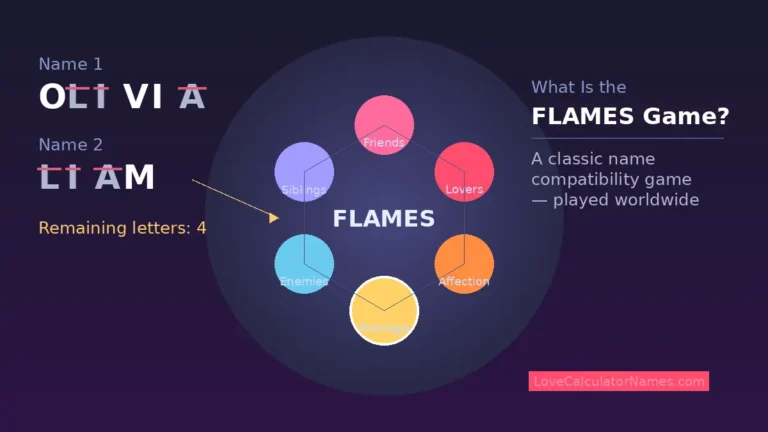
Find out what the numbers say with our fun FLAMES game tool today.