Millions of people turn to numerology every year hoping to figure out whether a name, a birthday, or a number sequence says something real about their romantic future. It’s an ancient practice — rooted in Pythagorean mathematics, Chaldean tradition, and centuries of cultural naming lore. But can it actually predict love?
Short answer: Numerology can reveal personality tendencies and highlight where two people naturally click or clash — but it doesn’t predict the future or guarantee relationship outcomes. Think of it as a personality map, not a crystal ball. It’s a tool for reflection and fun, not a substitute for real-world compatibility. Used that way, it’s genuinely interesting.
This article breaks down how numerology works for love, which numbers matter most, what the math actually shows, and where the system reaches its limits.
Numerology is used here for entertainment and self-reflection purposes only. It is not a scientific relationship predictor.
What Is Numerology, and How Does It Connect to Love?
Numerology is a belief system that assigns meaning to numbers derived from names and birth dates. In romantic contexts, it examines whether two people’s core numbers harmonize, clash, or complement each other. It’s less about prediction and more about pattern — the same way astrology describes tendencies rather than guarantees.
The system most people use today comes from Pythagorean numerology, named after the Greek mathematician who believed numbers were the foundation of all reality. Each letter in the alphabet is assigned a number from 1 to 9. You add those numbers together — reducing to a single digit — and that number carries a distinct meaning.
Two main numbers drive love compatibility analysis:
- Life Path Number — calculated from your full date of birth. This is considered your core personality number, the one that stays with you your whole life.
- Name Number (Expression Number) — derived from the full name at birth. It’s said to reflect your inner character, talents, and how you present yourself to others.
When two people’s Life Path Numbers are compatible, numerologists say there’s natural harmony. When they’re not, it often signals friction — though not necessarily a dealbreaker.
How Do You Calculate Your Love Compatibility Number?
To check numerology compatibility, you calculate each person’s Life Path Number, then compare them using a standard compatibility chart. The process takes about two minutes, and the math isn’t complicated.
Step 1 — Write out the full birth date in digits.
Example: June 14, 1992 → 06 / 14 / 1992
Step 2 — Add all digits together.
0 + 6 + 1 + 4 + 1 + 9 + 9 + 2 = 32
Step 3 — Reduce to a single digit.
3 + 2 = 5. Life Path Number: 5.
Step 4 — Repeat for the second person.
If the second person is a 7, you now compare 5 and 7.
Step 5 — Check the compatibility framework.
Most numerology systems rate pairs on a scale from natural harmony to productive tension to significant challenge. 5 and 7, for instance, are often considered a strong intellectual match — curious, adaptable, and independent enough to give each other space.
Special case — Master Numbers. If your reduction lands on 11, 22, or 33, don’t reduce further. These are Master Numbers considered to carry amplified traits.
You can run this same process using letters from your name. Assign each letter its Pythagorean value (A=1, B=2, C=3… I=9, then reset: J=1, K=2, etc.), add them up, and reduce to a single digit. That’s your Expression Number.
Which Life Path Numbers Are Most Compatible?
Some number pairings consistently show up as harmonious in numerology literature, while others tend to generate friction. This isn’t a verdict on a relationship — it’s a starting point for conversation.
Life Path Number compatibility varies by tradition, but here’s how the most widely used Pythagorean framework describes the main pairings:
| Life Path | Strongest Matches | Compatible | Challenging |
|---|---|---|---|
| 1 | 3, 5 | 1, 7, 9 | 2, 4, 8 |
| 2 | 6, 9 | 2, 4, 8 | 1, 5, 3 |
| 3 | 1, 5 | 3, 6, 9 | 4, 7, 8 |
| 4 | 2, 6 | 4, 8 | 1, 3, 5 |
| 5 | 1, 3, 7 | 5 | 2, 4, 6 |
| 6 | 2, 4, 9 | 3, 6 | 1, 5, 7 |
| 7 | 5 | 1, 7 | 2, 4, 6 |
| 8 | 4, 2 | 8, 6 | 1, 3, 5 |
| 9 | 2, 6 | 3, 9 | 4, 5, 8 |
A few pairings worth highlighting:
- 1 and 3 are widely cited as one of the most energetically compatible matches — the 1 brings drive and direction, the 3 brings creativity and warmth.
- 2 and 6 are both relationship-oriented numbers, making them a natural fit in numerology tradition.
- 7 and 5 create an intellectually stimulating pair. Both are independent thinkers who value space — which can actually make the relationship breathe.
- 4 and 8 are both stability-driven, pragmatic, and ambitious, which either creates strong shared values or a power struggle.
A cultural note: In Chinese numerology, the number 8 is considered especially auspicious — it sounds like the word for prosperity. Many couples in China deliberately time weddings and name their children to include the number 8. In Indian Vedic numerology, different digit mappings and planetary associations apply, making the “most compatible” pairings shift slightly compared to Western Pythagorean tradition.
Common Myths About Numerology and Love
Many people either expect too much from numerology or dismiss it entirely before understanding what it actually claims to do. Both extremes miss the point.
Myth 1: “Incompatible numbers mean the relationship is doomed.”
Not even serious numerologists claim this. Challenging pairings often describe real friction — but friction can create growth. A numerologist would say these pairs need more conscious communication, not that they should break up.
Myth 2: “If the numbers match perfectly, the relationship will work.”
Numerology describes potential, not outcome. A 2 and a 9 might be textbook compatible and still have a miserable relationship because of communication patterns, timing, or different life priorities that no number captures.
Myth 3: “Numerology is the same everywhere.”
There are at least three major systems — Pythagorean, Chaldean, and Vedic (Jyotish numerology). Each assigns letters to numbers differently. Your Expression Number in one system might not match what another system calculates. This is why results vary across different compatibility tools.
Myth 4: “Your name number can change if you change your name.”
Some numerologists believe your birth name carries permanent weight regardless of what you go by now. Others factor in your current name as an overlay — a second layer of influence rather than a replacement. There’s no consensus.
Myth 5: “Numerology has been scientifically validated.”
It hasn’t. Controlled studies have not found a causal link between number patterns and relationship outcomes. Numerology is a cultural and philosophical tradition, not an empirical science. The value is in how it prompts self-reflection, not in peer-reviewed prediction.
Frequently Asked Questions
Can numerology accurately predict who you’ll fall in love with?
No — numerology doesn’t predict specific people or events. It describes personality tendencies based on names and birth dates. Whether those tendencies lead to love depends on circumstances, choices, and timing that no number system can anticipate. It’s better used as a lens for self-understanding than a matchmaking oracle.
What is the most powerful number in love numerology?
The number 6 is most often cited as the most romantically oriented number — associated with nurturing, harmony, and deep commitment. Number 2 is a close second, linked to partnership, diplomacy, and emotional sensitivity. Neither guarantees a great relationship, but both tend to appear frequently in discussions of romantic compatibility.
Does your Life Path Number or Name Number matter more for love?
Most numerologists prioritize the Life Path Number for core personality and long-term compatibility. The Name (Expression) Number adds nuance — how you communicate and present yourself. In practice, many compatibility readings use both together to build a fuller picture of how two people might relate.
Is numerology the same as astrology?
No. Astrology is based on planetary positions at the time of birth. Numerology is based on numbers derived from birth dates and names. They’re separate traditions that sometimes appear together in spiritual or self-help contexts, but their mechanics and origins are completely different.
Can two people with the same Life Path Number be compatible?
It depends on the number. Two Life Path 1s often clash because both want to lead. Two Life Path 2s often thrive because they share a need for harmony. Two 7s can work well because they both value independence. Same-number compatibility varies — the traits the number describes either complement or amplify each other.
Is it bad luck if your name number and partner’s name number don’t match?
There’s no scientific basis for numerology bringing bad luck. In tradition, a “challenging” pairing is interpreted as an area requiring more awareness or effort — not a curse or a warning to end things. Many lasting relationships exist between people whose numbers don’t align on paper.
How do I calculate my name compatibility for free?
Write out both full birth names, assign each letter its Pythagorean value (A=1 through I=9, then J=1 through R=9, S=1 through Z=8), add up all the digits for each name, and reduce each to a single digit. Or skip the arithmetic entirely — tools like the free name compatibility test at LoveCalculatorNames.com do it instantly, no sign-up required.
Should I make relationship decisions based on numerology?
Numerology works best as a conversation-starter and a fun way to think about personality dynamics — not as decision-making criteria. Major life choices about relationships belong in the hands of real people who know each other, not a number system. Use it for curiosity and reflection, not direction.
What Numerology Can and Can’t Tell You About Love
Numerology is a centuries-old tradition with genuine staying power — not because it predicts the future, but because it gives people a structured way to think about personality, compatibility, and what they want from a relationship.
The Pythagorean number system is consistent. The compatibility frameworks are internally coherent. And honestly, going through the exercise of calculating your Life Path Number and comparing it with a partner’s is a surprisingly useful way to start a conversation about values, communication styles, and what you each need.
What it can’t do is tell you whether a relationship will last, who the right person is, or whether your feelings are “meant to be.” No tool does that — not a number, not a test, not an algorithm.
The best use of numerology for love is simple: treat it as a mirror, not a map. Use it to reflect on your own patterns, spark curiosity about someone else’s, and enjoy the process of exploring compatibility in a way that’s warm, lighthearted, and actually fun.
Ready to see your score? Try the free name compatibility test at LoveCalculatorNames.com — no sign-up, 100% private, results in seconds.
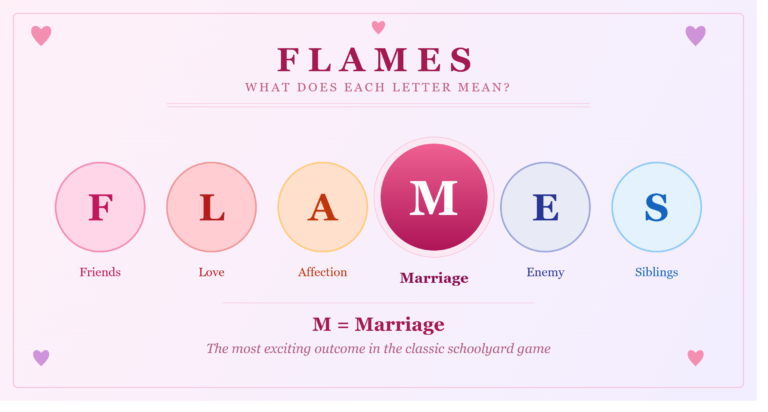
Use our FLAMES calculator to find out if it is Friends, Love, or Marriage.