You’ve probably scrawled two names in a notebook and crossed out letters with someone you liked. That game has a name, and it’s been passed between classmates for decades without any instruction manual. Just two names, a pen, and a shared curiosity about what might happen next.
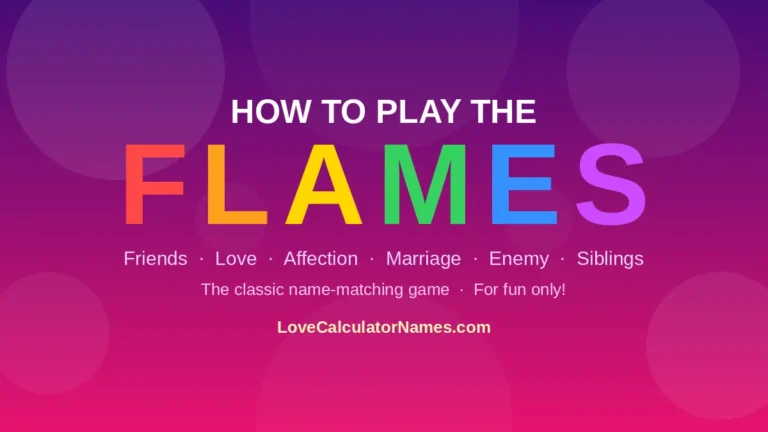
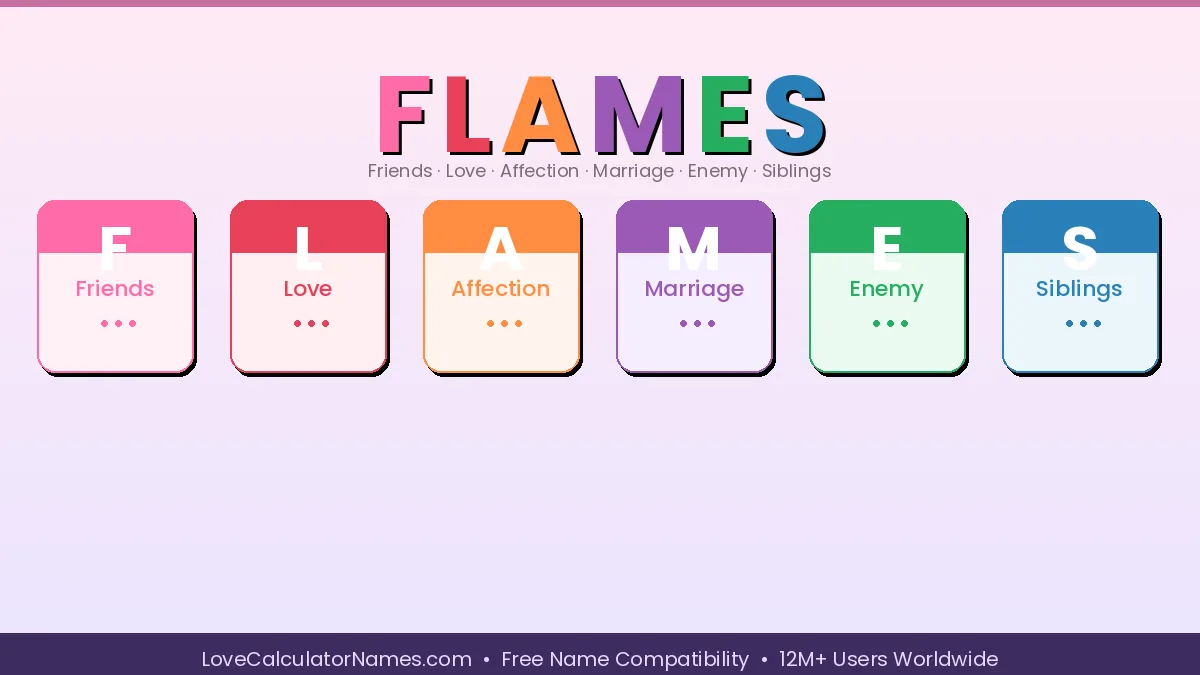
FLAMES stands for Friends, Love, Affection, Marriage, Enemy, and Siblings. It’s a letter-based game where you write two names, cross out every letter the two names share, count what’s left, and use that number to eliminate FLAMES letters one by one until only one remains. Each letter represents a possible relationship outcome — from a close friendship to a lifelong romance. That final letter is the game’s “prediction.”
This guide covers the meaning behind every letter, an exact step-by-step method, where the game came from, and what it genuinely cannot tell you.
Like all name-based games, FLAMES is for entertainment only, not a scientific relationship predictor. Treat results as a conversation starter, not a forecast.
What Does Each Letter in FLAMES Actually Stand For?
FLAMES is an acronym where each of its six letters represents a different relationship outcome: Friends (F), Love (L), Affection (A), Marriage (M), Enemy (E), and Siblings (S). When the counting game ends on one letter, that letter is the “verdict” on the connection between the two names you entered. Here’s exactly what each one means.
Here’s what each result carries in terms of meaning:
Friends (F)
The result points to a strong, stable friendship. This is one of the most common outcomes and, despite not being the romantic result everyone secretly hopes for, it reads as genuinely positive. People who land on Friends often already know each other well. The game just names what’s obvious.
Love (L)
The romantic result. Love suggests deep feelings or a genuine connection between the two names. It’s the outcome most players are quietly hoping for, which makes landing it feel disproportionately significant, even when everyone in the room knows it’s just letter math.
Affection (A)
Softer than Love, Affection points to real warmth and care without necessarily implying a full romantic relationship. Think of it as a tender connection: a crush, a fond closeness, or a bond that doesn’t fit neatly into any standard label. It’s the result that tends to make people smile and say nothing.
Marriage (M)
The biggest outcome in the game. Marriage implies long-term commitment and a lasting bond. Getting M tends to produce the most excitement and, for some people, the most embarrassed laughter, especially when it comes up between two people who barely know each other.
Enemy (E)
Don’t panic over this one. “Enemy” in the FLAMES context doesn’t signal hostility. It describes a competitive or charged dynamic between two people. Real friends who argue constantly, siblings who banter, or classroom rivals who push each other productively tend to land here. In practice, E is playful, not ominous.
Siblings (S)
This result describes a protective, deeply familiar relationship, the kind you’d typically share with a brother or sister. Warm, close, and loyal, but not romantic. Many long-term friends who play together land on Siblings and find it surprisingly accurate.
Why Exactly These Six Categories?
The six outcomes cover almost every meaningful relationship type that school-age imagination recognized: the friend group, the crush, the soft romantic connection, the serious commitment, the rival, and the sibling figure. That emotional map is surprisingly complete, which is why the game still feels relevant whether you’re 12 or 35. The acronym wasn’t accidental. Someone thought about the full range of how two people can relate, then picked six categories that between them cover nearly every possibility.
How Do You Play the FLAMES Game Step by Step?
To play FLAMES, write two names, cross out every letter both names share, count the remaining letters, then use that count to eliminate FLAMES letters one by one in a loop until only one survives. That letter is your result. No app needed, just a pen and paper.
Here is the exact method:
- Write both names clearly. One name above the other. You can use first names only, full names, or nicknames, but be consistent. The format you choose changes the outcome, so pick one and commit.
- Cross out shared letters. Find every letter that appears in both names. For each shared letter, cross out one occurrence from each name. If “Alice” and “Jake” both contain the letter A, cross out one A from Alice and one A from Jake. Repeat for every other shared letter.
- Count what’s left. After all shared letters are crossed out, count every letter still visible across both names combined. Write that number down. This is your counting number.
- Write out F-L-A-M-E-S. Set it out clearly so you can mark off each letter as you go.
- Start the elimination countdown. Count through the FLAMES letters using your number. When your count lands on a letter, cross it out. Restart your count from the next surviving letter, skipping anything already eliminated. Keep going, looping back through remaining letters, until only one is left.
Working example: Names are “Emma” and “Noah.” Shared letters are M and A. Cross out one M from Emma and one A from Emma matched with one A from Noah. After crossing out: remaining letters are E (from Emma) and N, O, H (from Noah), four letters total. Count to four through FLAMES: F(1), L(2), A(3), M(4) — cross out M. Restart from E: E(1), S(2), F(3), L(4) — cross out L. Continue until one letter remains.
A few things players do differently: Some count letters from only one name rather than both combined, which produces a different number and a different result. Some allow every duplicate instance of a shared letter to count, not just one per name. Some play with initials only.
None of these is the “official” rule because no official rulebook exists. FLAMES is a schoolyard game, not a standardized test. The version you learned first is usually the one you’ll defend most passionately.
Where Did the FLAMES Game Come From and How Does It Vary Worldwide?
The FLAMES game spread entirely through oral tradition, with no single inventor, no published origin, and no copyright. It became widely popular in South Asian school culture during the 1980s and 1990s, then traveled globally through diaspora communities and shared classroom traditions. By the 2000s, recognizable versions existed on nearly every continent.
Because it spread through word of mouth rather than any media, the game picked up regional variations naturally. The counting mechanic stayed almost identical across all versions, but the acronym itself got tweaked as it moved from school to school and country to country.
How the FLAMES Acronym Varies by Region
| Region | F | L | A | M | E | S |
|---|---|---|---|---|---|---|
| USA / UK (standard) | Friends | Love | Affection | Marriage | Enemy | Siblings |
| South Asia (most common) | Friends | Love | Affection | Marriage | Enemy | Sisters |
| Older US school variants | Friends | Lovers | Admirer | Marriage | Enemies | Secret Admirer |
| Alternate UK version | Friends | Love | Attraction | Marriage | Enemies | Soul Mates |
| Some Indian regional variants | Friends | Love | Affection | Marriage | Enemies | Strangers |
The Sisters vs. Siblings swap is the most common difference, same general meaning with slightly narrower wording. The versions with “Secret Admirer” and “Soul Mates” tend to have a more romantic overall tone and appear mostly in older American schoolyard traditions. “Strangers” as an outcome is the most pessimistic version of the game, suggesting cold distance rather than playful rivalry.
Why Name-Based Games Spread So Fast
Name-based games catch on because they feel personal. Your name isn’t an abstract input. It represents you. When a result ties specifically to your name alongside someone else’s, the brain searches for meaning in the output, even when the outcome is random.
Psychologists call this apophenia, the human tendency to perceive meaningful patterns in unrelated data. It’s not a flaw. It’s what makes FLAMES genuinely entertaining for adults who understand exactly how the counting works. The game works because it engages a very natural human impulse: the desire to find signal in noise.
FLAMES Goes Digital
The game moved online in the mid-2000s, when simple web tools started returning instant results from two name inputs. By the 2010s, FLAMES had become a nostalgia reference in social media content, YouTube videos, and mobile apps. Digital versions run the same letter-counting logic but remove the pencil-and-paper friction, making the game accessible to people who never once folded a note in class.
That shift also made the game easier to play repeatedly with multiple name combinations, something paper makes tedious. Online versions didn’t change what FLAMES is. They just made it faster.
Can FLAMES Actually Predict Your Relationship? Common Myths Busted
No, FLAMES cannot predict real relationships. The result changes depending on which name format you use, how you handle duplicate shared letters, and which version of the rules you apply. Two people using the exact same two names can get completely different results without either doing anything wrong. Knowing this actually makes the game more enjoyable, not less.
Here are five common FLAMES myths worth setting straight:
Myth 1: Using your full name gives the “real” result. There is no canonical input. “Christopher” and “Chris” both work, they just produce different outcomes. The game has no correct form of a name. Many players try multiple formats and quietly pick the result they prefer, which says something honest about how the game actually functions: it’s closer to wish fulfillment than prediction.
Myth 2: Getting “Enemy” means the relationship is bad. In practice, Enemy shows up between very close friends just as often as between people with genuine tension. The letter-counting math doesn’t detect relationship quality. It responds only to which letters are in the names. If the count lands on E, you get E.
Myth 3: FLAMES is a form of numerology. It isn’t. Real numerology in its Pythagorean or Chaldean forms assigns specific numerical values to individual letters and reduces name totals to core life numbers that carry symbolic meaning. FLAMES doesn’t assign any value to any letter. It counts mechanically and eliminates results in sequence. The resemblance to numerology is surface-level.
Myth 4: There’s one correct version of the game. The regional table above shows at least five meaningfully different FLAMES acronyms in active use around the world. None is more authoritative than the others. The game predates standardization, spread without any governing body, and has never been officially published anywhere.
Myth 5: Online tools are more accurate than paper. Digital versions run exactly the same counting logic your fingers would. The math is identical. Accuracy isn’t the variable, your name format is. Switching from “Sophie” to “Sophia” in an online tool shifts the result just as reliably as it would on paper. The tool adds speed, not accuracy.
The bottom line: FLAMES is a game, and it works best when you treat it like one.
Frequently Asked Questions About FLAMES
What does FLAMES stand for in a relationship? FLAMES stands for Friends, Love, Affection, Marriage, Enemy, and Siblings. Each letter describes a possible type of connection between two people. The game uses letter-counting and elimination to land on one of these six outcomes. It’s a lighthearted, name-based compatibility exercise, not a scientific tool for predicting how any real relationship will actually develop.
Is FLAMES a game or an acronym? It’s both. FLAMES is an acronym where each letter represents a relationship category, and it’s also the name of a game built entirely around that acronym. You play the game to discover which letter, and which relationship type, the counting process assigns to two names you enter. The acronym is what gives the game its name and its six possible outcomes.
How accurate is the FLAMES game? FLAMES is not scientifically accurate. It’s entertainment. The result shifts depending on whether you use a nickname or full name, how you handle duplicate shared letters, and which version of the rules you follow. Different inputs produce different outcomes for the same two people. Play it for fun and curiosity, not for genuine relationship guidance.
Can you play FLAMES with any two names? Yes, the game works with any two names written in the Latin alphabet. You can use first names only, full names, or nicknames. Different formats usually produce different results, so many people try a few variations to see what comes up. The flexible rules are part of what makes the game replayable and fun in a group setting.
Why do I get a different result when I play FLAMES twice? Results change when your input changes: full name vs. nickname, first name alone vs. first-and-last, or when players apply the letter-crossing rules slightly differently. There’s no single binding rulebook, so the same two names can legitimately produce different outcomes depending on how you play. That’s not a bug in the game; it’s just how letter counting works.
Where exactly did the FLAMES game originate? No single inventor is documented. The game spread widely through South Asian school culture during the 1980s and 1990s, then reached the UK, US, and other countries through diaspora communities and shared classroom traditions. It’s an oral game passed from friend to friend, which is why regional variations developed naturally and no “official” version has ever existed.
What’s the difference between FLAMES and a love calculator? FLAMES uses letter-counting and elimination based on shared letters in two names, producing one of six categorical labels. A love calculator typically applies a numerical formula to name values and displays a percentage score. Both are entertainment tools with no verified relationship science behind them, but the format of the output (category vs. percentage) is their key practical difference.
Can I play FLAMES online without paper? Yes, several tools let you type two names and get an instant result without a pen. These apply the same letter-counting mechanics automatically. For a broader name compatibility experience that goes beyond the classic FLAMES format, LoveCalculatorNames.com offers multiple compatibility methods including numerology-based scoring, all free, private, and instant.
The Staying Power of a Six-Letter Game
FLAMES has outlasted most schoolyard trends because it does one specific thing well: it gives two ordinary names a story. The result, whether Friends, Love, Affection, Marriage, Enemy, or Siblings, isn’t really a prediction. It’s a prompt. It gives people something to react to, argue about, laugh over, and share.
Three things worth keeping from this guide: the result changes with every input variation, the game runs on entertainment rather than relationship science, and the real compatibility between two people gets built through time and shared experience, not by crossing out letters.
If you want to take name compatibility further, try the free test at LoveCalculatorNames.com, no sign-up required, completely private, and results appear the moment you hit go.
Our free FLAMES result tool makes exploring name compatibility genuinely enjoyable.