You’ve looked at your name next to your partner’s and wondered: do these belong together? Maybe a friend told you your names “don’t match.” Maybe you saw a percentage score somewhere and have no idea what it means.
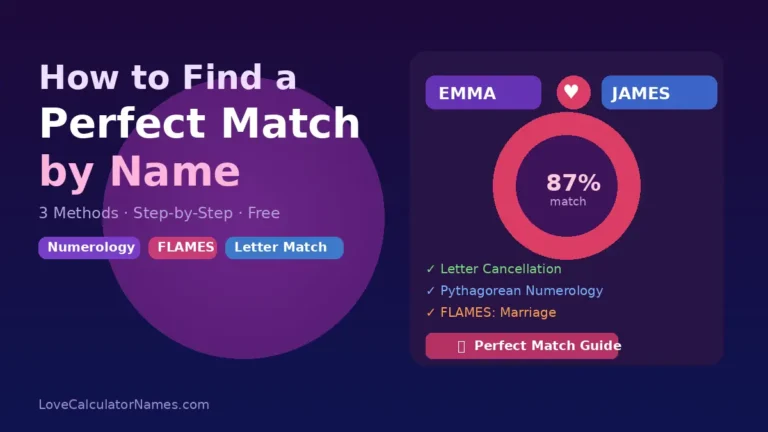
Here’s the honest answer: there is no single best name for marriage compatibility. What matters is how your name pairs with your partner’s within a specific scoring system. The most common methods, Pythagorean numerology, phonetic harmony, and the FLAMES letter game, generate a score based on letter values, sound patterns, or syllable counts. Names that produce complementary numerological totals or matching vowel structures tend to score higher. These tools are built for fun and personal curiosity, not as relationship predictions.
This guide breaks down every major system, shows you which pairings tend to score well, and clears up the misconceptions people carry into these tests.
What Actually Makes Two Names Compatible for Marriage?
Name compatibility comes down to how two names interact within a scoring system, not any quality either name holds on its own. A name that scores brilliantly with one partner’s name might score poorly with another. The relationship between the two names is everything, and that’s what these systems measure.
Three major frameworks drive most of the name compatibility tests available online today.
Pythagorean numerology assigns each letter a number from 1 to 9 based on its alphabet position. You add up the values in each name, reduce to a single digit, and compare those digits. Some digit pairings carry a reputation for harmony, like 1 with 5, or 2 with 6, while others are considered less naturally aligned. Because the pairing of reduced totals drives the score, names with very different letter compositions can still produce compatible results if their totals land in the right relationship.
Phonetic harmony takes a different approach. It focuses on how two names sound together when spoken aloud. Names that share open vowel sounds, like long A, short E, or round O, tend to create smoother phonetic flow. Similarly, names with similar syllable counts often register as more harmonious than a very short name paired with a very long one. Linguistics researchers who study naming patterns have noted that couples whose names share phonetic features feel easier to say together in everyday conversation, which is a small but real phenomenon.
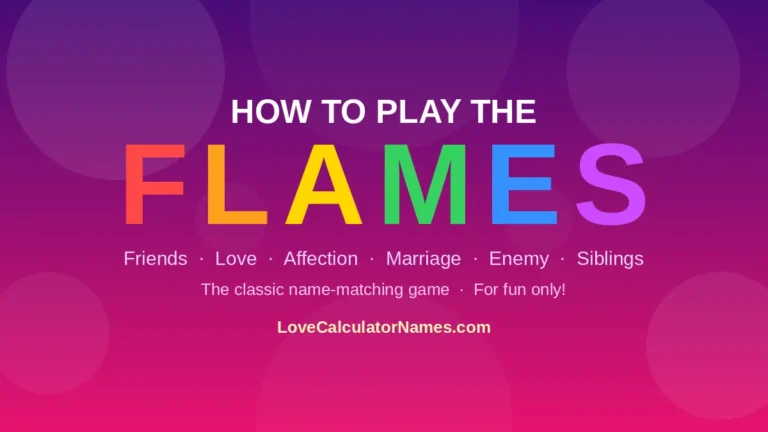
The FLAMES method is simpler and older than both. You write both names, cross out every shared letter, count the remaining letters, and cycle through F-L-A-M-E-S using that number until one letter remains. F stands for Friend, L for Love, A for Affection, M for Marriage, E for Enemy, and S for Sibling. It takes about ninety seconds with a pencil and has been passed between friends for generations. Unlike numerology, FLAMES doesn’t require any arithmetic beyond simple counting, which is a big part of why it has stayed popular across cultures and age groups for so long.
Each system produces a different result, and that’s part of what makes name compatibility interesting to explore. No single tool gives a definitive answer. Treat any score as one data point among many.
How Does a Name Compatibility Test Actually Work?
Most name compatibility tools convert both names into comparable values, compare them using a scoring matrix, and output a percentage between 0% and 100%. The inputs are almost always the same: two first names entered in any order. The calculation method is what varies.
Here’s how a standard Pythagorean name compatibility calculation works, step by step:
- Write out both first names. Example: Sofia and Marcus.
- Assign each letter its Pythagorean value. The sequence runs: A=1, B=2, C=3, D=4, E=5, F=6, G=7, H=8, I=9, then resets: J=1, K=2, L=3, M=4, N=5, O=6, P=7, Q=8, R=9, S=1, T=2, U=3, V=4, W=5, X=6, Y=7, Z=8.
- Add up each name’s values. Sofia = 1+6+6+9+1 = 23, which reduces to 2+3 = 5. Marcus = 4+1+9+3+3+1 = 21, which reduces to 2+1 = 3.
- Compare the two reduced digits. In Pythagorean numerology, 5 and 3 are considered a lively, communicative pairing with good compatibility.
- Convert to a percentage. Online tools use a scoring matrix to translate digit relationships into a percentage. Strong pairings often appear in the 75-95% range, while less aligned ones may land around 40-65%.
If you want to factor in middle names or last names, most tools support that as an option. For a simple, accurate reading, first names alone work well.
The FLAMES method works differently:
- Write your first name and your partner’s first name.
- Cross out every letter that appears in both names, one instance per shared occurrence.
- Count the total remaining uncrossed letters across both names combined.
- Starting from F, count through FLAMES repeatedly using that number until only one letter survives.
- That letter is your result: Marriage, Love, Affection, Friend, Enemy, or Sibling.
Both methods work perfectly with just a pen and paper. But if you’d rather skip the manual math, an online calculator handles everything instantly and provides a full percentage breakdown with context.
Which Name Types Score Highest in Marriage Compatibility Tests?
No name is universally “the best” for marriage. Compatibility always depends on the specific pairing. That said, certain name characteristics appear consistently in high-scoring combinations across multiple systems.
Names with similar syllable counts, overlapping vowel sounds, and numerological totals that reduce to traditionally compatible digits tend to produce stronger results. Here’s a quick reference for what each system tends to reward:
| Compatibility Factor | What Tends to Score Well | What Tends to Score Lower |
|---|---|---|
| Syllable Balance | Similar syllable counts (2+2, 3+3) | Very uneven pairs (1-syllable + 4-syllable) |
| Phonetic Harmony | Matching or complementary vowel sounds | Clashing hard consonant clusters in both names |
| Pythagorean Totals | Classic pairings: 1 and 5, 2 and 6, 3 and 9, 4 and 8 | Digits with noted friction such as 4 and 9 |
| FLAMES Result | Landing on M (Marriage) or L (Love) | Landing on E (Enemy) |
| Shared Letters | Some overlap supports FLAMES scores | Zero shared letters often lowers FLAMES results |
| Name Length | Both names between 4 and 8 letters | One very short name paired with a very long one |
How Different Cultures Approach Name Compatibility in Marriage
Name compatibility in marriage is not a recent trend, and it is far from a Western-only idea. Traditions across the world have developed their own systems for assessing whether two names are well-suited.
In Hindu astrology (Jyotish), the first letter of a person’s name is tied to their nakshatra, the lunar star position at birth. When families consider a marriage match, they often check whether the names’ starting letters align with harmonious nakshatras. Some communities follow this tradition carefully; others treat it as one factor among many in a broader compatibility assessment.
In Chinese naming culture, name characters carry both meaning and tonal quality. A couple’s names may be evaluated for yin-yang balance by a naming specialist before or during wedding planning. The goal is for both names together to carry auspicious rather than conflicting energy. The practice reflects a broader Chinese cultural principle that the characters a person carries through life shape the energy of their experiences, and a marriage joins those energetic profiles into a single household.
In Arabic and Persian naming traditions, names carry deep poetic and ancestral meaning. Compatibility is sometimes assessed based on how the root meanings of both names interact, and how they sound when spoken together in formal introductions.
These traditions differ in method but share a consistent instinct: the names two people bring into a marriage carry meaning, and the relationship between those names is worth taking seriously, even if the lens varies by culture.
What Research on Name Psychology Suggests
Psychologists studying the “name-letter effect” have documented a real tendency for people to feel more warmth toward names that contain their own initials or similar sounds. While this research doesn’t directly address marriage compatibility scores, it does point to a genuine connection between name sounds and interpersonal attraction. Name compatibility tools tap into a similar intuition. The systems are built for entertainment, but they’re rooted in patterns that researchers have studied in real populations. One implication worth noting: if you feel an unexplained pull toward certain names, there may be more going on than random preference — your own name’s phonetic fingerprint is likely part of the picture.
Myths About Name Compatibility in Marriage Worth Dropping
Name compatibility tests are genuinely fun and sometimes surprisingly resonant. But several persistent myths distort how people interpret the results. Here are the most common ones, and what’s actually true.
Myth 1: A low score means the relationship won’t work. No name-matching system can predict how a relationship will unfold. A score reflects mathematical or phonetic patterns between two names, not real-world compatibility factors like communication, trust, or emotional support. A 55% score between two genuinely connected people says nothing about their future together.
Myth 2: Changing your name after marriage will improve your score. This question comes up often. Compatibility tools typically use first names, so a surname change doesn’t affect the core calculation. The score reflects how the two first names pair, not a performance target to hit or improve after the wedding.
Myth 3: There’s one name that’s universally best for marriage. When people search for what is the best name for marriage compatibility, they often expect a ranked list. That list doesn’t exist. Because compatibility is always about a pairing, the best name for you is the one that aligns with your specific partner’s name within the system being used.
Myth 4: A higher score always means a stronger relationship. A 96% love percentage is exciting to see. But it reflects a name calculation, not the full picture of a human relationship. Many couples who score in the 60-75% range go on to build fulfilling, long-lasting partnerships. The score is one lens, not a complete view.
Myth 5: Name compatibility is pure superstition with no basis. The traditions behind these tests, Pythagorean numerology, phonetic theory, and Jyotish astrology, each have genuine historical roots. Researchers in linguistics, psychology, and cultural anthropology have studied these systems and the effects they point to. That doesn’t make them scientific relationship predictors. But it does mean they’re structured cultural frameworks with centuries of development behind them, not random algorithms.
The right way to approach these results is the same way you’d approach a personality quiz or a horoscope: interesting, sometimes resonant, and built for curiosity rather than serious life planning.
Frequently Asked Questions
What is the best name for marriage compatibility? There is no single best name because compatibility always depends on how two specific names pair together. Names that produce complementary numerological totals, share similar vowel sounds, or have balanced syllable counts tend to score higher across multiple systems. The only way to find the best pairing for your situation is to test your actual name alongside your partner’s in a free compatibility tool.
Which numerology number pairings are most compatible for marriage? In Pythagorean numerology, the pairings most often described as harmonious include 1 and 5, 2 and 6, 3 and 9, and 4 and 8. Each name reduces to a single digit, and those digits are compared to generate a score. Different numerology traditions may describe slightly different pairings as compatible, so results can vary by tool.
Can a name compatibility test predict whether a marriage will last? No. Name compatibility tests are designed for entertainment and personal curiosity, not as predictive tools. Relationship success depends on communication, trust, shared values, and sustained effort, none of which any name-matching system can measure. Use any score as a fun starting point, not a conclusion about your future.
Does the FLAMES method actually mean anything? FLAMES is a letter-counting game with roots in schoolyard tradition, not a scientific tool. That said, many people find it genuinely fun and nostalgic. Landing on M for Marriage is a satisfying result regardless of the math involved. It is best enjoyed as a lighthearted activity rather than a serious relationship assessment.
Should I use my full name or just my first name in a compatibility test? Most tools use first names only, which keeps the calculation simple and culturally neutral. Some offer full-name options for a more layered result. For a quick, useful reading, a first name on each side is usually enough and matches how most published compatibility scores are calculated.
Do nicknames or shortened names change the compatibility result? Yes. Any change in spelling changes the letter values and therefore the numerological total. “Liz” and “Elizabeth” will produce different scores when tested against the same partner name. Many people test both versions to compare. There is no single correct version to use; go with the name you actually use in daily life.
Which cultural tradition has the most developed name compatibility system for marriage? Hindu astrology through Jyotish has one of the most elaborate frameworks, connecting individual letters to lunar birth positions and assessing compatibility between both partners’ names and birth charts. Chinese and Arabic naming traditions also have rich, well-developed histories of name-based compatibility assessment, each using distinct criteria rooted in their own cultural frameworks.
Is name compatibility the same as zodiac compatibility? No. Zodiac compatibility compares birth charts, planetary positions, and sun or moon signs. Name compatibility compares the letters, sounds, and numerical values within two names. Some people explore both types of compatibility together for a fuller picture. They use different frameworks and can produce quite different results for the same couple.
The Bottom Line on Name Compatibility for Marriage
There is no single best name for marriage compatibility, because the best pairing is always specific to you and the person you’re with. What these tests offer is not a verdict. It’s a structured, culturally rich way of looking at what two names carry when they come together.
The most useful approach: test your actual names in a real compatibility tool, understand which system is driving the result, and take the score in the spirit it’s intended. These tools are built for curiosity and fun, not fate.
Name compatibility has been part of human culture across continents and centuries. Whether you’re drawn to Pythagorean numerology, trying the FLAMES method for the first time, or just curious about your love percentage, you’re joining a long tradition of wondering what names mean together.
Ready to find your score? Try the free name compatibility test at Love Calculator — no sign-up required, 100% private, and results in under a second.
Enter both names into our compatibility tool and get your score in seconds.