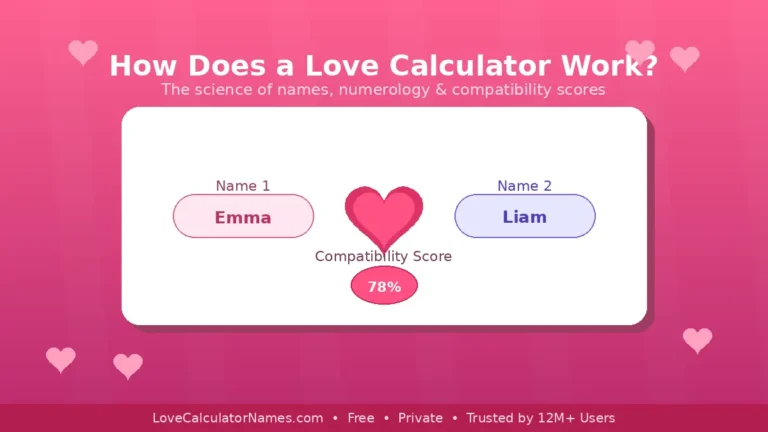
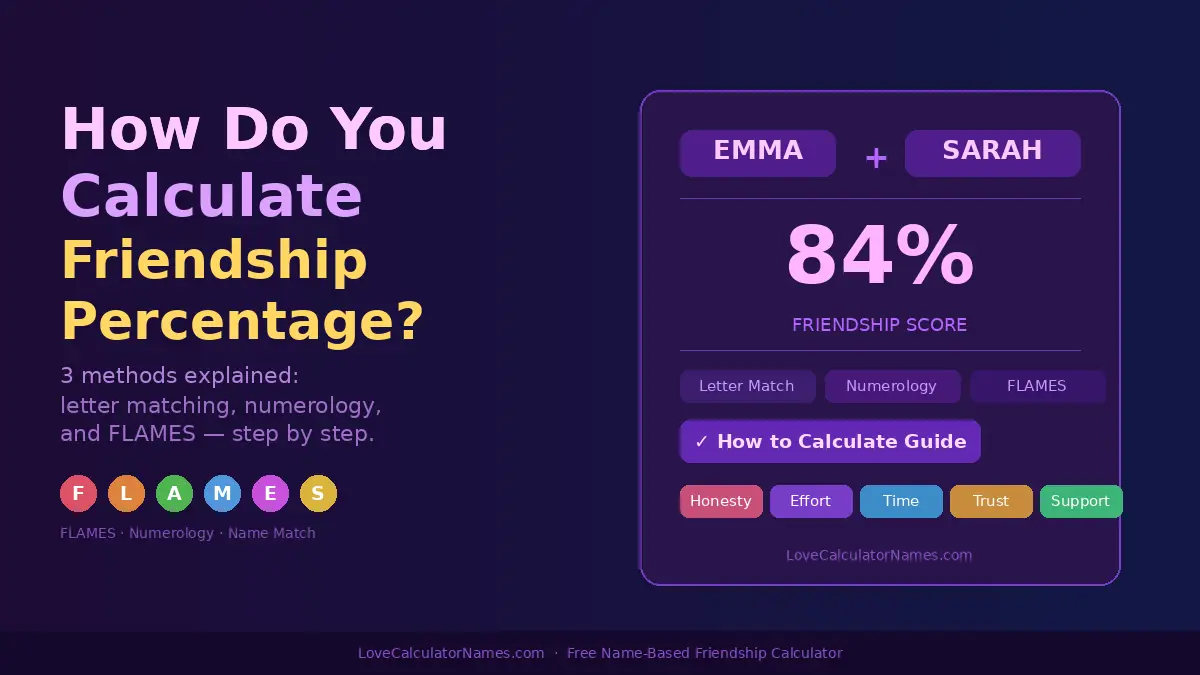
Ever wonder what the number behind a friendship score actually means? You type in two names, hit calculate, and get back “78%” — but where does that come from?
The short answer: friendship percentage is calculated by one of three methods — letter-frequency cancellation, Pythagorean numerology, or the FLAMES count-out technique. Each assigns a value to the letters in two names, then uses a formula to produce a score from 0 to 100. The result is meant for fun and entertainment only, not as a scientific assessment of any real relationship. Different calculators use different methods, which is why the same pair of names can score differently on different sites.
This guide breaks down all three methods, shows you the exact steps, and helps you understand what your score actually reflects.
What Does “Friendship Percentage” Actually Mean?
Friendship percentage is a fun, name-based score that estimates compatibility between two people using only their names. It does not measure your actual friendship — it runs your names through a mathematical formula and outputs a number. Think of it like a personality quiz: interesting to try, not a verdict.
Most friendship calculators pull from three calculation traditions: letter-frequency cancellation (borrowed from classic love calculators), Pythagorean name numerology (where each letter has a number value), and the FLAMES elimination game. Each method produces a different number for the same pair of names — there’s no single “correct” friendship percentage.
One more thing worth knowing: the method a calculator uses is almost never explained on the site. You just see the result. This article changes that.
How Does the Letter-Frequency Cancellation Method Work?
This is the most common method behind online friendship and love calculators. You write out both names, count how many times each letter appears across both names combined, then cancel out matching pairs. The remaining letter totals feed into a formula that produces a percentage.
Here’s the step-by-step process:
- Write both names side by side. Example: EMMA and SARAH.
- Combine into one letter string. E M M A S A R A H.
- Count the frequency of each letter. E=1, M=2, A=3, S=1, R=1, H=1.
- Cancel matching pairs. If the same letter appears more than once, pair up the counts and cross them out. Here A appears 3 times — one pair cancels, leaving one A. M appears twice — that pair cancels. Remaining: E=1, A=1, S=1, R=1, H=1.
- Add the remaining counts. 1+1+1+1+1 = 5.
- Run through the formula. Most calculators divide the remaining count by the total letter count, then convert to a percentage. With 5 remaining letters out of 9 total: 5 ÷ 9 = 0.56, rounded to 56%. Some calculators subtract this from 100 for an inverse score, which is why two sites can give you wildly different numbers for EMMA and SARAH.
The result changes every time you adjust the spelling — “Em” vs “Emma” will score differently. That’s not a bug. It’s just how letter counting works.
How Does Pythagorean Numerology Calculate Friendship Percentage?
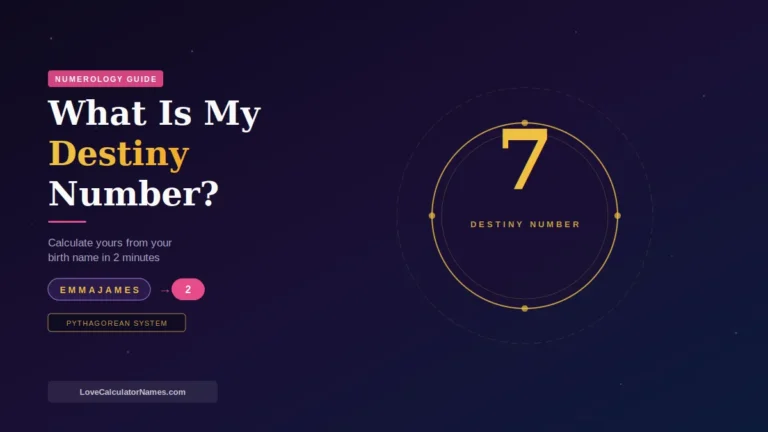
Pythagorean numerology assigns a number from 1 to 9 to every letter of the alphabet, adds up both names separately, reduces them to single digits, and then compares the two numbers against a compatibility scale. The higher the compatibility between those two destiny numbers, the higher your friendship percentage.
The standard Pythagorean letter-value chart:
| Letters | Value |
|---|---|
| A, J, S | 1 |
| B, K, T | 2 |
| C, L, U | 3 |
| D, M, V | 4 |
| E, N, W | 5 |
| F, O, X | 6 |
| G, P, Y | 7 |
| H, Q, Z | 8 |
| I, R | 9 |
Worked example — EMMA and SARAH:
EMMA: E(5) + M(4) + M(4) + A(1) = 14 → 1+4 = 5
SARAH: S(1) + A(1) + R(9) + A(1) + H(8) = 20 → 2+0 = 2
Life paths 5 and 2 are considered moderately compatible in numerology — 5 craves variety, 2 craves connection. A typical calculator might output around 68–74% for this pair. The exact percentage depends on which compatibility table the calculator uses internally.
What Is the FLAMES Method and How Does It Score Friendship?
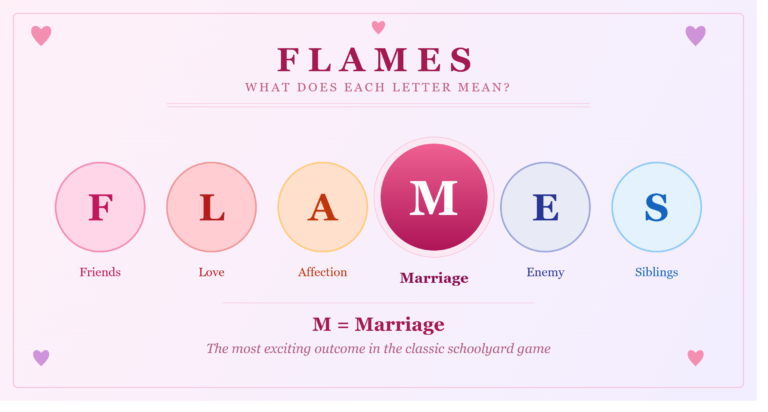
FLAMES is a letter-elimination game that produces one of six outcomes: Friends, Lovers, Affection, Marriage, Enemies, Siblings. It doesn’t give you a percentage directly — but many calculators convert the FLAMES outcome to a percentage by assigning each result a score on a 0-to-100 scale.
Here’s how FLAMES works:
- Write out both names: EMMA and SARAH.
- Cross out every letter that appears in both names. Shared letters between EMMA and SARAH: A, M appear in Emma but not Sarah… actually: A appears in both. Cross out one A from each name. Remaining: E, M, M (EMMA) and S, R, H (SARAH).
- Count the remaining letters: E, M, M, S, R, H = 6 letters.
- Count around the FLAMES circle repeatedly, eliminating one letter at a time at position 6.
- The last letter standing is your result.
How FLAMES outcomes convert to friendship percentage:
| FLAMES Result | Typical % Range | What It Suggests |
|---|---|---|
| Friends (F) | 70–80% | Strong platonic bond |
| Lovers (L) | 85–95% | Romantic compatibility |
| Affection (A) | 75–85% | Warm emotional connection |
| Marriage (M) | 90–100% | Deep long-term bond |
| Enemies (E) | 10–30% | Tension or contrast |
| Siblings (S) | 60–75% | Familiar, reliable tie |
The conversion percentages vary by site. “Friends” landing at 74% on one calculator and 80% on another is completely normal — both are just applying their own internal scoring maps to the same FLAMES output.
Why Do Different Sites Give Different Friendship Percentages?
Two calculators can give EMMA and SARAH a score of 56% and 89% for the same keyword on the same day, and both are technically “correct” — they’re just using different formulas.
This confuses a lot of people. Here’s why it happens:
Method variation. One site uses letter cancellation, another uses numerology. The math is different, so the result is different.
Name handling rules. Does the calculator count middle names? Spaces? Uppercase vs lowercase? Each choice shifts the output.
Internal lookup tables. For numerology and FLAMES, the compatibility score depends on a table the developer hard-coded. No two tables are identical.
Rounding. Some calculators round to the nearest whole number. Others use decimal math and display a truncated result.
| Factor | How It Affects the Score |
|---|---|
| Calculation method | Can shift result by 20–40 points |
| Spelling variation | Each different spelling = different count |
| Middle names included | Adds more letters, changes frequency |
| Rounding rules | Minor effect, usually ±1–3 points |
| Compatibility lookup table | Can shift numerology result by 10–20 points |
This is why friendship calculators are entertainment tools rather than measurement systems. There’s no standard, no governing body, and no peer-reviewed formula. Each site is its own universe.
Common Myths About Friendship Percentage Calculators
People have strong feelings about their scores — good and bad. Most of those feelings are built on a few misconceptions worth clearing up.
Myth 1: A higher score means a stronger real-life friendship. Not true. The calculator knows nothing about how long you’ve been friends, whether you’ve been there for each other during hard times, or how honest you are with each other. It only sees letters.
Myth 2: The same names always give the same score. Only if you use the same calculator and the same method. Change the site, change the score.
Myth 3: “Enemies” means you and your friend are actually incompatible. FLAMES assigns Enemies based on a counting pattern that has nothing to do with personality or relationship history. Millions of real, close friendships would score Enemies in FLAMES.
Myth 4: A 100% score is rare or meaningful. Some name pairs produce 100% on certain calculators because of how the letters fall. ANNA and ANNA, or any pair where the cancellation math happens to leave zero letters, can produce a perfect score with zero relationship significance.
Myth 5: You can find the “right” name combination by tweaking your spelling. Technically yes — you could keep adjusting nicknames until a calculator gives you a higher number. But that’s optimizing a math formula, not describing a real friendship.
Frequently Asked Questions
How do you calculate friendship percentage by hand? The simplest manual method is letter-frequency cancellation: write both names, count each letter across both, cross out matching pairs, add the remaining letters, then divide by the total letters. Multiply by 100 for your percentage. The full step-by-step is in the section above.
Why do friendship percentage calculators give different results for the same names? Different calculators use different methods — letter cancellation, Pythagorean numerology, FLAMES, or phonetic harmony. They also handle spelling, spaces, and uppercase letters differently. There’s no universal standard, so results vary widely between sites.
Is friendship percentage scientifically accurate? No. Name-based compatibility tools are entertainment only. They run your names through a math formula and return a number. Research on friendship quality focuses on shared values, reciprocity, and mutual support — none of which can be measured from letters alone.
Does spelling matter when calculating friendship percentage? Yes, significantly. “Emma” and “Em” produce different letter counts, which changes the cancellation result. In numerology, every letter has a value, so adding or removing a letter shifts the final destiny number. Always use the same spelling consistently if you want repeatable results.
What does a friendship percentage of 50% mean? It depends on the calculator’s scale. Some treat 50% as average compatibility, others as low. In letter-cancellation methods, 50% often means roughly half the letters cancelled out. It’s not a failing grade — it’s just a midpoint in a mathematical range.
Can two people with completely different names score 100%? Yes. If the letter-cancellation method leaves zero uncancelled letters, the result can reach 100%. Which name pairs achieve this depends entirely on the specific formula used. It’s a math coincidence, not a relationship verdict.
What is the best method for calculating friendship percentage? There’s no objectively best method. Letter cancellation is the most common and easiest to do by hand. Pythagorean numerology has deeper historical roots. FLAMES is the most game-like and fun for groups. Most people find it enjoyable to try all three and compare.
Is the FLAMES game the same as a friendship percentage calculator? Not exactly. FLAMES produces a category (Friends, Lovers, Affection, Marriage, Enemies, Siblings) rather than a number. Many calculators convert the FLAMES result to a percentage using an internal scoring map, but the original game just gives you a letter.
The Bottom Line
Friendship percentage calculators work by running names through one of three systems: letter-frequency cancellation, Pythagorean numerology, or FLAMES count-out. Each method uses different math, which is why the same pair of names can score very differently across different sites.
No calculator can measure what actually makes a friendship strong — the late-night conversations, the showing up without being asked, the years of building something real. Name-based tools are a lighthearted way to play with compatibility, not a test worth stressing over.
Take your score as a conversation starter, not a conclusion. And if you’re curious how your name pairs up with someone you care about, try the free compatibility tool at Love Calculator by Name — no sign-up, 100% private.
Our free name compatibility tool gives you a score based on your names.